A Family Bathhouse Faces a Crisis Far From Nagano
Yoshiko Kodama, 87, needs as much as 2,000 liters of heavy oil each month to heat the water at her family's traditional public bathhouse in Nagano. After 138 years in business, the institution has survived multiple world wars, the reign of five emperors and three devastating earthquakes. Now, soaring oil prices driven by the war in Iran have left her unsure whether it can stay open.
Contents
- A Family Bathhouse Faces a Crisis Far From Nagano
- How the Oil Shock Reached Japan
- Why Bathhouses Cannot Easily Pass On the Cost
- In Aichi, Less Fuel Means Shorter Hours
- Closures Reach Aomori and Gifu
- The Disruption Has Built Since March
- Steel, Chemicals and Drivers Face the Same Shock
- What Communities Lose When a Bathhouse Closes
- Operators Wait for Relief While Adapting
- Key Points
In the mountainous Japanese city, Kodama continues heating the water and opening the doors of a business that was already struggling before the conflict. The latest pressure comes from a war thousands of kilometers away, but reaches her directly through the cost of the fuel needed for every bath.
Across Japan, similar public bathhouses, known as sento, face a combination of expensive fuel, unreliable deliveries and limits on what they can charge. Some have shortened their hours. Others have suspended operations or announced that they will close permanently. For elderly customers who depend on these places for bathing and conversation, the consequences extend well beyond a higher energy bill.
As of May 8, 2026, the strain is visible from Aomori in northern Honshu to Aichi and Gifu in central Japan. A bathhouse that opened in 1968 has announced a permanent closure on May 31, while a facility run by a town government has already stopped operating because it cannot secure enough oil.
Japan's dependence on Middle Eastern oil connects these neighborhood businesses to the disruption around the Strait of Hormuz. Government releases of emergency oil reserves and gasoline subsidies have offered temporary support, but bathhouse operators say help is not reaching them quickly or directly enough.
How the Oil Shock Reached Japan
The conflict began with United States and Israeli airstrikes against Iran and triggered a de facto blockade of the Strait of Hormuz. The narrow waterway carries much of the oil moving around the world. Its effective closure has interrupted a route on which Japan depends heavily.
Japan imports more than 90 percent of its crude oil and relies on the Middle East for approximately 90 percent of its oil supplies. The vast majority of those supplies flow through the strait. That concentration makes a disruption in the Gulf an immediate problem for Japanese businesses that need a steady supply of fuel.
In March, Saudi Arabia's Arab light crude reached $126.28 per barrel, an increase of 84 percent from the previous month. This crude accounts for more than half of Japanese imports. Global crude prices climbed to their highest levels since 2008, putting pressure on industries ranging from steel manufacturing to agriculture.
For a bathhouse, heavy oil is a working necessity: it heats the large volumes of water customers use each day. When its price rises, keeping the same opening hours and water temperatures costs more. When deliveries shrink or stop, an operator may be unable to open at all.
Why Bathhouses Cannot Easily Pass On the Cost
Family businesses dominate the sento trade, often charging only a few dollars for a visit and operating with little money left after expenses. Many occupy buildings and use equipment that have served customers for decades or generations. Their finances were fragile before the latest fuel shock.
Private baths in modern homes have reduced demand, while upscale spas provide another source of competition. A chronic shortage of young successors willing to take on the demanding work has also accelerated the decline. Industry data show that the number of sento has fallen dramatically over recent decades.
Local governments cap admission prices to keep public bathing affordable, particularly for residents with low incomes. During the current crisis, those limits also restrict how much of the rising fuel bill an operator can recover from customers. Unlike businesses that can freely adjust their prices, sento owners can be left absorbing losses on each visit.
In Shizuoka Prefecture, the maximum bath fee is 520 yen. Operators say they need to charge at least 650 yen to reflect the jump in fuel expenses. The difference is 130 yen per admission, or 25 percent above the permitted price. Some operators report that annual fuel expenses have increased by more than 600,000 yen since the conflict began.
Large companies can sometimes absorb a sudden increase in costs or turn to other energy sources. Small bathhouses have much less room to respond. Aging equipment, declining attendance and a regulated entrance fee leave owners with few ways to balance their accounts while keeping a service their neighborhoods still use.
In Aichi, Less Fuel Means Shorter Hours
Ikesu Onsen in Tsushima, Aichi Prefecture, has delayed its opening time by one hour since late March because its fuel oil supply has become unstable. Monthly deliveries have been halved from about one tonne. Daily attendance has fallen to around ten customers at the facility, which has operated for 97 years.
Atsuko Matsui, the operator who is 57 years old, described both the financial blow and the lack of bargaining power when dealing with a supplier:
It is a major blow. If we are told by the supplier 'this amount at this price', we have no choice but to accept it.
Matsui's situation shows how shortages can damage a bathhouse from two directions at once. Less fuel limits the time it can serve customers, while fewer customers leave less admission income to cover the business's expenses. Accepting a delivery does not mean the quantity or price is enough to sustain normal operations.
Closures Reach Aomori and Gifu
Katsuragi Onsen in Aomori Prefecture, which opened in 1968 and regularly welcomed more than 200 people a day, has posted a notice announcing that it will close permanently on May 31. The message, shared on social media, cited the growing burden of fuel costs and equipment maintenance.
The operator said the price of heavy oil had risen every week, making it impossible to continue. For this bathhouse, the crisis has added to the cost of keeping its equipment working, turning pressure on the business into a decision to close.
In Gifu Prefecture, Ikeda Onsen Honkan suspended operations on April 3 after struggling to obtain enough heavy oil. The town government runs the facility, which needs about 1,400 liters a day to heat spring water from around 30 degrees Celsius to bathing temperature.
Ikeda's daily fuel requirement is equivalent to 70 percent of the maximum 2,000 liters Kodama's Nagano bathhouse uses in an entire month. The figures illustrate the different scales of the facilities and the volume of fuel a larger operation must secure before it can welcome bathers.
The town normally buys fuel through public tenders each month, a process in which suppliers bid to provide it. Many bidders withdrew from the latest round because of rising tensions and uncertainty about supplies. The town has no clear solution for securing oil next month, and no reopening date has been set.
Shintaro Katsuno of the Ikeda Town planning division explained the decision to suspend operations and the hope of restoring the service:
We made the decision to close with a heavy heart. We hope to resume operations as soon as possible.
The Disruption Has Built Since March
March and April brought a succession of price increases, reduced deliveries and shutdowns. By May 8, the pressure had moved from emergency adjustments to an announced permanent closure later in the month.
- By the middle of March, refinery runs across Japan had fallen below 70 percent, their lowest level in months.
- On March 19, JFE Steel shut one of five power generation facilities in Hiroshima Prefecture because of heavy oil shortages.
- During March, Saudi Arab light crude rose to $126.28 per barrel, 84 percent above the previous month's price.
- Since late March, Ikesu Onsen in Tsushima has opened one hour later because of unstable fuel supplies.
- On April 3, Ikeda Onsen Honkan suspended operations after struggling to secure heavy oil.
- On May 31, Katsuragi Onsen in Aomori is scheduled to close permanently.
The timetable also puts two pressures close together at the end of May: Katsuragi Onsen's planned closure and the expected exhaustion of the budget for government gasoline subsidies.
Steel, Chemicals and Drivers Face the Same Shock
JFE Steel, Japan's second largest steelmaker, reported that steelmaking continued normally after it shut the power generation facility in Hiroshima. Even so, the loss of one of its five facilities there showed that a shortage of heavy oil was affecting major industrial operations as well as small public baths.
Petrochemical companies have reduced output. Mitsubishi Chemical announced price increases of at least 70 yen per kilogram for products used in construction and automobiles. Together with the decline in refinery runs, these changes show how interrupted oil supplies can spread through the production of materials used far beyond the fuel market.
The government has made a record release from emergency oil stockpiles and introduced gasoline subsidies to cushion the impact on consumers. Prices at the pump still rose above 190 yen per liter. The subsidy budget is expected to run out by the end of May.
Emergency reserves provide oil already held in storage, giving the country a temporary supply when regular deliveries are disrupted. Gasoline subsidies address a different problem by helping contain the price paid by drivers. Bathhouse owners, meanwhile, need affordable heavy oil delivered reliably enough to heat their water every day.
Officials have discussed buying oil from outside the Gulf region, including the United States, and increasing electricity generation using coal to bridge the gap. These options reflect the wider effort to keep energy flowing while a route central to Japan's oil supply remains disrupted.
What Communities Lose When a Bathhouse Closes
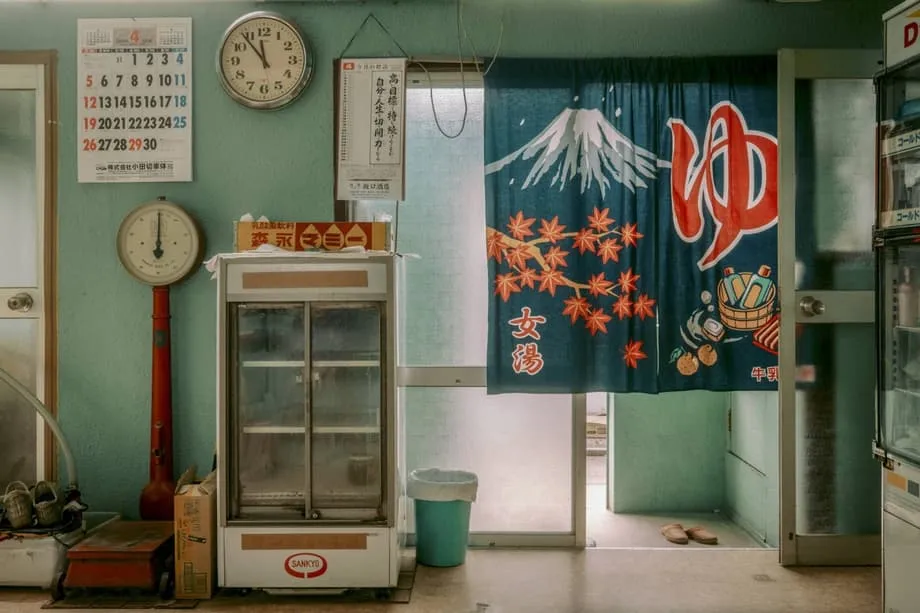
Japanese public bathhouses have served as neighborhood gathering places for nearly a millennium. Visitors enter through indigo curtains bearing the character "yu," meaning hot water, wash before soaking in shared tubs and spend time talking with other bathers.
For many elderly residents, especially those living alone or in older homes without modern bathing facilities, a sento provides both a practical service and regular contact with other people. The remaining bathhouses often serve customers who lack a bath at home or who continue visiting for the companionship.
An Ikeda Onsen customer in his 80s, who visited about twice a week, expressed shock at the suspension. He usually chatted with other regulars while using the hot spring. Losing access also meant losing a familiar setting for those conversations.
Japan's aging population and growing concern about social isolation make that role increasingly valuable. Public baths help residents keep clean, maintain their physical health and feel part of a community. For someone who lives alone, a routine visit can be one of the few dependable occasions to meet others.
A private bath at home can replace the act of bathing, but it offers no neighborhood gathering place. A commercial spa is a different kind of business. When a local sento disappears, residents lose a space built around affordable access and repeated encounters with familiar people.
Operators Wait for Relief While Adapting
Government action has concentrated on stabilizing the wider economy rather than assistance aimed specifically at bathhouses. Reserve releases and subsidies have provided temporary breathing room, but small operators say the support does not reach them quickly enough or directly enough to keep pace with their bills.
The supply crunch has also renewed debate over Japan's energy choices. Ryosuke Tsugaru, a senior managing executive officer at JERA, Japan's largest power generator, said the shortage may revive support for nuclear power.
Tokyo Electric Power Company restarted its first reactor following the 2011 Fukushima Daiichi accident just weeks before the current crisis intensified. The timing has appeared prescient to some energy planners. For a small business whose existing heating equipment depends on heavy oil, however, greater use of nuclear power offers doubtful relief in the immediate future: its urgent need remains fuel for its own heating system.
Bathhouse owners are adjusting wherever they can. Some have reduced their operating hours or limited the number of customers they can serve. Others have appealed to their communities for support while waiting for prices to stabilize. These measures may conserve fuel or bring in business, but the operators still face the same costly and uncertain deliveries.
Kodama continues to open her Nagano bathhouse despite the uncertainty. The institution her family has preserved for 138 years now depends on whether she can keep obtaining and paying for the oil that heats its water. For customers across Japan, the immediate stakes are equally concrete: a place to bathe, a familiar routine and people to talk to.
Key Points
- As of May 8, 2026, the Iran war and the effective closure of the Strait of Hormuz are driving up fuel costs and disrupting supplies to Japanese bathhouses.
- Japan relies on the Middle East for approximately 90 percent of its oil supplies. Saudi Arab light crude reached $126.28 per barrel in March, up 84 percent from February.
- Admission limits restrict operators' ability to recover higher costs. Shizuoka's maximum fee is 520 yen, while operators say they need at least 650 yen.
- Ikesu Onsen has shortened its hours, Ikeda Onsen Honkan suspended operations on April 3, and Katsuragi Onsen plans to close permanently on May 31.
- Emergency oil releases and gasoline subsidies provide temporary support, but the gasoline subsidy budget is expected to run out by the end of May.
- Bathhouse closures remove affordable bathing facilities and regular meeting places, particularly for elderly residents and people living alone.