Building a Road Beneath the Sea
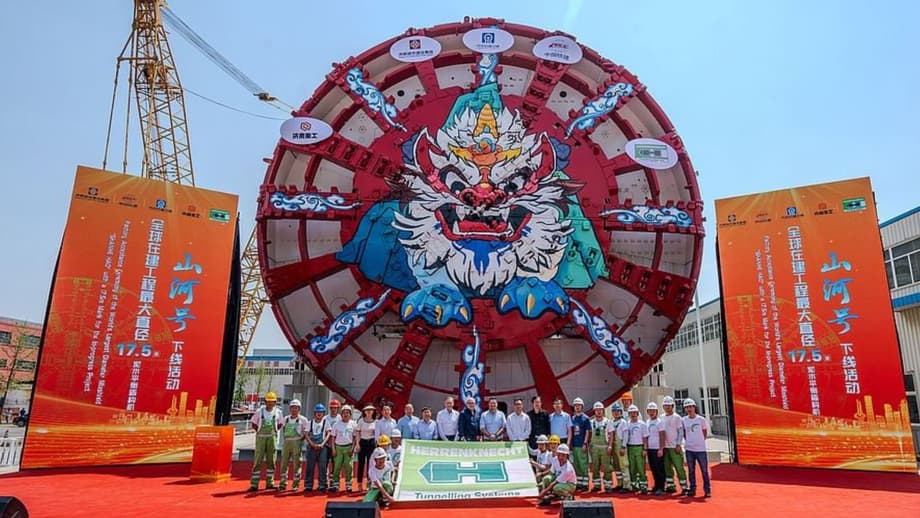
On December 27, 2020, Hong Kong opened a new kind of artery. The Tuen Mun–Chek Lap Kok Link Northern Connection cut through the seabed to connect the northwestern New Territories with Hong Kong International Airport and the Hong Kong–Zhuhai–Macau Bridge. At the heart of that project stood the Herrenknecht Mixshield S-880, a tunnel boring machine named Qin Liangyu. With a shield diameter of 17.63 meters, the machine still holds the Guinness World Records title for the largest tunnel boring machine by shield diameter. It was longer than a football field, heavier than most ships, and built to operate under pressures that would crush ordinary equipment. The tunnel it excavated is now the deepest, longest, and widest underwater road tunnel in Hong Kong, part of a 9-kilometer route costing about HK$18.2 billion, roughly US$2.3 billion.
- Building a Road Beneath the Sea
- Why the Machine Needed to Be So Large
- How the Mixshield Keeps the Seabed at Bay
- The Crushing Pressure of Working Below the Sea
- Changing Size Without Returning to the Surface
- Innovation in the Cross Passages
- Speed, Awards, and Environmental Gains
- A Record That Still Defines an Era
- Key Points
The project was never just about breaking records. It was a response to a city that needed better movement between land, sea, and air. A double tube, totaling about 5 kilometers of underwater tunnel, had to pass beneath shipping lanes, soft seabed mud, and sensitive coastal ecology. Building that kind of tunnel with older methods would have meant massive dredging, disruption to marine traffic, and years of environmental conflict. The answer was a single German-built machine that could dig, stabilize, and line the tunnel as it crawled forward.
Why the Machine Needed to Be So Large
The choice of a 17.63-meter shield came from the ground itself, not from engineering ambition alone. Between Tuen Mun and Chek Lap Kok, the seabed hides up to 30 meters of marine deposits and alluvial clays. These soils are extremely soft and saturated with water, which makes tunneling unstable. In some places, the bedrock lies about 90 meters below sea level. A conventional tunnel boring machine would struggle against water inflow and collapsing soil. The project needed a Mixshield design, a type of machine that can balance the pressure at the excavation face with a controlled mixture of slurry and compressed air.
Size also came from traffic demand. The planned tunnel needed an internal diameter of 15.6 meters to carry two highway lanes in each direction, plus safety space, ventilation ducts, electrical systems, and maintenance access. Because the tunnel boring machine installs prefabricated concrete lining segments as it advances, the external diameter of the tunnel has to be larger than the internal one. Add the thickness of the lining rings, the tail skin, and the cutter head, and the required shield diameter rises to 17.63 meters. That is roughly the height of a six-story building spinning in a circle underground. The Qin Liangyu was sized precisely for this geometry.
How the Mixshield Keeps the Seabed at Bay
A tunnel boring machine is often described as a giant drill, but the S-880 worked more like a moving submarine factory. At its front, a rotating cutter head scraped soil and rock from the tunnel face. Behind the cutter head, the machine held an excavation chamber filled with bentonite slurry, a thick clay-like fluid, and a compressed air cushion. The slurry pressed against the tunnel face and prevented seawater and mud from rushing into the machine. Compressed air above the slurry gave operators fine control over that pressure. As the cutter head advanced, the excavated spoil mixed with the slurry and was pumped through pipelines to a separation plant on the surface. There, machinery removed soil particles and returned the clean bentonite back underground.
While the front of the machine held the earth at bay, the rear installed the tunnel lining. A robotic segment erector lifted curved concrete segments into rings that formed the tunnel walls. Each ring supported the surrounding ground and created the smooth cylinder that would later hold roads, lights, and ventilation. The process required every system to advance in lockstep: pressure, pumping, slurry chemistry, hydraulic thrust, segment delivery, and surveying. If one part slowed, the entire operation stopped. This integrated approach turned a single machine into a complete production line.
The Crushing Pressure of Working Below the Sea
The hydrostatic pressure at the excavation face reached up to 5 bar, equal to five times the atmospheric pressure at sea level. That is the same kind of pressure a diver would feel at roughly 50 meters deep. An official report from the Hong Kong Government News Service described conditions this way:
The deepest section of the Tuen Mun-Chek Lap Kok Tunnel sits about 60 meters below sea level, and specialist hyperbaric workers faced pressure nearly six times greater than at the surface.
To keep workers safe while maintaining pressure at the cutter face, the S-880 used airlock chambers. These sealed compartments allowed personnel to move from normal atmospheric pressure into the pressurized excavation chamber in stages. Maintenance on cutting tools, inspections, and repairs required trained workers to enter the pressurized zone, follow strict hyperbaric medicine protocols, and decompress slowly to avoid the bends. Exposure times were limited, and the work demanded medical supervision. The conditions turned ordinary tunnel maintenance into a dive-like operation.
Changing Size Without Returning to the Surface
The most unusual chapter of the project came after the first 650 meters of excavation. The northern approach structure required a tunnel diameter of 17.6 meters, so the Qin Liangyu started at full size. After that transition, the remaining underwater route could be built with a 14-meter diameter. Instead of hauling the machine to the surface and launching a second boring machine, engineers converted the S-880 inside the tunnel itself. External parts of the 17.6-meter shield were removed, internal systems were reconfigured, and a new 14-meter shield was installed while the machine remained below the seabed.
This kind of in-tunnel shield reduction is extremely rare. The operation had to be done under sea pressure, with limited space and no direct access to daylight. Once the conversion was complete, the same machine continued excavating the rest of the tunnel, working alongside a second 14-meter Herrenknecht machine. The two machines broke through on February 27, 2019. The 17.63-meter section was excavated between March 25 and November 3, 2015, before the conversion was carried out. The process was documented as an advancement applicable to future projects where different tunnel diameters are needed in a single drive.
Innovation in the Cross Passages
Road tunnels with two tubes usually need cross passages, small connecting corridors that allow evacuation and maintenance between the two main bores. The Tuen Mun–Chek Lap Kok Link required 57 of these passages, and the pressure at their location reached 5.8 bar, above the 3.6-bar threshold where Herrenknecht recommends using professional divers for pressurized chamber work. The conventional approach in some underwater tunnels would have been soil freezing, a method that stabilizes the ground by freezing water in the soil. That technique would have been slow and risky in soft, saturated seabed clay.
The team instead used a 3.6-meter mini-slurry tunnel boring machine, a global first for constructing cross passages under such high pressure. The small machine bored through the walls between the two main tubes while the surrounding slurry system kept pressure under control. The solution avoided the need for freezing, reduced construction time, and limited risk in an environment where seawater, soft clay, and extreme pressure combined to create a dangerous workspace.
Speed, Awards, and Environmental Gains
Despite the complexity, the S-880 moved quickly. Its maximum daily advance reached 30 meters, and its weekly record hit 167.2 meters. Those figures reflect not just mechanical power but the logistical coordination needed to keep a continuous supply of concrete segments, bentonite, and replacement parts flowing to the machine. The American Society of Mechanical Engineers recorded the machine as having a power output of 5,600 kilowatts and the ability to advance about 30 meters per day in saturated ground and rock.
The project received the ITA Tunnelling Award in 2019 from the International Tunnelling and Underground Space Association, recognizing the technical innovations used during construction. Another award-winning solution was the caterpillar cofferdam system used in the northern approach structures, which offered an alternative to the conventional diaphragm wall in very soft soils. The environmental case was equally important. The Hong Kong Highways Department wrote in an engineering feature:
Using tunnel boring machines instead of the traditional immersed tube method reduced dredging and disposal of about 11 million cubic meters of marine sediment, roughly the capacity of 4,900 standard swimming pools, and helped minimize impact on Chinese white dolphins and other marine life.
The same official note said the method reduced disruption to heavy marine traffic along Urmston Road and avoided the need to divert existing submarine power cables serving the airport. The northern connection opened to traffic on December 27, 2020, while the southern connection had already started opening in 2018, tying the route into the broader Hong Kong–Zhuhai–Macau Bridge network.
A Record That Still Defines an Era
The S-880 Qin Liangyu is no longer the most powerful machine in every technical category. New Chinese and international tunnel boring machines have appeared in recent years with larger thrust, greater automation, or different cutter head designs. But Guinness still credits the Qin Liangyu with the record for shield diameter, and the project it completed remains extraordinary. Few other machines have combined such a large diameter, such deep underwater pressure, and an in-tunnel shield conversion in one continuous drive.
The machine also represents a broader shift in how coastal cities build infrastructure. As ports, airports, and metropolitan areas grow more crowded, planners are looking underground and under water for new routes. Mega-machines like the S-880 allow those routes to be built with less surface disruption, less dredging, and lower ecological impact than older methods. They are expensive, energy intensive, and technically demanding, but they offer a way to add capacity without covering more coastline with construction sites.
The Qin Liangyu was named after a Chinese general from the Ming Dynasty, born in 1574, who was known for courage and loyalty. The name follows the long underground engineering tradition of giving female names to large tunnel boring machines, a custom that stretches back to the nineteenth century. In that sense, the machine carried both history and future into the rock beneath Hong Kong.
Key Points
- The Herrenknecht Mixshield S-880 Qin Liangyu holds the Guinness World Records title for largest tunnel boring machine by shield diameter, at 17.63 meters.
- The machine excavated the 5-kilometer double underwater tunnel of the Tuen Mun–Chek Lap Kok Link, which opened in December 2020.
- The project cost about HK$18.2 billion and is now the deepest, longest, and widest underwater road tunnel in Hong Kong.
- Mixshield technology used bentonite slurry and compressed air to control pressure in soft, water-saturated seabed soils.
- Work occurred at pressures up to 5.8 bar, requiring hyperbaric protocols and airlock chambers for maintenance crews.
- Engineers converted the machine from 17.6 meters to 14 meters inside the tunnel itself, a rare in-tunnel shield reduction.
- A 3.6-meter mini-slurry TBM built the 57 cross passages under high pressure, an industry first.
- The project reduced dredging by about 11 million cubic meters and lessened impact on marine life and shipping lanes.