A Giant Emerges from the Mud
In 2016, during the dry season in Chaiyaphum province of northeastern Thailand, a local resident named Thanom Luangnan noticed something peculiar along the banks of a public pond. The water levels had receded, exposing formations that looked like strange rocks embedded in the mud. Curiosity led him to alert the Department of Mineral Resources. Those stones were not rocks at all. They were fossilized bones, and they belonged to an animal that would eventually reshape scientific understanding of prehistoric life throughout Southeast Asia.
- A Giant Emerges from the Mud
- Measuring a Prehistoric Colossus
- Anatomy of the Most Complete Khok Kruat Sauropod
- A Name Drawn from Myth and Landscape
- Placing Nagatitan on the Sauropod Family Tree
- A Hot, Open World Shared with Predators and Flyers
- How Did Such Massive Animals Handle the Heat?
- The Last Titan of a Vanished World
- Inspiring a New Wave of Discovery
- What to Know
A research team led by paleontologist Sita Manitkoon, a National Geographic Explorer based at Mahasarakham University, began investigating the site. Initial excavations between 2016 and 2019 yielded ten bones, including a forelimb fossil measuring nearly six feet in length. Work stalled in 2020 when funding ran dry, but a grant from the National Geographic Society allowed researchers to resume their efforts in 2024. The resulting study, published in the journal Scientific Reports, introduced the world to Nagatitan chaiyaphumensis and established a new benchmark for dinosaur discoveries in the region.
Measuring a Prehistoric Colossus
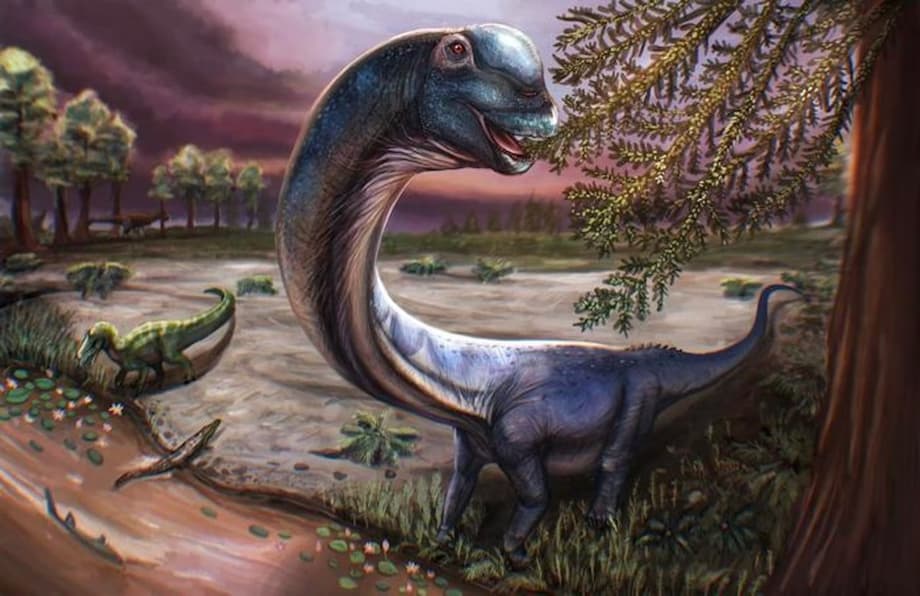
Nagatitan stretched approximately 27 meters from snout to tail, or roughly 89 feet. Its mass ranged between 25 and 28 metric tons, with some estimates approaching 30 metric tons. For perspective, that equals the weight of about nine adult Asian elephants and exceeds the mass of more than three Tyrannosaurus rex individuals. One front leg bone alone stood 1.78 meters tall, surpassing the height of many adult humans and confirming that the animal belonged to the upper ranks of terrestrial giants.
Thitiwoot Sethapanichsakul, the lead author of the study and a doctoral candidate at University College London, expressed the surprise the team felt when examining the remains.
When I first laid eyes on the humerus, it was taller than me, and that was quite surprising.
Despite these staggering numbers, Nagatitan was not the largest sauropod to ever live. It likely carried at least 10 tonnes more body mass than Diplodocus carnegii, the famous specimen known as Dippy. Yet it remained smaller than South American titans such as Patagotitan, which reached 60 tonnes, or the Asian giant Ruyangosaurus, estimated at 50 tonnes. Instead, Nagatitan occupies a crucial middle position in the size spectrum of gigantic dinosaurs, offering clues about how and when these animals began their evolutionary march toward truly monumental proportions across multiple continents.
Anatomy of the Most Complete Khok Kruat Sauropod
The recovered remains provide the most complete sauropod specimen ever extracted from the Khok Kruat Formation, a rock layer that has historically produced only rare and fragmentary material. The inventory includes four dorsal vertebrae, four sacral vertebrae, five dorsal ribs, a right humerus, a right ilium, left and right pubis bones, and a largely complete right femur. Because no elements were duplicated and all bones matched in size and lay in close association, scientists concluded they came from a single individual rather than a jumbled collection from multiple animals.
Several anatomical traits set Nagatitan apart from its relatives. Its middle and posterior dorsal vertebrae display two distinct types of joint structures, specialized features that helped lock the spinal column together and provided stability under immense weight. The right forelimb is proportionally longer than those of recently discovered giants such as Patagotitan and Dreadnoughtus. Using three dimensional scanning and printing, researchers based at University College London and in Thailand studied the material without needing to transport fragile fossils across continents. All specimens now reside at the Sirindhorn Museum in Kalasin Province, where they remain available for future study.
A Name Drawn from Myth and Landscape
The genus name Nagatitan carries layers of cultural and scientific meaning. Naga refers to the serpentine beings of Southeast Asian folklore and Buddhist tradition, mythical creatures often associated with water and guardianship. The choice felt fitting because the bones emerged from the edge of a communal pond. Titan invokes the primordial giants of Greek mythology. The species name, chaiyaphumensis, pays direct tribute to Chaiyaphum province, ensuring the location remains forever linked to the creature that once walked there.
This naming marks a milestone for Thai paleontology. Nagatitan chaiyaphumensis became the fourteenth formally named dinosaur species in the country, a list that began only in 1986 with Siamosaurus suteethorni. For lead author Thitiwoot Sethapanichsakul, a Thai doctoral student at University College London, the moment carried personal weight. He had dreamed of naming a dinosaur since childhood, and he specifically hoped it would hail from Thailand.
Placing Nagatitan on the Sauropod Family Tree
Phylogenetic analysis placed Nagatitan within Somphospondyli, a widespread group of titanosauriform sauropods that flourished throughout the Cretaceous. More precisely, it belongs to Euhelopodidae, a subgroup previously known only from Asia. Other members include Phuwiangosaurus sirindhornae from Thailand and Tangvayosaurus hoffeti from Laos, both of which lived during roughly the same period and shared the same general body plan of long necks and pillar like legs.
However, Nagatitan does not cluster into an exclusive Southeast Asian subclade with these neighbors. A suite of anatomical differences in its spine, pelvis, and leg bones distinguishes it from both Phuwiangosaurus and Tangvayosaurus. Researchers constructed the evolutionary tree using a data matrix of 153 taxa and 570 characters analyzed under maximum parsimony. The resulting well resolved topology confirms that Asian euhelopodids were diverse and geographically widespread, rather than representing a single localized offshoot. The discovery therefore expands known diversity and sharpens the picture of titanosauriform biogeography across the region.
A Hot, Open World Shared with Predators and Flyers
Approximately 113 million years ago, during the Aptian to Albian ages of the Early Cretaceous, the land that is now northeastern Thailand sat closer to the equator than it does today. Palynomorph data and sedimentological evidence indicate a warm, semi arid climate dominated by open shrublands and savanna like vegetation, laced with meandering river systems. These rivers teemed with fish, freshwater sharks, crocodiles, and turtles, creating a complex ecosystem that supported animals of all sizes.
Nagatitan shared this landscape with a rich assortment of other dinosaurs. Smaller plant eaters such as iguanodontians and early ceratopsians, relatives of the later Triceratops, browsed on lower vegetation. Giant predators including carcharodontosaurians and spinosaurids prowled the same terrain, though an adult Nagatitan would have faced few threats. Pterosaurs, the flying reptiles, likely fished along the river corridors. As a bulk browser, Nagatitan probably consumed conifers and seed ferns with minimal chewing, using its vast body volume to process enormous quantities of plant matter and reshape the landscape through constant grazing and movement.
How Did Such Massive Animals Handle the Heat?
The tropical setting raises an obvious question that has puzzled scientists for generations. Large bodies retain heat more readily than small ones, so gigantic dinosaurs living near the equator should have faced severe overheating risks. An animal the size of Nagatitan would have generated enormous internal warmth simply by digesting huge quantities of plant matter each day. Nagatitan suggests otherwise, and its anatomy may explain why sauropods thrived under these conditions rather than being restricted to cooler latitudes.
Coauthor Paul Upchurch, a paleontologist at University College London, addressed the paradox of gigantic body size in tropical climates.
It seems a little odd that sauropods were able to cope with higher temperature conditions.
Its elongated neck and tail increased surface area, allowing more efficient heat dissipation across a broader exterior. The skin itself offered ample space for radiation and convection. Inside the body, a complex system of air sacs connected to the lungs functioned almost like a natural cooling apparatus, releasing thermal energy with each exhalation. This biological innovation likely gave sauropods a decisive advantage over other herbivores in the same ecosystems. These adaptations meant that when global temperatures rose during the middle Cretaceous and habitats shifted toward open, warm woodlands, sauropods were already equipped to capitalize on the change. Rather than suffering, they grew larger. The trend continued for millions of years after Nagatitan, eventually producing the supersized titanosaurs of the Late Cretaceous in Asia, South America, and possibly Africa.
The Last Titan of a Vanished World
Scientists have taken to calling Nagatitan the last titan of Thailand, and the nickname carries geological truth. The Khok Kruat Formation represents the youngest rock layer in the country known to contain dinosaur fossils. Palynomorph studies date the formation to the upper Aptian, with the possibility that the upper portion extends into the Albian. Shortly after Nagatitan lived, much of the region sank beneath a shallow sea, halting the preservation of terrestrial remains in younger sediments and replacing forests and floodplains with marine deposits.
For this reason, researchers do not expect to find any larger or more recent sauropods in Thai rock formations. Younger rocks laid down toward the end of the dinosaur age are unlikely to contain dinosaur remains because the area had become ocean. This context makes the discovery especially bittersweet. Nagatitan stands as the final representative of an age when giants ruled the landscape of Southeast Asia. Its bones close a chapter of deep time, preserving a snapshot of a world just before rising seas transformed the region forever. The fossil site has since become home to a research center dedicated to further study and public education, ensuring that the story of the last titan continues to reach new audiences.
Inspiring a New Wave of Discovery
Thailand entered formal dinosaur science only four decades ago, yet it now ranks among the most fossil rich nations in Asia. Manitkoon noted that the country holds possibly the third highest abundance of dinosaur remains on the continent, surpassed only by major fossil powers such as China and Mongolia. Collaborative networks linking Thai institutions with international partners such as University College London are accelerating the pace of discovery and training a new generation of scientists. Advanced technologies like three dimensional scanning allow global experts to examine specimens without the carbon cost of constant travel, making research both more sustainable and more accessible to specialists around the world.
The team believes that existing museum collections contain numerous undescribed sauropod fossils that may represent additional new species. Some of these specimens have awaited formal description for years, hidden in storage drawers and overlooked due to limited resources. Public outreach forms another priority. Researchers hope that announcing a homegrown giant will excite rural communities about the value of paleontology and encourage locals to report unusual finds before erosion or construction destroys them. A life size reconstruction of Nagatitan chaiyaphumensis is already on display at the Thainosaur Museum at Asiatique in Bangkok, giving visitors a tangible sense of the scale of the animal and cementing its place in the public imagination.
What to Know
- Nagatitan chaiyaphumensis is the largest dinosaur ever found in Southeast Asia, measuring about 27 meters long and weighing 25 to 28 metric tons
- A local resident discovered the fossils in 2016 near a pond in Chaiyaphum province, Thailand
- The species belongs to Euhelopodidae, an Asian family of long necked sauropod dinosaurs, and lived roughly 113 million years ago
- Its anatomy reveals unique features in the vertebrae and limbs that distinguish it from related species in Thailand and Laos
- The discovery comes from the Khok Kruat Formation, the youngest dinosaur bearing rock unit in Thailand, earning the animal the nickname the last titan
- Researchers used three dimensional scanning to study the bones, which are housed at the Sirindhorn Museum
- A life size reconstruction is currently on view at the Thainosaur Museum in Bangkok