A Predawn Effort to Feed a City
At 3am, while much of Kuala Lumpur still sleeps, Ms Zainab Dali is already preparing food inside a modest kitchen in Kampung Datuk Keramat. By 5.30am, the 55 year old former hotel chef carries trays of fried rice, spaghetti aglio e olio, macaroni and kuih to a vending machine at Ampang Park MRT station, a short walk from the Petronas Twin Towers. Every item is priced between RM3 and RM5, making her one of the remaining vendors fighting to keep cheap meals within reach of low income communities.
Ms Zainab is part of an Economy Ministry programme called the People Income Initiative, which helps participants sell affordable food through vending machines with a ceiling price of RM5. The programme aims to raise earnings for the bottom 40 percent of households, known as the B40 group. Yet after three years, she says margins are vanishing. She has switched from whole chicken pieces to cheaper fillets and hunts for supermarket discounts to keep prices low.
“Before, I could include whole chicken pieces. Now, I use fillets as they are cheaper. You have to be smart. I usually look for supermarket offers,” she explained.
Her monthly revenue reaches around RM10,000, yielding a profit of RM7,000 to RM8,000 largely because bottled water sales offset thin food margins. Government aid currently covers her machine and rental space, but her two year contract expires at the end of May. Without that support, she is unsure whether the operation can survive.
“If the rent and machine fees increase, I am not sure I can continue. For me, it is more like charity. I do not make a big profit, just enough to survive. People still depend on it, so I will try to continue for as long as I can,” she said.
The Shrinking Rahmah Menu
The vending operation run by Ms Zainab sits alongside a wider government effort that is rapidly losing participants. The Rahmah Menu, which translates to compassionate menu, was introduced in January 2023 as a lifeline for low income groups. At its launch, some 15,000 food outlets ranging from local Indian Muslim restaurants, popularly called mamak eateries, to major chains signed up to offer budget meals. By October 2025, Deputy Domestic Trade and Cost of Living Minister Fuziah Salleh said only 3,141 operators were still active. That means four out of five vendors have withdrawn.
The initiative also lost its earliest champion when then minister Salahuddin Ayub died in July 2023, less than six months after the rollout began. Without its primary architect, the programme struggled to maintain momentum amid rising costs.
Some large retailers have stayed the course. Mydin Mohamed Holdings managing director Ameer Ali Mydin said his company remains committed to serving Rahmah meals of rice, chicken or fish, vegetables and iced tea at RM5. Fast food chain KFC also continues to sell a RM5 set consisting of a piece of chicken, a bun and bottled water.
“There are no changes to our objective of serving RM5 meals, even with cost pressures. This is about helping the community, especially the B40 group,” said Datuk Ameer.
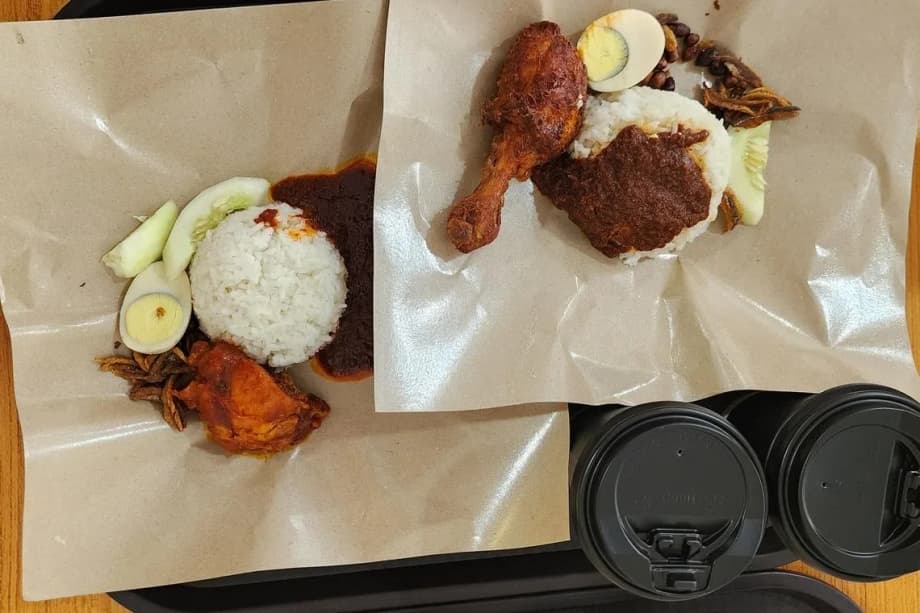
Yet such resolve is harder to find among smaller businesses. Kesum, a social enterprise founded by former economy minister Rafizi Ramli, now sells nasi lemak with spiced fried chicken for RM4.90 and fried noodles for as little as RM3.90. Supervisor and cook Izzan Ilham said the outlet serves between 200 and 300 customers daily, with demand growing since Hari Raya Aidilfitri in March, a sign that household budgets are tightening further.
“It is not about whether the food is nice or not, the price is the main thing. Customers tell us the food is nice. The profit is very small, but we can still survive,” he said.
The Economic Squeeze on Households and Vendors
The struggles of these food vendors mirror a broader economic strain affecting Malaysian families. A recent report by policy think tank Khazanah Research Institute warned that global crises from pandemics to wars and energy disruptions have exposed structural weaknesses in the national economy. Rising energy and logistics costs hit both firms and households, while lower income groups face the greatest pressure because wages have stagnated for years.
According to central bank data cited in the report, real wages for the bottom 50 percent of households grew by merely around RM56 annually between 2010 and 2019. Today, the bottom 70 percent of households struggle to keep pace with rising living costs. A simple meal out can easily cost RM20 or more, while a roadside burger starts at RM5 and a plate of mixed rice at a stall can reach RM10 to RM15.
The strain has intensified as global energy disruptions ripple through supply chains. The government currently spends billions of ringgit each month to maintain fuel subsidies and keep petrol prices stable, yet those subsidies themselves are under pressure. With quotas reduced and the state urging conservation measures, the cost of moving ingredients from farms to kitchens continues to climb. Vendors who rely on daily deliveries feel each price jump acutely.
Homemaker Norlisa Ayub, 34, discovered Kesum through a social media post in early May and was immediately drawn by the prices. She runs a home baking business and has watched ingredient prices double.
“The food is good and affordable. It is hard to find prices like this any more. Cocoa powder used to be RM20 plus per kg, now it is RM40. Butter went up from around RM10 to RM16.90,” she said.
Lorry driver Din Ali, 40, voiced the frustration of many workers who depend on cheap meals to get through the day.
“People want cheap and tasty food. The economy now is not good, we cannot control it. Even nasi lemak sold by the roadside is RM7 now,” he said.
The Hidden Workforce in Public Housing
Behind many of these micro food businesses are women from B40 communities living in Public Housing Projects, known as PPR flats. They form a large share of the 70.1 percent of micro enterprises that make up the national MSME landscape. Working from cramped 600 to 700 square foot flats that double as production spaces, these women sustain entire low income neighborhoods even as their contributions go largely unnoticed.
Department of Statistics Malaysia figures show the average household has just 1.8 income earners. For B40 families, secondary income from self employment is no longer optional. It has become a critical buffer against inflation. Yet these women buy ingredients in small quantities at higher per unit prices, leaving margins as thin as fifty sen per item. Unlike large retailers, they cannot absorb cost spikes or negotiate bulk discounts.
Access to financing remains a persistent barrier. Bank Negara Malaysia financial stability reviews confirm that micro enterprises struggle to secure credit because of thin documentation, inconsistent cash flows and a lack of collateral. Many PPR women mix household and business finances and rely on daily revenue to restock, leaving them ineligible for programmes like TEKUN, DanaNita MARA or BSN Micro i.
Physical working conditions add to the burden. Kitchens often serve simultaneously as study areas for children and laundry spaces, creating operational inefficiencies and food safety risks. Several housing blocks have introduced shared kitchens, but coverage remains limited. Community leaders note that even when training programmes exist, they rarely translate into sustained progress. One off workshops on digital sales or bookkeeping cannot overcome the reality that many low income households share a single smartphone and endure unstable internet connections. Programmes such as PEDi and MDEC eUsahawan offer foundations, but participants say they need ongoing mentorship and simplified tools designed for micro operations rather than formal SMEs.
Workdays frequently stretch 14 to 18 hours, with no paid leave or childcare support, pushing many toward exhaustion. Since the pandemic, hyperlocal saturation has intensified. More households began selling similar items such as nasi lemak, kuih and frozen snacks within the same small neighborhoods, depressing prices in markets where purchasing power is already weak. Without daily sales records or clear cost tracking, many women discover only after months of work that hidden expenses have consumed nearly all their earnings. What these entrepreneurs lack is not motivation, but an ecosystem built for their realities.
Lessons from Across the Region
Malaysia is not alone in wrestling with cheap food programmes. Regional neighbors have pursued different strategies, each carrying distinct trade offs. In Singapore, the Housing and Development Board now requires all leased coffee shops to offer budget meals by 2026, typically priced between S$3 and S$3.50, with rent discounts to ease the transition. Malaysian retail executives argue that voluntary participation preserves goodwill, while forced compliance could trigger resentment or corner cutting. Singapore authorities, by contrast, have tied rent renewal conditions to the provision of budget meals and offered operators a one year rental discount to soften the blow. Both models face resistance from stallholders who say that rising manpower and ingredient costs make low price meals economically irrational without external support.
Indonesia offers another stark comparison. President Prabowo Subianto has launched a free meals programme costing about US$20 billion annually, aiming to feed more than 80 million people, mostly schoolchildren. The initiative consumes roughly 11 percent of central government spending and has drawn a constitutional court challenge from civil groups arguing that the budget law lacks transparency and adequate fiscal safeguards. Major credit agencies have shifted Indonesia outlook to negative, citing concerns over fiscal priorities.
In Thailand, Prime Minister Anutin Charnvirakul has faced fuel shortages and price spikes linked to conflict in the Middle East, prompting economists to trim growth forecasts as exports and tourism suffer. These regional pressures illustrate how global energy disruptions and supply chain shocks are straining social safety nets across Southeast Asia.
Nutrition in the Balance
Beyond economics, the health value of budget meals is under scrutiny. Many Menu Rahmah options revolve around deep fried chicken or fish, partly because frying extends shelf life and allows unsold items to be repurposed the following day. Fresh vegetables and whole grains are often scarce on the plate, raising concerns that cost cutting may come at the expense of balanced nutrition.
Critics have called for a tighter framework to ensure meals meet Health Ministry dietary guidelines. A stronger regulatory and monitoring system could enforce quality, portion sizes, hygiene standards and nutritional balance across age groups. Some have suggested menu guides for participating eateries and spot checks conducted with local government and health departments. Reducing single use plastic containers through incentives for customers to bring their own food boxes could lower raw material costs for vendors while cutting waste. Tax deductions for small enterprises that adopt green practices might ease the financial load and align the programme with national sustainability targets.
A controversial parliamentary speech by opposition lawmaker Halimah Ali suggested that low quality cheap food might expose consumers to long term health risks, remarks for which she later apologised. Medical expert Dr Zainul Ariffin Omar, an adviser to the Malaysian Public Health Organization, said that options at established retailers like Mydin are sufficiently balanced, but warned that fast food chains joining the programme may use it to promote less healthy choices.
“Customers must be aware that paying low prices does not mean they should accept low quality,” he said.
At Kesum, the kitchen team tries to meet expectations on taste despite the low price point, yet the broader industry reality is that when a vendor earns barely enough to cover ingredients, adding fresh produce becomes a luxury rather than a standard.
What Will It Take to Keep Affordable Meals on the Table
The government has responded with a suite of measures under the Payung Rahmah umbrella, including cash aid, discounted broadband packages, basic donations and the People Income Initiative. In April, Prime Minister Anwar Ibrahim announced that Menu Rahmah operators would be able to purchase raw materials such as chicken, onions and rice at special discounted rates through selected supermarket partners. The 2023 Rahmah Cash Donations channelled almost RM8 billion to 8.7 million recipients, covering nearly 60 percent of the adult population. The People Income Initiative has reached 4,100 households so far, yet contracts like that of Ms Zainab are time bound, and participants worry that once subsidies end, market rents will wash away their thin profits.
Yet advocates say such measures remain patchy. Analysts argue that policymakers need to strike a better balance between protecting consumers and safeguarding vendor welfare. Proposals include tax deductions for small businesses that adopt environmentally friendly practices, expanding NGO partnerships to reach peripheral communities, and establishing watchdog channels through digital platforms to monitor food quality at the local level. Analysts note that transforming these pilots into permanent fixtures will require local government coordination, regular spot checks, and a formal link to health and education departments to guarantee that cheap food is also safe and nourishing.
For Ms Zainab, policy debates feel distant compared with the immediate threat of a rent increase when her contract ends. She continues to fill the vending machine before dawn, knowing that commuters, office workers and nearby residents rely on the trays she delivers. Her future, like that of thousands of micro entrepreneurs, hinges on whether the state can convert short term charity into long term structural support.
“I think Kesum should open up in other places. The food is good. It is a nice looking place, and it is air conditioned, too,” said Din Ali, reflecting a demand that far outstrips current supply.
The Bottom Line
- Participation in the Rahmah Menu has collapsed from roughly 15,000 outlets at launch to about 3,141 operators by late 2025.
- Small traders face unsustainable margins because of rising food, energy and logistics costs, while large chains absorb losses as community service.
- B40 women running micro enterprises in public housing projects struggle with capital shortages, cramped kitchens, limited financing and 14 to 18 hour workdays.
- Nutritional quality varies widely, with many budget meals relying on fried protein and small vegetable portions rather than balanced diets.
- Government cash aid and discounted raw material schemes provide relief, but experts say stronger regulation, accessible micro financing and community partnerships are essential to keep affordable dining alive.