Deep Sea Milestone Opens New Window on Universe
Chinese scientists have successfully completed critical sea trials for the Tropical Deep-sea Neutrino Telescope (TRIDENT), marking a major step forward in the construction of what will become the world’s largest underwater observatory designed to detect ghostly subatomic particles from deep space. Shanghai Jiao Tong University announced on Sunday that the precision instruments and engineering equipment have demonstrated full operational capability at depths of 3,500 meters in the South China Sea, validating years of intensive research and development.
- Deep Sea Milestone Opens New Window on Universe
- Chasing Ghost Particles Through Dark Waters
- Precision Engineering at Extreme Depths
- Architecting the World’s Largest Underwater Observatory
- The Equatorial Advantage in Neutrino Astronomy
- Unlocking Cosmic Mysteries and Fundamental Physics
- Construction Timeline and International Context
- Key Points
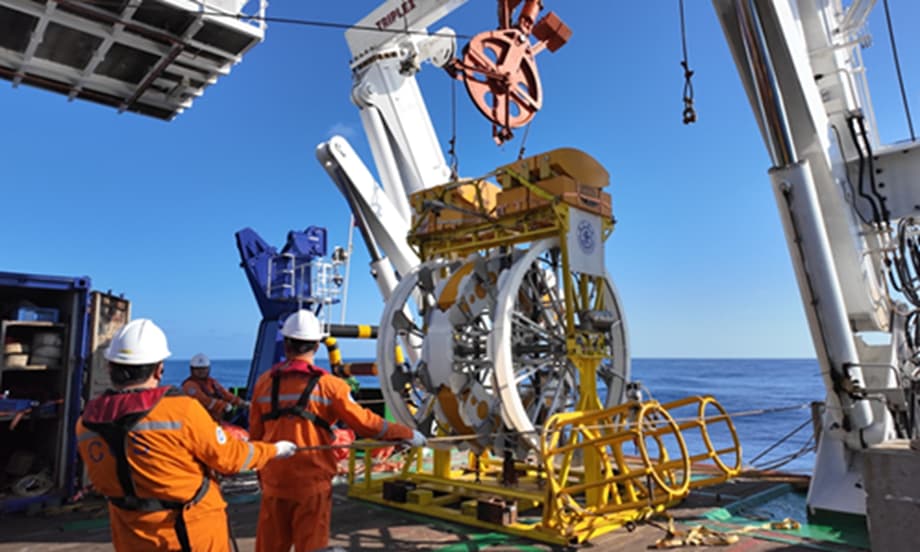
The recently concluded tests validated the Subsea Precision Instrument Deployer with Elastic Releasing (SPIDER) system, a sophisticated mechanism designed to place delicate detection equipment on the ocean floor with extreme precision. During the trials, SPIDER completed a seabed landing test at the target depth of 3,500 meters and executed coordinated movement tests with a dynamically positioned vessel, confirming both impact resistance and deep sea precision positioning capabilities essential for the massive construction project ahead.
Beyond the deployment system, researchers successfully recovered neutrino environmental moorings that were initially placed in April 2025. These instruments provided complete cycle meteorological, oceanographic, and hydrological data while recording equipment operations under extreme pressure conditions. The sensors showed minimal biofouling after months underwater, delivering continuous data that will guide final site selection for the massive telescope array and ensuring that the chosen location maintains stable conditions year round.
The project team also conducted in situ sampling and large volume filtration experiments during the voyage, gathering comprehensive biodiversity data from the abyssal plain ecosystem. These findings will provide essential reference points for distinguishing true neutrino signals from potential biological interference or other background noise in the deep sea environment, while also contributing to marine science understanding of these little explored depths.
The successful trials represent more than mere engineering validation. They confirm that China possesses the technological capability to construct and maintain sophisticated scientific infrastructure in one of the most challenging environments on the planet. The abyssal plain at 3,500 meters presents crushing pressures, complete darkness, and near freezing temperatures, conditions that would destroy conventional equipment within hours.
Chasing Ghost Particles Through Dark Waters
TRIDENT, known as Hailing or Ocean Bell in Chinese, represents a bold attempt to capture neutrinos, subatomic particles so elusive that scientists nickname them ghost particles. These particles possess nearly zero mass and no electrical charge, allowing them to pass through solid matter including entire planets without interaction. Approximately 100 billion neutrinos traverse every square centimeter of the human body each second, yet they leave no trace of their passage.
This ghostly quality makes neutrinos extraordinarily difficult to detect, but it also renders them invaluable as cosmic messengers. Because they travel in straight lines without being deflected by magnetic fields, neutrinos point directly back to their sources, potentially revealing the origins of cosmic rays and the violent astrophysical events that produce them. These sources include supernova explosions, colliding galaxies, and jets from active galactic nuclei.
When high energy neutrinos occasionally collide with water molecules, they produce secondary particles called muons that emit faint flashes of blue light known as Cherenkov radiation. TRIDENT will detect these momentary glimmers using thousands of ultra sensitive optical sensors suspended throughout a massive volume of deep ocean water.
Precision Engineering at Extreme Depths
The recent sea trials focused on validating several key technologies essential for Phase I construction. The SPIDER system emerged as a particular triumph, having undergone eight design iterations before achieving the current success. The device descended to approximately 1,700 meters during testing, uncoiling a 700 meter line composed of 20 sensors and four buoyancy blocks while maintaining position for ten minutes and rotating slowly to simulate operational conditions.
Engineers also tested the prototype hybrid Digital Optical Module (hDOM), the telescope’s core detection unit. This advanced sensor captured subtle neutrino signals and achieved single photon level precision in extremely weak light conditions, demonstrating the sensitivity required to spot ghost particle interactions.
Additionally, the project team completed multiple underwater mating tests on five domestic systems of the deep sea wet mate connector. These devices will link subsurface buoys with seabed junction boxes, forming critical connections in the observatory’s data and power infrastructure. Underwater acoustic positioning systems were also verified during the expedition.
Innovative Hybrid Sensor Design
The hDOM units represent a significant technological advance over previous neutrino telescopes. Each module combines traditional photomultiplier tubes (PMTs) with modern silicon photomultipliers (SiPMs), creating a hybrid detection system that maximizes light collection while achieving timing resolution measured in tens of picoseconds. The SiPMs fill spaces between PMTs, providing additional photocathode coverage and enabling coincidence triggering that improves signal discrimination.
This hybrid approach allows TRIDENT to accurately measure the arrival times of unscattered Cherenkov photons, directly improving the angular resolution of detected particle tracks. Scientists expect to achieve pointing accuracy of approximately 0.1 degrees for high energy events, a precision that will help isolate individual astrophysical sources from the background of diffuse cosmic neutrinos.
Architecting the World’s Largest Underwater Observatory
When fully constructed in the early 2030s, TRIDENT will dwarf all existing neutrino observatories. The complete array will comprise 1,211 vertical strings, each extending 700 meters tall and equipped with 20 hybrid optical modules spaced 30 meters apart. These strings will cover depths ranging from 2,800 to 3,400 meters below sea level, creating an instrumented volume of approximately 7.5 cubic kilometers.
The strings will follow a Penrose tiling distribution pattern using the golden ratio, with inter string distances alternating between 70 and 110 meters. Researchers selected this uneven geometry rather than a regular grid because simulations indicate it expands the range of detectable neutrino energies while reducing edge effects that can compromise data quality. The design also incorporates spiral pathways between string clusters, allowing underwater robots to access interior components for maintenance without creating large empty regions where neutrino interactions might be missed.
This massive scale offers a substantial advantage over the current record holder, IceCube, which monitors approximately 1 cubic kilometer of Antarctic ice. The increased volume means TRIDENT will capture significantly more neutrino interactions, with researchers predicting detection of certain steady sources like the Seyfert galaxy NGC 1068 within just one year of operation at five sigma statistical significance.
The Equatorial Advantage in Neutrino Astronomy
TRIDENT’s location in the western Pacific Ocean near the equator provides unique scientific advantages unavailable to polar or mid latitude observatories. Xu Donglian, the telescope’s chief scientist from the Tsung-Dao Lee Institute under Shanghai Jiao Tong University, explained the project’s innovative observation strategy.
“Using Earth as a shield, TRIDENT will detect neutrinos penetrating from the opposite side of the planet. As TRIDENT is near the equator, it can receive neutrinos coming from all directions with the rotation of the Earth, enabling observation of the complete sky without any blind spot.”
This downward looking configuration filters out background radiation from atmospheric muons, which cannot pass through the entire planet. Only high energy neutrinos can penetrate Earth from the opposite side, creating a clean signal environment for detecting astrophysical sources. Because the detector sits near the equator, Earth’s rotation continuously sweeps its field of view across the entire sky, eliminating the blind spots that affect polar detectors.
Site selection surveys conducted in 2021 confirmed that the chosen abyssal plain offers optimal conditions. At 3,500 meters depth, water currents remain slow, measuring less than 10 centimeters per second. The seawater exhibits excellent optical clarity with absorption lengths of approximately 27 meters and scattering lengths of 63 meters, allowing Cherenkov photons to travel substantial distances between interaction points and sensors.
Unlocking Cosmic Mysteries and Fundamental Physics
The scientific ambitions driving TRIDENT extend far beyond simply counting ghost particles. Project chair Jing Yipeng outlined the broader research agenda during a recent news conference, noting that the telescope will help test space time symmetries, search for evidence of quantum gravity, and conduct indirect searches for dark matter.
The primary mission remains solving the century old puzzle of cosmic ray origins. While scientists have known since 1912 that high energy particles constantly bombard Earth from space, the exact mechanisms and locations that accelerate these particles to extreme energies remain uncertain. Neutrinos provide the crucial missing link, as they are produced when cosmic rays interact with matter or radiation near their birthplaces.
By detecting neutrinos from specific astronomical objects, TRIDENT will identify the cosmic ray factories scattered throughout the universe. The observatory will also measure neutrino flavor ratios, examining how electron, muon, and tau neutrinos transform into one another during their journeys across astronomical distances. These oscillation measurements may reveal physics beyond the Standard Model and provide insights into quantum gravity effects.
Additionally, the telescope will search for the Glashow resonance, a specific energy signature where electron antineutrinos interact with atomic electrons, creating a distinctive signal that can be distinguished from other neutrino interactions. Detecting these rare events would provide valuable constraints on astrophysical models and fundamental particle physics.
Construction Timeline and International Context
The project follows a phased implementation strategy. Phase I will deploy ten neutrino detection strings to form a compact array, serving as a technology demonstration scheduled for around 2026. Following a successful pilot phase, construction of the full 1,211 string array will commence, with the complete observatory expected to begin operations in the early 2030s.
A dedicated manufacturing facility will be constructed in the port city of Sanya to mass produce the hybrid optical modules and string systems. From this facility, completed components can be conveniently shipped to the installation site approximately 540 kilometers south of Hong Kong.
TRIDENT joins an expanding global network of neutrino observatories. Russia’s Baikal GVD currently operates in Lake Baikal, while the KM3NeT project is under construction in the Mediterranean Sea. The IceCube observatory at the South Pole continues operations in Antarctica, and the proposed Pacific Ocean Neutrino Experiment (P ONE) may deploy in the East Pacific. Each location offers distinct advantages, with TRIDENT’s equatorial position providing complementary sky coverage to the northern and southern hemisphere detectors.
More than a dozen Chinese universities and research institutes participate in the project, including the Institute of High Energy Physics in Beijing, Ocean University of China, and the University of Science and Technology of China. This collaborative approach combines expertise in particle physics, astronomy, ocean engineering, and marine biology to address the multidisciplinary challenges of building a particle physics laboratory in the deep ocean.
Key Points
- Chinese scientists successfully tested TRIDENT neutrino telescope hardware at 3,500 meters depth in the South China Sea, validating the SPIDER deployment system and hybrid optical sensors
- The SPIDER system completed seabed landing tests and coordinated vessel movements, while the hybrid Digital Optical Module achieved single photon level detection precision
- When completed in the early 2030s, TRIDENT will span 7.5 cubic kilometers with 1,211 sensor strings, making it the world’s largest neutrino observatory
- The equatorial location allows the telescope to use Earth as a shield and observe the entire sky without blind spots as the planet rotates
- Scientists expect to identify specific cosmic neutrino sources within one year of full operation, advancing research into cosmic ray origins, quantum gravity, and dark matter
- A ten string pilot array is scheduled for deployment around 2026, with manufacturing facilities planned for Sanya