A Landmark Link Across the Tumen
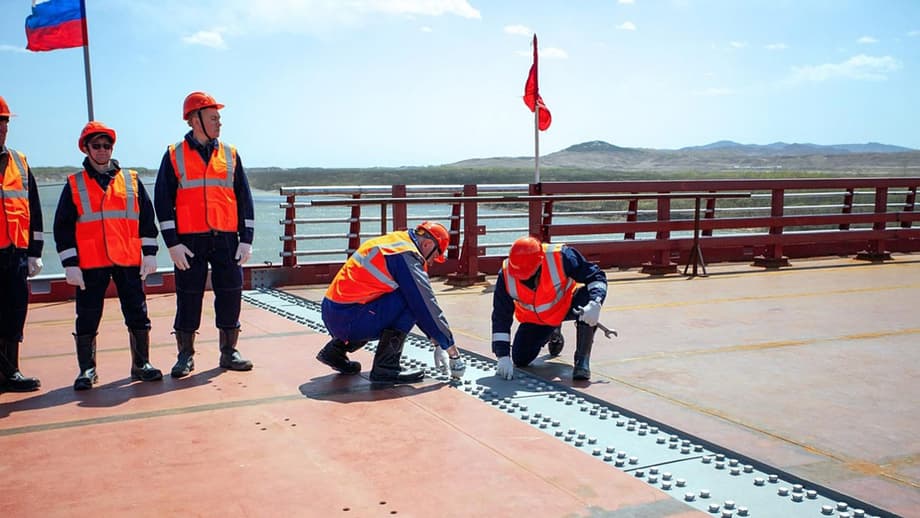
Russia and North Korea held a ceremony on Tuesday to celebrate the structural joining of the first road bridge connecting the two nations, a project Moscow hailed as a “landmark stage” in their rapidly deepening alliance. The ceremony marked the physical connection of the bridge’s two halves spanning the Tumen River, which forms the border between the countries in Russia’s Far East.
- A Landmark Link Across the Tumen
- Engineering Specifications and Construction Pace
- Customs Infrastructure and Border Facilities
- Strategic Context: Sanctions and Military Cooperation
- Contractor Controversies and Local Impact
- Historical Context and Regional Consequences
- Economic Prospects and International Concerns
- The Essentials
The crossing, officially known as the Khasan-Tumangang bridge, represents a significant engineering and geopolitical achievement. Scheduled to open for traffic on June 19, the bridge will handle up to 300 vehicles and 2,850 people daily, according to Russia’s Transportation Ministry. This capacity dramatically exceeds what the existing rail-only connection could support and establishes the first direct vehicular route between the heavily sanctioned neighbors.
Russian Transport Minister Andrey Nikitin presided over the virtual ceremony, emphasizing the historic nature of the project.
“Direct road traffic will appear between the countries for the first time. The most important stages of construction have been completed in less than a year.”
The rapid construction timeline reflects the priority both governments placed on establishing this tangible physical connection.
Engineering Specifications and Construction Pace
The bridge itself stretches approximately 850 meters to 1 kilometer across the Tumen River, depending on measurement criteria, with the entire crossing including approach ramps extending nearly 5 kilometers. The structure features two traffic lanes with a combined width of seven meters, accommodating standard vehicle traffic in both directions. Construction required 5,000 tons of metal structures and over 9,000 cubic meters of concrete, according to Russian authorities.
The project cost approximately 9 billion rubles, roughly equivalent to $111 million at current exchange rates. This investment underscores the strategic importance both nations attach to the link, which will connect to Russia’s highway system and reduce travel distance between Vladivostok and North Korea’s border city of Rason to 320 kilometers.
Construction officially began with a groundbreaking ceremony in April 2025, though preparatory work started as early as November 2024. Satellite imagery analysis from 38 North, a website specializing in North Korea studies, tracked the construction’s swift progress. Imagery from February 2026 showed a gap of around 210 meters between bridge decking, while by March 10, 2026, high-resolution photos indicated the two sides had either physically connected or maintained only a small gap.
The construction employed innovative techniques to manage the river flow. Previous reports from January 2026 indicated workers temporarily dammed the river to flow through an opening just 40 meters wide while establishing bridge footings. On the Russian side, 70 workers and 30 pieces of equipment executed the building operations, while North Korea established a temporary aggregate plant near the construction site to support materials production.
Customs Infrastructure and Border Facilities
Beyond the bridge itself, both nations have constructed extensive border infrastructure to support the crossing. On the North Korean side, a new port of entry facility covering approximately five square kilometers is under construction. This complex includes six buildings: a customs house, warehouse, motor vehicle maintenance facility, and several support buildings, surrounded by a large parking area designed as a truck transfer facility.
This arrangement mirrors North Korea’s existing border crossing with China at Wonjong-ni to Quanhe, located approximately 20 kilometers to the northwest. At such facilities, foreign trucks typically enter North Korea’s border area but cannot drive further into the country. Instead, they exchange goods at border warehouses where North Korean trucks then transport items into the interior. This system allows North Korea to maintain strict control over foreign vehicles while enabling trade.
On the Russian side, a larger customs area is under construction, along with a new right-of-way extending approximately 1.9 kilometers from the existing highway serving Khasan to the new bridge site. The route runs east around the Khasan rail facilities. A helicopter landing pad located roughly 300 meters north of the Russian construction site suggests provisions for high-priority passengers and officials.
Strategic Context: Sanctions and Military Cooperation
The bridge’s completion comes amid rapidly expanding ties between Moscow and Pyongyang, both subject to extensive international sanctions. Russia’s Foreign Ministry explicitly stated the bridge’s significance “goes far beyond a purely engineering task,” describing it as a vital artery for “trade, economic and humanitarian exchanges” between the allied nations.
The construction timeline aligns closely with Russia’s military needs in Ukraine. Since the 2022 invasion, Western intelligence agencies have repeatedly accused North Korea of supplying Russia with artillery shells, ballistic missiles, and other munitions in exchange for economic assistance and technological support. The new road bridge provides a crucial logistical artery that will significantly speed up the transfer of goods, resources, and potential military supplies between the two states.
Concurrent with road bridge construction, rail traffic between the nations has remained at high levels, an indication of ongoing trade expansion. Satellite imagery from October 2025 showed freight trains traveling between Khasan and Tumangang, with the south classification yard at the Tumangang rail facility containing nine locomotives, eleven ore cars, and sixty-five tank cars. This sustained rail activity suggests the new road crossing will supplement rather than replace existing supply routes.
The project stems directly from agreements reached during President Vladimir Putin’s visit to Pyongyang in June 2024, when both leaders signed a “comprehensive strategic partnership treaty” including mutual defense provisions. Since then, North Korea has reportedly dispatched thousands of soldiers to fight alongside Russian forces in the Kursk region following a Ukrainian incursion.
Contractor Controversies and Local Impact
The construction project has not been without controversy regarding its contracting arrangements. Russian Prime Minister Mikhail Mishustin tasked a construction firm legally registered in Sochi, TonnelYuzhStroi, with completing the project by December 31, 2026. However, investigative reports revealed the company serves as a front for BTS-Most, a firm run by Chechen business mogul Ruslan Baisarov, a confidant of regional head Ramzan Kadyrov.
Despite being tasked with a multimillion-dollar strategic project, TonnelYuzhStroi officially employed only four people, maintained a history of financial losses, and lacked a record of national-level success. Experts noted that while the project offers potential for embezzlement given these corrupt underpinnings, the strong Kremlin connections of BTS-Most likely ensured completion on schedule through access to necessary resources and political backing.
Local residents near the Russian settlement of Khasan have voiced complaints about the construction impact. Heavy machinery and large trucks reportedly destroyed the main gravel road, creating significant difficulties for local drivers. The destruction of local infrastructure highlights the rushed nature of the project and its prioritization over existing community needs.
Historical Context and Regional Consequences
Before this construction, the only permanent link between Russia and North Korea was the Korea-Russia Friendship Bridge, a rail crossing commissioned in 1959 as a replacement for a temporary wooden bridge. Located immediately downstream from the China-North Korea-Russia tripoint, that bridge features dual-gauge tracks to accommodate both Russian broad gauge and North Korean standard gauge systems. While planks can be laid between tracks to allow limited vehicle crossing by special arrangement, it primarily serves rail traffic and cannot handle the volume or convenience of a dedicated road bridge.
The Friendship Bridge gained modern significance in October 2017 when a fiber-optic cable running across it provided North Korea with an additional internet connection through Russia’s TransTelekom, reducing Pyongyang’s dependence on Chinese connectivity. Use of the rail bridge was suspended during the COVID-19 pandemic, resuming in November 2022.
The new road bridge’s location near the tri-border area with China adds complex geopolitical dimensions. Beijing has long sought direct access to the Sea of Japan via the Tumen River, and both the existing low-clearance rail bridge and the new road crossing will impede Chinese navigation ambitions. This creates a potential tension point in the otherwise cooperative relationship between the three nations, as China watches its two allies develop infrastructure that excludes or limits Chinese maritime interests.
Economic Prospects and International Concerns
South Korean officials have warned that support from Russia and China is helping revive the North Korean economy, which has struggled under decades of international isolation and sweeping sanctions. The new bridge provides a physical manifestation of this economic resuscitation, offering North Korea a land route to Russian markets and Pacific ports that bypasses Chinese territory entirely.
The bridge’s opening coincides with a flurry of diplomatic activity. This week alone, Russian Interior Minister Vladimir Kolokoltsev met with North Korean officials in Pyongyang, while Russian Health Minister Mikhail Murashko attended a hospital construction ceremony in Wonsan. These visits underscore the comprehensive nature of the bilateral relationship extending beyond military cooperation into healthcare, interior security, and civilian infrastructure.
For Russia, the bridge offers expanded access to North Korean labor and resources, while providing an eastern outlet for trade circumventing Western sanctions. For North Korea, it represents a literal bridge to the outside world that does not depend on China, offering diversification of economic partnerships and reduced vulnerability to Beijing’s political pressure.
The Essentials
- Russia and North Korea completed the structural joining of the Khasan-Tumangang road bridge on April 21, 2026, with an official opening scheduled for June 19, 2026
- The 850-meter bridge spans the Tumen River, creating the first direct vehicular link between the nations, supplementing the existing 1959 rail-only Friendship Bridge
- Construction cost approximately $111 million and took roughly one year to complete, employing innovative river management techniques and extensive customs facilities on both sides
- The crossing will handle up to 300 vehicles and 2,850 people daily, connecting Russia’s highway system to North Korea’s border city of Rason and reducing travel distance to Vladivostok to 320 kilometers
- The project reflects deepening military and economic ties between the sanctioned nations, including North Korean troop deployments to Ukraine and munitions supplies to Russia
- Contractor arrangements involving Chechen business interests raised corruption concerns, while local Russian residents complained about infrastructure damage from construction traffic
- The bridge may complicate China’s Tumen River navigation ambitions while providing North Korea with an economic lifeline independent of Beijing