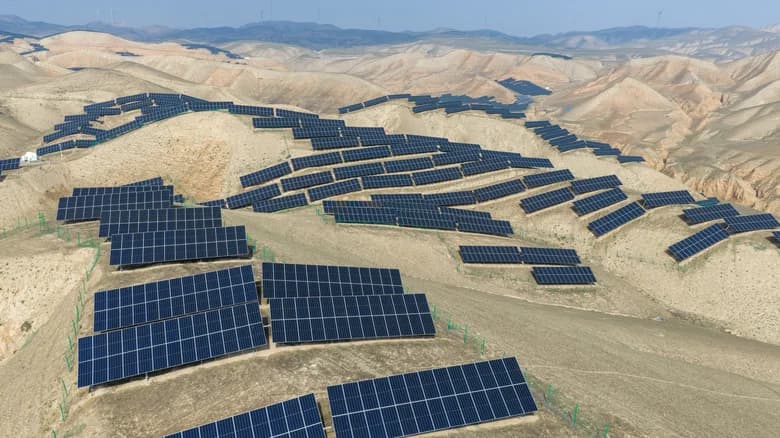
The Unexpected Oasis Beneath the Panels
Yehdor, a 49 year old herder in northwest China, remembers the desperation of 1998. Natural grass had disappeared across the Talatan Gobi Desert, leaving his cows and sheep starving. He and his father traveled to distant villages to buy hay, hauling it back on a tricycle through treacherous terrain. During one trip, Yehdor injured his ankle while pulling the overloaded cart. The desert, which had reached 98.5% desertification by the end of the last century, offered nothing but sandstorms and struggle.
Today, Yehdor rides his motorcycle through a landscape transformed. Deep blue solar panels stretch across 162 square miles of what was once barren wasteland in Gonghe County, Qinghai Province. Beneath these arrays, his sheep graze on lush grass that grows so thick it sometimes blocks the panels. His flock has grown from 200 to over 300 animals, and his annual income has reached nearly 100,000 yuan (about $14,000). The same land that exported sandstorms thirty years ago now exports clean electricity and premium mutton branded as “photovoltaic sheep.”
This transformation at the Gonghe Photovoltaic Park, the world’s largest solar installation on the Tibetan Plateau, represents more than an energy project. Peer reviewed research published in Scientific Reports confirms that the installation has produced measurable ecological improvements across the desert floor. The panels have created cooler, wetter microclimates where vegetation now thrives, turning a near lifeless expanse into a working ecosystem that supports both gigawatts of power and thousands of grazing animals.
Yehdor described the transformation in concrete terms that reflect the economic reality of the change.
Our family earns nearly 100,000 yuan a year from raising sheep. My flock has grown from 200 to over 300, and our sheep are healthy and strong. Life is much better.
Scaling the Rooftop of the World
The Talatan Solar Park sits nearly 10,000 feet above sea level on the Qinghai Xizang Plateau, where thin air and intense solar radiation create ideal conditions for photovoltaic generation. Construction began in 2012 as part of China’s first 10 million kilowatt class solar power base. By the end of 2024, the park had grown to cover more than 300 square kilometers (116 square miles) according to official accounts, with some international reports citing total coverage of 162 square miles including associated installations.
The scale dwarfs any comparable facility in the United States. The entire complex now hosts 91 energy enterprises, including 63 solar photovoltaic companies and 28 wind power operations, with a combined grid connected capacity of 17.73 million kilowatts. High voltage power lines carry this electricity more than 1,000 miles away to industrial centers, supporting China’s expanding electric vehicle market and artificial intelligence data centers. Last year alone, construction of new energy projects in the area created over 3,000 jobs for local farmers and herders.
The location choice was pragmatic. The Talatan Gobi offered vast, flat terrain with minimal competing land uses and some of the strongest solar resources on Earth. The plateau receives sunlight much brighter than at sea level because the atmosphere is thinner. However, the same factors that made the site perfect for solar panels, the intense radiation and arid conditions, had long prevented plant growth and contributed to severe desertification.
How Shade Rewrites Desert Ecology
The ecological changes occurring beneath the solar arrays challenge conventional assumptions about industrial development in fragile environments. Researchers from Xi’an University of Technology applied the DPSIR framework (Drivers, Pressures, State, Impact, Response), an assessment tool developed by the European Environment Agency, to measure 57 different ecological indicators at the Gonghe site. Their findings, published in 2024, revealed that areas directly under the panels scored 0.4393 for general ecological health, substantially higher than transitional zones (0.2858) or untouched desert areas (0.2802).
Researchers monitoring the ecological changes have documented the measurable improvements in soil conditions beneath the arrays.
The presence of solar panels modifies the energy balance at the surface. We are seeing higher biological activity under the arrays compared to the bare desert outside.
The mechanism behind this improvement is surprisingly straightforward. By intercepting direct sunlight, the panels reduce ground temperatures and slow evaporation, allowing precious moisture to linger in soils where it would normally vanish within hours. Satellite remote sensing data indicates that wind speed has decreased by 50% within the photovoltaic park, while soil moisture evaporation has dropped by 30%. A 2025 study in Frontiers in Environmental Science found that soil beneath fixed panels held approximately 75% more water than nearby exposed ground.
Additional water comes from maintenance routines. Solar panels require regular cleaning to remove dust that reduces efficiency, and this runoff seeps into the soil beneath the arrays. In the Talatan Desert, this steady micro supply of water, combined with reduced evaporation, has enabled grass to grow over one meter high in some areas. The vegetation coverage has reached 80% within the park, according to data from State Power Investment Corporation Limited and Xi’an University of Technology.
These microclimatic buffers create conditions where hardy plants and soil microbes can establish themselves. The shade reduces the daily temperature swing that stresses vegetation, while the physical structures break wind patterns that would otherwise scour away topsoil and young seedlings. The result is a self reinforcing cycle where improved soil moisture supports plant growth, which further stabilizes the soil and reduces dust.
The Agrivoltaic Revolution
The return of vegetation created an unexpected challenge for solar operators. As grass grew thick beneath the panels, it began blocking sunlight and reducing power generation efficiency. In winter, the dry vegetation posed fire hazards. Initially, companies hired workers to clear the grass manually, an expensive and labor intensive process.
In 2018, operators turned to local herders for a solution that has since become a model for agrivoltaic integration worldwide. Herders like Yehdor now graze their sheep beneath the panels at no cost, providing natural vegetation control that eliminates the need for herbicides or mechanical clearing. Technicians adjusted the infrastructure to accommodate the animals, widening the spacing between arrays from three to five meters and raising mounting heights from 50 centimeters to between 1.5 and 1.8 meters.
The arrangement has proven mutually beneficial. The sheep receive shade during blistering summer days and abundant grazing on high quality grass nourished by the improved microclimate. The “photovoltaic sheep” have gained recognition for their quality, with herdsmen developing a branded product sold nationwide through e commerce platforms. Each animal carries a digital ID card in the form of a QR code ear tag that stores information about age, vaccination history, and ownership.
The prefecture has established 32 photovoltaic eco pastures and 56 centralized grazing sites within the solar park, supporting 18 surrounding villages that raise more than 20,000 sheep annually. The park produces an estimated 118,000 tonnes of grass each year, enough to theoretically support 200,000 sheep. In 2023 alone, sales of photovoltaic sheep brought herdsmen a total income of 11 million yuan, while 173 formerly poverty stricken villages generated 67 million yuan through solar related businesses.
Evidence Beyond Qinghai
Scientists emphasize that single site observations require replication to validate ecological claims. Similar patterns have emerged at other desert solar installations across China, suggesting the Gonghe phenomenon represents a broader trend rather than a local anomaly. In the Kubuqi Desert, thirty years of development have transformed a region that once exported sandstorms into an area where the Junma Solar Power Station generates electricity while supporting shrubs, bushes, and wildlife including foxes and hares.
A comprehensive analysis published in the Journal of Environmental Management examined 12 major Chinese deserts using remote sensing data from 2010 to 2018. The study found that photovoltaic power stations expanded from zero to 102.56 square kilometers during this period, and the greening area within these installations reached 30.80 square kilometers, accounting for 30% of the total solar farm footprint. The researchers attributed this primarily to government led Photovoltaic Desert Control Projects combined with favorable climatic conditions.
Even outside China, the principles are being tested. Project Nexus in California is examining how solar panels installed over the Hickman Canal east of San Francisco might save 63 billion gallons of water by preventing evaporation. While the scale differs from desert greening, the underlying physics remains identical. Shade reduces water loss and moderates temperatures, creating opportunities for vegetation or water conservation in arid environments.
Promise, Scale, and Caution
While the ecological benefits at individual sites appear robust, researchers caution against uncritical expansion. Climate models indicate that extremely large scale installations could alter regional circulation patterns, potentially affecting precipitation zones far from the solar arrays. Changes in surface reflectivity (albedo) and heat redistribution might have knock on effects that extend beyond park boundaries.
The benefits also depend heavily on design and maintenance. Module height, row spacing, and orientation significantly influence how much light and moisture reach the ground. East to west configurations can distribute light more evenly than south facing arrays. Without proper erosion control and water management, the positive effects may remain fragile or temporary. Site selection remains critical; projects must avoid sensitive habitats and migration corridors.
Long term monitoring presents another challenge. Most solar farms in these deserts have operated for less than fifteen years. Scientists need decades of data to determine whether the vegetation gains persist as installations age, how dust accumulation patterns might shift, and whether the altered microclimates might eventually produce unexpected consequences for local biodiversity or soil chemistry.
The Bottom Line
- The Gonghe Photovoltaic Park in Qinghai Province, covering 162 square miles on the Tibetan Plateau, ranks as the world’s largest solar installation at high altitude.
- Scientific studies confirm the solar panels have created cooler, wetter microclimates that have increased vegetation coverage to 80% within the park, up from near total desertification.
- Soil moisture beneath the panels has increased by approximately 75% compared to exposed desert, while wind speeds have dropped by 50%.
- Local herders now graze over 20,000 sheep beneath the panels in a model known as agrivoltaics, generating millions of yuan in income while providing natural vegetation management.
- Research across 12 Chinese deserts found that 30% of solar farm areas showed significant greening, though scientists caution that long term monitoring and careful site selection remain essential.