Social Media Anxiety Sparks Unnecessary Scarcity Fears
As military operations in the Middle East trigger the largest oil supply disruption in history, Japanese consumers are facing a different kind of crisis at home. Social media platforms have flooded with warnings about impending toilet paper shortages, with users urging others to stockpile supplies before prices surge or shelves empty. One post on X captured the growing sentiment: “We’d better buy toilet paper before the price skyrockets due to the surge in oil prices, or we’re in big trouble.” Another cautioned that panic buying itself could create temporary empty shelves regardless of actual supply levels, while posts drawing parallels to the oil shock of half a century ago gained significant traction among concerned citizens.
The anxiety stems from the effective closure of the Strait of Hormuz, a vital shipping route that normally carries roughly 20 million barrels of oil daily through the narrow passage between Iran and Oman. With crude prices climbing past $100 per barrel and Asia-bound supplies effectively halted, memories of past shortages have resurfaced in the collective consciousness. The closure has blocked tankers carrying crude oil destined for refineries across Asia, creating genuine concerns about energy costs and availability even as paper supplies remain unaffected. In response, the Japan Household Paper Industry Association moved quickly to counter the rumors. The organization, representing 41 companies that manufacture household hygiene products such as toilet paper and tissues, issued an urgent statement calling for calm: “There are no problems with sourcing raw materials, manufacturing or supply. Please rest assured.”
Morio Ishizuka, the association’s executive managing director, explained that panic purchasing represents the greatest threat to stable supplies. He advised shoppers to maintain normal buying patterns and avoid fueling anxiety through speculative social media posts. The association emphasized that manufacturing facilities continue operating at full capacity with no interruptions anticipated.
The Ghost of 1973
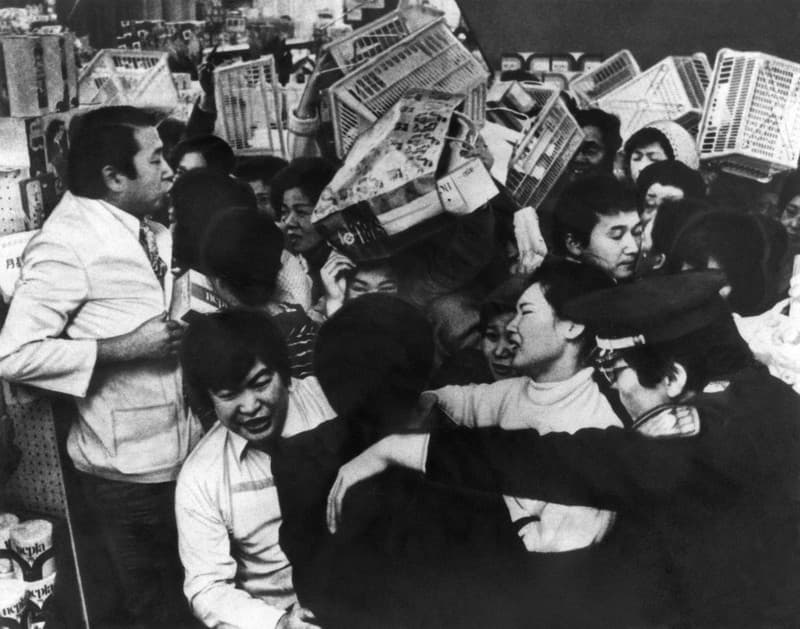
Current fears trace directly back to a national trauma that occurred half a century ago. During the first oil shock of 1973, a simple government advisory triggered one of Japan’s most memorable consumer panics. Yasuhiro Nakasone, then Minister of International Trade and Industry, announced that citizens should conserve paper products amid rising oil prices and supply concerns. This message aimed at conservation morphed rapidly through word-of-mouth into rumors that “paper will run out,” causing citizens to line up outside supermarkets nationwide.
The incident, sometimes called the “durumari toilet paper disturbance,” demonstrated how quickly rational behavior can collapse when fear takes hold. Historical accounts describe frantic crowds buying rolls by the cartload, creating exactly the shortage they feared despite manufacturers maintaining normal production levels. The 1973 panic became a case study in behavioral economics, illustrating how information spreads through social networks before fact-checking can occur. The episode left a permanent mark on Japanese consumer psychology, with the memory passed down through generations who did not even experience the original event firsthand.
“The mentality linking oil shocks to toilet paper still hasn’t changed,” observed one commentator on Japanese online forums, highlighting how deeply the 1973 trauma remains embedded in the national psyche.
Similar patterns emerged in the United States during the same period. In late 1973, Congressman Harold V. Froelich of Wisconsin issued a press warning about potential government paper shortages, which comedian Johnny Carson subsequently joked about on his television program. The combination of official concern and media amplification caused millions of Americans to hoard toilet paper for four months, creating artificial scarcity that persisted until February 1974. Like the Japanese experience, the American panic revealed that consumer behavior itself, rather than supply constraints, often creates shortages.
Supply Chain Reality Check
Modern Japan’s toilet paper supply chain bears little resemblance to the import-dependent vulnerabilities of 1973. According to Morio Ishizuka, executive managing director of the Japan Household Paper Industry Association, approximately 60% of raw materials come from domestically recycled paper, specifically collected printed materials and waste paper. The remaining 40% consists of pulp imported from North America, South America, and Southeast Asia.
Crucially, none of the raw materials originate from the Middle East. While petroleum-based chemicals serve as additives in the manufacturing process, industry representatives emphasize that the impact of deteriorating Middle East conditions on toilet paper production remains extremely limited. Distribution networks report no shortages at retail sites, and manufacturers maintain sufficient inventory to meet normal demand.
The technical details reveal why oil price shocks do not directly threaten paper supplies. Pulp production relies primarily on timber resources from stable regions, while the recycling infrastructure operates domestically. Even the shipping containers used for pulp transport rarely pass through the Strait of Hormuz, instead crossing the Pacific or traveling from nearby Asian sources. The industry has effectively insulated itself from Middle East oil dependency through decades of strategic sourcing.
Global Oil Crisis Context
While toilet paper supplies remain secure, the underlying oil crisis presents genuine economic challenges. The International Energy Agency identified the current Strait of Hormuz closure as triggering the largest disruption to global oil markets in history, with supply expected to fall by approximately 8 million barrels per day, representing roughly 8% of global consumption. This dwarfs the 1973 Arab oil embargo, which removed about 4.5 million barrels daily and caused prices to quadruple.
Japan relies on Gulf countries for more than 90% of its crude oil needs, making it particularly exposed to the shipping route closure. In response, Prime Minister Takaichi Sanae announced the release of approximately 80 million barrels from strategic reserves, representing about 45 days of consumption. These reserves, established specifically following the 1973 trauma, currently total enough supply for an estimated eight months of normal operations.
The 1973 embargo originally spurred Japan to create extensive oil stockpiles and pursue energy diversification. The current release marks the largest drawdown in history and the first coordinated international response since Russia’s invasion of Ukraine in 2022. The United States committed to releasing 172 million barrels over four months, while the International Energy Agency authorized a collective 400 million barrel release from member nations’ emergency reserves.
“One of the lessons from the 1970s, of course, is everybody needs to have emergency stockpiles for exactly the kind of crisis we have today,” noted Pavel Molchanov, an analyst at Raymond James.
Recurring Patterns of Consumer Panic
Toilet paper hoarding has become a predictable reflex in Japan during periods of social stress. The 2011 Great East Japan Earthquake and tsunami, including the massive earthquake and tsunami that devastated coastal communities in Tohoku, triggered similar buying sprees, as did the initial outbreak of COVID-19 in February 2020. During the pandemic, social media posts warning of supply disruptions caused shelves to empty within hours, despite manufacturers maintaining normal production schedules.
Analysts consistently identify the same mechanism behind each shortage: excessive buying driven by anxiety creates temporary distribution bottlenecks that validate the original fears. During the 2020 shortages, the Japanese government resorted to publishing photographs of warehouses stacked high with toilet paper to demonstrate that supplies existed but simply required time to reach stores. The images aimed to break the psychological cycle of hoarding by proving abundance.
The phenomenon extends beyond Japan. In 2020, Venezuela’s government occupied a toilet paper factory after panic buying induced shortages. The familiar pattern of rumor, hoarding, and subsequent scarcity appears across cultures whenever populations perceive threats to daily necessities. In each case, social media platforms accelerated the spread of anxiety far faster than traditional news cycles could moderate them, creating feedback loops of fear. Marketing professor Steuart Britt once described the mechanism as the “did-you-hear-that syndrome,” where the desire to be first with information overrides critical evaluation of its validity.
Industry experts emphasize that modern supply chains can accommodate normal consumption fluctuations but buckle under the strain of simultaneous mass purchasing. When thousands of consumers buy six months of supplies in a single week, the delivery systems optimized for efficiency cannot physically restock shelves quickly enough, creating visible emptiness that fuels further panic even when warehouses remain full.
Regional Impact and Government Responses
Across Asia, governments are implementing increasingly stringent measures to manage the oil shock. South Korea introduced oil price caps for domestic fuels for the first time in three decades. The Philippines implemented a four-day workweek for government employees to reduce energy consumption, while Vietnam and Thailand imposed work-from-home policies. India faces acute cooking gas shortages that have forced restaurants to close entirely, despite the country increasing domestic LPG production by 25% through emergency measures. Bangladesh and Myanmar have instituted fuel rationing systems to manage dwindling supplies.
Japan’s position remains comparatively stable due to its extensive reserve system, though concerns persist about prolonged conflict extending beyond current stockpiles. Parliamentarian Suzuki Muneo suggested diversifying energy sources toward Russian supplies from Vladivostok, which could reach Japan within half a day compared to longer Middle East shipping routes. Japan maintains strategic investments in Russian Sakhalin oil and gas projects, viewing them as essential for energy security despite international sanctions imposed after the 2022 invasion of Ukraine.
The contrast between genuine oil shortages and phantom paper shortages highlights how different commodities face varying vulnerabilities. While oil flows through a single chokepoint vulnerable to military action, toilet paper benefits from distributed sourcing and domestic recycling. The Japanese government has focused its communications on distinguishing between real energy constraints that require conservation measures and unfounded consumer goods fears that only require calm behavior.
The Bottom Line
- The Japan Household Paper Industry Association confirmed no shortages exist in raw materials, manufacturing, or distribution for toilet paper supplies
- Approximately 60% of Japanese toilet paper uses domestically recycled materials, with remaining pulp sourced from the Americas and Southeast Asia rather than the Middle East
- Current fears stem from social media posts linking the Strait of Hormuz oil disruption to memories of the 1973 oil shock toilet paper panic
- The International Energy Agency identified the current Middle East conflict as causing the largest oil supply disruption in history, with 8 million barrels per day removed from markets
- Japan maintains strategic oil reserves totaling approximately eight months of consumption and has begun releasing 80 million barrels to stabilize markets
- Historical patterns from 1973, 2011, and 2020 demonstrate that hoarding behavior itself creates temporary shortages regardless of actual production capacity
- Industry officials urge consumers to purchase only normal amounts, emphasizing that unnecessary stockpiling remains the primary risk to shelf availability