A Rare Spectacle Unfolds on Thailand Eastern Coast
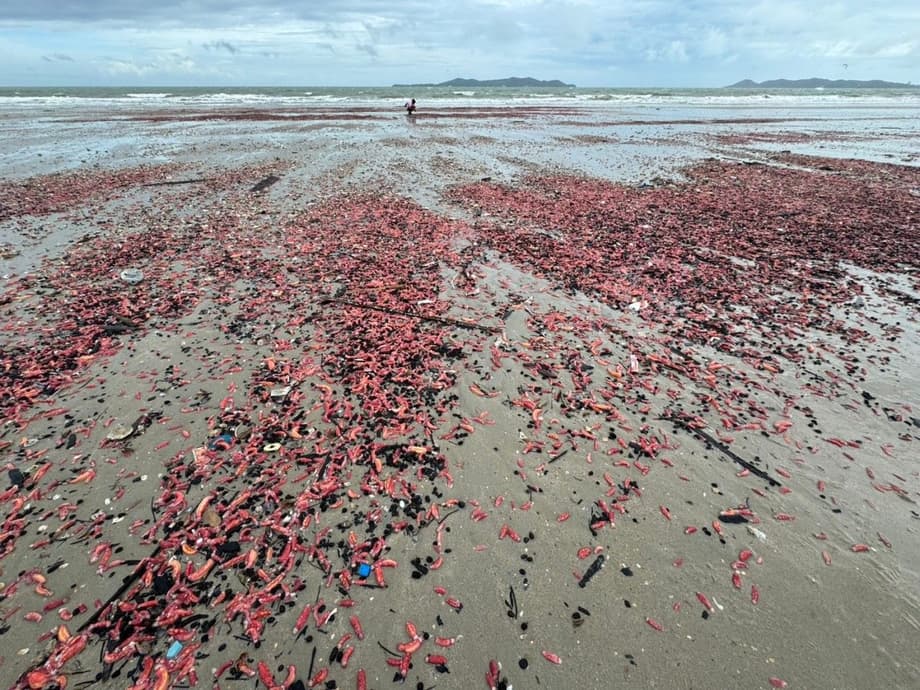
Beachgoers at Suan Son Beach in Rayong province received a startling surprise on the morning of June 6, 2026, when they discovered that hundreds of meters of shoreline had transformed into a vivid carpet of pink and reddish orange. The sand itself appeared to change color, creating an otherworldly landscape that drew crowds of tourists and sparked immediate concern among local residents. Upon closer inspection, visitors realized the stunning hue came not from pollution or paint, but from millions of living marine animals that had been driven ashore by powerful overnight storms.
The extraordinary event took place at Suan Son Beach in Phe subdistrict, located within Mueang Rayong district along the eastern seaboard of Thailand. Tourists first reported the unusual sight around 10:00 AM, describing how the normally golden sand had become completely submerged beneath a dense layer of small, cylindrical creatures. Within hours, photographs and videos of the temporary pink beach began circulating across social media platforms, attracting both scientific curiosity and widespread public fascination. Local authorities moved quickly to investigate the phenomenon, sending marine biologists and coastal resource officers to examine the scene and determine whether the event signaled an environmental threat or merely represented one of the rare displays of nature.
What Are Pink Sea Cucumbers
Marine officials identified the stranded organisms as Cercodemas anceps, commonly referred to as the pink sea cucumber, pink warty sea cucumber, or pink spiny sea cucumber. These animals belong to a larger class of marine invertebrates known as Holothuroidea, which encompasses approximately 1,700 species worldwide. Despite their vegetable-inspired name, sea cucumbers are animals, not plants, and they play critical roles in maintaining healthy ocean environments.
The pink sea cucumber possesses a soft, elongated body that typically resembles a cucumber or sausage in shape, usually measuring several centimeters in length. Its skin features numerous small bumps or spines that give it a textured appearance, while its coloration ranges from bright bubblegum pink to dark reddish orange. These creatures are benthic organisms, meaning they live on or just beneath the seabed, where they burrow through sandy or muddy substrates in search of food. Unlike fish or dolphins, sea cucumbers move slowly across the ocean floor using tiny tube feet, making them particularly vulnerable to strong underwater disturbances.
Cercodemas anceps is found throughout coastal waters in the Indo-Pacific region, including the Gulf of Thailand. The species prefers relatively shallow marine environments where it can efficiently process organic material accumulating on the seafloor. While individual sea cucumbers occasionally wash ashore during severe weather, marine experts emphasized that seeing millions of these creatures stranded simultaneously represents an exceptionally unusual occurrence for Rayong province. Local officials noted they had never documented this particular species appearing in such massive numbers along this stretch of coastline.
How Storms Drove the Creatures Ashore
Preliminary investigations by the Thailand Department of Marine and Coastal Resources pointed to a straightforward natural cause: intense monsoon activity combined with rough seas and powerful wave action. During the days leading up to June 6, the region experienced unsettled weather patterns characterized by strong winds and heavy swells that disrupted normal marine conditions along the eastern Gulf of Thailand.
Thanet Mannoi, director of the Marine and Coastal Resources Regional Office 1, explained the physical mechanisms behind the mass stranding. Severe surface winds generated powerful waves that penetrated to the seabed, stirring up sediment and creating strong underwater currents. These hydrological forces essentially scooped the slow moving sea cucumbers from their muddy habitats and carried them toward shore. Tidal movements then pushed the massive aggregation onto the beach, where they became stranded as the water receded.
This type of event, while dramatic, follows recognizable patterns. Marine animals including shellfish, crabs, and various seabed species frequently wash ashore during monsoon periods or rough sea conditions throughout Southeast Asia. However, officials stressed that the sheer volume of pink sea cucumbers involved in this particular incident made it extraordinarily rare. The confluence of specific wind directions, wave intensity, and tidal timing apparently concentrated the animals in a narrow coastal zone, amplifying the visual impact.
Officials noted that authorities found no evidence suggesting pollution, chemical contamination, or harmful algal blooms contributed to the stranding. An official statement from the Department of Marine and Coastal Resources reassured the public that continuous monitoring had revealed no abnormal factors affecting the broader marine ecosystem. The sea cucumbers discovered on the beach were reportedly still alive, and marine biologists expected many would return to the ocean naturally as high tides rose in subsequent days.
The Housekeepers of the Sea
Beyond the spectacle itself, the mass appearance of pink sea cucumbers highlighted the vital ecological functions these humble creatures perform in marine environments. Scientists frequently describe sea cucumbers as the housekeepers of the sea because of their unique feeding habits and contributions to nutrient cycling.
These invertebrates consume decaying organic matter, dead microorganisms, and other debris that accumulates on sandy seabeds. As they process this material through their digestive systems, they break down complex organic compounds and excrete cleaner, oxygenated sand. This biological filtration recycles valuable nutrients back into the water column, supporting the growth of phytoplankton and providing sustenance for other marine organisms. The process also helps prevent the buildup of toxic hydrogen sulfide in sediments, creating healthier habitats for fish, crabs, and coral reef communities.
Research published in marine ecology journals has demonstrated that sea cucumber populations directly influence the chemical and physical structure of seafloor sediments. In areas where these animals thrive, the seabed remains more porous and aerated, which benefits burrowing species and promotes stable benthic communities. The presence of Cercodemas anceps and similar species thus serves as an indicator of general marine ecosystem health. Their sudden displacement from the seabed, while visually striking, temporarily removed thousands of tiny nutrient processors from their usual work stations beneath the waves.
Government Response and Public Safety Guidance
The scale of the event prompted an immediate response from the Thailand Ministry of Natural Resources and Environment. Minister Suchart Chomklin personally ordered the Department of Marine and Coastal Resources to conduct an urgent investigation and verify the facts surrounding the unusual beachfront phenomenon. He specifically instructed department Director-General Dr. Pinsak Suraswadi to dispatch specialized teams to Suan Son Beach immediately to assess possible environmental impacts and provide the public with accurate scientific information rather than speculation.
Thanet Mannoi led a joint survey team comprising conservation officers, marine biologists, and local Rayong marine resource officials. The group conducted detailed on-site assessments, carefully identified the species using biological classification methods, and collected comprehensive data to determine whether the stranding posed any long-term risks to regional biodiversity or indicated broader oceanographic changes. Following their preliminary evaluation, officials emphasized that the phenomenon did not threaten the marine ecosystem and should be understood as a rare natural occurrence driven entirely by seasonal weather patterns and mechanical wave action.
Despite the reassuring scientific assessment, authorities issued specific safety warnings for tourists and local residents. The Department of Marine and Coastal Resources advised the public to avoid direct physical contact with the stranded sea cucumbers. While most species pose no danger to humans, certain sea cucumbers release defensive chemical secretions when stressed or disturbed. These substances can cause skin irritation, rashes, or allergic reactions, particularly in individuals with sensitive skin. A department official offered the following reassurance:
The situation is currently being monitored and assessed continuously. So far, no information has been found indicating abnormal pollution or other factors affecting the marine ecosystem.
Officials encouraged beachgoers who observe large numbers of stranded marine animals or notice other coastal abnormalities to contact the Forest and Marine Protection Hotline at 1362 or notify local authorities. This collaborative approach to surveillance helps scientists track changes in marine ecosystems and respond quickly to potential environmental concerns.
Public Fascination and Global Attention
The pink sea cucumber invasion transformed Suan Son Beach into an impromptu tourist attraction, drawing visitors who wanted to witness the rare natural phenomenon firsthand. Rather than panic, the prevailing public reaction leaned toward curiosity and wonder. Many tourists pulled out smartphones to capture images of the pink coated shoreline, sharing them across platforms where the story quickly gained traction beyond the borders of Thailand.
International media outlets soon picked up the story, reflecting global interest in unusual marine events and the biodiversity of coastal waters in Southeast Asia. The incident provided an unexpected opportunity for environmental education, as officials and marine biologists explained the ecological significance of sea cucumbers to audiences who might otherwise never consider these obscure bottom dwellers. For many visitors, the event offered a tangible connection to ocean ecosystems and a reminder of how weather systems above the waves can dramatically reshape life below them.
The spectacle also underscored the growing relationship between environmental phenomena and social media documentation. Within hours of the first sightings, images of the Rayong pink beach had reached audiences worldwide, demonstrating how quickly localized natural events can capture global attention. This visibility carries both benefits and responsibilities: while it raises awareness about marine biodiversity, it also increases pressure on local ecosystems as crowds gather to observe and photograph delicate wildlife.
Ongoing Monitoring and Scientific Study
State agencies have committed to continued surveillance of the Suan Son Beach area and the broader Rayong coastal environment. Marine officials plan to collect additional data to study the precise causes of the stranding and evaluate any potential delayed impacts on local sea cucumber populations or seabed ecology. This longitudinal approach helps scientists understand whether such events might become more frequent as regional weather patterns shift.
The mass wash-up also prompted discussions about coastal preparedness and the need for rapid response protocols when unusual marine events occur. By establishing clear communication channels between tourists, local communities, and scientific institutions, authorities hope to gather better information about strandings in real time while minimizing human interference with stranded wildlife.
For the marine ecosystem itself, the event likely represents a temporary disruption rather than a catastrophe. Because the stranded animals remained alive and capable of returning to the ocean, the overall impact on the local Cercodemas anceps population may prove minimal. Nevertheless, the incident serves as a valuable case study for marine biologists examining the relationship between extreme weather events and benthic invertebrate communities in the Gulf of Thailand.
Key Points
- Millions of pink sea cucumbers (Cercodemas anceps) washed ashore at Suan Son Beach in Rayong, Thailand, on June 6, 2026, turning hundreds of meters of shoreline pink.
- Officials attributed the rare natural phenomenon to strong monsoon winds, rough seas, and powerful wave action that dislodged the creatures from the seabed.
- The Thailand Ministry of Natural Resources and Environment ordered an immediate investigation, which found no evidence of pollution or harmful environmental factors.
- Sea cucumbers serve as housekeepers of the sea by breaking down organic matter and maintaining healthy seabed ecosystems.
- Tourists were advised to avoid touching the animals, as some species release defensive substances that can irritate sensitive skin.
- Officials confirmed the sea cucumbers were alive and expected many to return to the ocean naturally with rising tides.