A Silent Tally Revealed: Pyongyang’s New Memorial
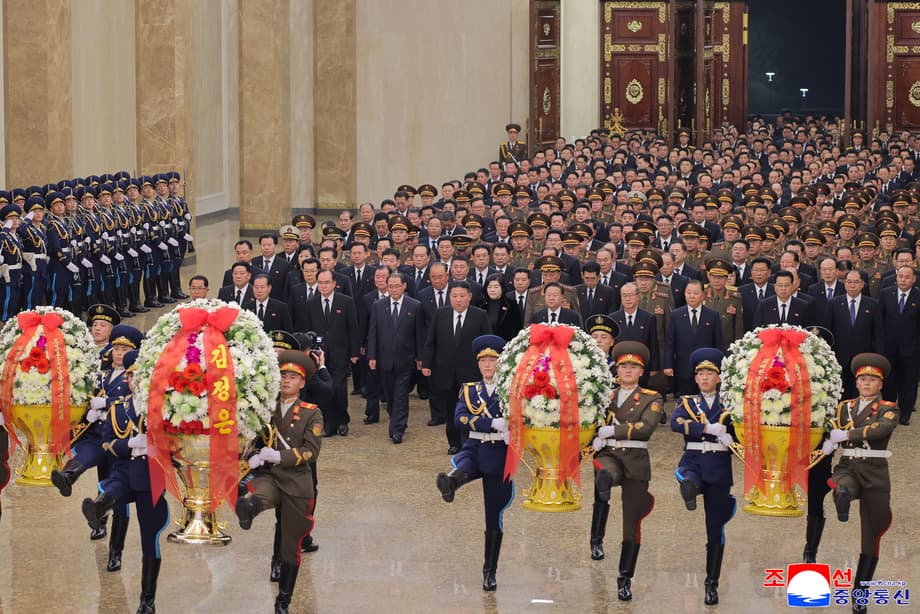
On April 26, 2026, North Korean leader Kim Jong Un unveiled a sprawling war memorial in Pyongyang’s Hwasong district that offers the first concrete evidence of the human cost of his military alliance with Russia. The Memorial Museum of Combat Feats at Overseas Military Operations, constructed over six months in a heavily forested area covering 52,000 square meters, contains two 30-meter memorial walls engraved with thousands of names. A BBC analysis of satellite imagery and official photographs suggests these walls contain approximately 2,304 names, providing the strongest indication yet that roughly 2,300 North Korean soldiers have died fighting alongside Russian forces in Ukraine.
The calculation derives from the architecture of the monument itself. Each wall is divided into roughly 14 sections, with nine sections bearing names arranged in 16 columns. Close-up photographs reveal eight names inscribed in each column, totaling approximately 1,152 names per wall. Songhak Chung, a senior researcher at the Korea Institute for Security Strategy, confirmed this assessment, noting that the walls are packed with names written in extremely small characters. The exact figure remains difficult to verify due to image resolution limitations, but the estimate aligns closely with earlier intelligence from South Korea’s National Intelligence Service, which reported in September 2025 that about 2,000 North Korean soldiers had been killed and another 2,700 wounded.
The Kursk Deployment: How North Korea Entered the War
The memorial honors troops who died during operations to recapture Russia’s Kursk region, where Ukrainian forces launched a surprise incursion in August 2024. Following this breach of Russian territory, Moscow turned to Pyongyang for military assistance. Between October 2024 and mid-2025, North Korea dispatched an estimated 11,000 to 15,000 troops to the western Kursk region, marking the country’s largest foreign military deployment since the Korean War ended in 1953.
South Korean intelligence agencies tracked the deployment closely, estimating that Pyongyang sent conventional weapons alongside infantry units. The soldiers faced immediate challenges adapting to modern warfare. Military experts note that North Korean troops initially suffered heavy casualties due to their lack of combat experience and unfamiliarity with the terrain, making them particularly vulnerable to Ukrainian drone strikes and artillery fire. Despite these early losses, Ukrainian military assessments indicate that the North Korean forces gained crucial battlefield experience over time and became central to Russia’s efforts to overwhelm Ukrainian positions through mass infantry tactics.
Decoding the Monument: Architecture of Remembrance
The memorial complex employs what Korean research company SI Analytics describes as a tiered system of commemoration. While the walls bear thousands of names, the physical gravesite contains only approximately 280 marked graves, divided evenly between the west and east sides of the cemetery. According to Kim Jin-mu, a former senior research fellow at the Korea Institute for Defense Analyses, those interred in the graveyard likely represent recovered bodies, senior officers, or individuals granted special recognition for acts of self-sacrifice.
The majority of fallen soldiers appear to be commemorated within a three-story columbarium situated in the cemetery’s center. Songhak Chung explains that the building’s walls contain grid-patterned storage compartments designed to house funeral urns. Even excluding office and exhibition spaces, the indoor repository could accommodate at least 1,000 sets of remains. This architectural distinction suggests a hierarchy of honor, with outdoor burial reserved for those who demonstrated what state media calls extraordinary valour, while others are remembered through urns inside the memorial building.
A Blood Alliance: Diplomacy and Rewards
The opening ceremony drew high-ranking Russian officials including State Duma Chairman Vyacheslav Volodin and Defense Minister Andrei Belousov, underscoring the deepening military partnership between the two isolated nations. Volodin publicly thanked Kim Jong Un for sending troops to liberate Kursk, stating that Korean soldiers fought shoulder to shoulder with Russian forces to liberate Russian soil from Ukrainian Nazis. Russian President Vladimir Putin addressed a letter to Kim, describing the memorial as a distinct symbol of the friendship and unity between the peoples of our two countries.
A new history of friendship between Korea and Russia written in blood.
Kim Jong Un, in his speech at the ceremony, hailed the fallen troops as symbols of Korean heroism who thwarted the United States and the West’s hegemonic ambitions and military adventurism. The lavish commemoration serves multiple purposes for Pyongyang. Analysts believe North Korea received substantial compensation for its military support, including food shipments, hard currency, and technical assistance with satellite and missile programs. This soldiers-for-sustenance deal provides a vital economic lifeline for a country facing the most stringent international sanctions in history.
The relationship was formalized in 2024 when Putin and Kim signed a Comprehensive Strategic Partnership Treaty containing a mutual defense provision. During the April ceremonies, Belousov announced plans to sign a military cooperation agreement covering 2027 through 2031, indicating that the alliance extends well beyond the immediate Ukraine conflict.
Counting the Dead: Discrepancies in Casualty Reports
While the memorial walls suggest approximately 2,300 deaths, South Korea’s intelligence estimates present a more complex picture. In February 2026, the National Intelligence Service updated its assessment, stating that roughly 6,000 of the estimated 11,000 deployed personnel had been killed or wounded, without providing a specific breakdown between the two categories. This figure significantly exceeds the number of names visible on the memorial walls.
Several factors may explain this discrepancy. Naoko Aoki, a political scientist with the RAND think tank, suggests that North Korea’s songbun system, a social classification structure based on family loyalty to the regime, may determine which soldiers receive public memorialization. Those honored with graves and wall inscriptions likely come from the most reliable social classes, while others may be omitted from public record to prevent domestic unrest or simply because their remains were never recovered from the battlefield.
North Korea has a social classification system called songbun, which categorizes people into groups based on their forbears’ loyalty to the regime. This determines one’s access to everything from food, education, and work. I think we can assume that those who are memorialized are from a class that the regime considers reliable.
Additionally, South Korean officials note that it remains difficult to confirm whether all fatalities have been inscribed on the walls. The Ministry of Unification has expressed caution about accepting the memorial count as complete. However, researcher Kim Jin-mu argues that Pyongyang likely inscribed all names to maintain public support among bereaved families, suggesting the memorial represents a complete record while the higher intelligence figures may include wounded or missing personnel not yet confirmed deceased.
The Future of Military Cooperation
The April 2026 ceremonies signal that Pyongyang intends to sustain its military commitment to Moscow regardless of how the Ukraine conflict unfolds. Lim Eul-chul, a professor at the Institute for Far Eastern Studies at Kyungnam University, interprets the proposed five-year cooperation plan as preparation for a post-war period, suggesting the relationship is evolving into an institutional alliance that will persist beyond the current conflict.
This long-term alignment raises significant concerns among Western and Asian allies. Officials in Seoul, Washington, and Tokyo fear that Russia may transfer advanced military technology to North Korea, potentially accelerating Pyongyang’s nuclear and missile programs. The presence of approximately 11,000 North Korean soldiers remaining in Russia as of early 2026, according to Ukrainian President Volodymyr Zelenskyy, indicates that the deployment continues despite the heavy losses.
Only two North Korean soldiers have been captured alive by Ukrainian forces, both of whom reportedly expressed desire to defect to South Korea. North Korean military doctrine allegedly instructs troops to kill themselves rather than face capture, reflecting the regime’s intense control mechanisms even on foreign battlefields.
Key Points
- North Korea unveiled a memorial museum in Pyongyang on April 26, 2026, honoring soldiers killed fighting for Russia in Ukraine.
- Analysis of the memorial walls suggests approximately 2,300 North Korean soldiers died in the Kursk region operations.
- South Korea estimates 11,000 to 15,000 North Korean troops were deployed to Russia starting in October 2024.
- The memorial features a tiered commemoration system with approximately 280 outdoor graves and a columbarium capable of holding over 1,000 urns.
- Russian Defense Minister Andrei Belousov announced plans for a five-year military cooperation agreement covering 2027 through 2031.
- South Korean intelligence estimates total casualties at approximately 6,000 killed or wounded, though this figure includes both confirmed deaths and injuries.
- North Korea reportedly received food, financial aid, and technical assistance in exchange for providing troops and weapons to Russia.