A Decade of Documentation Culminates in English Debut
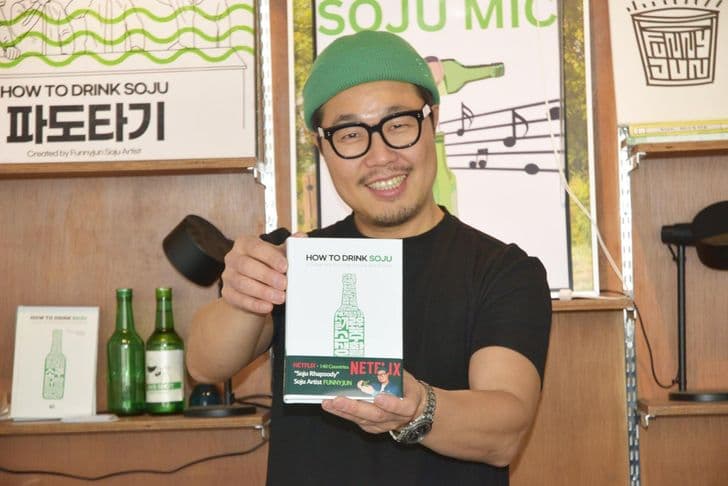
Kim Wan-jun has spent over ten years observing the green bottles that populate nearly every Korean dining table. At 52 years old, this former public relations executive and recycling artist has transformed his fascination with soju into a cultural mission. Operating under the moniker Funnyjun, he recently released the English translation of his illustrated guide, “How to Drink Soju: A Guide to K-Drinking Culture & Games,” following the success of the original Korean edition that sold out rapidly upon its 2021 publication.
The 300-page volume features more than 200 hand-drawn illustrations and represents a singular artistic vision. Kim personally wrote the text, created the artwork, designed the layout, and handled digital editing to produce what he describes as a comprehensive bridge between Korean social traditions and global audiences. The first English print run consists of 1,000 copies currently available at Korean bookstores and through direct distribution from the author, with plans for broader Amazon distribution in the coming months.
Funnyjun’s professional trajectory informs his current work. He graduated from Sungkyunkwan University in Seoul and earned a master’s degree in journalism and mass communication from the same institution. From 1997 to 2003, he worked as an editor for a Dong-A Ilbo fashion magazine and as a TV producer at MBC’s entertainment department, later continuing as a journalist at IT magazine Webcasting. Between 2004 and 2014, he managed public relations at Sungkyunkwan University and Korea National Open University, followed by a stint as executive director of PR at marketing company Hahm Partners from 2015 to 2023. During this period, he authored “The Laws of University Public Relations” and delivered lectures focused on public institutions. Now running Proudcomm, a public relations company in Seoul, he uses his corporate work to finance his artistic endeavors.
The Ten Steps of Consideration
At the heart of Funnyjun’s work lies a simple yet profound observation: drinking soju in Korea involves a choreography of respect that outsiders often miss. His book breaks down the process into ten distinct steps, from taking one’s seat to the final placement of the empty glass. These steps include grabbing and opening the bottle, offering and pouring drinks, holding and receiving glasses, clinking, drinking, and setting the glass down.
Each step carries unspoken meaning. When pouring, the bottle holder must cover the label with their hand, preventing the receiver from noticing the brand or quality, ensuring conversation remains uninfluenced by price or prestige. Using two hands while pouring or receiving signals respect, particularly when interacting with elders. During toasts, younger drinkers must position their glass rims lower than those of senior companions, a physical manifestation of hierarchy and deference. When clinking glasses, the positioning indicates social standing, creating a visible map of relationships at the table.
Funnyjun explains that these gestures form a “process of joyful consideration practiced through mutual respect, so that everyone can enjoy the final glass together.” The etiquette extends naturally into broader Korean table manners and daily social behavior, making soju consumption a microcosm of interpersonal relationships. He emphasizes that understanding these rituals provides insight into Korean social philosophy, where shared drinking serves as a mechanism for building friendship, business relationships, and even diplomatic connections.
Soju as Cultural Mirror
Beyond mere mechanics, Funnyjun presents soju as a social polygraph that reveals authentic character. The clear, affordable distilled spirit, often called the green bottle for its iconic packaging, creates an egalitarian environment where social barriers dissolve. Kim notes that soju attracts no prejudice because of its accessibility. It costs less than most alternatives and pairs universally with Korean cuisine, contributing umami to savory and spicy dishes in ways that wine or whisky cannot replicate.
This democratic nature makes soju a fixture in Korean cultural content. The drink appeared prominently in “Parasite,” where “A Glass of Soju” by Im Chang-jung featured on the soundtrack, and in “Squid Game,” where protagonist Gi-hun uses the beverage to emotionally disarm himself. Over 70 Korean songs bear soju in their titles, while more than 2,000 mention it in lyrics. Recent hits like “APT.” by Rose and Bruno Mars have renewed global attention on Korean drinking games often played with soju.
Kim Wan-jun, who operates under the name Funnyjun, explained the motivation behind his extensive documentation project.
“Soju is the most popular alcohol in Korea and one of the best-selling liquors in the world,” he said. “You can see it everywhere, at every restaurant, every pub, but surprisingly, there were no books about it.”
His research began around 2014 when frequent consumption sparked curiosity about deeper cultural meanings, leading to seven years of documentation before the original Korean publication.
Global Exhibitions and the Netflix Effect
Funnyjun’s promotional strategy has emphasized visual storytelling through international exhibitions. Beginning in 2021, he has mounted more than 20 shows across Korea, Japan, Europe, and Southeast Asia. His 2022 debut outside Korea in Bangkok, Thailand, was followed by exhibitions in Vientiane, Laos, and Hanoi, Vietnam, in 2023. In Hanoi, he became the first foreign artist to hold a solo exhibition at Complex01, a 4,000-square-meter cultural space renovated from a 1960s factory in the Dong Da district.
Phuc Tran, CEO of Complex01, explained the venue’s decision to host the exhibition.
“Complex01 is a cultural space regenerated from an abandoned factory with the slogan ‘Time Connect’,” he said. “Through this work by Funnyjun about K-culture, I thought it represented another connection through time and space and decided to permit this exhibition.”
These exhibitions feature large-scale poster mosaics illustrating the ten steps of soju etiquette and popular drinking games like “APT.” and “Wi-Fi,” a game where participants make toasting gestures at varying distances to mimic signal strength. Visitors from diverse backgrounds engage with the artwork as both educational material and photo opportunities.
Swedish tourists Anton and Elisa, who were enjoying work and vacation simultaneously at the Hanoi exhibition, commented on the cultural exchange.
“Interest in Korea has increased tremendously in Sweden due to ‘Squid Game’,” they said. “The pictures and contents are really interesting and we would buy a book right away if a book came out in English.”
The artist’s reach expanded significantly following his appearance in “Soju Rhapsody,” a KBS documentary that premiered on Netflix in early 2025. The streaming platform acquired the program for ten years of distribution across 140 countries. During the show, Funnyjun unveiled “soighball,” his creation mixing soju with highball, while wearing an all-green outfit complete with a beanie resembling a soju cap. Since the Netflix appearance, he has begun receiving direct exhibition invitations rather than personally seeking venues, transforming years of effort into a rewarding experience.
Contrasting Receptions at Home and Abroad
The response to Funnyjun’s work reveals a fascinating cultural divide. Korean audiences often hesitate to embrace the book, viewing the described customs as simply everyday behavior rather than something requiring documentation. Foreign readers, however, have responded with enthusiasm, eager to decode social situations they previously found confusing.
Funnyjun observed this difference in audience reactions.
“Koreans know how to do these things, but they often don’t know why they do them,” he said. “Foreign readers responded eagerly. Many said the book answered questions they had long wondered about but felt hesitant to ask.”
This dichotomy highlights how cultural immersion often renders invisible the very customs that outsiders find most intriguing. Specifically, international visitors expressed surprise at rules prohibiting drinking directly from the bottle, a practice sometimes seen among tourists in Seoul’s Itaewon or Hongdae districts. Funnyjun draws parallels to Western spirits, suggesting that Koreans swigging directly from whisky bottles would appear alcoholic to Western observers. His guide aims to help non-Koreans drink more responsibly while appreciating the cultural context. The etiquette essentially functions as a social lubricant that maintains dignity while facilitating connection.
Kim has collaborated with major corporations to expand his reach. Among his fifteen Seoul exhibitions were partnerships with cosmetic company Able C&C’s flagship brand Missha at Missha Island in Myeongdong, and with Lotte Chilsung, one of Korea’s largest soju producers, for a pop-up store introduction. These collaborations demonstrate the commercial interest in promoting authentic Korean cultural practices.
Launch Events and Linguistic Expansion
The English edition release celebration took place at Hanstyle Studio in Seoul’s Itaewon neighborhood, featuring an immersive K-drinking session accompanied by art, music, and soju tastings. The March event included a book talk by Funnyjun at 5 p.m. and live performances by musicians Xen Sapphire, the Lavelies, Rob Nichols, and Jazzphai. Concurrently, the artist displayed work in collaboration with HBC Art Club in an exhibition running from March 19 to April 11.
Looking forward, Funnyjun has assembled a team of volunteers from various countries to translate the book into Japanese, Chinese, German, French, Thai, and Vietnamese. The translation team for the current English edition included Jean-Pierre Polonovski, You Yeji, and Evan Barringer, who reviewed the text for accuracy and cultural nuance. Kim intends to make future editions available on Amazon to reach broader international markets.
Funnyjun elaborated on the deeper significance of his project.
“What feels completely normal to Koreans may appear unfamiliar to foreigners: how to pour, how to receive a drink, how to subtly check whether someone’s drink is empty,” he said. “These small actions reflect a deeper philosophy behind Korean social life. This is why understanding K-drinking culture is essential for understanding Korea.”
With his catchy motto “A Glass of Soju, Bridging the World,” Kim continues to promote the book independently while planning additional exhibitions in the United States, United Kingdom, and Japan. His work demonstrates how everyday rituals can become powerful tools for cross-cultural communication, one green bottle at a time. Whether through the pages of his illustrated guide or the immersive atmosphere of his exhibitions, Funnyjun ensures that the next time someone raises a glass of soju, they will understand that they are participating in centuries of social tradition.
The Essentials
- Kim Wan-jun, known as Funnyjun, published the English edition of “How to Drink Soju: A Guide to K-Drinking Culture & Games” following the 2021 Korean release
- The 300-page illustrated guide documents ten specific steps of soju etiquette, emphasizing respect and consideration in social drinking
- Key customs include using two hands when pouring, covering bottle labels, positioning glasses lower for elders, and avoiding drinking directly from bottles
- Soju serves as a cultural polygraph in Korean society, revealing character through adherence to social rituals while maintaining egalitarian accessibility
- Funnyjun has held over 20 international exhibitions across Thailand, Laos, Vietnam, and other countries to promote Korean drinking culture
- The artist appeared in Netflix’s “Soju Rhapsody,” a KBS documentary now streaming in 140 countries for the next decade
- Future translations are planned for Japanese, Chinese, German, French, Thai, and Vietnamese to further globalize understanding of Korean social customs