Taiwan Sounds Alarm Over Beijing’s New Legal Weapon
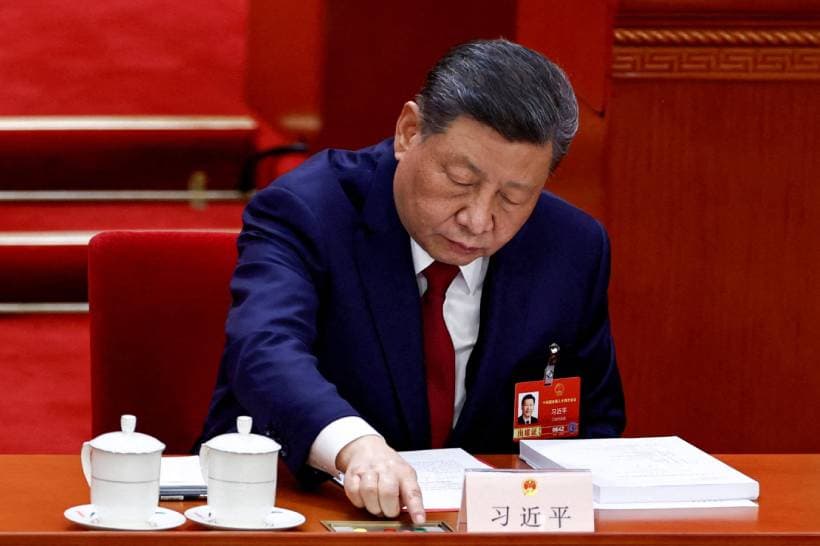
Officials in Taipei have issued stark warnings that a newly enacted Chinese law promoting “ethnic unity” may serve as Beijing’s latest instrument to target Taiwanese citizens, potentially criminalizing support for the island’s distinct identity and democratic governance. The legislation, approved by China’s National People’s Congress on March 12, 2026, ostensibly aims to forge a shared national consciousness among China’s 55 officially recognized ethnic minority groups, but contained within its 62 articles are provisions that extend far beyond China’s borders.
Shen Yu-chung, deputy minister at Taiwan’s Mainland Affairs Council, told reporters that language within the law referencing the protection of national sovereignty creates dangerous ambiguity. “How exactly one is supposed to promote unification or promote unity is left vague and hollow, but the punishments are concrete,” Shen explained. He warned that the legislation could “spill over into becoming a legal basis for handling cross-Strait issues,” effectively establishing a mechanism to prosecute Taiwanese independence supporters as threats to Chinese ethnic unity.
The law represents a significant evolution in Beijing’s approach to Taiwan. Previously, Chinese legislation primarily targeted explicit advocacy for Taiwanese independence. Under this new framework, however, individuals could face legal consequences not merely for supporting separation, but for failing to actively promote unification. As one senior Taiwanese official noted, speaking on condition of anonymity, “In the past, you’d be punished for supporting Taiwan independence. Now, you also have to actively support unification, or you’ll get into trouble as well.”
Mandating Assimilation Across Ethnic Lines
While Taipei’s concerns focus on cross-strait consequences, the law fundamentally restructures how China governs its diverse ethnic landscape. The legislation mandates that Mandarin Chinese serve as the primary language of instruction from preschool through the end of compulsory education, effectively relegating minority languages to secondary status. Article 15 requires that children “basically master” Mandarin by age 15, while official documents must display Mandarin more prominently than minority languages when both are used.
This linguistic imposition extends beyond education. The law requires parents and guardians to “educate and guide minors to love the Chinese Communist Party” and to “establish the concept that all ethnic groups of the Chinese nation are one family.” Children must be taught that they “shall not teach minors concepts detrimental to ethnic unity and progress.” These provisions transform family life into an instrument of state ideology, criminalizing the transmission of distinct cultural identities from one generation to the next.
Religious institutions face similar pressure to conform. The law directs religious groups, schools, and venues to conform to “the direction of the Sinicization of religion in China,” a policy that has already resulted in the demolition of mosques in Xinjiang and the installation of surveillance equipment in Tibetan monasteries. Marriage customs also fall under scrutiny, with the legislation banning interference with marriage choices based on ethnicity or religion, effectively promoting intermarriage as a tool of assimilation.
The End of Meaningful Autonomy
China’s constitution and the 1984 Law on Regional National Autonomy once guaranteed ethnic minorities the right to use and develop their own languages, along with limited self-governance. The new ethnic unity law effectively supersedes these protections, marking a definitive shift from what scholars term China’s “first-generation ethnic policy” to a “second-generation” framework that prioritizes assimilation over diversity.
James Leibold, a professor at Australia’s La Trobe University who has studied China’s ethnic policies for decades, described the new legislation as putting “a death nail in the party’s original promise of meaningful autonomy.” The law codifies policies that have already been implemented through administrative fiat in Tibet, Xinjiang, and Inner Mongolia, transforming ad-hoc repression into systematic legal doctrine.
In Tibet, this transition has manifested through the expansion of state-run boarding schools that separate approximately one million Tibetan children from their families and communities. These institutions operate primarily in Mandarin, restricting the use of Tibetan language even during daily activities. The traditional examination system that allowed ethnic minority students to take university entrance exams in their native languages has largely disappeared, forcing Tibetan students to compete in Mandarin or face severely limited educational opportunities.
Similar patterns emerged in Inner Mongolia in 2020, when authorities replaced Mongolian-language textbooks with Chinese versions, sparking mass protests that were met with immediate crackdowns. Students in the region now study Mongolian for merely one hour daily, treating their native tongue as a foreign language within their own homeland. The new law extends these restrictions nationwide, ensuring that no ethnic minority region maintains educational autonomy.
Extraterritorial Reach and Transnational Repression
Perhaps the most alarming provision for international observers appears in Article 61, which states that “organizations and individuals outside the territory of the People’s Republic of China” who “undermine ethnic unity and progress or incite ethnic separatism” will be pursued for “legal liability.” This clause mirrors the extraterritorial provisions of the 2020 Hong Kong National Security Law, under which authorities have issued bounties for 34 overseas activists accused of subversion.
Taiwanese officials have labeled this mechanism “long-arm jurisdiction,” noting that it provides legal cover for Beijing to target dissidents abroad, including the millions of Taiwanese citizens who travel internationally or maintain business relationships with mainland China. The law effectively criminalizes advocacy for Tibetan, Uyghur, or Taiwanese self-determination anywhere in the world, subjecting diaspora communities and foreign citizens to Chinese legal standards.
Human rights organizations have documented extensive transnational repression campaigns where Chinese security services harass students studying abroad and threaten family members remaining in China to enforce ideological compliance. In July 2025, authorities arrested a Chinese student for “inciting separatism” after speaking out for Tibetan rights while studying overseas. The new law formalizes these practices, providing prosecutors with explicit statutory authority to pursue cases against foreign residents.
Maya Wang, associate Asia director at Human Rights Watch, analyzed the legislation’s broader impact on expression.
The draft law on ethnic unity is a blatant effort by the Chinese government to control people’s thoughts and expression about China both inside and outside the country.
Wang noted that the legislation enables intensifying ideological controls and targets ethnic and religious minorities by erasing language rights previously guaranteed under Chinese law.
Strategic Consequences for Cross-Strait Relations
Beyond its immediate legal mechanisms, the ethnic unity law serves as a component of Beijing’s broader political warfare strategy against Taiwan. By framing the island’s 24 million residents as merely another ethnic group within the Chinese nation, the legislation attempts to delegitimize Taiwan’s distinct political identity and democratic institutions. This narrative framework supports ongoing disinformation campaigns, including the “Yimeilun” or U.S. skepticism narrative, which seeks to drive wedges between Taipei and Washington by questioning American reliability as an ally.
Financial analysts warn that the law could trigger new phases of economic coercion against Taiwan, potentially restricting cross-strait trade flows and regional supply chains under the guise of protecting ethnic unity. The legislation provides a legal basis for more systematic targeting of Taiwanese exports and investment flows, creating persistent volatility for companies with significant exposure to the Taiwan market.
The law also potentially lowers thresholds for military posturing in the Taiwan Strait. By establishing ethnic unity as a national security imperative with extraterritorial reach, the legislation creates political conditions less tolerant of ambiguity regarding Taiwan’s status. Military analysts suggest that the law’s passage signals victory for hardliners within Beijing’s leadership, potentially reducing internal constraints on aggressive military tactics.
Taiwan’s Foreign Minister Lin Chia-lung recently rebuffed claims by Chinese diplomats that Beijing upholds United Nations Charter principles, stating that China’s recent military provocations “once again expose a hegemonic mindset that does not match its words with its actions.” Lin emphasized that Taiwan’s sovereignty has never belonged to the People’s Republic of China, regardless of how Beijing frames ethnic unity.
What to Know
- China’s National People’s Congress passed the Law on Promoting Ethnic Unity and Progress on March 12, 2026, with 2,756 votes in favor, three against, and three abstentions.
- The law mandates Mandarin Chinese as the primary language of instruction from preschool through compulsory education, effectively marginalizing minority languages including Tibetan, Uyghur, and Mongolian.
- Taiwanese officials warn that provisions regarding “national unity” could be used to target Taiwanese independence supporters and impose legal obligations on Taiwanese citizens to support unification with China.
- Article 61 establishes extraterritorial jurisdiction, allowing Chinese authorities to pursue legal action against individuals and organizations outside China accused of undermining ethnic unity.
- The legislation requires parents to teach children to “love the Chinese Communist Party” and prohibits teaching concepts deemed detrimental to ethnic unity.
- Human rights experts describe the law as codifying forced assimilation policies that have already been implemented in Tibet, Xinjiang, and Inner Mongolia through mass boarding schools and language restrictions.
- The law represents a shift from China’s previous “first-generation” ethnic policy, which promised regional autonomy and language rights, to a “second-generation” framework prioritizing cultural homogenization.