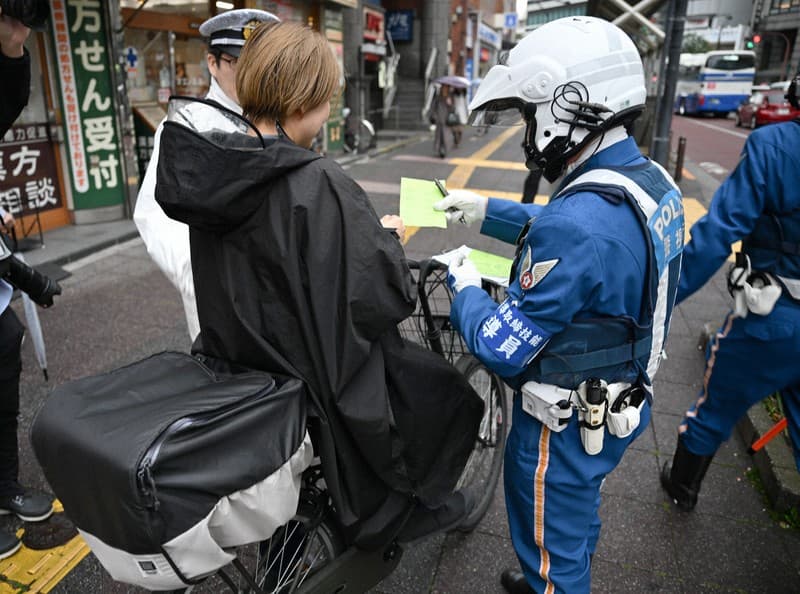
A Strict New Framework for Cycling
Since April 1, cyclists across Japan have faced a sharp increase in accountability under the new bicycle blue ticket system. Under this framework, riders aged 16 and older can receive fines on the spot for any of 113 types of traffic violations. Penalties range from 3,000 yen to 12,000 yen (approximately $19 to $76). Violations include riding while using a smartphone, operating a bicycle without lights after dark, ignoring traffic signals, and riding on sidewalks that are not marked for bicycle use. The change brings bicycle enforcement closer to the system long used for automobiles, replacing a previous era in which many infractions resulted in little more than verbal warnings.
The reform arrives amid persistent concerns about road safety. National data recorded over 72,000 traffic incidents involving bicycles in 2023, representing roughly 20 percent of all collisions in the country. Although total collisions decreased slightly in 2024, incidents involving cyclists remain a stubborn safety issue. By reclassifying many common infractions as fineable offenses, the National Police Agency aims to curb risky behavior before it leads to serious injury or death.
Enforcement Data Shows Immediate Impact
Initial enforcement figures reveal that police have not hesitated to apply the new rules. During the first month of implementation, authorities issued approximately 2,147 blue tickets nationwide. According to the National Police Agency, the most common citation was for failing to halt at stop signs, accounting for 846 cases with 5,000 yen fines. Smartphone use while riding generated 713 cases carrying the maximum 12,000 yen penalty. Running red lights produced 298 cases at 6,000 yen each.
Early figures show at least 842 fines issued within the first two weeks alone, alongside roughly 21,900 warnings. Regional data highlights sharp disparities. Aichi Prefecture led with 136 tickets, followed by Osaka with 125, Saitama with 104, and Kyoto with 99. Nine prefectures, including Aomori, Kochi, and Okinawa, reported zero tickets during the same window. Officials noted that blue tickets are typically issued only after riders ignore guidance or warnings, except for dangerous violations such as smartphone use. Despite the tough start, some departments report early signs of change. Officers in Niigata say more cyclists now stop completely at stop signs, while Tochigi police observe fewer riders holding phones. Miyagi authorities even sense a general decline in bicycle accidents since the launch.
Public Support Masks Deep Divisions
Public reaction reflects broad support on the surface, yet beneath the headlines lie stark generational and economic fault lines. A nationwide poll found that 62 percent of respondents consider the new rules appropriate, compared with 20 percent who say they are too strict and 8 percent who believe they are not strict enough. Many older respondents back the change forcefully, with one man in his 60s linking the fines directly to serious accidents.
“Fatal accidents are happening, so stricter rules are better.”
Women in their 50s and 60s expressed similar frustration. One described bicycles as a moving weapon, while another said cyclists should recognize that bicycles are light vehicles subject to traffic law. Support climbs steadily with age. Among respondents aged 70 and older, 75 percent called the rules appropriate. That figure exceeded 60 percent for people in their 50s and 60s, and remained above 50 percent for those in their 30s and 40s.
The dynamic shifts dramatically among youth. Among respondents aged 18 to 29, just 36 percent found the rules appropriate, while 33 percent deemed them too strict, nearly tying the two views. Occupational status also shapes opinion. While 57 percent of employees working full time and 69 percent of homemakers approved, only 20 percent of students agreed. A majority of students, 60 percent, called the system too strict. Given that many teenagers rely on bicycles for school commutes and often lack independent income, the financial sting hits hard. One observer noted that even if the goal is accident prevention, penalties are harsh for students. Yet even critics make distinctions. A respondent in their 20s supported crackdowns on smartphone use and riding without lights while opposing other restrictions.
Even among the majority who called the rules appropriate, specific complaints surfaced. Parents warned that the regulations ignore practical family obligations. A woman in her 30s explained that when taking a first grade child to a hospital, following every rule becomes nearly impossible for mothers. A woman in her 50s complained that the sheer variety of violations essentially tells people to walk instead of cycle. A respondent in their 40s warned that the system limits freedom of movement for people with low incomes. These comments reveal that support for the concept of safety does not always translate into endorsement of every specific rule.
When Rules Conflict With Road Reality
Perhaps the loudest outcry centers on the disconnect between strict legal obligations and the physical reality of Japanese roads. Under the Road Traffic Act, bicycles qualify as light vehicles and must travel on the left side of roadways. In practice, riders across the country face narrow streets lined with parked cars, delivery trucks blocking shoulders, and a severe shortage of dedicated bicycle lanes. Riders in Tokyo often point to Minato City as one of the rare exceptions, where poles separate cyclists from motor traffic. Beyond such isolated examples, most urban roads offer little protection.
The absence of safe infrastructure pushes riders onto sidewalks, which the new rules heavily restrict. Riding on unmarked sidewalks now carries a 6,000 yen fine, a policy that directly affects parents using bicycles that carry children, known as mamachari, to transport young children or run daily errands. One mother in her 30s explained that following every rule becomes nearly impossible when rushing a first grade child to a hospital. Another respondent in their 40s warned that the system limits freedom of movement for residents who have low incomes and cannot afford alternative transport.
Drivers add their own complaints. A woman in her 20s warned that bicycles hugging the edge of narrow lanes can block cars and cause severe congestion. Some respondents demanded tighter parking restrictions for automobiles if bicycles are expected to share the road. Others saw the crackdown as a revenue strategy rather than a safety measure, with one man in his 30s dismissing it as an attempt to pad police numbers. The frustration is rooted in a simple complaint repeated across age groups: authorities are penalizing behavior that infrastructure itself encourages.
Comments in open response fields overflowed with anger about missing bike lanes. A man in his 20s insisted there is no way to ride on a narrow road full of parked cars. A man in his 40s called it strange to impose harsh penalties without first building infrastructure such as bike lanes. A woman in her 50s argued that if bicycles must use roadways, then restrictions on cars parking in the street should be tightened. These voices all point to the same conclusion: rules and roads are out of sync.
Fraudsters Exploit the Crackdown
The sudden visibility of blue tickets has produced an unexpected criminal side effect. Scammers impersonating police officers now accost cyclists and demand immediate cash payment for invented infractions. In Fukuoka, a university student aged 18 handed over 8,000 yen to a fake officer in plain clothes who accused him of failing to signal a turn, an offense not actually included in the revised violation list. In Oyama City, north of Tokyo, a cyclist paid 15,000 yen to a man who identified himself as a traffic division officer named Yamanishi. The fraudster produced a convincing replica ticket and threatened arrest if payment was not made immediately. A teenage boy in Hiroshima lost 2,000 yen to a similar scheme on April 4.
The National Police Agency has responded with urgent warnings. Real officers never collect fines at the scene. Anyone receiving a legitimate blue ticket must pay within seven days at a bank or post office. The agency stated that any demand for immediate payment on site is fraudulent and urged victims and witnesses to report encounters to police without delay. While the scams reflect the public attention the new law has generated, they also expose a knowledge gap that criminals are eager to exploit.
The environment of fear created by the crackdown appears to aid the scammers. Because riders now worry about large fines and potential license suspensions, the threat of immediate arrest sounds plausible. Japan already tightened penalties for drunk cycling last year using a separate red ticket system, which led to 1,507 license suspensions in 2025 compared with just 23 the previous year. That precedent leaves cyclists aware that authorities treat certain violations with extreme severity, making threats from impersonators feel credible.
Widespread Confusion Clouds Compliance
Even as enforcement intensifies, public understanding of the rules remains shallow. A survey conducted in early March found that 82.4 percent of people had heard about the new system, yet only 7.6 percent claimed to know all the specific violations it covers. Roughly half admitted to knowing some but not all infractions, and about one in five respondents in their 20s through 40s had never heard of the system at all. The data suggest authorities face a steep climb in educating the public.
Popular knowledge centers on a handful of obvious behaviors. Respondents commonly identified smartphone use, earphone use, and running red lights as fineable acts. Many failed to grasp nuanced distinctions. Some incorrectly believed drunk cycling and riding without a helmet were covered by blue tickets. In reality, drunk cycling falls under the more serious red ticket regime, while helmet use remains a voluntary guideline rather than a mandatory rule. The confusion leaves cyclists vulnerable to both accidental violations and fraudulent scams.
Real officers have noticed the knowledge gap. Police departments across the country report an incessant flow of inquiries about what exactly constitutes a traffic violation while riding. In response, headquarters are beefing up public awareness campaigns, hosting traffic safety classes, and disseminating information via social media. The early enforcement period has already produced surreal scenes. Because April 1 brought heavy rain to Tokyo, officers issued tickets for umbrella riding, which accounted for roughly 70 percent of infractions that day. Many riders protested that they had no idea carrying an umbrella while pedaling was illegal. The incident illustrates how daily habits and legal codes have drifted apart.
Seeking Balance Between Safety and Convenience
With more than 70 million bicycles in daily use across Japan, the new system touches a central thread of national life. In Tokyo, roughly 20 percent of residents commute to school or work by bike. In Osaka, the figure approaches 28 percent. Cycling offers an affordable, flexible transport option that many families and students simply cannot replace. Policymakers must therefore balance safety imperatives against the risk of undermining a practical mobility lifeline.
Advocates for stronger enforcement point to hard data. Kochi Prefectural Police reported that 85 percent of the 152 injury accidents involving bicycles in that region during 2025 involved traffic violations. The most common causes were failures to watch the road ahead and neglecting to check other road users, followed by unsafe intersection behavior and signal violations. Between 2018 and 2022, collisions caused by cyclists using smartphones jumped by more than 50 percent, climbing to 454 incidents. An agency official attributed the rise not merely to the ubiquity of smartphones, but also to the growing variety of video and gaming content that distracts riders.
Even supporters acknowledge that fines alone cannot replace physical infrastructure. Experts argue that stricter enforcement is necessary, but confusion will persist until road environments improve and guidance becomes clearer. Social media users echo this view. One Tokyo resident observed that even a simple line of poles separating bikes from cars on Minato City roads makes a huge difference in perceived safety. Others demanded that authorities also fine drivers who block existing bike lanes. The public largely sympathizes with the purpose of the system, with surveys showing around 70 percent support for the underlying goal. Yet a significant portion of that same group says the policy does not match reality on the ground.
The task ahead for Japan involves weaving together education, infrastructure investment, and consistent enforcement. Older pedestrians deserve safe sidewalks. Young commuters deserve clear rules they can follow without financial ruin. Drivers deserve roads where all participants understand their roles. Achieving these goals simultaneously will require more than blue tickets. It will require cities to build lanes, planners to restrict roadside parking, and police to maintain a measured hand that prioritizes warnings over punishment when riders genuinely lack safe alternatives.
Key Points
- Japan introduced the blue ticket system on April 1, applying fines to 113 bicycle violations for riders aged 16 and older.
- Police issued over 2,100 fines during the first month, with stop sign violations and smartphone use accounting for the majority.
- Public opinion is split by age and occupation, with strong support among older residents but heavy opposition from students.
- Critics argue that poor cycling infrastructure, narrow roads, and a lack of bike lanes make strict enforcement impractical.
- Scammers impersonating police have exploited the new system, defrauding cyclists with fake on site fines.
- Surveys show most citizens have heard of the system, yet fewer than 8 percent fully understand its specific rules.