A Financial Lifeline Built on Compulsion
Myanmar’s military junta has transformed the earnings of its overseas workforce into the single largest source of foreign currency entering the country. Finance ministry data show that worker remittances reached US$5.6 billion (S$7.1 billion) in 2025, accounting for approximately 38 percent of all foreign inflows. This marks a staggering increase from just US$670 million in 2022, the year following the military seizure of power in February 2021. The surge stems directly from coercive rules enacted in 2024 that mandate migrant workers to route 25 percent of their income through official banking channels controlled by the state. For a regime starved of foreign exchange amid international sanctions and a grinding civil conflict, these forced transfers have become an essential mechanism for survival.
The scale of the increase reveals the extent of economic desperation gripping the State Administration Council, as the junta calls itself. Inflation hovers near 30 percent, and foreign direct investment collapsed to just US$83 million in 2025, according to the same data. By comparison, remittances now dwarf every other legitimate capital source. Dr Kaho Yu, principal Asia analyst at risk intelligence company Verisk Maplecroft, explained that the inflows are providing critical support to a tightly controlled banking system under severe pressure to stabilise foreign exchange liquidity. The policy effectively turns the economic vulnerability of millions of migrants into a direct revenue stream for regime coffers.
Officials inside Myanmar have framed the remittance rules as an effort to channel funds through formal banking systems and curb informal transfers. They argue that moving money into regulated accounts helps the central bank manage exchange rates and ensure sufficient reserves for essential imports. Yet with foreign currency reserves hovering near US$8.5 billion as of March 2024, the buffer remains thin for a nation of roughly 54 million people. The central bank has printed more than 30 trillion kyat since the coup, a tenfold increase over 2020 levels, triggering runaway inflation and an 80 percent collapse in the currency value. Against this backdrop, the remittance windfall looks less like prudent financial management and more like emergency extraction.
The Machinery of Enforcement
To ensure compliance, the junta has constructed a supervisory apparatus that reaches across borders and into the daily lives of migrant workers. A 13-member committee was formed on August 30, 2024, chaired by Brigadier General Win Myint Khaing from the Defense Ministry and populated by officials from military intelligence, the Office of the Chief of Military Security Affairs, police Special Branch, and multiple ministries including Finance, Foreign Affairs, Immigration, and Labor. This body reports directly to the Foreign Exchange Supervisory Committee, which manages exchange rate stabilisation and authorises hard currency spending on essential imports such as fuel, medicine, fertiliser, and building materials.
The enforcement mechanism relies on bureaucratic pressure. Migrant workers who travelled through official Memorandum of Understanding pathways must open joint accounts in banks regulated by the regime before departure, then remit 25 percent of earnings monthly or quarterly. Those who fail to comply face restrictions on passport renewals, effectively trapping them abroad without legal status or preventing them from leaving again after returning home. Employment agencies are pressured to monitor their clients, and regime representatives in destination countries actively track remittance flows. In Thailand, where roughly 5 million licensed and unlicensed Myanmar migrants work, the Labor Ministry of the junta began enforcing the rules in August 2024, while authorities in Laos have also been urged to push workers toward formal channels.
Workers who fall behind on payments risk repercussions that extend beyond their own status. Advocacy groups report that families inside Myanmar can be contacted if transfers lapse, creating a system of indirect pressure that turns relatives into enforcers.
Human Cost on the Ground
For individual workers, the policy translates into immediate financial hardship. Migrants in Thailand report being told to remit at least 2,500 baht monthly, an amount that sometimes exceeds 25 percent of their actual wage. Many migrants earn the minimum wage or slightly above, leaving almost nothing for discretionary spending after mandatory transfers and taxes are deducted. The burden intensified when Myanmar amended tax laws in October 2023 to revoke a 2012 income tax exemption for overseas workers, exposing them to flat rates of 2 percent or tiered taxes between 10 percent and 25 percent on foreign earnings. Because workers already pay income tax in host countries, the change amounts to double taxation on populations earning modest salaries in factories, seafood processing plants, and construction sites.
Mr Aung Thein Kyaw, a 31 year old factory worker in Thailand, told a labour rights organisation that he had originally left Myanmar to escape the chaos and politics of the coup. Yet he found himself caught in a system that strips autonomy from workers.
“But sadly we are still bound by crazy rules that could help them get foreign currencies. We have no choice but to send money.”
Myo Ko Oo, a 29 year old seafood processing worker in Thailand, described how mandatory remittances compound existing struggles. Sick days and lost overtime hours make basic survival difficult when a substantial portion of every paycheck is automatically diverted.
“We are struggling to make ends meet, particularly when we have to take sick leave or cannot work overtime. It would be great if we are allowed to freely manage our hard earned money on our own.”
Banks, Exchange Rates, and Military Ties
Once remittances enter the formal banking system, they flow into institutions with documented links to the military. Several private conglomerates operating banks maintain deep ties to the Tatmadaw, Myanmar’s armed forces. United Nations investigators in 2019 called for criminal investigations into two of these conglomerates for their substantial and direct contribution to crimes against humanity committed against the Rohingya, allegations the government has denied. The same fact finding mission found that private financial institutions have enabled the procurement of aviation fuel and military equipment, suggesting the formal banking sector serves strategic defence priorities beyond mere commercial activity.
Currency conversion practices have added another layer of extraction. When the 25 percent remittance rules first took effect, banks reportedly converted dollars at below market rates, capturing hidden value before the funds even reached families. Advocates note that conversion rates have since moved closer to market pricing, which reduces direct losses for migrants but preserves the regime control over hard currency. The official exchange rate has long diverged from street reality. While the central bank pegs the kyat near 3,600 to the dollar, informal markets trade closer to 4,200, a gap that makes hundi networks, the banned informal transfer systems, vastly more attractive for anyone not compelled to use official channels. The International Labour Organization has warned that punitive remittance policies risk driving workers underground toward these informal systems, undermining the stated goal of formalisation.
Employment agencies frequently require migrants to sign agreements committing to regular transfers before they ever earn a paycheck overseas, locking workers into compliance contracts from the moment they depart.
Conscription Fears Compound Migration Crisis
The remittance squeeze sits atop an already precarious migration landscape shaped by Myanmar’s revived conscription law. In February 2024, the junta began enforcing the 2010 People’s Military Service Law, requiring men aged 18 to 35 and women aged 18 to 27 to serve two year military terms. The announcement triggered a mass exodus of young people seeking legal and irregular routes into Thailand, Malaysia, and other neighbors. Passport offices became overwhelmed, with appointments booked months in advance, while exploitative brokers inflated prices for urgent applications. In a further restriction, the regime suspended permits for male citizens seeking overseas employment starting May 2024, explicitly to prevent draft age men from fleeing service.
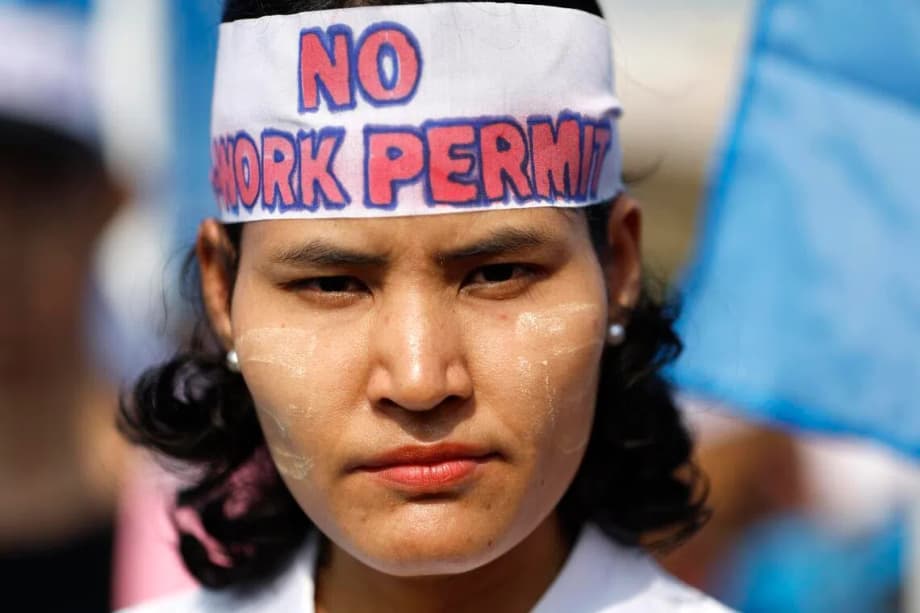
Thailand has inadvertently strengthened the grip of the junta on its diaspora. A 2025 Thai labor documentation rule requires Myanmar government approval for work permits, effectively giving the embassy representing the junta in Bangkok veto power over who may remain employed. Brahm Press, director of the Migrant Assistance Program, noted that many migrants avoided registration precisely because they feared Burmese government retaliation, particularly against former Civil Disobedience Movement participants or People’s Defense Forces affiliates.
“Most people who are opting to stay outside of the system are doing so because they are fearful of repercussions from the Burmese government, either to themselves and their families. Especially people who have been escaping conscription, anyone who was part of the People’s Defense Forces or the Civil Disobedience Movement.”
In western districts like Mae Sot, thousands of workers were expected to skip registration deadlines to protect identities from a regime that has detained more than 21,000 political prisoners since the coup. Yet undocumented status strips workers of social security, healthcare access, banking services, and freedom of movement within Thailand. Press warned that leaving populations undocumented, with little access to formal services like healthcare, can lead to increases in malaria, tuberculosis, and other communicable diseases. Myanmar’s exiled parallel National Unity Government has called on Thailand to end the growing control exercised by the junta over its overseas workers.
Regional Implications and Economic Fragility
While the junta frames remittance rules as central bank efforts to stabilise foreign exchange markets, the broader economic picture is deteriorating. The World Bank reported that remittances in the 2024-25 fiscal year rose 46 percent to US$2.1 billion, pushing the current account into surplus even as trade and investment collapsed. This statistical health masks profound underlying sickness. Rising outbound migration, driven by economic ruin and conscription terror, is generating domestic labor shortages that threaten long term investor confidence. Verisk Maplecroft’s Yu warned that these shortages could further erode its appeal to investors.
International dynamics add further complexity. China has used Myanmar’s isolation to advance Belt and Road Initiative projects, including the strategically vital Kyaukpyu port in Rakhine State, while Beijing supplies weapons and diplomatic cover at the United Nations. Washington has imposed targeted sanctions, including measures against the Myanmar Foreign Trade Bank in 2023, but the regime adapted by shifting transactions to the Myanmar Economic Bank. Analysts at the Lowy Institute argue that Washington possesses underutilised economic tools, including central bank designation and redirection of frozen assets toward the parallel National Unity Government, that could alter the financial trajectory of the conflict. The New York Federal Reserve currently holds more than US$1 billion in frozen assets belonging to the central bank of Myanmar, and some experts have suggested redirecting the interest earned on these funds to the National Unity Government, similar to the approach used with Russian assets to support Ukraine. For ordinary migrants, however, geopolitical calculations remain distant abstractions overshadowed by the immediate reality of compulsory transfers and tax demands.
What to Know
- Myanmar’s junta collected US$5.6 billion in remittances during 2025, representing roughly 38 percent of all foreign inflows and an eightfold increase from 2022.
- A 2024 rule mandates that migrant workers remit 25 percent of salaries through banks regulated by the regime, with non compliance triggering passport renewal denials and travel restrictions.
- Authorities formed a 13 member military led supervisory committee in August 2024 to enforce the remittance policy and pressure employment agencies.
- Workers face double taxation after a 2023 tax amendment revoked exemptions on foreign income, exposing migrants to rates between 2 percent and 25 percent in addition to host country taxes.
- Rights groups and the International Labour Organization warn that tying remittances to passport validity may violate freedom of movement and push workers toward banned informal transfer networks.
- Thailand’s 2025 labor documentation requirement grants the Myanmar embassy oversight over migrant work permits, raising fears of conscription and political targeting.