The Announcement and Immediate Doubts
Myanmar’s military junta announced on April 30, 2026, that Aung San Suu Kyi, the 80-year-old Nobel Peace Prize laureate and former civilian leader, had been transferred from solitary confinement in a Naypyidaw prison to house arrest. State broadcaster MRTV declared that Senior General Min Aung Hlaing, who orchestrated the 2021 coup that toppled her government, had commuted her remaining prison sentence to be served at a designated residence. The announcement, which coincided with the Full Moon Day of Kason marking Buddha’s birthday, was accompanied by a photograph showing Suu Kyi seated on a wooden bench in traditional attire alongside uniformed personnel. Yet the gesture, presented as an act of state benevolence, was immediately met with widespread skepticism from her family, legal team, and international observers who questioned both the timing and the authenticity of the claims. The regime has refused to disclose her exact location, and the photograph broadcast on state television appears to date from 2022, casting doubt on whether the transfer has actually occurred or whether Suu Kyi remains alive.
- The Announcement and Immediate Doubts
- From Icon to Prisoner: A Timeline of Detention
- The 2021 Coup and Secret Trials
- Isolation and Health Concerns
- A Son’s Plea: Demands for Proof of Life
- The Junta’s Public Relations Offensive
- The Rohingya Controversy and Tarnished Legacy
- Myanmar’s Ongoing Civil War
- Key Points
From Icon to Prisoner: A Timeline of Detention
Suu Kyi’s current confinement represents merely the latest chapter in a life marked by prolonged periods of detention at the hands of Myanmar’s military rulers. Between 1989 and 2010, she spent nearly 15 years under house arrest at her family residence at 54 University Avenue in Yangon, a leafy villa on Inya Lake that became a symbol of peaceful resistance. First detained on July 20, 1989, without charge or trial under the State Protection Act, she became the world’s most famous political prisoner while organizing rallies inspired by Mahatma Gandhi and Martin Luther King Jr. The military junta repeatedly extended her detention beyond legal limits, violating even Myanmar’s own draconian laws that capped such restrictions at five years total.
During her years of isolation, she was separated from her husband, Michael Aris, and their two sons, Alexander and Kim. When Aris was diagnosed with terminal cancer in 1999, the military junta offered Suu Kyi permission to visit him in the United Kingdom, but she refused, fearing the regime would never allow her return. She remained in detention even as her party, the National League for Democracy (NLD), won a landslide victory in the 1990 general elections, securing more than 80 percent of parliamentary seats. The military simply ignored the results, extending her house arrest repeatedly while brutally suppressing pro-democracy protests.
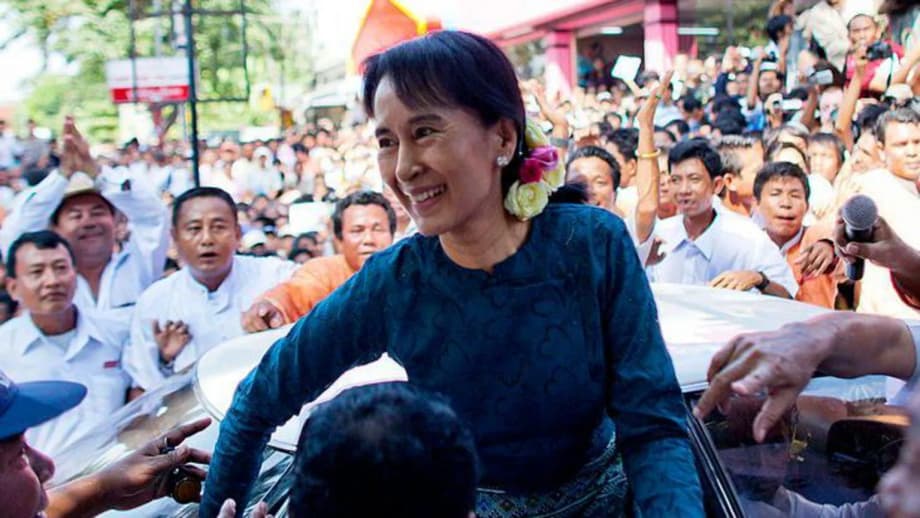
She was released unconditionally in May 2002, only to be detained again in 2003 after a government-backed mob attacked her convoy in Depayin, killing dozens of her supporters. Following the bizarre incident of American John Yettaw swimming uninvited to her house in 2009, she was sentenced to 18 months of extended house arrest. Her final release came on November 13, 2010, just days after military-backed elections that the NLD boycotted. Six days after her release, thousands of supporters gathered at her gates as she addressed them, calling for unity and marking the beginning of a decade-long experiment with democracy.
The 2021 Coup and Secret Trials
The current ordeal began in the early hours of February 1, 2021, when Min Aung Hlaing’s forces arrested Suu Kyi, President Win Myint, and other NLD leaders just hours before the newly elected government was scheduled to begin its second term. The military claimed widespread voter fraud in the November 2020 elections, which the NLD had won decisively, though international observers found no evidence to support these allegations. The coup triggered massive public resistance that was brutally suppressed, sparking a bloody civil war that continues to rage across the country.
Over the following months, Suu Kyi faced a series of closed-door trials on charges ranging from illegally importing walkie-talkies and violating Covid-19 restrictions to corruption, election fraud, and violations of the Official Secrets Act. Rights groups and the United Nations condemned the proceedings as a sham designed to legitimize the coup and permanently sideline Myanmar’s most popular politician. She was initially sentenced to 33 years in prison, later commuted to 27 years, and most recently reduced by one-sixth as part of a prisoner amnesty, leaving her with approximately 18 years and nine months to serve, of which more than 13 years remain.
Until this latest announcement, Suu Kyi had been held in solitary confinement at a specially built detention facility in Naypyidaw, subjected to a regimented routine with strictly controlled access to the outside world. Her legal team had not been permitted to meet with her in person since December 2022, and her family had heard nothing from her in years. Leaked prison logs from early 2024 revealed she was receiving medications for various health issues while being held in conditions described by former detainees as medieval, with cells open to the elements and inadequate food and medical care.
Isolation and Health Concerns
At 80 years old, Suu Kyi’s health has become an increasing source of alarm for her family and supporters. Reports from 2024 and 2025 indicated declining health, including low blood pressure, dizziness, and heart complications. Her son, Kim Aris, who lives in London, has repeatedly warned that his mother’s health was deteriorating during her years of incommunicado detention. He has stated that she requested to see a cardiologist but it remains unclear whether these requests were granted by her captors.
Former economic adviser Sean Turnell, an Australian economist who was detained alongside Suu Kyi for more than a year after the coup, described the prison conditions as terrible for anyone, but especially dangerous for an elderly woman. The secrecy surrounding her new location has only intensified these worries, with authorities refusing to disclose which designated residence would house her. Sources suggest she will likely remain in Naypyidaw, the sprawling garrison capital of high walls and secretive compounds, rather than returning to her historic Yangon villa. A member of her dissolved NLD party confirmed she was moved on Thursday night, with legal representatives planning to meet her on Sunday to discuss her position and bring supplies, marking the first time lawyers will have direct access to her in over three years.
A Son’s Plea: Demands for Proof of Life
Kim Aris responded to the house arrest announcement with profound skepticism, describing the move as a calculated gesture rather than genuine progress. In statements to multiple news agencies, he revealed that he still had no confirmation of his mother’s whereabouts or condition, and he demanded verified proof of life before accepting the regime’s claims. Aris noted that the photograph broadcast by state media appeared to date from 2022, taken during the trial process, rendering it meaningless as evidence of her current status.
I still do not know where my mother is. I do not know how she is. I remain deeply concerned about whether she is still alive. If she is alive, I ask for proof of life. Moving her from a prison to a secret location does not mean freedom. She remains a hostage, completely cut off from the world and under the absolute control of those who continue to unlawfully detain her.
Aris suggested the timing was not coincidental, coming shortly after public statements from the Chinese government regarding his mother’s status, and accused the junta of using her as a public relations pawn to ease international pressure while the reality on the ground remained brutal and unchanged. He emphasized that thousands of political prisoners remain incarcerated across Myanmar, and that his appeal extended beyond his mother to all those unjustly detained.
The Junta’s Public Relations Offensive
The transfer announcement arrives amid a broader campaign by Min Aung Hlaing to legitimize his rule and end Myanmar’s international isolation. In April 2026, the general relinquished his military title and arranged to be sworn in as civilian president following tightly controlled elections that excluded the NLD and were widely dismissed as a sham designed to give a veneer of legitimacy to army rule. In his inauguration speech on April 10, he promised to prioritize stability and peace, and to enhance international relations with the Association of Southeast Asian Nations (ASEAN), from which he has been barred since the coup.
Analysts suggest the house arrest transfer serves multiple strategic purposes for the regime. It attempts to placate ASEAN, which has barred Myanmar’s leadership from high-level summits since the coup, and to create the illusion of reform for international observers. The junta has also contracted foreign lobbyists, including Roger Stone, a longtime ally of U.S. President Donald Trump, to represent the administration in Washington. UN spokesperson Stephane Dujarric welcomed the commutation as a meaningful step toward credible political process, though he emphasized that any viable solution must include an immediate cessation of violence and genuine inclusive dialogue.
However, human rights groups dismissed the move as cynical manipulation. Mark Farmaner of Burma Campaign UK stated that the military uses political prisoners who should never have been jailed as public relations pawns, taking credit for releasing them while simultaneously stepping up airstrikes targeting health facilities and civilians. The Assistance Association for Political Prisoners estimates that more than 22,000 political prisoners remain incarcerated across Myanmar, with over 14,200 verified cases. In March 2026 alone, more than 450 people were killed in air and drone strikes, the highest monthly death toll since the resistance began.
The Rohingya Controversy and Tarnished Legacy
Suu Kyi’s international standing has undergone a dramatic transformation since her years as a celebrated democracy icon. During her time as state counsellor from 2016 to 2021, a position she created because the constitution barred her from the presidency, her leadership was defined by the military’s brutal crackdown against the mostly Muslim Rohingya minority in Rakhine State. Following deadly attacks on police stations by Rohingya insurgents in 2017, the army launched a campaign that killed thousands and drove nearly one million Rohingya to flee to Bangladesh.
While international observers demanded condemnation, Suu Kyi chose to defend the military’s actions, personally leading Myanmar’s delegation to the International Court of Justice in 2019 to refute genocide charges. This decision badly tarnished her saint-like global image, though she remained wildly popular among Myanmar’s Buddhist majority, who largely supported the military’s campaign and hold little sympathy for the Rohingya. Her former supporters accused her of doing nothing to stop rape, murder, and possible genocide, while some analysts argued she was navigating a pragmatic path through a complex political landscape where the military retained control of key ministries, defence, and a quarter of parliamentary seats.
During her time in power, Suu Kyi and the NLD government also faced criticism for prosecuting journalists and activists using colonial-era laws. In August 2018, she described the generals in her cabinet as rather sweet, and analysts noted that Myanmar’s democratic transition appeared to have stalled. Despite these controversies, her standing among the Burmese people remains extremely high, with Sean Turnell noting that she has a charisma and connection with the population that is almost spiritual.
Myanmar’s Ongoing Civil War
Despite the junta’s attempts to project stability, Myanmar remains engulfed in a bitter civil war that has killed thousands and displaced millions since the 2021 coup. The military has faced sustained armed resistance from pro-democracy forces and ethnic minority militias, suffering significant territorial losses in recent years before mounting a counteroffensive. The conflict has created a humanitarian catastrophe, with widespread displacement and economic ruin compounding the country’s troubles.
Suu Kyi’s long-held belief in non-violent struggle has been rejected by many younger activists who have joined the armed resistance, arguing that fighting is necessary to end the military’s role in political life. There is now more criticism of how she governed when in power than before, with many opposition activists willing to condemn her handling of the Rohingya crisis. As she enters her 80s with uncertain health, it remains unclear how much influence she would have even if fully released, though her symbolic importance to the resistance movement remains potent. The real test of her freedom, observers say, will be whether she will be allowed to commune again with Myanmar’s citizens, and whether they will again feel safe to openly support her without fear of the violent reprisals that have characterized military rule.
Key Points
- Aung San Suu Kyi, 80, was transferred from prison to undisclosed house arrest on April 30, 2026, after more than five years in detention
- Her son Kim Aris demands proof of life, saying a photo released by the junta appears to be from 2022 and he has had no contact with her for years
- The military reduced her sentence from 33 years to approximately 18 years and nine months, with over 13 years still to serve
- Analysts view the move as a public relations effort by Min Aung Hlaing to legitimize his new civilian presidency and ease international isolation
- Her legal team plans to meet her for the first time since December 2022, though her exact location remains secret
- Myanmar remains in civil war, with the military continuing airstrikes against civilians despite prisoner amnesties
- Suu Kyi previously spent 15 years under house arrest between 1989 and 2010 at her Yangon family home on Inya Lake