When Policy Becomes Criminal
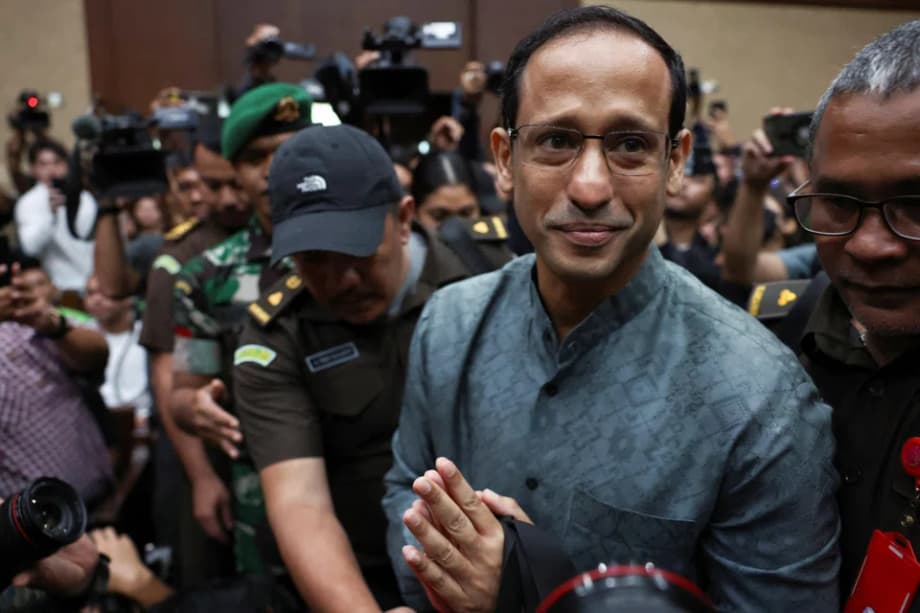
Indonesia’s high-profile trial of former education minister and Gojek co-founder Nadiem Makarim represents a critical moment for the archipelago nation. What began as an ambitious digitalization program to equip schools with laptops during the Covid-19 pandemic has evolved into a corruption case that prosecutors say caused more than 2.18 trillion rupiah ($125 million) in state losses. The 41-year-old Harvard graduate, who transformed from startup icon to cabinet member under former president Joko Widodo, now faces potential life imprisonment if found guilty of abuse of power and corruption charges.
- When Policy Becomes Criminal
- The Procurement Scandal at the Heart of the Case
- The Zoom Meeting and Secret Planning
- Google’s Investment and the Conflict of Interest Question
- Google Executives Take the Stand
- Technical Failures in Remote Indonesia
- Nadiem’s Defense and Health Concerns
- Impact on Tech Investment and Governance
- The Bottom Line
The trial, which began in January 2026 after months of investigation, has captured attention far beyond Jakarta’s courtrooms. Technology investors and policy analysts are watching closely because the case tests a troubling question: where does flawed policymaking end and criminal liability begin? For a country positioning itself as Southeast Asia’s premier technology hub, the proceedings could determine whether entrepreneurs view public service as an opportunity for impact or a minefield of legal risk.
At the center of the controversy lies the procurement of 1.2 million Chromebook laptops between 2020 and 2022, a project with an estimated budget of 10 trillion rupiah ($740 million). Prosecutors allege that Nadiem manipulated procurement specifications to favor devices running Google’s ChromeOS operating system, despite internal ministry reviews that had previously rejected these machines as unsuitable for Indonesia’s educational infrastructure. The Attorney General’s Office contends that this was not merely a policy misstep but a deliberate scheme to benefit specific vendors and enrich the former minister himself.
The Procurement Scandal at the Heart of the Case
The digitalization program launched during the height of the Covid-19 pandemic aimed to accelerate technology adoption in classrooms across Indonesia’s vast archipelago. With schools forced to close and students transitioning to remote learning, the Education Ministry sought to distribute laptops to institutions nationwide. However, the procurement process soon attracted scrutiny from investigators.
According to the indictment read in court, the ministry’s technical teams had originally favored devices running Microsoft Windows, recognizing that these systems offered greater offline functionality. Chromebooks, by contrast, rely heavily on cloud-based applications and stable internet connectivity. A 2018 internal ministry review had already determined that Chromebooks were ineffective for Indonesian schools, particularly in remote regions where internet access remains sporadic or nonexistent.
Despite these recommendations, prosecutors allege that Nadiem steered the procurement toward ChromeOS devices through a series of meetings and directives. The case file includes allegations of a Zoom meeting held on May 6, 2020, during which Nadiem allegedly instructed four associates to procure laptops based on Google’s ChromeOS. This instruction came one month before a study claiming Chromebooks’ superiority was published in June 2020, raising questions about the timing and basis for the decision.
Investigators have identified state losses exceeding 2.18 trillion rupiah, stemming from inflated pricing and the purchase of devices ill-suited to their intended environment. The Attorney General’s Office has named multiple co-defendants, including Ibrahim Arief, a former vice-president at e-commerce platform Bukalapak who served as a consultant to the ministry, and several former ministry directors including Sri Wahyuningsih and Mulyatsyah. The latter is accused of receiving bribes totaling S$120,000 and $150,000. Another key suspect, Jurist Tan, identified as Nadiem’s former special staffer, remains at large as a fugitive.
The Zoom Meeting and Secret Planning
Prosecutors have constructed a timeline suggesting systematic manipulation of the procurement process beginning even before Nadiem officially took office. According to court documents, Nadiem formed a WhatsApp group called “Mas Menteri Core Team” in August 2019, three months prior to his October inauguration as education minister. The group included his former special staffer Fiona Handayani and was allegedly used to discuss plans for digitalizing education programs at the ministry.
This early planning allegedly culminated in the pivotal May 6, 2020 video conference. During this Zoom meeting, prosecutors claim Nadiem instructed four individuals to move forward with ChromeOS-based procurement. The instruction allegedly came with full awareness that the devices required internet connectivity that most Indonesian schools, particularly those in remote and underdeveloped regions, simply did not possess.
The indictment suggests this was part of a broader pattern where Nadiem allegedly appointed close associates as directors and beneficial owners of various entities, allowing him to maintain indirect control over company decisions even after resigning from his startup roles. Prosecutors describe his resignation from PT Aplikasi Karya Anak Bangsa (AKAB), Gojek’s parent company, as “strategic concealment” designed to mask conflicts of interest rather than genuine divestment.
Furthermore, investigators allege connections between the procurement and Agustina Wilujeng, a former deputy chair of the House of Representatives Commission X overseeing education. Prosecutors claim she recommended specific vendors including Hendrik Tio of Bhinneka Mentari Dimensi, Michael Sugiarto of Tera Data Indonusa (Axioo), and Timothy Siddik of Zyrexindo Mandiri Buana. These companies allegedly profited by billions of rupiah from the contracts, though the vendors have denied any political backing in court testimony.
Google’s Investment and the Conflict of Interest Question
Perhaps the most contentious aspect of the case involves the alleged links between the Chromebook procurement and Google’s significant investments in Indonesian technology companies. Prosecutors have drawn attention to Google’s financial relationship with Gojek, the ride-hailing and payments giant that Nadiem co-founded in 2009 and led until 2019.
Between 2017 and 2021, Google invested approximately $786 million in PT Aplikasi Karya Anak Bangsa (AKAB), Gojek’s parent company, through Google Asia Pacific. These investments occurred contemporaneously with the education ministry’s laptop procurement decisions. Prosecutors allege that Nadiem enriched himself by 809 billion rupiah ($48.2 million) through the transfer of investment funds to his interests, and that he manipulated procurement specifications to make Google “the sole controller of the education ecosystem in Indonesia.”
The indictment claims that after allegedly meeting with Google Asia-Pacific and Google Indonesia representatives in February and April 2020, Nadiem’s associate Jurist Tan proposed a 30 percent co-investment from Google in the ministry’s ICT procurement. This alleged arrangement would have created a direct financial link between the vendor’s ecosystem and the minister’s former company.
The prosecution’s theory suggests that by mandating ChromeOS devices, Nadiem ensured a captive market for Google’s educational technology in Indonesia’s public school system. With 1.2 million units procured, the ministry effectively locked the national education infrastructure into Google’s ecosystem, generating extended revenue through device management licenses and cloud services. Prosecutors calculate that losses included Rp 1.56 trillion tied to the digitalization program and an additional $44 million linked to Chrome Device Management licenses they deem unnecessary.
Google itself has not been indicted in the case, and the company has maintained that it licenses software without dictating hardware pricing. The tech giant has defended Chromebooks as designed for classroom realities, including remote areas, noting that while optimized for cloud computing, the devices retain offline capabilities.
Google Executives Take the Stand
In a dramatic development that could prove decisive for the defense, three former Google executives testified in April 2026, explicitly denying any connection between the company’s investment activities and the education ministry’s procurement decisions. The testimony came via video conference from Singapore, with Scott Beaumont, former president of Google Asia Pacific, and Caesar Sengupta, former vice-president and general manager, leading the virtual appearance.
Beaumont addressed the court with categorical denials.
There was no connection at all between Google’s investment in GoTo and any of the conversations with the Ministry of Education,
he told the panel of three judges. He further stated that Google had never requested investment or payment from the Indonesian government in connection with the Chromebook policy.
Sengupta reinforced this position, explaining that Google operated as a minority investor in Indonesia’s technology ecosystem without controlling corporate or government policy decisions. He specifically rejected the allegation that 809 billion rupiah in payments were made to Nadiem, calling the claim “not true and does not reflect what we did.”
William Florence, another former Google executive, joined the testimony supporting the defense narrative. The collective statements undercut the prosecution’s central theory linking the investment timeline to procurement decisions. Sengupta emphasized that Google’s investment strategy focused on supporting the growth of Indonesia’s digital economy rather than influencing specific government purchasing policies.
The executives’ testimony aligns with Nadiem’s defense argument that procurement decisions were made by technical teams and officials rather than the minister himself, and that Google’s investment in Gojek represented normal market activity unrelated to the education ministry’s laptop purchases.
Technical Failures in Remote Indonesia
The case highlights significant infrastructure challenges that plagued the laptop distribution program from its inception. Chromebooks, which operate primarily through cloud-based applications and Google’s ChromeOS, require reliable internet connectivity to function effectively. This dependency proved problematic for Indonesia, an archipelago of more than 17,000 islands where broadband penetration remains uneven.
According to testimony presented in court, the ministry’s own technical staff had identified these limitations in 2018, two years before the mass procurement began. The internal review concluded that Chromebooks were incompatible with educational needs in remote regions where students lacked internet access at home or school. Despite these warnings, the procurement proceeded, resulting in devices that prosecutors claim were largely ineffective for their intended purpose.
Harli Siregar, a spokesman for the Attorney General’s Office, revealed that investigators tested approximately 1,000 of the distributed Chromebooks and found they showed “poor performance” in real-world educational settings. The mismatch between the technology and infrastructure represented what investigators called “significant state losses” because the devices could not fulfill their primary educational function.
Google has countered that Chromebooks are designed for classroom realities including remote areas, and that they possess offline capabilities. However, critics note that while the devices can function offline, their utility is severely limited without connectivity, essentially rendering them expensive paperweights in regions without reliable internet service. The procurement proceeded despite these known limitations, suggesting to prosecutors deliberate indifference to actual educational outcomes in favor of other motivations.
Nadiem’s Defense and Health Concerns
Throughout the proceedings, Nadiem has maintained his innocence with consistent denials of all charges. His legal strategy centers on several key arguments: that he divested from his company holdings upon taking office, that his personal wealth actually declined by more than 50 percent during his ministerial tenure, and that procurement decisions were made by technical teams rather than the minister personally.
In court appearances, Nadiem has argued that the Chromebook purchase actually saved public funds rather than causing losses. He contends the laptops were purchased below market prices through Indonesia’s e-catalogue system, which he describes as transparent and competitive. The software licenses were provided free of charge, further reducing costs.
This program did not create losses, but instead generated budget savings because the price was lower than the market rate,
he stated during one hearing.
Nadiem has also highlighted that witnesses admitted receiving illicit payments but have not implicated him directly. Speaking after a February hearing, he noted that many witnesses have admitted receiving gratuities, but all stated they never informed me and were never instructed by me to accept any money.
The trial has taken a visible toll on the former minister’s health. In April 2026, he broke into tears after a hearing, telling reporters,
I want all of this to end soon because I am very tired.
His parents and Gojek motorcycle taxi drivers have attended hearings regularly to show moral support.
His legal counsel, Ari Yusuf Amir, has raised medical concerns with the court, stating that doctors have advised Nadiem to undergo medical treatment. The lawyer has also indicated he will ask the court to dismiss the charges, arguing the prosecution lacks strong evidence. The trial, which began in January after two postponements due to Nadiem’s illness, is expected to reach a verdict in May 2026, roughly eight months since his initial detention in September 2025.
Impact on Tech Investment and Governance
The case extends far beyond the courtroom, sending ripples through Indonesia’s technology sector and international investment community. For a nation seeking to establish itself as Southeast Asia’s leading digital economy hub, the trial raises uncomfortable questions about the risks of public service for private sector leaders.
Achmad Hidayat, an economist and public policy specialist at UPN Veteran Jakarta university, notes the case has unsettled parts of Indonesia’s technology diaspora.
What investors and technology professionals see is not merely a legal case,
he observes.
They see a signal that controversial policy decisions in Indonesia can easily turn into criminal risk.
This perception could deter the very entrepreneurial talent Indonesia needs to achieve its digital economy ambitions.
The proceedings touch on a fundamental tension in governance: the need for policy experimentation versus accountability. In many innovation-driven sectors, policymakers must try new approaches without guaranteed outcomes. Hidayat warns that if every flawed decision faces criminal interpretation, the result is not good governance, but a bureaucracy paralysed by fear.
Leigh McKiernon, founder of advisory firm StratEx, notes that while Indonesian laws appear sound on paper, their interpretation can shift with political circumstances. He cites the parallel case of Thomas Lembong, former trade minister under Widodo, who faced corruption charges in 2024 for raw sugar import policies from 2015-2017 despite no evidence of personal benefit.
While the legal framework makes sense on paper, there is a history of people believing they were operating within the law, but later finding themselves in hot water,
McKiernon explains.
For foreign investors, this uncertainty affects capital allocation decisions. McKiernon advises companies to adopt cautious approaches when partnering with government entities, emphasizing thorough due diligence and collaboration with experienced local legal advisers who understand Indonesia’s regulatory environment and political dynamics.
Despite these concerns, Indonesia remains one of Southeast Asia’s largest and most attractive markets. The outcome of Nadiem’s trial may determine whether the country can attract the next generation of tech talent to public service, or whether the intersection of technology and governance becomes a no-go zone for innovators.
The Bottom Line
- Former Education Minister and Gojek co-founder Nadiem Makarim faces corruption charges over the procurement of 1.2 million Chromebook laptops for Indonesian schools between 2020 and 2022
- Prosecutors allege state losses of Rp 2.18 trillion ($125 million) and claim Nadiem enriched himself by Rp 809 billion ($48 million) linked to Google’s investments in his former company
- Key evidence includes a May 6, 2020 Zoom meeting where Nadiem allegedly ordered ChromeOS procurement, and a WhatsApp group formed three months before he took office
- Former Google executives Scott Beaumont and Caesar Sengupta testified in April 2026, denying any link between Google’s $786 million investment in Gojek and the education ministry’s laptop purchases
- The trial highlights risks for tech entrepreneurs entering Indonesian public service, with analysts warning that criminalizing policy failures could deter innovation and investment
- Nadiem faces potential life imprisonment if convicted; verdict expected in May 2026 after trial began in January 2026