A New Era for Linux Desktops Begins
Canonical has officially released Ubuntu 26.04 LTS, codenamed “Resolute Raccoon,” marking a watershed moment for the world’s most popular Linux distribution. Arriving on April 23, 2026, this long-term support release represents the first time an Ubuntu LTS has shipped without native X11 session support, completing a transition to Wayland that began nearly a decade ago. The release also introduces fundamental changes to the operating system’s foundations, replacing critical system utilities with memory-safe Rust alternatives and establishing new security benchmarks with post-quantum cryptography.
- A New Era for Linux Desktops Begins
- The Legacy Behind the Mascot
- Wayland-Only Desktop and GNOME 50
- Memory Safety Through Rust Integration
- Advanced Security and Encryption
- AI Development and GPU Computing
- System Management and Package Evolution
- Visual Identity and User Experience
- Upgrade Path and Support Timeline
- The Bottom Line
Beyond the technical milestones, Ubuntu 26.04 carries special significance as the final codename selected by Steve Langasek, the veteran Debian and Ubuntu release manager who passed away in early 2025. Langasek chose “Resolute” to embody determination and unwavering commitment, qualities that define both the raccoon’s survival instincts and the steadfast reliability expected of an LTS release that millions of systems will depend upon until 2031 and beyond.
With standard support extending five years until April 2031, and expansion options reaching fifteen years through Ubuntu Pro subscriptions, this release targets enterprise deployments and individual users requiring stability. The kernel ships at version 7.0, a numbering change reflecting Linus Torvalds’ tradition of resetting counters when minor versions approach twenty rather than indicating architectural revolution. Users can download Desktop and Server editions immediately for 64-bit systems, with ARM64 images available for alternative architectures.
The Legacy Behind the Mascot
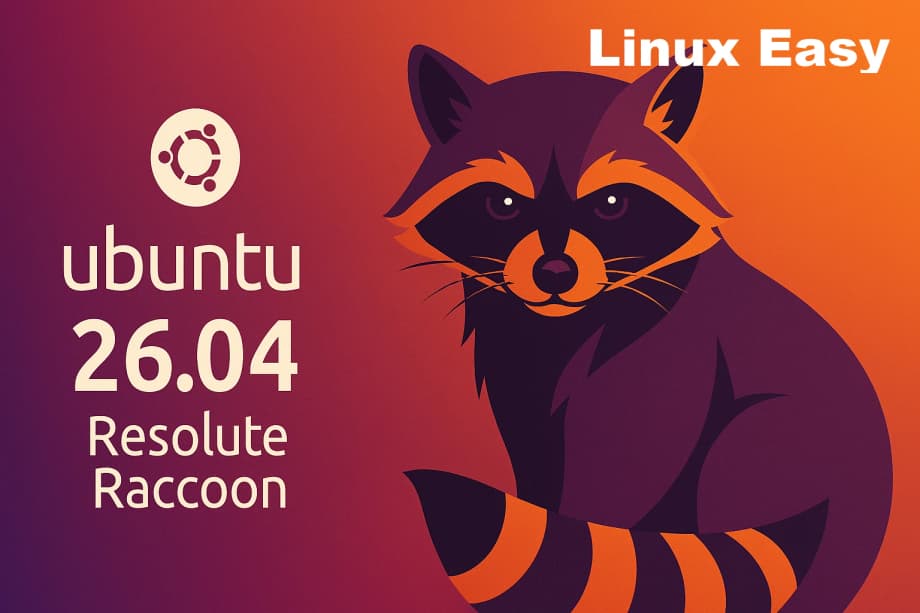
The Resolute Raccoon mascot emerged from both biological inspiration and community tribute. Raccoons have thrived in urban environments through adaptability and problem-solving intelligence, traits that mirror the open source community’s approach to software development. Canonical’s design team, led by artist Marcus Haslam, crafted a geometric, radial structure emphasizing system logic and consistency, with the character’s tail bands creating a visual rhythm throughout the composition.
The codename selection holds deeper meaning for those within the Ubuntu community. Steve Langasek, known widely by his IRC handle “Vorlon,” spent decades advocating for open source principles and shepherding Ubuntu releases through complex development cycles. His choice of “Resolute” reflects the determination he brought to his work, creating a lasting memorial within the distribution’s naming tradition.
Resolute Raccoon is a mascot designed around resilience and reliability, with a quiet confidence at its core. Resourceful and steady under pressure, it exemplifies a problem-solving mindset.
The release artwork extends beyond the default wallpaper, with nearly two hundred community submissions contributing to a diverse collection of backgrounds. Winners across mascot, digital abstract, and photography categories will grace desktops throughout the operating system’s lifespan, offering users extensive personalization options.
Wayland-Only Desktop and GNOME 50
Ubuntu 26.04 LTS stands as the first long-term support release to eliminate the X11 GNOME session entirely, establishing Wayland as the sole display protocol for the default desktop experience. While X11 applications continue functioning through the XWayland compatibility layer, users cannot launch a full X11 desktop session in the main Ubuntu distribution. This change, delayed from previous releases due to last-minute bugs, now proceeds with GNOME 50 providing the interface foundation.
The transition brings tangible benefits for modern hardware. Variable refresh rate (VRR) and fractional scaling graduate from experimental status to stable features, automatically activating on compatible displays. GNOME 50 introduces session save and restore capabilities, attempting to reopen windows and applications in their previous positions after reboots. The Nautilus file manager receives performance improvements, offering up to five times faster directory loading and ten times faster thumbnail generation.
Default Application Overhaul
The move to Wayland coincides with a comprehensive refresh of default applications. Showtime replaces Totem as the video player, offering a minimalist GTK4 interface that fades controls during playback. Resources supplants the System Monitor, providing hardware usage visualization through an engaging interface built with Rust. Papers takes over from Evince for document viewing, adding ink annotation tools and digital signature support. Loupe succeeds Eye of GNOME for image viewing, featuring multi-touch gesture support and basic editing capabilities.
Terminal users encounter Ptyxis, a GPU-accelerated emulator replacing GNOME Terminal. The application includes tab overview functionality, profile switching, and container support for Podman and Toolbox. A distinctive safety feature turns the header bar red when sudo privileges are active, providing visual confirmation of elevated permissions.
Memory Safety Through Rust Integration
Perhaps the most profound architectural change in Ubuntu 26.04 LTS lies beneath the surface, where critical system components have undergone “oxidation” (replacement with Rust implementations). The sudo command now executes through sudo-rs, a memory-safe rewrite eliminating buffer overflow vulnerabilities that plagued the original C implementation. Similarly, core utilities including ls, cp, mv, and cat now run through uutils, a Rust-based alternative to GNU coreutils.
This shift addresses fundamental security concerns. The 2021 CVE-2021-3156 vulnerability in traditional sudo remained undetected for ten years, allowing privilege escalation through memory management errors. Rust’s compile-time safety guarantees prevent such entire classes of vulnerabilities. While uutils currently passes approximately eighty-eight percent of GNU coreutils compatibility tests, both original implementations remain available in repositories for edge cases requiring full compatibility.
It’s the enhanced resilience and safety that is more easily achieved with Rust ports that are most attractive to me.
Jon Seager, Canonical’s Vice President of Engineering, has stressed that these changes prioritize resilience over performance improvements. The transition remains invisible to most users, with commands functioning identically while providing substantially improved security foundations.
Advanced Security and Encryption
Ubuntu 26.04 LTS strengthens security through multiple vectors beyond Rust integration. TPM-backed full disk encryption graduates from experimental status to a production-ready feature, binding encryption keys to specific hardware and Secure Boot states. Users can configure disk encryption during installation without entering passphrases at every boot, while the Security Center allows post-installation PIN management and re-encryption.
The release prepares for future computational threats by enabling post-quantum cryptography by default. OpenSSH utilizes the hybrid mlkem768x25519-sha256 algorithm, while OpenSSL applies X25519+ML-KEM for TLS connections. These hybrid approaches combine classical and quantum-resistant algorithms, maintaining compatibility with existing systems while protecting against potential quantum computing attacks.
Additional security enhancements include Snap Permissions Prompting, requiring explicit user approval when sandboxed applications access cameras, microphones, or file systems. The kernel gains Intel TDX support for hardware-isolated virtual machines, enabling confidential cloud computing scenarios. The Security Center application consolidates these features into a unified interface, replacing disparate configuration tools and reducing the cognitive load associated with hardening systems.
AI Development and GPU Computing
Canonical has positioned Ubuntu 26.04 LTS as a premier platform for artificial intelligence and machine learning workloads through native GPU computing support. AMD ROCm and NVIDIA CUDA packages now reside directly in Ubuntu’s official repositories, eliminating complex manual installation procedures previously required.
Developers can install ROCm using standard apt commands rather than adding external AMD repositories and managing signing keys manually. Canonical has established a dedicated engineering team to maintain these packages, providing security patches through standard update mechanisms. With Ubuntu Pro subscriptions, ROCm and CUDA packages receive support extending up to fifteen years.
These additions position Ubuntu competitively against specialized AI distributions, offering enterprise-grade stability alongside cutting-edge development tools. The inclusion eliminates version conflicts and dependency issues that previously complicated multi-GPU setups, particularly in server environments where automated deployment scripts benefit from standardized package availability.
The Linux 7.0 kernel (versioned thus because Linus Torvalds resets major versions when minor numbers approach twenty) brings improved hardware support for Intel Nova Lake and AMD Zen 6 processors, alongside initial Qualcomm Snapdragon X2 compatibility. A new Time Slice Extension mechanism allows applications to request brief execution time extensions during critical operations, benefiting audio processing and gaming workloads.
System Management and Package Evolution
Software management undergoes significant restructuring in this release. The Ubuntu App Center expands its capabilities to manage Deb packages alongside Snap applications, allowing users to uninstall traditional packages directly from the GUI. However, the Software & Updates application no longer ships by default, with Canonical determining that repository management features posed excessive risks for casual users. Those requiring PPA management must install the utility manually.
APT 3.2 introduces transaction history with rollback capabilities, logging every installation, upgrade, and removal with unique identifiers. New commands including apt why and apt why-not trace dependency chains, explaining package presence or absence. The system splits the linux-firmware package into eighteen vendor-specific sub-packages, reducing update bandwidth by allowing selective downloads rather than six hundred megabyte monolithic updates.
Server installations benefit from updated infrastructure components including PHP 8.5.2, PostgreSQL 18, MySQL 8.4, and OpenStack 2026.1. The next-generation Subiquity installer brings live-session comfort to server deployments, streamlining bare-metal and virtualized installations through automated partitioning and network configuration options.
Not all changes preserve legacy functionality. Support for cgroup v1 has been removed, potentially breaking older container workloads. The linux-lowlatency package has been retired in favor of lowlatency-kernel, which applies tuning via GRUB at boot. Google Drive integration no longer functions within Nautilus, requiring browser-based access.
Visual Identity and User Experience
Aesthetic changes accompany the technical improvements, beginning with a revamped Yaru icon theme. Folder icons now adopt shorter, squatter proportions with rounded edges and vivid accent color application. The Ubuntu Dock abandons transparency for an opaque background, improving contrast against varied wallpapers. New boot animations feature the raccoon mascot’s tail as a sunburst motif.
Accessibility improvements include relocated login screen menus, bold text in notifications, and a “reduce motion” setting for users sensitive to animations. The Wellbeing panel introduces optional screen time tracking and break reminders, while parental controls enable usage limits for managed accounts. Community artwork winners include “Simple Raccoon” by cnusr25 in the mascot category, “Ubuntu Coffee Mug” by ezspain in digital abstract, and “Winter Grand Triangle” by mizuno-as in photography.
Flavor Variations and Support Status
While the main Ubuntu distribution advances, not all official flavors maintain LTS status for this cycle. Ubuntu MATE and Ubuntu Unity have suspended their long-term support releases due to contributor shortages, though they continue with regular six-month releases. Remaining flavors including Kubuntu (KDE Plasma 6.6), Xubuntu (Xfce 4.20), Lubuntu (LXQt 2.3), Ubuntu Budgie (Budgie 10.10), Ubuntu Cinnamon (Cinnamon 6.4), Ubuntu Studio, and Edubuntu retain full LTS support.
System requirements have increased modestly, with Canonical recommending six gigabytes RAM for comfortable desktop operation, though the operating system will install on systems with less memory. Users with limited hardware may prefer lighter flavors such as Xubuntu or Lubuntu, which maintain lower resource requirements.
Upgrade Path and Support Timeline
Ubuntu 26.04 LTS receives standard security updates until April 2031, with Extended Security Maintenance extending through 2036 via Ubuntu Pro (available free for personal use on up to five machines). Commercial Legacy add-ons can extend support through 2041, providing fifteen years of coverage total.
Direct upgrades from Ubuntu 24.04 LTS remain disabled until the 26.04.1 point release arrives on August 6, 2026, following Canonical’s standard practice of allowing initial bug fixes before enabling LTS-to-LTS migrations. Users requiring immediate upgrades must perform clean installations. Those currently running Ubuntu 25.10 should receive upgrade prompts within days of release.
Organizations planning infrastructure deployments should consider testing environments before production migration. The combination of Wayland-only operation, Rust-based utilities, and revised system requirements necessitates compatibility verification for specialized workflows.
The Bottom Line
- Ubuntu 26.04 LTS “Resolute Raccoon” released April 23, 2026, with five-year standard support extending to fifteen years via Ubuntu Pro
- First LTS release to ship Wayland-only for GNOME desktop, removing X11 session support while maintaining XWayland for application compatibility
- Critical system components including sudo and core utilities rewritten in Rust for memory safety, with original versions available as fallback options
- TPM-backed disk encryption and post-quantum cryptography enabled by default, establishing new security benchmarks
- Native AMD ROCm and NVIDIA CUDA support in official repositories simplifies AI and machine learning deployment
- Linux kernel 7.0 with improved hardware support for latest Intel, AMD, and Qualcomm processors
- Default applications refreshed with Showtime, Resources, Papers, Loupe, and Ptyxis replacing legacy tools
- Ubuntu MATE and Ubuntu Unity flavors do not receive LTS status due to resource constraints
- Direct upgrades from Ubuntu 24.04 LTS deferred until August 2026 point release; clean installation available immediately