The Crisis in the Countryside
Across the mountainous regions and coastal plains of South Korea, a silent transformation is underway. Once vibrant farming communities are gradually emptying as younger generations migrate to urban centers, leaving behind a landscape of abandoned homes and shuttered businesses. This phenomenon, known as regional extinction, has reached critical levels in Northeast Asia, where birth rates have plummeted and aging populations have concentrated in major cities while rural villages face demographic collapse.
The statistics paint a stark picture of this urban rural divide. In Seoul, the population of those aged 19 to 39 has fallen from 3.18 million in 2016 to 2.86 million in 2023, yet the capital continues to absorb resources while the countryside hollows out. Empty houses, known as vacant houses in Korea and akiya in neighboring Japan, now dot rural landscapes like architectural ghosts. These structures, often decades old and built in traditional styles with curved tile roofs and wooden beams, represent both a safety liability and an untapped resource for communities struggling to survive economic stagnation.
Recognizing the urgency of this demographic crisis, the South Korean government has launched an ambitious initiative that reimagines the very concept of rural hospitality and community development. Rather than viewing abandoned properties as blight to be demolished, officials are increasingly treating them as the foundation for a new economic model that could reverse migration patterns. This approach draws inspiration from across the East Sea, where Japanese innovators have pioneered a concept that turns entire villages into decentralized hotels, creating new economic lifelines for dying communities.
A Japanese Blueprint for Survival
The recent Rural Empty House Regeneration Forum in Mungyeong, North Gyeongsang Province, brought together Korean policymakers and private sector leaders to examine solutions to this growing crisis. The event featured a prominent guest from Japan: Shunpei Shimada, chief executive of Satoyume Corp., a consulting firm specializing in regional revitalization. Shimada has become something of a legend in rural development circles for his work on the Kosuge Village hotel project, which has served as a regional benchmark for breathing life back into dying communities.
The village hotel concept represents a radical departure from traditional tourism infrastructure. Rather than constructing a single massive resort building that dominates the landscape, this model transforms the entire community into the hotel itself. An abandoned house becomes the reception desk. Another derelict property is renovated into a luxury guest suite. The local public bath, perhaps once facing closure due to lack of customers, now functions as the spa. Neighborhood residents, many of them elderly, find employment staffing the village restaurant or offering local knowledge to visitors.
Kosuge, the remote Japanese hamlet that served as the proof of concept for this model, was once on the brink of vanishing entirely. Today, it welcomes 180,000 visitors annually, a remarkable turnaround for a community with only hundreds of residents. The success has not gone unnoticed. Satoyume now operates similar village hotels in more than 50 regions across Japan, demonstrating that the model can be replicated with the right combination of community engagement and architectural vision.
Escaping Hell Joseon
The Korean adoption of this Japanese model comes at a moment of profound social crisis in the nation’s capital. Young South Koreans have coined a bitter term for life in Seoul: Hell Joseon, a reference to the ancient kingdom that once occupied the peninsula. This expression captures the suffocating pressure of a city where housing costs have spiraled beyond reach and corporate culture demands endless work hours while offering limited rewards.
The desperation driving this exodus is palpable in individual stories. Kim Ji-ung, a former salesman in his early 30s, recalls his life in Seoul as a period of profound isolation. Single and living alone, he spent his days at work or holed up in his apartment, scrolling through television channels or playing video games. The turning point came when a close friend collapsed at work and died, prompting Kim to question whether he was heading toward the same fate.
His escape route appeared through an online advertisement for Don’t Worry Village in Mokpo, a southwestern city with a population of 210,000 and an abundance of abandoned buildings. Founded by Hong Dong-woo, another Seoul deserter who rejected the predetermined path of university and corporate employment, the village was designed as a community where young people could find the social connections missing in urban life.
The phenomenon Kim represents has been studied by academics as the rise of Young In-migrant Tourism Entrepreneurs, or YMTEs. These individuals represent a form of counter urbanization driven by rural post productivism and government support policies. Unlike previous generations who viewed rural areas merely as sites of agricultural production, these young migrants see them as spaces for creative enterprise, community building, and lifestyle redesign. Research analyzing interviews with 20 such entrepreneurs reveals that they are driven not merely by economic necessity but by a desire for meaningful social connections and control over their time.
How Village Hotels Work
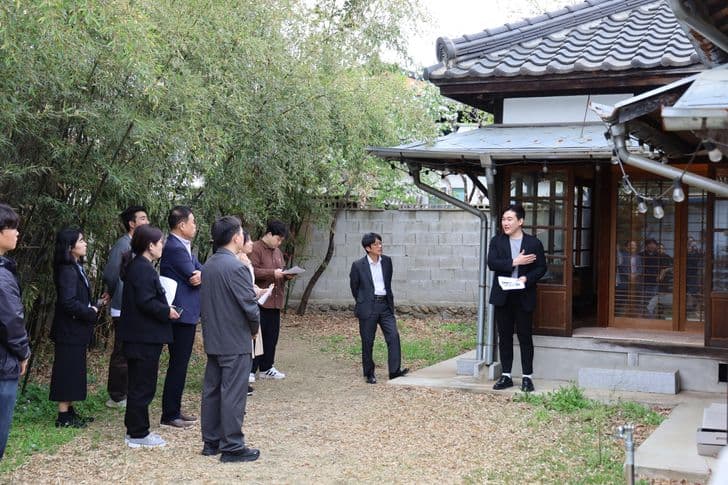
The implementation of the village hotel concept in Korea involves a sophisticated blend of public policy and private innovation. At the recent forum in Mungyeong, officials toured Sanyang Jeonghaengso, a former brewery that had fallen into disrepair before being repurposed into a multi-use cultural hub. The site demonstrates the positive interaction that occurs when private creativity meets public support, attracting 60,000 tourists last year by blending regional agricultural products with modern cafe aesthetics.
The Korean company Replace, a subsidiary of hospitality tech firm H2O Hospitality, has emerged as the primary domestic partner for this initiative. Replace has already renovated 200 year old traditional houses and abandoned industrial tanks in Mungyeong, and recently signed a memorandum of understanding with Satoyume to create a distinctly Korean version of the village hotel model. The partnership aims to combine Satoyume’s operational experience with Replace’s spatial planning capabilities to recreate Japan’s success by 2028.
The mechanics of these projects are intricate. Rather than centralizing all amenities in one location, the village hotel distributes functions across multiple properties. A guest might check in at a renovated farmhouse that serves as the reception, then retire to a private suite in a traditional hanok located several streets away. Breakfast could be served in a cafe operated by local residents, while evening meals feature ingredients sourced from gardens maintained by elderly villagers who have become part of the hospitality workforce.
This decentralized approach offers several advantages. It spreads economic benefits throughout the community rather than concentrating them in a single corporate entity. It preserves the architectural character of the village by renovating existing structures rather than constructing new ones. It also creates a more authentic experience for visitors, who interact with the actual fabric of rural life rather than a simulation of it.
Government Policy and Financial Tools
Behind these cultural shifts stands a framework of aggressive administrative measures designed to accelerate the renovation process. The Ministry of Agriculture, Food and Rural Affairs has taken the unusual step of increasing financial support for demolition, more than doubling the maximum subsidy to 16 million won ($11,540) per house. This recognizes that some abandoned properties are beyond saving and must be cleared to make way for new uses or to eliminate safety hazards.
For properties with architectural or historical value, the government is expanding its Vacant House Bank, an online platform that matches derelict properties with urbanites looking to relocate for work or entrepreneurship. This digital marketplace serves as a bridge between aging rural landowners who can no longer maintain their properties and young urban professionals seeking affordable spaces to live and work.
The next frontier for this strategy is Jeju Island, where officials have designated a Startup Village in the Hankyeong district. Here, 15 abandoned homes will undergo transformation into coworking spaces and long-term residences specifically designed for digital nomads and remote workers. This represents a recognition that the future of rural Korea may depend on attracting workers who can perform their jobs from anywhere, provided they have reliable internet access and suitable living spaces.
Jeon Han-young, director of the ministry’s Rural Policy Bureau, encapsulated the philosophical shift underlying these policies. He stressed that vacant houses should be viewed not as blight, but as regional resources. This perspective represents a significant departure from previous approaches that often treated rural depopulation as an irreversible trend to be managed rather than a problem to be solved through creative intervention.
Two Types of Rural Migration
While the village hotel model targets young entrepreneurs and digital nomads, it exists alongside a very different form of rural labor migration. South Korea’s agricultural sector currently relies heavily on approximately 56,000 migrant workers from 16 countries, primarily entering on E9 and E10 visas. These individuals perform the essential labor that keeps Korean farms operational, filling the gaps left by young Koreans who have abandoned agricultural work.
The contrast between these two groups could not be more stark. The YMTEs and digital nomads arrive with government support for entrepreneurship, seeking lifestyle fulfillment and community connection. They are celebrated as pioneers of rural revitalization. Meanwhile, many migrant laborers face conditions that activists describe as abusive. A Cambodian worker identified only as Botum worked 16-hour days at a strawberry farm for 1.4 million won monthly, sleeping in a plastic greenhouse with a broken ceiling during winter months.
Rights advocates note that abuse against migrant workers appears more commonplace at farms and fishing villages than at factories or construction sites. Female workers face additional risks, with a 2016 study indicating that 48 percent of migrant women either experienced sexual harassment or witnessed it. The murder of a Thai migrant worker by her employer last year highlighted the extreme dangers facing this vulnerable population.
This dual reality raises complex questions about the future of rural Korea. The village hotel model promises to bring capital and creativity to dying communities, yet the actual agricultural work that defines these regions continues to depend on a marginalized workforce. As Korea prepares new special laws to streamline restorations and attract more urban migrants, activists argue that any comprehensive rural policy must also address the working conditions of those who currently sustain the agricultural economy.
The Hard Realities of Rural Revival
Despite the enthusiasm surrounding village hotels and startup communities, the hard data suggests that reversing rural decline remains an uphill battle. Government figures reveal that while approximately 10,000 people have participated in workshops at youth centred communities across the country, only about 900 have actually remained in these locations. At Don’t Worry Village specifically, despite hosting more than 21 workshops and attracting over 2,000 visitors, only 20 people have chosen to stay permanently.
The challenges facing rural migrants extend beyond finding affordable housing. Workplaces and key infrastructure remain concentrated in Seoul and other major cities. Digital nomads may thrive in renovated hanoks with high speed internet, but those seeking traditional employment often find limited opportunities outside urban centers. The infrastructure for healthcare, education, and transportation in rural areas remains underdeveloped compared to the capital, creating practical barriers for families considering relocation.
Meanwhile, the suicide rate in South Korea has reached 28.3 per 100,000 people in 2024, a 13-year high, with young people accounting for a significant portion of cases. While rural communities offer an escape from Hell Joseon, they cannot single-handedly resolve the deeper social isolation and economic pressures driving this mental health crisis. The government has launched initiatives such as Seoul Without Loneliness, investing 451.3 billion won over five years in emotional support hotlines and community centers, yet the fundamental tension between economic opportunity and quality of life persists.
As Korea and Japan continue to share experiences through forums and exchange programs, including the proposed Korea-Japan Village Hotel Network, both nations face the reality that architectural innovation alone cannot reverse demographic trends. The silence of the countryside may be broken by the arrival of new workers, but whether they remain depends on creating sustainable economic ecosystems that support long-term residency.
Key Points
- Korea is adopting Japan’s village hotel model to combat rural depopulation, transforming abandoned houses into decentralized hospitality networks
- The Ministry of Agriculture has doubled demolition subsidies to 16 million won and expanded the Vacant House Bank platform to match properties with urban migrants
- Japanese firm Satoyume Corp. and Korean company Replace have partnered to create a localized version of the village hotel concept by 2028
- The initiative targets Young In-migrant Tourism Entrepreneurs escaping Seoul’s high costs and stressful work culture, known as Hell Joseon
- Only 900 out of 10,000 workshop participants have actually relocated to rural youth communities, highlighting retention challenges
- The policy contrasts sharply with conditions faced by 56,000 migrant agricultural workers who sustain farms but often face abuse and poor housing
- Jeju Island will host a Startup Village converting 15 abandoned homes into coworking spaces for digital nomads