Turning Dead Space Into Digital Infrastructure
Tokyo faces a paradox that defines modern urban centers. The city serves as Asia’s technological heartbeat, yet it is running out of physical room to house the digital infrastructure powering that heartbeat. In response to this scarcity, a consortium of four Tokyu Group companies announced on March 23 an unconventional solution that will transform otherwise unused urban real estate into computing power. Starting in June 2026, the group plans to install a modular data center beneath an elevated section of the Oimachi Line, testing whether server infrastructure can operate reliably in the shadow of thundering trains.
The experiment represents more than an engineering curiosity. It signals a potential shift in how densely packed cities might approach digital infrastructure deployment when traditional construction becomes economically unfeasible. By utilizing the dead space beneath railway overpasses, Tokyu aims to bypass the land scarcity and permitting delays that currently strangle data center expansion in Japan’s capital.
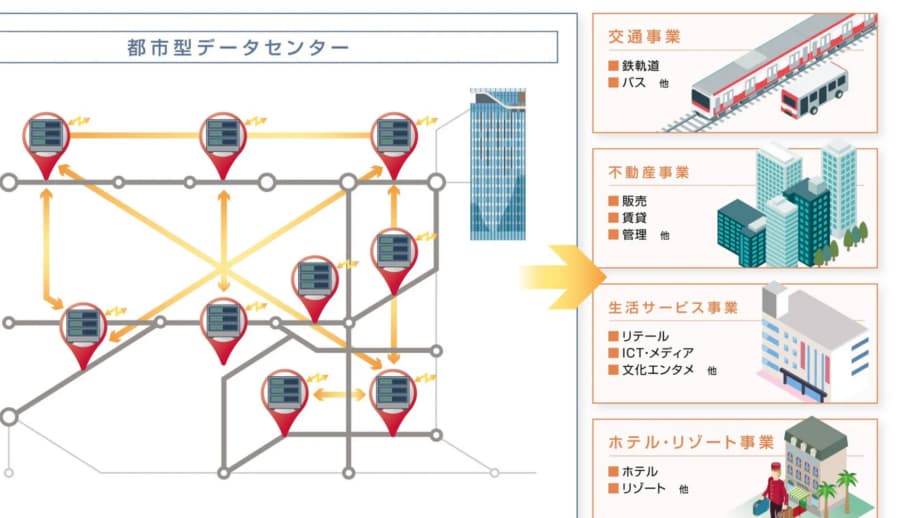
The consortium brings together distinct expertise from across the Tokyu empire. Tokyu Construction is developing the container-sized modular unit itself, engineering an enclosure that packages servers, cooling systems, and power supply equipment into a deployable format requiring no traditional building construction. Tokyu Electric Railway is providing the site beneath the elevated track, effectively contributing real estate that generates no current revenue. It’s Communications Corporation, the group’s telecommunications arm, will supply fiber connectivity through optical cables already installed along the railway corridor. Tokyu Corporation coordinates the overall initiative as the parent company.
Surviving the Tokyo Shake
The technical challenges facing this installation would give most data center engineers pause. Active railway overpasses present a hostile environment for sensitive electronic equipment. Every passing train introduces vibration that can loosen connections, damage hard drives, and stress solder joints on circuit boards. The thermal environment fluctuates dramatically as steel structures heat in direct sunlight and cool rapidly in evening shadows. Acoustic noise from rolling stock creates additional stress factors for both equipment and any necessary maintenance personnel.
The consortium plans to measure four critical performance metrics during the trial period: sound insulation effectiveness, thermal insulation capabilities, vibration isolation performance, and cooling system efficiency under these specific environmental conditions. These measurements will determine whether the modular format can maintain the precise temperature and stability standards that server hardware demands when situated meters beneath tons of moving steel.
Data centers typically require exacting environmental controls. Temperature fluctuations can cause hardware expansion and contraction, leading to premature component failure. Vibration, often measured in gravitational units, must be kept below specific thresholds for spinning disk drives and even solid-state storage systems. The Tokyo experiment will effectively test whether industrial-grade isolation systems can filter out the rhythmic pounding of urban rail traffic.
Plugging Into Existing Arteries
One strategic advantage makes this railway deployment particularly viable compared to other urban infill projects. It’s Communications has already constructed a large-capacity optical fiber network running along Tokyu’s rail lines, creating a high-speed digital backbone that typically requires expensive trenching and municipal permitting to establish. Rather than excavating city streets to lay new fiber connections, these under-track installations can tap directly into existing telecommunications infrastructure.
This connectivity strategy eliminates one of the most time-consuming and expensive aspects of data center deployment. In dense urban environments, securing rights-of-way for fiber optic cables often involves negotiations with multiple property owners, city governments, and utility companies. By utilizing the railway infrastructure that already possesses robust communication lines, the modular units can achieve immediate network integration.
The consortium has indicated that successful results could lead to broader deployments across the Tokyu Line network, with Shibuya specifically mentioned as a target location. This suggests a long-term digital infrastructure strategy that treats the railway corridor not merely as transportation infrastructure, but as a linear digital highway with ready-made real estate for edge computing facilities.
A City Running Out of Room
The urgency driving this unconventional experiment stems from severe infrastructure constraints currently gripping Tokyo’s data center market. Land prices in the capital rose 69% in 2024 according to research firm Mordor Intelligence, making traditional facility construction prohibitively expensive for many operators. The city already hosts 132 operational data centers with at least 18 additional facilities currently under construction, yet demand continues outpacing supply.
Perhaps more critically, power infrastructure cannot support the pace of digital expansion. Yasuo Suzuki, executive vice president and managing director for Japan and APAC at NTT Global Data Centers, provided a stark assessment of the situation in a recent industry interview. He noted that power grid connection wait times in inner Tokyo can stretch between five and ten years, creating an insurmountable barrier for companies needing immediate computing capacity.
Power grid connection wait times in inner Tokyo can stretch five to 10 years.
This bottleneck has shifted market dynamics toward smaller, faster-deployable solutions. Medium-sized data center facilities in Japan are growing at a 12% compound annual growth rate through 2031, significantly outpacing larger builds precisely because they can be deployed more rapidly in constrained urban environments. Modular installations like those proposed by Tokyu represent the extreme end of this trend, prioritizing deployment velocity and creative real estate utilization over traditional facility scale.
Container-Sized Computing
The modular data center concept has gained traction globally as a response to exactly these kinds of spatial constraints. Unlike traditional facilities that require years of architectural planning, foundation work, and building construction, modular units arrive as pre-engineered containers housing fully integrated systems. These enclosures can be manufactured off-site while permits are processed, then craned into position and connected to existing utilities.
Tokyu Construction’s specific design for the Oimachi Line test will likely incorporate advanced vibration damping systems, potentially including spring isolators, rubberized mounting platforms, or active counter-vibration technologies. Cooling systems must operate efficiently despite ambient temperature swings caused by the overhead steel structure’s solar gain. The units will also require specialized weatherproofing to protect against rain splash-back and urban pollution common in railway environments.
Maintenance access presents additional operational complexities. Unlike ground-level facilities where technicians can approach from any direction, under-track installations offer limited clearance and potentially hazardous proximity to electrified rails. The consortium will need to develop specific maintenance protocols that ensure both personnel safety and railway operational continuity, possibly including scheduled maintenance windows during low-traffic periods or specialized access platforms.
From Oimachi to the Future
The June 2026 deployment on the Oimachi Line serves as a proof of concept for a potentially expansive network. If the modular units demonstrate acceptable failure rates and thermal stability beneath the railway, Tokyu could rapidly deploy similar facilities across its extensive network, converting thousands of meters of unused under-track space into revenue-generating digital infrastructure.
The mention of Shibuya as a future location carries particular significance. As one of Tokyo’s busiest commercial and transportation hubs, Shibuya represents high-value real estate where traditional data center construction would face maximum financial and logistical barriers. Successfully deploying modular units in such a dense environment would validate the concept for other global megacities facing similar space constraints, from Hong Kong to Manhattan.
This initiative also reflects broader trends in urban infrastructure hybridization. Railway operators globally are exploring secondary uses for their linear real estate assets, including solar panel installations, commercial retail pods, and now computing facilities. By utilizing existing fiber networks and dormant real estate, Tokyu is effectively creating a new asset class that bridges transportation and telecommunications infrastructure.
The experiment’s success remains unproven. Vibration-induced hardware failures might prove too frequent for commercial viability. Thermal management might require excessive energy consumption. Maintenance costs under active rail lines might eliminate profit margins. Yet the attempt itself signals a necessary evolution in urban digital infrastructure, acknowledging that the traditional model of dedicated, ground-up data center construction cannot satisfy the computing demands of increasingly dense global cities.
The Essentials
- Four Tokyu Group companies announced plans on March 23 to install a modular data center beneath Tokyo’s Oimachi Line starting June 2026
- The trial will test server reliability under active railway conditions, measuring vibration isolation, thermal insulation, sound insulation, and cooling performance
- Tokyu Construction is developing the container-sized unit while It’s Communications provides fiber connectivity through existing rail-line networks
- Tokyo’s data center market faces severe constraints, with land prices rising 69% in 2024 and power grid connection waits extending five to ten years according to NTT Global Data Centers
- Success could lead to expanded deployments across the Tokyu network including Shibuya, utilizing otherwise dead space beneath elevated tracks
- Medium-sized data center facilities in Japan are growing at 12% annually through 2031 as operators seek faster deployment in space-constrained urban environments