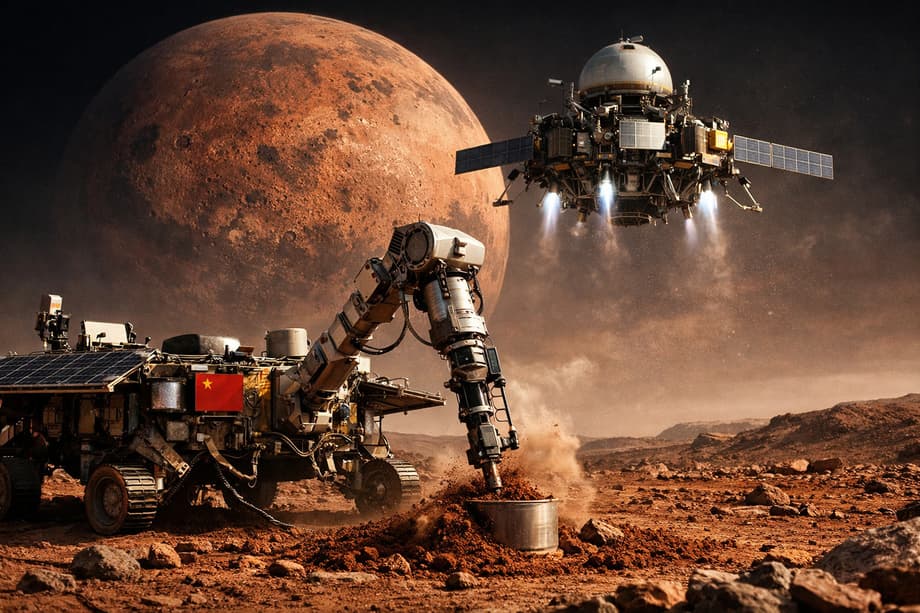
The Race to Answer Humanity’s Oldest Question
China is positioning itself to achieve what no nation has accomplished before: bringing physical samples from Mars back to Earth. The Tianwen-3 mission, scheduled for dual launches in 2028, aims to return at least 500 grams of Martian material by 2031, potentially securing a historic first in deep space exploration while answering one of science’s most fundamental questions. Liu Jizhong, chief designer of the mission, announced during China’s annual political sessions in March that the project has achieved breakthroughs in key technologies and will enter the flight model development phase this year. This timeline places China on a trajectory to potentially beat competing international efforts to the Red Planet and back, with implications that extend far beyond national prestige.
The mission represents the culmination of years of planning and builds upon China’s previous Mars success. In 2021, the Zhurong rover landed on Mars as part of the Tianwen-1 mission, making China only the second country to operate a rover on the Martian surface. That mission found evidence of water ice mixed with soil and gravel beneath the surface, a discovery that heightened scientific interest in returning physical samples for detailed laboratory analysis. Unlike robotic explorers that must carry miniaturized instruments millions of kilometers from Earth, returned samples would allow scientists to use the full power of terrestrial laboratories to hunt for microscopic fossils, organic compounds, and chemical signatures that might indicate whether life ever existed on our neighboring planet.
The stakes involve more than scientific curiosity. If successful, Tianwen-3 would mark the first time humanity has retrieved material from another planet capable of potentially harboring life, establishing China as a leader in planetary exploration and creating new opportunities for international scientific collaboration. Liu Jizhong described the undertaking as a highly challenging and pioneering major aerospace project during his announcement to the press.
The Tianwen-3 mission is a highly challenging, innovative and leading major aerospace project. It is expected to achieve humanity’s first Mars sample return, greatly promoting the high-quality integrated development of space science, space technology and space applications.
Engineering an Unprecedented Mission
Unlike previous Mars missions that relied on single launches, Tianwen-3 employs a complex two-launch architecture requiring precise coordination between multiple spacecraft. Two Long March 5 carrier rockets will lift off during the optimal Mars launch window in late 2028, each carrying separate components of the mission. One rocket will transport an orbiter combined with an Earth return vehicle, while the other carries a lander equipped with an ascent vehicle and service module. This dual-launch approach addresses the massive energy requirements of sending both landing and return systems to Mars simultaneously while ensuring each component carries sufficient fuel for its specific tasks.
The mission sequence spans more than three years and involves thirteen distinct phases. After seven to eight months of interplanetary travel, the lander will touch down at a carefully selected site between 17 and 30 degrees north latitude, where engineering constraints balance against scientific potential. The spacecraft must land at least three kilometers below Mars’s global average altitude to ensure sufficient atmospheric density for deceleration during entry. Once on the surface, the lander will operate for approximately one year, collecting samples through multiple methods including surface scooping, deep drilling, and drone-assisted collection from locations several hundred meters away.
The ascent phase presents one of the greatest technical challenges in spaceflight history. After collecting and sealing samples, the ascent vehicle must launch from the Martian surface using the lander as a launch pad, achieving Mars orbit for the first time from the planet’s surface. In orbit, the ascent vehicle must rendezvous and dock with the waiting orbiter, transferring the precious cargo before the return vehicle begins its journey back to Earth. This orbital rendezvous around Mars has never been attempted before and requires precision navigation in an environment where ground control cannot provide real-time guidance due to communication delays lasting up to 20 minutes.
Drilling for Evidence of Ancient Life
The primary scientific objective driving Tianwen-3 is the search for biosignatures, physical or chemical indicators that life once existed on Mars. While previous missions have detected organic molecules and ancient lake beds, the ability to analyze samples in Earth’s advanced laboratories offers the best chance of finding definitive proof of past microbial life. To maximize these odds, mission planners have developed an ambitious sampling strategy that includes drilling two meters beneath the Martian surface, a depth never before attempted by any Mars mission and significantly deeper than the shallow surface collections planned by other programs.
This depth is critical for astrobiological success. Mars lacks a global magnetic field and possesses a thin atmosphere, leaving the surface constantly bombarded by cosmic radiation and exposed to highly oxidizing chemicals that destroy organic materials over time. By drilling below this hostile surface layer, the mission hopes to reach sediments that have been shielded from radiation for billions of years, potentially preserving organic compounds or even microscopic fossils from an era when Mars possessed liquid water and a denser atmosphere. The drilling system must detect and avoid obstacles like bedrock while maintaining sample integrity in the harsh Martian environment.
The landing site selection process reflects the mission’s biological focus. Scientists have identified 86 potential sites from an initial pool of over 80 candidates, narrowing these to 19 prime locations concentrated in Amazonis Planitia, Utopia Planitia, and Chryse Planitia. These regions feature ancient coastlines, delta deposits, clay minerals, and canyon systems that form in water-rich environments where life might have emerged and been preserved. By the end of 2026, the team will select three final candidate sites that offer the optimal balance of scientific merit and engineering safety. The selection criteria prioritize locations with hydrated minerals that indicate past water activity while meeting strict requirements for slope angles under 8 degrees and rock abundance below 10 percent to ensure safe landing.
Beijing Opens the Door to Global Partners
In a move that signals China’s confidence in the mission’s technical readiness, the China National Space Administration announced on March 11, 2025, that Tianwen-3 is open to international collaboration. The call for proposals offers 15 kilograms of payload capacity on the Earth return orbiter and an additional 5 kilograms on the Mars orbiter for scientific instruments developed by international partners. This invitation represents a significant shift toward shared scientific ownership of what could become one of the most important space missions in history, with proposals due by June 30, 2025, and final selections scheduled for October of the same year.
Interested international teams can propose piggyback payloads requiring support from the Tianwen-3 spacecraft or independent scientific instruments that align with the mission’s overarching scientific objectives. Selected partners must deliver their flight hardware by 2027 to integrate with the spacecraft before the 2028 launch window. Proposed investigations must complement the search for life, studies of Martian geology, or examinations of atmospheric processes, though innovations that extend the mission’s value are also welcome. This collaborative framework positions Tianwen-3 as a global platform for advancing humanity’s shared scientific interests rather than solely a national project.
Hou Zengqian, chief scientist of the mission and an academician of the Chinese Academy of Sciences, emphasized the collaborative approach in a recent article published in Nature Astronomy. He noted that China hosted international conferences during the goal-setting phase and plans to open access to returned samples for global researchers once planetary protection protocols are satisfied. Hou expressed hope that the mission would provide the international community with an unprecedented opportunity to understand Mars, potentially attracting partnerships from European, Asian, and other spacefaring nations looking to participate in the historic first return of Martian material.
Planetary Protection and Technical Safeguards
The prospect of returning material from another planet raises profound safety questions that mission planners must address with extreme care. Planetary protection protocols, established by the Committee on Space Research, require strict measures to prevent both forward contamination of Mars by Earth organisms and backward contamination of Earth by potential Martian life. China has committed to following these international standards, recognizing that the mission’s scientific integrity depends on ensuring that any biological discoveries truly originate from Mars rather than being contaminants carried from Earth. Strict contamination control is a critical challenge that must be addressed through every phase of the mission.
To manage these risks, China is constructing a specialized Mars Sample Laboratory on the outskirts of Hefei, near the Chinese Academy of Sciences’ Institute of Physical Sciences. This facility will feature ultra-clean rooms and biosafety containment areas where returned samples will undergo comprehensive testing, sterilization, and biological risk assessment before release to the broader scientific community. The samples will remain isolated from Earth’s environment until rigorous analysis confirms they contain no active biological agents that could threaten terrestrial ecosystems. Only after safety confirmation will materials be distributed to designated laboratories worldwide for detailed analysis.
The engineering team has already achieved breakthroughs in the critical technologies required for the mission, including Mars surface sampling and sealing, ascent from the Martian surface, orbital rendezvous, and sample transfer mechanisms. The mission requires developing a special soil sampling system that must collect samples and seal them securely to ensure the material arrives intact on Earth. Liu Jizhong noted that retrieving samples from Mars represents the most technically challenging space exploration mission since the Apollo program, and such a retrieval has never been realized. The complexity involves not just the mechanical systems but also the biological containment and chain-of-custody procedures that must maintain sample integrity from the Martian surface through atmospheric reentry and laboratory analysis.
Shifting Global Dynamics in Space Exploration
While China advances toward its 2028 launch date, NASA’s competing Mars Sample Return program faces significant uncertainty. A House appropriations bill enacted in early 2025 effectively canceled the current MSR architecture, redirecting $110 million toward future Mars technology studies rather than the sample return mission. Although the Senate has considered authorization bills calling for a new MSR effort, the United States currently lacks a clear path to returning Martian samples before the 2030s, creating a window of opportunity for China to achieve this milestone first and potentially claim the scientific and diplomatic advantages that accompany such an achievement.
This shift in timelines carries strategic implications beyond scientific prestige. The nation that first returns Martian samples will control the initial distribution of these precious materials to the global research community, potentially influencing the direction of astrobiological research for decades. Samples from Mars could reveal whether life emerged independently on two planets in our solar system, a discovery that would fundamentally alter our understanding of biology and suggest that life might be common throughout the universe. If China succeeds while other programs face delays, international partnerships and payload opportunities may increasingly flow toward Beijing’s space initiatives.
China’s progress occurs within a broader context of expanding deep space capabilities. The Tianwen-2 mission, launched in 2025, is currently en route to the near-Earth asteroid Kamo’oalewa, having traveled approximately 700 million kilometers, and will reach its target this year to conduct sampling operations before returning to Earth by late 2027. Looking further ahead, Tianwen-4 is planned for launch around 2030 to study the Jupiter system and eventually orbit Callisto, one of the gas giant’s icy moons. This steady progression from lunar to Martian to outer solar system exploration demonstrates China’s systematic approach to deep space science and its commitment to long-term presence in space exploration.
From Prototype to the Red Planet
With flight model development now underway and prototypes transitioning to formal hardware construction in 2026, the Tianwen-3 team is moving from design studies to physical assembly. The mission’s 13 phases include Earth launch, Mars transfer, entry descent and landing, surface sampling, ascent, Mars orbit rendezvous, Earth return, and atmospheric reentry, each requiring precise execution across hundreds of millions of kilometers. The entire process will span over three years from launch to the return of samples in 2031, with the spacecraft carrying advanced scientific payloads to support its astrobiological priorities.
The instruments selected for the mission reflect its search for life. The lander will carry a Mars Subsurface Penetrating Radar to probe underground layers and a Raman and Fluorescence Analyzer to detect organic materials and minerals similar to NASA’s Perseverance rover instruments. The orbiters will study atmospheric escape processes and magnetic fields using specialized magnetometers and energetic particle detectors, while imaging systems will map surface composition in mid-infrared and multispectral bands. These tools will support the nine research themes established by the mission science team, covering life-related elements, environmental conditions, and geological history from surface features to internal dynamics.
As development continues, the mission maintains its invitation to domestic and international scientists to participate in what leadership describes as a demonstration of Chinese creativity and international influence. Whether Tianwen-3 finds definitive evidence of ancient Martian life or returns samples that tell a story of a sterile but geologically fascinating world, the mission promises to deliver answers that have occupied scientists for generations. The effort represents humanity’s next step beyond Earth, following the philosophy that while our planet remains humanity’s cradle, we cannot stay in the cradle forever.
The Essentials
- Tianwen-3 is scheduled for dual launches in 2028 using Long March 5 rockets, with sample return to Earth planned for 2031
- The mission aims to collect at least 500 grams of Martian soil and rock through surface sampling and 2-meter deep drilling
- Primary scientific goal is searching for biosignatures and evidence of past or present life on Mars
- Mission architecture involves two separate spacecraft that will rendezvous in Mars orbit, a feat never before accomplished
- China opened the mission to international partners in March 2025, offering 20 kilograms of total payload capacity for foreign scientific instruments
- Engineering constraints limit landing sites to between 17 and 30 degrees north latitude and at least 3 kilometers below Mars’s average altitude
- A specialized containment facility in Hefei will handle returned samples under strict planetary protection protocols to prevent Earth contamination
- The mission enters flight hardware construction phase in 2026, following successful development of key technologies including Mars ascent and orbital rendezvous