
The New Arsenal: Cluster Bombs and Electromagnetic Weapons
North Korea has conducted a sweeping series of weapons tests this month, unveiling cluster-bomb missiles capable of blanketing areas equivalent to ten football fields with submunitions, alongside electromagnetic weapons designed to cripple electrical grids. The tests, which included a new mobile air defense system and a missile engine built from low-cost materials, represent more than routine military modernization. They signal a deliberate effort by Pyongyang to integrate battlefield lessons from the ongoing wars in Ukraine and the Middle East into a comprehensive strategy designed to strain missile defenses, survive sustained air attack, and fight through a regional conflict in Asia.
Contents
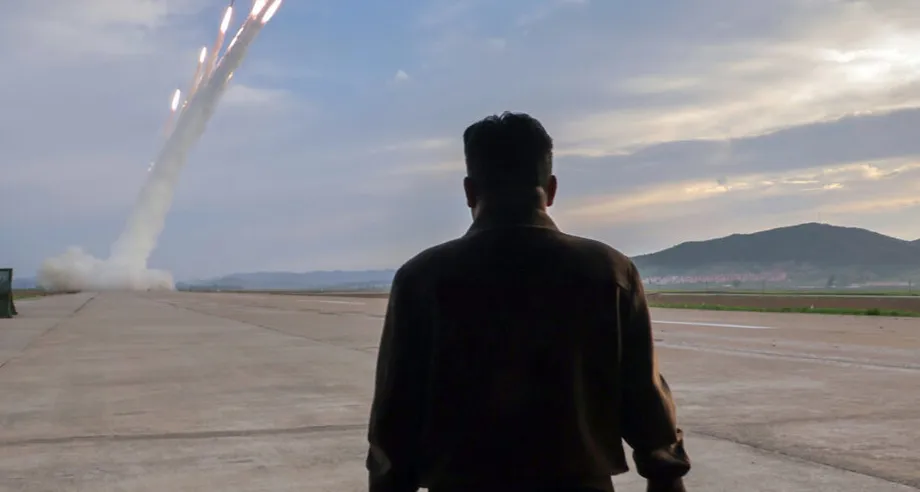
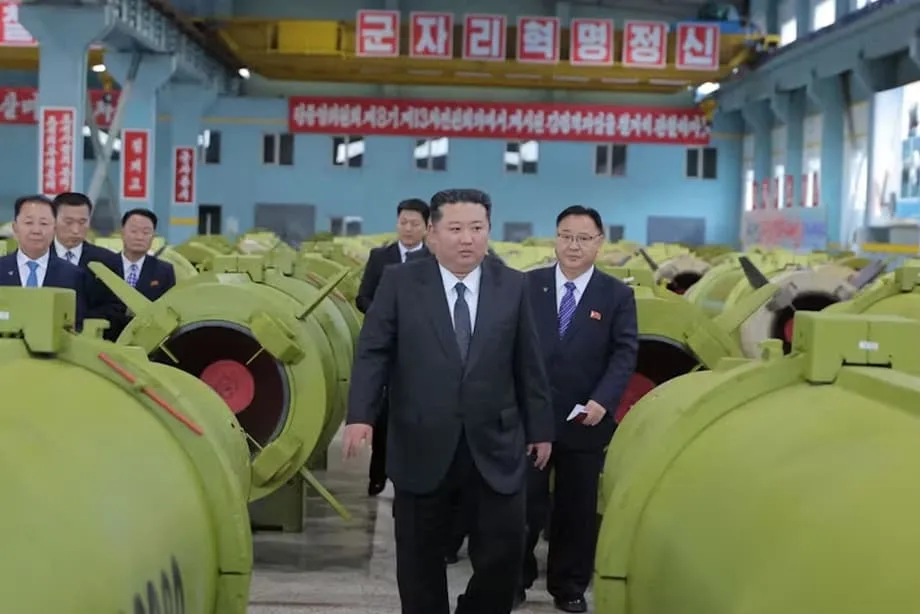
The Hwasong-11A (KN-23) short-range ballistic missile featured a cluster-munition warhead that state media claimed could "reduce to ashes any target" covering approximately seven hectares. This dispersal pattern allows a single missile to target dispersed infantry formations, air defense batteries, or logistics hubs with hundreds of submunitions, dramatically increasing the cost effectiveness of each launch by complicating point defense systems. Missiles launched during the tests flew between 241 and 698 kilometers off North Korea's east coast, prompting South Korean officials to convene an emergency national security meeting.
Also tested were carbon-fiber "blackout bombs," which scatter conductive filaments over power infrastructure to short-circuit electrical grids, and an electromagnetic weapon system that could potentially disable the electronic circuits in advanced military assets such as South Korea's F-35A stealth fighters or Aegis-equipped destroyers.
General Kim Jong Sik, who oversaw the trials, described these capabilities in official state media.
The electromagnetic weapon and carbon fiber bomb are special assets of strategic nature to be combined with and applied to various military means.
Analysts noted that the testing of a missile engine constructed with low-cost raw materials reflects a strategic priority on mass production, offsetting technological disadvantages through sheer volume and industrial scalability. These capabilities align with leader Kim Jong Un's five-year military buildup plan and coincide with deepening ties to China and Russia, alongside continued hostility toward South Korea and stalled diplomacy with the United States. Together, these developments suggest North Korea is not merely modernizing its arsenal but refining how it intends to fight and survive a future conflict.
Battlefield Lessons from the Middle East
The timing of these tests carries particular significance as global attention remains fixed on the conflict between Israel, the United States, and Iran. North Korean military planners are studying how Tehran's forces have employed ballistic missile volleys against American and Israeli targets, and more critically, how Iranian systems have survived weeks of relentless air strikes.
According to United States intelligence sources, Iran has demonstrated remarkable resilience in its missile force, digging out ballistic missile bunkers and silos struck by American and Israeli bombs and returning them to operation within hours. Despite claims that hundreds of Iranian road-mobile launchers have been destroyed, roughly half of Iran's ballistic missile launchers and thousands of one-way attack drones remain intact. This survival of dispersed and hardened systems offers a practical demonstration for Pyongyang, which maintains 20 undeclared missile bases and extensive underground facilities that closely mirror Iranian infrastructure.
The killing of Iranian Supreme Leader Ali Khamenei in the opening strikes of the Iran war has also provided a stark warning to North Korean leadership. The decapitation strike demonstrated that even nuclear threshold states face existential risks from advanced surveillance and precision strike capabilities. For Kim Jong Un, this validates longstanding efforts to protect leadership through redundant command networks, mobile missiles, hardened infrastructure, and doctrines aimed at preempting preemption.
Bruce Bechtol Jr., writing in the Korea Regional Review, described the extensive operational use of North Korean-derived missile systems in Iranian strikes against American, Israeli, and regional targets.
Short-range Qiam missiles, derived from Scud systems, reach up to 800 kilometers, while Nodong-based variants such as Emad and Ghadr extend 1,750 to 1,950 kilometers, enabling broad regional coverage.
Robert Peters noted in a Heritage Foundation report that North Korea could apply similar tactics against South Korean and American targets, using large salvos to strain missile defenses with conventionally armed missiles before follow-on strikes. North Korea has demonstrated the ability to fire mixed salvos of different missile types, complicating interception and saturating defensive systems.
Experience from the Ukrainian Battlefield
While Iran provides lessons in missile survivability and air defense saturation, Ukraine offers instruction in drone warfare and cost-effective mass production. North Korean troops fighting alongside Russian forces have gained firsthand experience with Shahed-style one-way attack drones, which cost between $30,000 and $50,000 to produce compared to $2 million or $3 million for ballistic missiles like the Iskander-M.
Russia has reportedly shared guidance, control, navigation and airframe technology with North Korea, strengthening Pyongyang's ability to produce effective systems domestically. North Korean workers may also be gaining experience constructing drones in Russia, while battlefield innovations include integrating drone intelligence directly into artillery firing systems and creating smaller, more nimble infantry units rather than large-scale battalions.
John Hemmings, director of the National Security Centre at the Henry Jackson Society, assessed the impact of this combat experience.
The Korean People's Army is significantly more dangerous than the one that existed just two years ago.
The low cost of drone technology enables mass production strategies that offset technological inferiority. As South Korean defense experts noted, North Korea appears to be developing weapons with an asymmetric warfare model in mind, emphasizing electronic warfare to disrupt power grids and industrial infrastructure while maintaining the capacity for rapid weapons production using inexpensive materials.
From Nuclear Deterrence to Conventional Survivability
The integration of these lessons points to a broader strategic shift in Pyongyang's approach to regime survival. Rather than relying solely on nuclear weapons to deter attack, North Korea is building what analysts describe as survivable conventional in-theater combat capabilities, an approach reminiscent of Cold War strategies in Europe where the threat of prolonged conventional conflict served as a deterrent against aggression.
This layered deterrence strategy combines nuclear weapons with protected leadership, redundant command networks, mobile missiles, hardened underground facilities, and asymmetric escalation tools. The goal is not necessarily to initiate conflict but to convince adversaries that any war would be prolonged, costly, and difficult to control, denying the prospect of a quick or decisive victory.
Defense analysts have identified eight key lessons North Korea likely extracted from the Iran conflict, including the need to increase missile stockpiles to sustain high expenditure rates, bolster drone and counter-drone capabilities, and protect road-mobile launchers against air attack. The Iran experience showed that even extensive air operations may not fully suppress mobile missile forces, provided they are dispersed across numerous smaller bunkers and protected by decoys.
The CRINK Axis and Dual-Theater Coercion
North Korea's military evolution occurs within a broader alignment of authoritarian states sometimes referred to as the CRINK axis, encompassing China, Russia, Iran, and North Korea. This convergence creates what defense analysts call dual-theater coercion, where tensions in the Middle East and Asia become interconnected fronts within a single escalation landscape.
As the United States diverts THAAD and Patriot missile defense batteries from South Korea and Europe to the Middle East to counter Iranian strikes, Pyongyang and Beijing quietly observe the strain on American military capacity. Chinese Foreign Minister Wang Yi's recent visit to Pyongyang, his first in six years, coincided with the weapons tests and preceded an anticipated summit between President Donald Trump and Chinese leader Xi Jinping.
Research suggests this alignment allows China and Russia to exploit Korean Peninsula tensions to stretch US military capacity during simultaneous crises over Taiwan or in the South China Sea. North Korea's enhanced conventional capabilities strengthen the logic of this integrated Indo-Pacific framework, where South Korea, Japan, Taiwan, and Southeast Asia are no longer separate contingencies but interconnected fronts.
Kim Jong Un's meeting with Wang Yi emphasized socialist solidarity, with Kim pledging to place ties with Beijing above all else and support China's One China principle regarding Taiwan. This ideological framing masks practical military coordination, as North Korea's strengthened capabilities serve Chinese strategic interests in complicating American military planning.
Allied Defensive Challenges
The weapons tested pose specific challenges to South Korean and American defensive postures. Cluster munitions complicate traditional missile defense by dispersing submunitions before interceptors can engage the parent booster. Electromagnetic weapons threaten the sophisticated electronics in modern fighter aircraft and naval vessels. The potential volume of low-cost drones and missiles risks overwhelming expensive defensive systems where Patriot interceptors cost $3 million and South Korean Cheongung-II systems cost $1.5 million per missile.
South Korea has fast-tracked an 18 billion won ($11.9 million) program to develop interceptor drones, recognizing that traditional missile defenses face unfavorable cost exchanges against cheap drone swarms. Some analysts suggest Seoul should partner with Ukrainian drone manufacturers to license battlefield-tested technology rather than developing indigenous systems from scratch, given the rapid pace of innovation in the Ukraine conflict.
JCS spokesperson Jang Do-young addressed South Korea's readiness.
Our military maintains the capability and readiness to respond overwhelmingly to any provocation by North Korea under the strong South Korea-US combined defense posture.
As North Korea continues to test the boundaries of sanctions and export controls, the integration of Iranian and Ukrainian combat lessons into its military doctrine represents a significant evolution in the threat facing Northeast Asia.
The Bottom Line
North Korea's recent weapons tests represent a strategic evolution from isolated nuclear deterrence to integrated conventional warfare capabilities designed to survive, saturate, and retaliate. By applying lessons from active war zones, Pyongyang aims to ensure that any future conflict would be prolonged and costly, complicating strategic calculations for Washington and Seoul while strengthening its position within an emerging axis of authoritarian cooperation.
- North Korea tested cluster-bomb missiles covering areas equivalent to ten football fields and electromagnetic blackout weapons designed to disable electrical infrastructure
- Pyongyang is integrating lessons from the Iran war regarding missile force survivability under air attack and from Ukraine regarding drone warfare and mass production
- The killing of Iranian Supreme Leader Khamenei reinforces North Korean efforts to protect leadership through hardened facilities, redundant command, and decapitation fallback plans
- The strategy aims to make any potential conflict prolonged and costly through survivable conventional capabilities, moving beyond reliance on nuclear deterrence alone
- Deepening ties with China and Russia create a dual-theater coercion risk, potentially stretching US military resources between the Middle East and Asia during simultaneous crises
- The weapons pose specific technical challenges to missile defense systems through saturation tactics, submunition dispersal, and low-cost mass production strategies