
The Drill: Preparing for Radiological Contamination
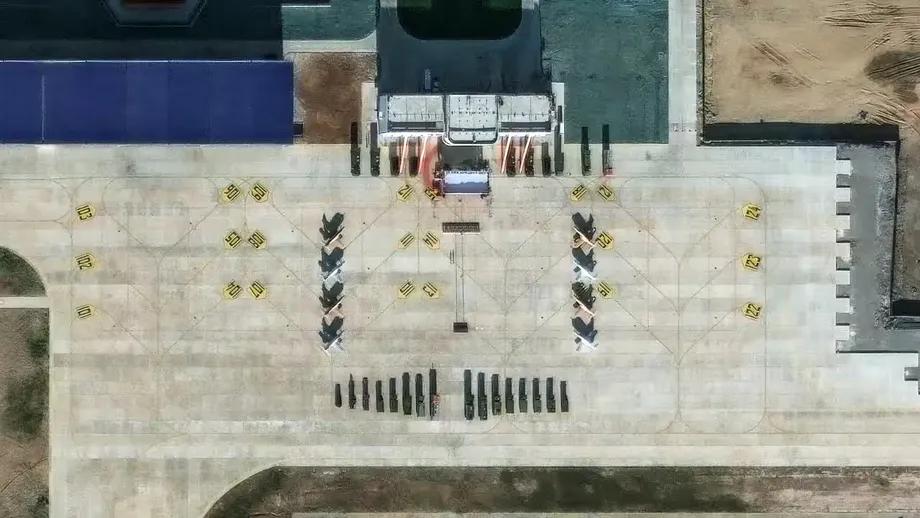
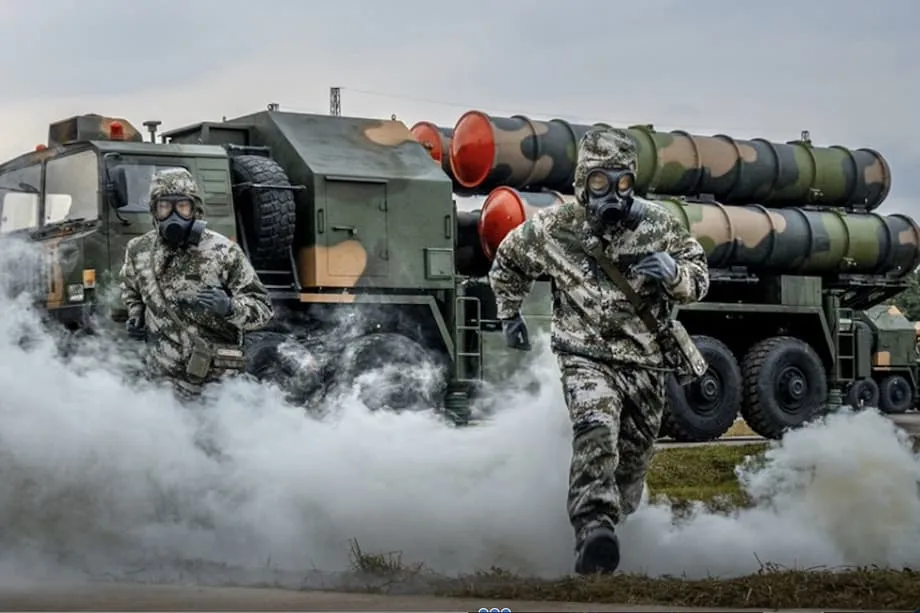
China’s Eastern Theater Command has conducted military exercises simulating a nuclear attack response, revealing Beijing’s preparation for worst-case scenarios in a potential conflict over Taiwan. The drills, reported by Chinese state broadcaster CCTV and detailed in the South China Morning Post, involved chemical, biological, radiological and nuclear (CBRN) defense teams operating at an unspecified naval base within the command’s area of responsibility.
Contents
- The Drill: Preparing for Radiological Contamination
- A Pattern of Escalation: Airspace Closures and Naval Buildups
- The Nuclear Offset Strategy Debate
- Wargaming Armageddon: Insights from Guardian Tiger
- Japan’s Nuclear Shadow and Extended Deterrence
- Taiwan’s Energy Vulnerability and Blockade Preparations
- China’s Expanding Arsenal and No-First-Use Policy
- The Bottom Line
The exercise featured rapid detection and decontamination operations in simulated contaminated zones. Military personnel deployed uncrewed helicopters equipped with sensors alongside handheld radiation detectors to map the scope and boundaries of radioactive contamination. Specialized teams then screened personnel and equipment before conducting full-scale decontamination procedures. The Eastern Theater Command oversees operations in the Taiwan Strait and East China Sea, placing these drills squarely within the theater of a potential cross-strait conflict.
State media described the purpose as training to respond to "emergencies in complex battlefield environments." The timing of the exercise coincided with heightened global anxiety regarding nuclear facilities, specifically following reported US and Israeli strikes near Iran’s Bushehr nuclear power plant. The International Atomic Energy Agency (IAEA) had warned of potential radiological risks, stating that nuclear plant sites and surrounding areas should never be struck militarily.
A Pattern of Escalation: Airspace Closures and Naval Buildups
The nuclear response drill represents just one element of a broader Chinese military signaling campaign. Beijing recently declared a 40-day airspace exclusion zone off its eastern coast, running from March 27 through May 5, covering an area stretching 340 miles across five zones. Such notices to airmen typically precede major military exercises or missile test firings, though no specific drills were announced.
Simultaneously, Taiwan has tracked an unusual surge in Chinese naval activity, with security officials reporting nearly 100 naval and coast guard vessels operating in the South and East China Seas. This represents nearly double the typical deployment of 50 to 60 ships. The increase comes as Washington remains focused on the Middle East and President Donald Trump prepares for a May meeting with Chinese leader Xi Jinping.
Against this backdrop, Cheng Li-wun, chairwoman of Taiwan’s opposition Kuomintang (KMT), met with Xi in Beijing while her party stalls a proposed $40 billion defense spending increase. Xi declared that unification is a "historical inevitability" while Cheng emphasized sowing "seeds of peace." The contrasting messages highlight Beijing’s dual-track approach of diplomatic engagement paired with military pressure.
The Nuclear Offset Strategy Debate
The Chinese drills suggest preparation for a specific strategic scenario: the potential use of tactical nuclear weapons by the United States or its allies in a Taiwan conflict. With China’s conventional military advantages growing in the Taiwan Strait, Western analysts have debated whether the US might employ nuclear weapons to offset these gains, similar to NATO’s Cold War strategy against Soviet conventional superiority.
Greg Weaver argued in a November 2023 Atlantic Council report that amphibious landing operations are "almost uniquely vulnerable" to nuclear attack. Matthew Kroenig expanded on this in a September 2023 analysis, suggesting that in scenarios where US conventional forces prove insufficient, Washington could consider limited nuclear first use against People’s Liberation Army Navy vessels and invasion forces at sea. Such maritime targeting, proponents argue, could destroy staging forces while signaling limited intent and potentially constraining escalation.
A Taiwan invasion scenario would expose China’s amphibious landing fleet to nuclear attack, as such operations are almost uniquely vulnerable.
However, David Kearn challenged this logic in a March 2024 War on the Rocks article, calling the proposed first use of tactical nuclear weapons in the Pacific a short-sighted overreaction. He contends that such threats lack credibility given ambiguous US commitments to Taiwan and limited domestic support for escalation. Kearn warns that nuclear use would risk dangerous Chinese retaliation against US forces and bases, alarm allies, undermine alliance cohesion, and weaken non-proliferation efforts.
Wargaming Armageddon: Insights from Guardian Tiger
Recent tabletop exercises conducted by the Atlantic Council’s Indo-Pacific Security Initiative, known as the Guardian Tiger series, have explored how nuclear escalation might unfold in future conflicts. These exercises, set in 2030 scenarios, modeled simultaneous confrontations involving China and North Korea, with participants including US government officials and military officers.
The wargames revealed distinct escalation patterns between the two potential adversaries. North Korea tends toward early vertical escalation, threatening tactical nuclear strikes frequently and employing demonstration shots. China, conversely, prefers horizontal escalation across domains and geography, including cyber attacks on the US homeland and strikes against Japanese bases, while holding strategic nuclear forces in reserve.
In the Guardian Tiger II scenario, which began with a Chinese attempt to seize Taiwan, Beijing issued explicit threats of nuclear use by the third turn of the exercise to force a resolution. The simulation included Chinese missile strikes overflying North Korean and South Korean airspace to hit US bases in Japan, as well as the deployment of fractional orbit bombardment systems. One exercise turn featured a North Korean low-yield nuclear strike on a South Korean airbase, triggering debate among US participants about appropriate responses ranging from conventional pulsed operations to nuclear retaliation.
We have to be ready for a local fight to become a regional war with nuclear escalation and threats to the homeland. It is scary, but we cannot assume it away.
A US government official participating in the exercises concluded that the United States must prepare for the possibility that a limited nuclear attack might not be deterred by threats of complete annihilation alone.
Japan’s Nuclear Shadow and Extended Deterrence
The Guardian Tiger exercises and Chinese strategic calculations both highlight growing concerns about Japan’s latent nuclear capability. Chinese state media and experts have increasingly focused on Japan’s potential to develop nuclear weapons rapidly, with estimates suggesting Tokyo could build an arsenal in less than three years given its plutonium reserves, uranium enrichment capability, complete nuclear fuel cycle, and advanced delivery systems including the Epsilon-S rocket and improved Type-12 cruise missile.
Wakana Mukai, writing in the Journal for Peace and Nuclear Disarmament, notes that Japan faces significant constraints in re-evaluating its nuclear stance, including its identity as the only country to have suffered nuclear attack and strong domestic anti-nuclear norms. Nevertheless, declining confidence in US extended deterrence raises the specter of proliferation.
Marigold Black and Iain MacGillivray of the Lowy Institute argue that US extended nuclear deterrence in the Indo-Pacific faces growing strain as Cold War-era frameworks struggle with a complex, multipolar environment. As US credibility declines, incentives for allies to remain non-nuclear weaken, potentially prompting consideration of indigenous arsenals and creating risks of fragmentation and miscalculation.
Japan has already deployed 620-mile-range missiles targeting China and has accelerated defense spending toward 2 percent of GDP. Prime Minister Sanae Takaichi’s remarks suggesting Japan might intervene in a Taiwan contingency have further inflamed tensions, with Chinese officials accusing Tokyo of seeking to revise the three non-nuclear principles.
Taiwan’s Energy Vulnerability and Blockade Preparations
While Beijing rehearses nuclear response scenarios, Taipei is planning its own drills focused on a different threat: energy blockade. Taiwan’s government recognizes that China need not invade to cripple the island; a maritime exclusion zone could sever fuel supplies with devastating effect.
Taiwan’s energy import dependence exceeds 97 percent, with natural gas accounting for roughly 40 percent of power generation. LNG storage tanks currently cover only 10 to 11 days of supply under normal conditions. The island’s two main LNG terminals on the west coast at Yongan and Taichung, plus a third under construction, would be vulnerable to any interruption of tanker traffic through the Taiwan Strait.
Taiwan’s Ocean Affairs Council has been coordinating with the United States, Japan, and the Philippines to protect critical shipping lanes through the Bashi Channel to the east. Planned drills will stress-test convoy tactics, floating storage options, and port capacity at east coast facilities like Hualien and Su’ao. The exercises reflect a shift from theoretical tabletop planning to practical logistics rehearsal.
The timing of these preparations coincides with increased Chinese military exercises rehearsing maritime interdiction. State media has described Eastern Theater Command operations as "around-the-island combat-readiness patrols," while recent geometries have effectively boxed in shipping lanes to Kaohsiung, Taichung, and Keelung.
China’s Expanding Arsenal and No-First-Use Policy
Behind these preparations lies a rapidly shifting nuclear balance. Hans Kristensen and colleagues at the Bulletin of the Atomic Scientists estimate China possesses approximately 600 nuclear warheads as of 2025, with projections exceeding 1,000 by 2030 and potentially 1,500 by 2035. This makes China’s arsenal the fastest-growing among nuclear-armed states.
The expansion includes large-scale silo construction in northern China, new missile systems like the DF-17 and DF-26 (both capable of carrying conventional or nuclear warheads), and increasingly survivable sea-based deterrents. This growth provides Beijing with more coercive options in a conflict, enabling limited theater nuclear strikes while maintaining secure second-strike capability.
China maintains a longstanding no-first-use (NFU) policy, declaring it will never be the first to use nuclear weapons under any circumstances. However, analysts note that decisions regarding first use would likely reflect the worldview of Xi Jinping himself rather than formal doctrine. In a Taiwan invasion scenario, where failure could equate to loss of domestic power for Chinese leaders, the NFU policy faces a severe stress test.
The US Naval Institute has warned that the next Taiwan crisis will almost certainly involve nuclear threats, even if Beijing never crosses the threshold. China could leverage its arsenal through dispersion, alert-level adjustments, or demonstration shots near Guam or Hawaii without attacking Taiwan itself.
The Bottom Line
- China’s Eastern Theater Command conducted CBRN defense drills simulating nuclear attack response, using drones and decontamination teams in contaminated zones
- The exercise occurred amid global nuclear anxiety following strikes near Iran’s Bushehr facility and a 40-day Chinese airspace exclusion zone off the eastern coast
- Western analysts debate whether the US might use tactical nuclear weapons as an "offset strategy" against Chinese conventional advantages in a Taiwan invasion scenario
- Guardian Tiger wargames revealed high risks of simultaneous China-North Korea conflicts escalating to limited nuclear use, with distinct horizontal and vertical escalation patterns
- Japan’s latent nuclear capability and declining confidence in US extended deterrence raise proliferation risks in the region
- Taiwan is preparing energy blockade drills to address 97% import dependence and limited LNG storage, while facing nearly 100 Chinese naval vessels in surrounding waters
- China’s nuclear arsenal is the fastest-growing among nuclear powers, projected to exceed 1,000 warheads by 2030, challenging traditional deterrence frameworks