
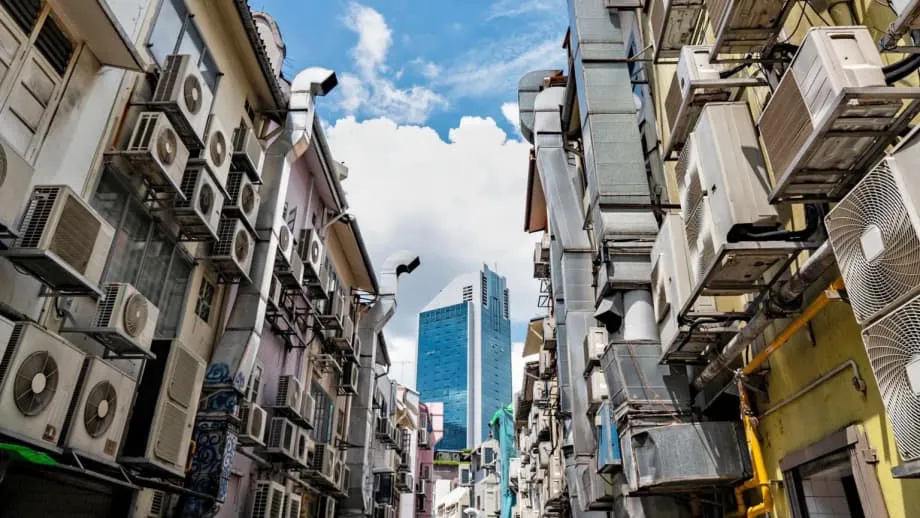
A Tropical Necessity Becomes a National Liability
In 1999, Lee Kuan Yew, the founding architect of modern Singapore, offered a simple explanation for his city-state's meteoric economic rise. "The first thing I did upon becoming prime minister was to install air conditioners in buildings where the civil service worked," he famously remarked. "This was key to public efficiency." Lee credited air-conditioning with having "changed the lives of people in tropical regions" by enabling productive indoor work despite the equatorial heat outside. A quarter century later, that very foundation of Singaporean productivity has become a symbol of vulnerability. As the Iran war chokes global energy supplies, the city-state has ordered government employees to raise office thermostats to 25 degrees Celsius (77 degrees Fahrenheit) or higher, a move that would have been unthinkable during Lee's era. The directive represents more than an energy-saving measure. It signals a profound stress test for a nation that imports 100 percent of its crude oil and depends heavily on liquefied natural gas (LNG) piped through the volatile Strait of Hormuz.
Contents
The contrast between Singapore's air-conditioned present and its suddenly constrained future captures the broader dilemma facing Asia. While the wealthy city-state enjoys greater fiscal buffers than its neighbors, its structural dependence on Middle Eastern energy has forced uncomfortable trade-offs between comfort, economic stability, and national security. For a population accustomed to stepping from icy malls onto breezeways that blast cold air onto sidewalks, the adjustment is proving as psychological as it is physical.
The World's Energy Artery Clogs
To understand why Singapore is sweating, one must look 6,500 kilometers away at the Strait of Hormuz. This narrow waterway between Iran and Oman typically handles roughly 20 million barrels of oil daily, representing about one-fifth of global petroleum consumption. Since February 28, when the United States and Israel initiated large-scale strikes against Iran, the strait has functionally closed. Iran's Revolutionary Guards declared they would not allow "one litre of oil" to be exported from the Middle East if attacks continued, and merchant ships have been struck attempting passage.
The closure has unleashed what energy economists are calling the most severe supply disruption in history. According to the International Energy Agency, approximately 80 percent of the oil and petroleum products and nearly 90 percent of the LNG that normally transit Hormuz are destined for Asian markets. In 2025 alone, roughly 84 percent of oil and 83 percent of LNG shipped through the strait served Asian economies. When Iran effectively blockaded the passage in early March, it severed the primary energy lifeline for the world's most populous and industrially dynamic region.
Singapore's exposure is particularly acute. About two-thirds of its crude oil imports originate from Middle Eastern countries, according to the US Energy Information Administration. The island nation's newly established centralized gas buyer, Singapore GasCo, faces its first major crisis as Qatar's Ras Laffan facility, the world's largest LNG export plant, suffered missile strikes in mid-March. Rebuilding that facility could take three to five years. While Singapore maintains strategic reserves and a standby LNG facility established in 2021, Minister-in-charge of Energy Tan See Leng has warned that electricity tariffs will inevitably rise as the nation pays premium prices for alternative supplies.
Cooling Down a Nation
On April 8, Singapore's Ministry of Sustainability and the Environment issued directives that would have shocked Lee Kuan Yew. All government facilities must set air-conditioning to 25 degrees Celsius or higher and actively manage operating times for cooling, lighting, and elevators. Agencies must accelerate installation of LED lighting and smart sensors while replacing equipment with the highest efficiency ratings available. "Each degree raised reduces energy needs by around 10 percent," the ministry noted in a statement, framing the measures as the government "taking the lead" in national conservation efforts.
The measures extend beyond temperature controls. Public officers are urged to switch to fans, unplug non-essential equipment to eliminate "vampire power" (electricity drawn by devices on standby), and utilize public transportation. The government has backed these behavioral requests with substantial financial support. Singapore unveiled approximately S$1 billion ($778 million) in enhanced support measures, including increased corporate income tax rebates, S$200 cash relief for active platform workers and taxi drivers, and expedited Community Development Council vouchers. The package represents recognition that the crisis strikes hardest at those whose livelihoods depend on mobility.
Unlike neighboring countries that have mandated work-from-home arrangements or shortened workweeks, Singapore has maintained normal operations while requesting voluntary conservation. This approach reflects both the city-state's administrative discipline and its lack of domestic energy alternatives. Without significant domestic oil or gas production, Singapore cannot simply drill more wells or expand coal mining as Indonesia or Vietnam might. It must conserve its way through the crisis while paying whatever the spot market demands for LNG cargoes.
The Human Mathematics of Crisis
Behind the policy directives and macroeconomic statistics, ordinary Singaporeans are rewriting daily routines. A survey conducted by CNA TODAY of 55 residents aged 22 to 69 found that nearly 64 percent have made lifestyle changes in response to the energy crisis. For some, the adjustments are minor, such as taking shorter showers or ensuring lights are switched off. For others, the war in the Middle East has fundamentally altered domestic life.
Ms Lalitha Dorairajoo, a 48-year-old private-hire driver, has seen her fuel costs rise from S$80 to over S$100 per tank for her hybrid vehicle. To manage both transport and household expenses, she has moved her seven-year-old child into her bedroom so they can share a single air-conditioning unit rather than cooling multiple rooms. "Normally, I'm not an air-con person, but this weather, the haze, it's very bad," she explained. "We're not able to (stand it) without the air-con, it's like you're sitting in an oven."
Other drivers face impossible arithmetic. Gary Harris, a 51-year-old cabby, now spends two to three hours waiting at Changi Airport for fares because roaming the city wastes petrol. With fewer tourists arriving due to disrupted air travel, he joins growing queues of drivers competing for scarce passengers. "Nowadays, most night-shift drivers like me go home by 3am, because if they roam around, they waste petrol," he said. Some families have ceased using air-conditioning entirely, swapping to fans despite the tropical humidity. Mr Kokki Kumar, another private-hire driver, reports his four children are learning to sleep without cooled air for the first time.
The crisis is accelerating transportation transitions. Madam Ruth Goi traded her internal combustion vehicle for an electric car months before her Certificate of Entitlement expired, citing monthly fuel costs that jumped from S$120 to S$160. After switching, she estimates spending approximately S$50 on electricity for charging. Others are abandoning cars entirely. Valerie Khoo, a 31-year-old wealth management consultant, now takes public transport to client meetings despite doubling her commute time from 15 minutes to 30. "Even though my commute time has doubled, I save so much more (money)," she explained. The constraints extend to small rituals; as one driver quipped, "Nowadays, I cannot afford to drink kopi gao or kopi C, now I can only drink kosong."
Asia's Diverse Responses to a Shared Predicament
Singapore's thermostat adjustments represent just one node in a regional network of emergency measures. Across Southeast and South Asia, governments are scrambling to manage the fallout from the Hormuz closure with varying degrees of severity. Thailand has mandated remote work for civil servants while urging office workers to take stairs instead of elevators and set air-conditioning between 26 and 27 degrees Celsius. The Philippines has implemented four-day workweeks for government offices and mandated that agencies cut fuel and electricity consumption by 10 to 20 percent.
Poorer nations face more drastic disruptions. Bangladesh, which imports 95 percent of its energy, has deployed military forces at major oil depots to prevent hoarding while closing universities early for holidays. Pakistan has imposed two-week school closures and limited government offices to four-day weeks while restricting official vehicle usage. Myanmar's junta has introduced fuel rationing based on license plate numbers, allowing vehicles with even-numbered plates to drive only on even dates. Sri Lanka has designated Wednesdays as holidays to create a permanent four-day workweek and implemented QR code-based fuel rationing.
Even major economies are feeling the strain. South Korea imposed its first domestic fuel price cap in nearly three decades, while Japan initiated its largest-ever release from strategic reserves, equivalent to 45 days of supply. China, despite possessing massive stockpiles, has reportedly received clandestine oil shipments from Iran and increased Russian imports after the US waived sanctions temporarily. India has absorbed more than half of fuel price increases through government subsidies while redirecting liquefied petroleum gas from industrial users to households fearing cooking fuel shortages.
The divergence in responses highlights the inequality of energy security across the continent. Wealthier states like Japan and South Korea can draw on strategic reserves and fiscal cushions to absorb price shocks. Nations like Bangladesh, Pakistan, and Sri Lanka lack foreign exchange reserves to secure supplies in volatile markets, forcing them into painful trade-offs between education, mobility, and basic energy access. As one energy analyst noted, the crisis has exposed the structural reality that Asia remains the world's most import-dependent region, vulnerable to any disruption in Middle Eastern flows.
Economic Shockwaves and Subsidy Strains
The immediate pain of higher fuel costs represents only the first wave of economic disruption. As oil prices surged past four-year highs before stabilizing near $95 per barrel, inflation pressures have begun cascading through Asian economies. Higher transport costs increase prices for food and daily necessities, while rising jet fuel prices (exceeding $200 per barrel in Singapore) threaten the tourism sectors critical to Thailand, Vietnam, and the Philippines. The Asian Development Bank has warned that sustained disruptions could halve economic growth in import-dependent nations.
Governments are fighting these pressures with subsidies that appear increasingly unsustainable. Indonesia has promised to maintain subsidized fuel prices through the Eid al-Fitr holiday, but providing such support to 143.9 million holiday travelers is projected to push the national budget deficit beyond the legal cap of 3 percent of GDP. Thailand's oil fuel fund is spending tens of millions of dollars daily to keep diesel prices artificially low. India faces similar constraints; as one think tank analyst warned, "The scale of demand in India, the world's most populous nation, limits how long it can cap prices to shield consumers."
The crisis extends beyond transportation fuel. Asia depends heavily on Middle Eastern natural gas for fertilizer production, and disruptions threaten agricultural yields across the continent. Qatar, which supplies roughly a third of global helium (essential for semiconductor manufacturing), halted production at its Ras Laffan facility after the March strikes. This loss threatens electronics supply chains in Taiwan, South Korea, and Japan, where semiconductor packaging accounts for significant export revenues. The potential for stagflation, combining rising prices with falling output, looms large across the region.
Leadership Under Scrutiny
As authorities urge conservation, public skepticism regarding elite compliance has emerged as a political issue. When Deputy Prime Minister Gan Kim Yong suggested households use fans instead of air-conditioning and take public transport, social media platforms erupted with questions about whether Parliamentarians would follow their own advice. "Want to gain credibility with the electorate? Have ministers take public transport very regularly during peak hours," wrote one Reddit user. Others demanded specifics: "Will air conditioning be turned off in Parliament?" asked one commenter. "Parliament use fans first, then I use," another replied.
This credibility gap highlights the broader challenge of demanding sacrifice from populations already stressed by rising living costs. Prime Minister Lawrence Wong has stressed that Singapore's energy resilience requires "collective effort," yet the visual contrast between ministers in climate-controlled offices and taxi drivers sleeping in their vehicles to save fuel creates natural tensions. Coordinating Minister K. Shanmugam has acknowledged that "potential disruptions to our domestic energy and electricity supply cannot be ruled out" if the conflict extends, suggesting harder choices may await.
The skepticism extends to whether the current measures match the scale of the crisis. While Singapore has avoided the school closures and fuel rationing seen in Dhaka or Karachi, some citizens question whether the relatively mild 25-degree mandate and voluntary conservation requests suffice for what DPM Gan characterized as the "worst disruption since the 1973 oil embargo." The memory of Lee Kuan Yew's air-conditioning revolution serves as a constant reference point, implicitly asking whether current leadership can match the adaptive ingenuity that built the modern city-state.
Energy Security Reimagined
As the crisis enters its second month, policymakers across Asia are confronting long-term structural vulnerabilities that short-term conservation cannot resolve. The blockade has forced a reconsideration of the region's heavy reliance on Middle Eastern hydrocarbons transported through a single maritime chokepoint. Singapore's creation of GasCo in 2025, intended to diversify LNG procurement through longer-term contracts and multiple suppliers, is undergoing its first real trial by fire.
The immediate temptation is to retreat into energy nationalism and carbon-intensive fuels. Thailand has restarted decommissioned coal units, while South Korea plans to lift restrictions on coal generation and increase nuclear plant utilization to 80 percent. These moves risk entrenching fossil fuel dependence just as global climate commitments require the opposite trajectory. Alternatively, the crisis could accelerate investment in renewable energy and regional integration projects like the ASEAN Power Grid, which would allow nations to share electricity across borders rather than relying solely on imported fuel.
For Singapore specifically, the crisis validates recent investments in solar infrastructure, with some households now generating excess electricity to sell back to the grid, effectively insulating themselves from volatile fuel markets. Yet the city-state's density limits renewable potential, making regional energy interdependence essential. The question facing Lee Kuan Yew's successors is whether they can replicate his infrastructure vision for a new era, one where air-conditioning must be powered not by the cheapest available oil, but by resilient, diversified, and eventually decarbonized energy systems.
Historical parallels suggest the psychological impact may outlast the physical disruption. The 1973 oil shock permanently altered Western energy consciousness, leading to efficiency standards and strategic reserves that persist today. Asia's 2026 crisis, if prolonged, could similarly reshape everything from urban planning to transportation electrification. The taxi drivers switching to EVs and families sharing bedrooms to save electricity are improvising solutions that may become permanent features of Singaporean life. Whether these adaptations represent temporary inconvenience or the first steps toward a new energy paradigm depends largely on how long the Strait of Hormuz remains closed, and what lessons Asia's leaders absorb once the tanks begin flowing again.
The Bottom Line
- Singapore has mandated that government offices set air-conditioning to 25 degrees Celsius or higher and implement energy-efficient technologies as part of a national conservation drive.
- The measures respond to the closure of the Strait of Hormuz since February 28, which has blocked roughly 20 percent of global oil supplies and 80 percent of Asia-bound LNG exports.
- The city-state unveiled approximately S$1 billion in support measures including cash relief for drivers and tax rebates, while urging citizens to use public transport and fans rather than air-conditioning.
- Across Asia, nations are implementing emergency measures including four-day workweeks in the Philippines and Pakistan, military deployment at fuel depots in Bangladesh, and odd-even vehicle rationing in Myanmar.
- Energy analysts warn that current subsidy programs in Indonesia, Thailand, and India are unsustainable beyond the short term, risking fiscal deficits and social unrest if the conflict persists.
- The crisis threatens secondary impacts including fertilizer shortages affecting agriculture, helium supply disruptions for semiconductor manufacturing, and potential returns to coal power despite climate commitments.
- Public skepticism has emerged regarding whether political leaders will personally adopt the conservation measures they recommend to citizens.
- Long-term energy security may require accelerated investment in renewable energy, regional power grids, and diversification away from Middle Eastern supply dependence.