Racing Against the Monsoon Without Fuel
In the rice paddies of Myanmar’s Ayeyarwady Delta, the annual harvest season has become a race against time that farmers are increasingly losing. With monsoon rains typically beginning in May, agricultural workers are scrambling to bring in their crops before fields flood. Yet a catastrophic fuel shortage, triggered by the closure of the Strait of Hormuz during the escalating conflict between the United States and Iran, has left tractors idle and threshing machines silent.
“Many of the crops are now overdue for harvest. If the tide rises or the weather worsens, it will be even more devastating for us,” one farmer told CNA. The crisis extends beyond machinery. Even manual harvesting offers little relief, as fuel powers the threshing equipment necessary to separate grain from husk. “How can we afford these prices? Even if we could afford them, the fuel isn’t available. It’s almost impossible to find,” the farmer added. “Those with money can use connections to get what they need, but farmers like us are the ones who suffer.”
The fuel shortage represents the latest shock to a nation already reeling from the aftermath of a 2021 military coup, runaway inflation, and the lingering devastation of a 7.7-magnitude earthquake that struck Mandalay one year ago. With Myanmar dependent on imports for approximately 90% of its fuel, the closure of the Strait of Hormuz (which normally carries roughly one-fifth of global seaborne oil trade) has created acute shortages that threaten to push the country’s fragile food system toward collapse.
Black Market Prices and Desperate Measures
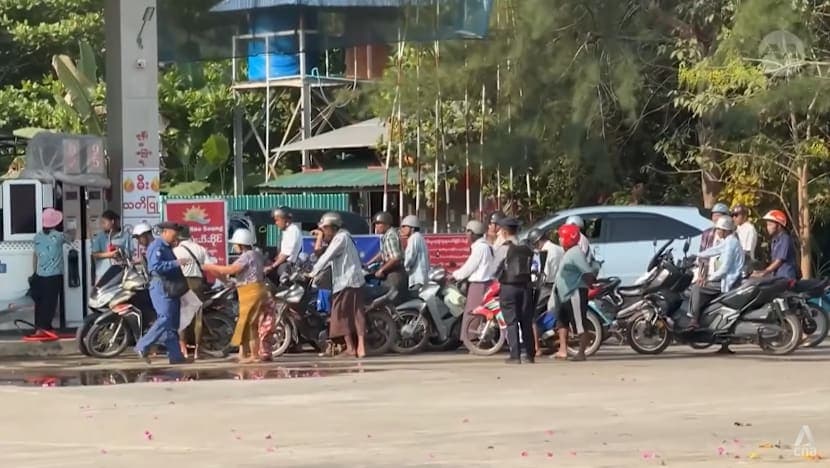
Official petrol stations in Myanmar have attempted to maintain regulated prices, but supply constraints have created a thriving black market where fuel now sells for approximately 12,000 kyat (about US$3) per litre. This represents more than double the rates at official stations, placing the cost far beyond the reach of ordinary farmers and laborers. In Yangon, the nation’s largest city, motorists queue for up to six hours to secure limited rations, while in some towns and cities, stations have reportedly run dry entirely.
To manage the dwindling supplies, authorities implemented an odd-even rationing system in March 2026, requiring vehicles to purchase fuel only on alternate days based on whether their license plate numbers end in odd or even digits. The military council has announced that the country possesses approximately 50 days of strategic fuel reserves and that 16 additional fuel tankers are expected to arrive. Military leader Min Aung Hlaing has publicly pledged agricultural support, stating during his April 10 oath-taking speech as president that “reducing poverty and improving the lives of farmers is our main priority.”
However, structural vulnerabilities complicate these assurances. “What makes it a little bit more difficult is we don’t have storage facilities like Malaysia and Singapore,” noted Amara Thiha, a non-resident fellow at the Stimson Center’s China Program. “Myanmar can’t buy a lot and store it for a while. It has to rely on week-to-week imports coming in.” This lack of strategic storage leaves the nation exposed to every fluctuation in global energy markets.
The Fertilizer Crisis Compounds Agricultural Woes
The fuel shortage represents only one dimension of the agricultural crisis. Simultaneously, Myanmar’s farmers face a fertilizer shortage driven by the same Middle East conflict that has choked off fuel supplies. Up to one third of global trade in fertilizer raw materials normally passes through the Strait of Hormuz, but with the waterway effectively closed, shipments of ammonia and nitrogen have dropped sharply while prices have surged.
According to local reporting from Myanmar Now, a bag of urea fertilizer that cost 90,000 kyat before the Iran war has now reached over 170,000 kyat, while compound fertilizer prices have doubled from just over 100,000 kyat to over 200,000 kyat per bag. The timing could hardly be worse. Farmers preparing for monsoon planting face the prospect of production expenses potentially doubling last year’s levels, according to the World Food Programme.
The World Food Programme has warned that a 50% reduction in fertilizer use during the current planting season could result in a 10% to 15% decline in agricultural production. For a country where agriculture employs roughly 70% of the rural population and constitutes the backbone of the economy, such a decline would have cascading effects throughout society. Years of mechanization have further limited farmers’ options, as many households no longer maintain cattle or buffalo for manual fieldwork, leaving them entirely dependent on fuel-powered machinery.
From Fields to Cities: The Crisis Widens
The fuel crisis extends far beyond rural agricultural communities, disrupting urban economies and household survival strategies across Myanmar. In the Ayeyarwady Delta, migrant farmhands who traveled to the region seeking seasonal work find themselves stranded as harvesting operations slow. “If we can’t get any fuel, what can we do? We cannot do our job. If there’s no fuel, we will just have to go back home,” one worker explained. Others warn that a food shortage is a “real possibility” if diesel cannot reach the region.
Small-scale rice millers, essential for farmers processing rice for their own consumption, are struggling to remain operational as fuel costs erode their margins. Some fishermen have abandoned their work entirely, finding that fuel has become either unavailable or prohibitively expensive for making trips to sea worthwhile. In Mandalay, where residents are still rebuilding homes destroyed by the March 2025 earthquake, the fuel crisis has compounded existing economic distress.
“The main problem is the cost of living. We were already struggling after the earthquake with the added cost of repairing our homes. One year after the quake, businesses were starting to recover. But now, with this fuel crisis, we are facing a huge struggle just to survive. Everything is connected – higher prices, shortage of goods and the lack of fuel.”
This taxi driver’s testimony reflects the interconnected nature of the crisis. Higher transport costs push up food prices, while reduced mobility limits access to work and markets. The World Food Programme reports that diesel prices nationwide have risen by nearly 200% on average compared to pre-crisis levels, with even steeper increases in remote and conflict-affected regions such as Rakhine State.
Humanitarian Operations Under Strain
The fuel shortage is severely complicating humanitarian efforts to address Myanmar’s existing food security crisis, in which 12.4 million people (nearly one quarter of the population) already face acute hunger. The WFP requires $150 million to assist 1.5 million people across the country this year, but rising operational costs are constraining the agency’s reach.
“People who survived the earthquake have barely begun to stand again, and now another blow is knocking them back down,” said Michael Dunford, WFP Country Director for Myanmar. “The people of Myanmar have endured shock after shock – conflict, climate disasters, the devastating earthquake, and now a global fuel crisis.”
Keeping humanitarian supply chains operational has become increasingly difficult. “When supply chains are disrupted, it’s felt when they cash out at the supermarket,” explained Corinne Fleischer, WFP Director of Supply Chain. “Delays and higher transport costs push up food prices, and families who spend 50 to 70 percent of their income on food are the first to go without.” The agency is adapting by planning two-month distributions, sourcing food closer to beneficiaries, and switching to cash-based assistance where possible to reduce transport costs.
Global Ripple Effects
Myanmar’s crisis represents one node in a widening network of food security threats stretching across Asia, Africa, and beyond. The conflict between the US and Iran, which triggered the temporary closure of the Strait of Hormuz on February 28, 2026, removed an estimated 20% of global oil supply from circulation and drove international prices up by more than 50%. The UN Food and Agriculture Organization warns that the global food market faces a massive supply shock that could last into early next year.
The Strait of Hormuz, a narrow maritime chokepoint between Iran and Oman, normally carries roughly one-quarter of global seaborne oil trade along with significant volumes of liquefied natural gas and fertilizers. With vessel traffic dropping sharply since late February and maritime insurance costs surging, the effects have radiated outward to touch import-dependent economies across the developing world.
In Asia alone, the UN estimates that 9.1 million additional people could face acute food insecurity if the crisis persists. Countries including Sri Lanka, Pakistan, Bangladesh, and Nepal have introduced fuel rationing measures, four-day work weeks, and school closures to conserve supplies. In Thailand, fishermen have reportedly stopped going out to sea as diesel costs have made operations economically unviable, threatening supplies of jasmine rice that require extensive irrigation.
Máximo Torero, Chief Economist of the FAO, emphasized the time-critical nature of agricultural cycles. “The clock keeps ticking… the crop calendar is based on the climate and biological conditions of the countries. That we cannot change,” he stated. “If the inputs keep going up, [farmers] will plant less and yields will be lower for the next half of the season.”
The Conflict Dimension
Within Myanmar, the fuel shortage is creating divergent pressures on different factions in the country’s ongoing civil conflict. According to analyst Amara Thiha, the military maintains separate reserves for jet fuel, ensuring that air defense and air raid capabilities remain largely unaffected by civilian shortages. “The military, they only require jet fuel – that’s a very tiny portion compared to the whole country’s consumption,” he explained.
However, resistance forces face significant challenges. “For the resistance forces, that’s going to be a huge blow,” Amara Thiha noted. “Those groups along the Thai-Myanmar border may not be able to smuggle fuel as easily as before. The Thai government is now strictly controlling everything.” This dynamic could potentially alter the tactical balance in certain regions, even as civilian populations bear the primary burden of the shortages.
Structural Vulnerabilities Exposed
The current crisis has exposed fundamental weaknesses in Myanmar’s economic infrastructure. Of five state-run fertilizer factories in the country, only two remain operational, producing a combined 40,000 tons annually against a national requirement of 1.6 million tons. This near-total dependency on imports leaves the agricultural sector exposed to every shock in global markets.
Meanwhile, inflation that already reached 20% last year has spiked again, eroding purchasing power for households already spending the majority of their income on food. In Myanmar’s black market currency exchanges, the kyat has weakened significantly against the dollar, further complicating the ability of importers to secure foreign currency needed for fuel and fertilizer purchases.
The regime’s reference pricing system exists increasingly in name only. While the Central Bank sets domestic prices and sells foreign currency to importers, market participants report that official rates do not reflect actual availability. In April 2026, the reference price for urea fertilizer in Yangon was set at 94,000 kyat per 50kg bag, while open market prices topped 150,000 kyat.
For farmers operating on thin margins and dependent on loans to finance each planting cycle, the combination of high input costs and uncertain output prices creates a debt trap. Many farmers have not yet repaid credit from last year’s summer paddy season, leaving them unable to secure new financing for the current planting window. An agricultural supply shop owner in Naypyitaw noted that farmers are prioritizing cheaper, lower-quality fertilizers or reducing application rates, decisions that will inevitably affect yields.
The Essentials
- Fuel prices on Myanmar’s black market have surged to 12,000 kyat (US$3) per litre, more than double official rates, driven by the closure of the Strait of Hormuz during the US-Iran conflict
- The World Food Programme warns that 12.4 million people in Myanmar (nearly 25% of the population) already face acute food insecurity, with fertilizer shortages threatening to reduce agricultural production by 10-15%
- Fertilizer prices have nearly doubled, with urea bags rising from 90,000 to over 170,000 kyat, while fuel prices have increased by approximately 200% nationwide
- Authorities have implemented odd-even license plate rationing systems in major cities, where motorists face queues of up to six hours for limited fuel allocations
- The crisis compounds existing vulnerabilities from the 2021 military coup, 2025 Mandalay earthquake recovery, and ongoing civil conflict, with rural farming communities (70% of the population) most severely affected
- Humanitarian operations face $150 million funding gaps and rising logistical costs, forcing agencies to transition from recovery efforts to emergency life-saving assistance
- Only two of Myanmar’s five state fertilizer factories remain operational, producing just 40,000 tons annually against a requirement of 1.6 million tons, leaving the country almost entirely dependent on disrupted imports
- Globally, the UN warns that up to 45 million additional people could face acute hunger if Middle East disruptions continue, bringing the worldwide total to 363 million