When Peacekeeping Turns Tragic
The deaths of three Indonesian soldiers in southern Lebanon have transformed President Prabowo Subianto’s foreign policy gamble into a national crisis. Major Infantry (Posthumous) Zulmi Aditya Iskandar, Sergeant Major (Posthumous) M. Nur Ichwan, and Corporal (Posthumous) Farizal Rhomadhon lost their lives while serving with the United Nations peacekeeping force during late March 2026, victims of a conflict that has exposed the risks of Indonesia’s controversial diplomatic alignment.
- When Peacekeeping Turns Tragic
- The Board of Peace: A Contested Initiative
- Mounting Public Scepticism
- Political Pressure From Coalition and Opposition
- The Economic Calculus: Trade Ties and Tariff Threats
- Energy Security and the Strait of Hormuz Crisis
- Constitutional Questions and Diplomatic Tradition
- Seeking a Middle Path
- The Shadow of Alternative Diplomacy
- Key Points
Corporal Farizal fell on March 29 after being struck by artillery projectiles in Adchit al-Qusayr, while Major Zulmi and Sergeant Nur Ichwan died the following day when their logistics convoy came under attack near Bani Hayyan. A United Nations investigation determined that a projectile fired from an Israeli tank killed the first peacekeeper, while an improvised explosive device likely placed by Hezbollah claimed the other two lives.
These casualties represent the first deaths among UN peacekeepers since the new war between Israel and Hezbollah erupted on March 2. The losses have amplified public anger over Indonesia’s participation in the Board of Peace (BoP), a Trump administration initiative originally intended to oversee post-conflict reconstruction in Gaza. President Prabowo expressed condolences through his official Instagram account on April 5, featuring five photos of the arrival procession and final tribute. The post garnered over 134,000 likes and 5,700 comments, many demanding a reassessment of Indonesia’s foreign commitments.
We, fellow countrymen and compatriots, strongly condemn every heinous act that disrupts peace and causes the fall of the nation’s best soldiers.
The Board of Peace: A Contested Initiative
The Board of Peace emerged from a January 22, 2026 signing ceremony at the World Economic Forum in Davos, Switzerland, where President Prabowo joined leaders from 21 countries as founding members. Conceived by United States President Donald Trump, the body was ostensibly created to ensure effective post-war reconstruction in Gaza. However, its structure has drawn sharp criticism from international legal experts and religious authorities alike.
Unlike traditional multilateral bodies, the BoP grants Trump lifetime chairmanship with unilateral veto power over all decisions. Membership operates on a tiered system: countries receive three-year terms initially, with permanent status available only to those contributing $1 billion in cash. Indonesia has publicly stated it will not pay this fee, limiting its role to peacekeeping support within the International Stabilization Force (ISF), where Jakarta was appointed deputy commander.
Sudarnoto Abdul Hakim, the MUI’s Chairman for Foreign Relations and International Cooperation, has been particularly vocal in his criticism of the BoP’s legal structure. In an interview with VOI.id, he characterized the body as fundamentally flawed.
The BoP is a strange and unclear institution. International legal experts consider the BoP’s creation to be odd in the context of the formation of world institutions. Among other things, it is not based on the principles of multilateralism. That’s why I don’t believe the statement that there’s ‘no choice’ regarding joining the BoP. The BoP is a dilemma; Trump will become an authoritarian Chairman.
Mounting Public Scepticism
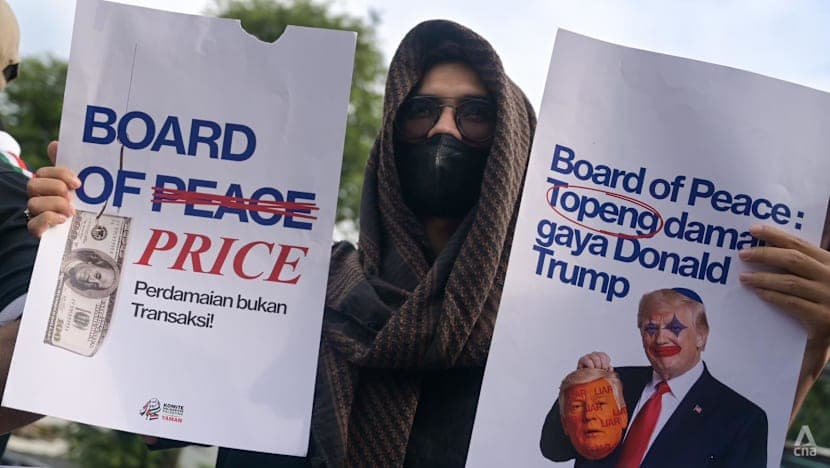
Survey data reveals a population increasingly uncomfortable with its government’s alignment with the Trump-led initiative. Research conducted between March 12 and 31 by Indikator Politik Indonesia, the Indonesian Survey Institute (LSI), and Saiful Mujani Research and Consulting (SMRC) found that 50.9 per cent of over 1,000 respondents disagreed with Indonesia’s BoP participation. Only 33.8 per cent expressed support. This represents a marginal decline from February, when Media Survey Nasional (Median) recorded 50.4 per cent opposition among 1,200 respondents.
Experts suggest these figures would likely show even stronger opposition if measured after the March 29 peacekeeper deaths. The survey period captured responses both before and after the fatalities. Agung Nurwijoyo, an international relations expert from the University of Indonesia, observed that Indonesia’s diplomatic benefits from the BoP remain unclear.
Teuku Rezasyah, an international relations lecturer at Indonesia’s President University, has captured the shifting public sentiment with stark clarity.
The Board of Peace has become the Board of Problems.
Political Pressure From Coalition and Opposition
The fallout has reached the halls of power, with politicians from Prabowo’s own coalition joining opposition voices in questioning Indonesia’s continued participation. Golkar Party, the largest party in the ruling coalition, has formally urged reconsideration. Ahmad Doli Kurnia, the party’s deputy chairman, issued a formal statement on April 1 linking the peacekeeper’s death directly to the BoP’s failure.
Israel’s attack on an Indonesian soldier is a clear disregard for the very notion of ‘peace’ that is supposed to be a core value of the BoP. We encourage the government to rethink Indonesia’s presence in the BoP.
The Islam-based Prosperous Justice Party (PKS), another coalition member, issued a similar call on March 30, arguing for serious evaluation of Indonesia’s position in international peace forums. The Indonesian Democratic Party of Struggle (PDI-P), led by former president Megawati Soekarnoputri, has demanded complete withdrawal. Tubagus Hasanuddin, a PDI-P politician serving on the parliamentary commission overseeing defence and foreign affairs, insisted the government must act to maintain constitutional consistency.
The government should immediately take steps to withdraw. This is important to maintain consistency with the ‘free and active’ foreign policy principle mandated by our Constitution.
The Indonesian Ulema Council (MUI) has delivered six specific points of advice to the President through the Minister of Religion, including demands that the BoP pressure Israel to recognize Palestinian sovereignty, ensure no further colonization of Palestinian land, implement the two-state solution consistently, and champion Palestinian involvement in BoP membership. The religious body warned that troop deployment should not harm Palestinians or benefit Israel behind the scenes of the BoP.
The Economic Calculus: Trade Ties and Tariff Threats
Beyond the moral and strategic arguments, economic imperatives weigh heavily on Prabowo’s decision. Indonesia’s relationship with Washington has grown increasingly transactional, with the BoP membership apparently serving as a precondition for favorable trade treatment. On February 19, 2026, Jakarta signed the Agreement on Reciprocal Trade (ART) in Washington, a pact marketed as ushering in a Golden Era but functioning, according to critics, as a constraint on foreign policy autonomy.
The Trump administration had initially threatened sweeping tariffs of up to 32 per cent on Indonesian exports to address a $23.7 billion trade deficit. The ART agreement eliminated tariffs on more than 99 per cent of American goods entering Indonesia, but contained a binding clause requiring Jakarta to import $15 billion worth of American energy annually. This represents a twelvefold increase from previous levels, effectively shifting Indonesia’s energy dependence from the Middle East to the Gulf of Mexico precisely when the Strait of Hormuz faces closure.
Made Supriatma, a visiting fellow at Singapore’s ISEAS-Yusof Ishak Institute, notes that Prabowo faces a delicate balancing act involving potential retaliation from Washington.
Prabowo understands that this Trump-created body has become politically toxic domestically. No other member country has left the BoP. Prabowo doesn’t want to be the first to cross Trump, because he knows that Trump will certainly retaliate against any perceived disloyalty.
Rezasyah added concerns about the long-term American political landscape. Trump will be in power until 2028 and after that, we cannot rule out the possibility that he will be succeeded by a Trump loyalist Republican.
Energy Security and the Strait of Hormuz Crisis
The United States-Israeli war on Iran has precipitated a regional crisis with direct economic consequences for Indonesia. Tehran’s response to the attacks included closing the Strait of Hormuz, a narrow shipping route through which much of the world’s oil and gas supply passes. The resulting supply shock has driven crude prices above $120 per barrel, with analysts warning of potential spikes exceeding $150 if the conflict persists.
Indonesia faces a domestic crisis if these elevated prices force cuts to fuel subsidies relied upon by millions of consumers and essential for public transport and goods distribution. The government last raised subsidized fuel prices in 2022, increasing diesel from 5,150 to 6,800 rupiah per litre and petrol from 7,650 to 10,000 rupiah per litre. The move triggered widespread protests, strikes, and unrest across the archipelago. Finance Minister Purbaya Yudhi Sadewa assured parliament on April 6 that prices would remain stable at least through year’s end, stating that subsidies are secure and there is no need to worry. However, several economists question whether the fiscal capacity exists to sustain these subsidies if global energy markets remain volatile.
In a sign of Jakarta’s search for alternatives, Kremlin spokesperson Dmitry Peskov confirmed on April 7 that President Prabowo may soon visit Russia to discuss energy purchases with President Vladimir Putin. Contacts between the two leaders were being prepared, Peskov stated, noting that a huge number of requests for the purchase of our energy resources have emerged from nations seeking alternatives to Hormuz-dependent supplies. Such a visit would mark Prabowo’s third to Russia since taking office in October 2024, reflecting his policy of assertive non-alignment to reduce dependence on any single power.
Constitutional Questions and Diplomatic Tradition
The controversy has sparked debate about Indonesia’s adherence to its foundational foreign policy doctrine of bebas aktif (independent and active), articulated in 1948 by founding father Mohammad Hatta. This principle mandates that Indonesia remain free from great power blocs while actively participating in world order based on independence, peace, and social justice. Critics argue that joining an ad hoc body dominated by a single foreign leader contradicts this tradition.
Under the 1945 Constitution, all international agreements require ratification by the House of Representatives (DPR). The BoP charter signed at Davos has yet to undergo this process, creating a constitutional grey area that opponents have exploited. Dave Laksono, deputy chairman of the parliamentary defence and security commission from Golkar, indicated that lawmakers will scrutinize the agreement carefully. The ratification process is currently still in the discussion stage between the government and the DPR, with a focus on examining the substance and conducting a comprehensive analysis of the political, legal and national security implications, he stated on April 6.
Dominique Nicky Fahrizal, a researcher at the Centre for Strategic and International Studies (CSIS) Indonesia, warned that Indonesia’s presence in the BoP creates a security dilemma where actions taken for security actually trigger insecurity in others.
We are trapped in the geopolitical game of Israel and the US in the Middle East. This Peacekeeping Force attack could serve as a warning regarding Indonesia’s exit from the BoP.
Seeking a Middle Path
Between complete withdrawal and full commitment, analysts suggest several intermediate options. Foreign Minister Sugiono announced on March 3 that all BoP discussions are on hold pending the Iran situation. President Prabowo has offered to mediate between Washington and Tehran, though experts view the chances of success as low. The Iranian Embassy in Jakarta welcomed the offer, with the ambassador noting that both nations are influential middle powers capable of promoting peace.
Rezasyah suggested Prabowo could consult the seven countries, many of them Islamic nations, that he met when joining the BoP. Such consultations would make any potential withdrawal appear less unilateral to Washington, or conversely, make remaining appear more considered to domestic audiences. Other options include postponing the deployment of 8,000 troops to Gaza until tensions ease, or downgrading from full membership to observer status.
Agung Nurwijoyo emphasized that public rejection of the BoP reflects deeper sentiments about justice. Public rejection of the BoP is not merely a technical policy issue, but a reflection of Indonesians’ sensitivity to global justice, he noted. The challenge for the government is to ensure that foreign policy pragmatism is not perceived as a compromise of principles.
The Shadow of Alternative Diplomacy
While the administration maintains official restraint, former president Megawati Soekarnoputri has engaged in what analysts describe as shadow diplomacy. Following the reported death of Iran’s Supreme Leader Ayatollah Ali Khamenei during the February 28 Operation Epic Fury attacks, Megawati issued condolences and subsequently congratulated his successor Mojtaba Khamenei on his March 10 election by the Assembly of Experts. These gestures, invoking the spirit of the 1955 Bandung Conference, serve as a pressure valve for domestic Muslim constituencies while the government maintains economic ties with Washington.
This dual-track approach allows Indonesia to retain economic access to the United States while symbolically sustaining its standing in the Islamic world. However, the banking sector faces growing exposure to secondary sanctions from the US Treasury’s Office of Foreign Assets Control (OFAC) regarding dealings with Iranian entities. The collapse of the Iranian rial and reimposition of multilateral UN sanctions have effectively severed Tehran’s shadow banking networks, requiring Indonesia’s Financial Services Authority and Bank Indonesia to ensure domestic institutions avoid entanglement with blacklisted entities.
Key Points
- Three Indonesian UN peacekeepers died in Lebanon on March 29-30, 2026, intensifying criticism of the Board of Peace
- Surveys indicate over 50 per cent of Indonesians oppose participation in the Trump-initiated BoP
- The BoP grants Donald Trump lifetime chairmanship with unilateral veto power and requires $1 billion for permanent membership
- Political parties across the spectrum, including coalition partners Golkar and PKS, urge reassessment of Indonesia’s role
- Indonesia faces potential US trade retaliation if it withdraws, following the February 2026 ART agreement
- The US-Israel-Iran war has closed the Strait of Hormuz, threatening Indonesia’s energy security and fuel subsidies
- President Prabowo has offered to mediate the conflict and may visit Russia to secure alternative oil supplies
- The BoP agreement requires parliamentary ratification under Indonesia’s Constitution, creating a constitutional mandate debate
- Options include scaling back to observer status, postponing troop deployment, or consulting other Islamic members before deciding
- Former president Megawati Soekarnoputri has conducted parallel diplomacy with Iran while the government maintains US ties