Ordinary Users Could Face the Rules Applied to Newsrooms
India has proposed extending its digital media rules to individual social media users who share news and current affairs, bringing influencers, podcasters and ordinary citizens into a regulatory framework built for established publishers. Released by the Ministry of Electronics and Information Technology (MeitY) on March 30, 2026, the draft amendments would also make platforms' legal protection depend on compliance with a wider range of government instructions.
Contents
- Ordinary Users Could Face the Rules Applied to Newsrooms
- What Would Change for People Sharing News?
- Three Hours to Act on a Blocking Order
- Why Safe Harbour Is Central to the Dispute
- More Than 28,000 Restrictions in Six Months
- Creators Describe Fear, Blocking and Lost Anonymity
- Earlier Court Decisions Shape the Legal Challenge
- The Press Club Demands Withdrawal
- The Government Says the Draft Can Change
- A Regional Pattern of Greater Digital Control
- The Dates That Define the Dispute
- Key Points
The proposal arrives after a separate February amendment shortened the deadline for platforms to comply with government blocking orders from 36 hours to three hours. That change took effect on February 20. Together, the measures would broaden the reach of government oversight while leaving platforms much less time to assess removal demands.
As of April 14, the March proposal remains under consultation. The government has extended the deadline for feedback from April 14 to April 29, and MeitY Secretary S. Krishnan says disputed provisions could be revised or repealed. Digital rights advocates and media representatives, however, argue that the draft would place substantial legal and financial pressure on people who publish without the resources of a newsroom.
The central dispute concerns who should be treated as a news publisher, how government instructions become binding, and what opportunity speakers have to challenge restrictions. The consequences are already tangible for creators whose accounts or posts have been blocked, including people publishing satire about Prime Minister Narendra Modi and his Bharatiya Janata Party government.
What Would Change for People Sharing News?
The Information Technology (Intermediary Guidelines and Digital Media Ethics Code) Rules, 2021, currently govern digital media publishers and over-the-top (OTT) platforms through a grievance mechanism with three levels. OTT platforms deliver content through the internet. The March draft would extend the Code of Ethics used for established media organisations to users described as "users who are not publishers" when they share news and current affairs.
The Ministry of Information and Broadcasting would gain authority to issue takedown notices directly to individual users, beyond registered news outlets. Facebook, YouTube and X are among the platforms where creators could face the expanded framework. A person discussing an election, a constitutional case or monetary policy could encounter obligations originally designed for organisations that employ journalists and exercise editorial control.
The Inter-Departmental Committee would also be able to take up matters on its own initiative instead of waiting for a formal complaint. That would move part of the system from responding to grievances toward proactively examining content. Critics argue that this change, combined with the wider definition of regulated speakers, would increase executive control over digital expression.
Nikhil Pahwa, a digital rights activist who co-founded the Internet Freedom Foundation with Apar Gupta, describes the cumulative effect of regulatory changes since 2021 as an infrastructure for mass censorship. The foundation warns that government agencies could use the expanded mechanism to target critics and dissent while offering limited transparency and procedural safeguards.
The concern is especially acute for individuals. A media organisation may have lawyers and staff to handle complaints. A solo creator may have to stop publishing, pay for legal help or defend a complaint before a government committee while also trying to maintain an income.
Three Hours to Act on a Blocking Order
MeitY's February 2026 amendments reduced the compliance window for government blocking orders by 33 hours, from 36 hours to three. Platforms consequently have one twelfth of the previous time to respond. Legal review, translation, checking context and deciding whether to contest an instruction must fit into that much shorter period.
Akash Karmakar, a partner specialising in technology law at Indian law firm Panag & Babu, questioned the practicality of the deadline. He said the three hour window assumes no application of mind or real world ability to resist compliance. The Internet Freedom Foundation similarly argues that the compressed timetable turns platforms into rapid fire censors, encouraging automated removal because meaningful human review becomes difficult.
The accelerated regime involves categories of unlawful content including intimate imagery, impersonation and morphed content, meaning images or other material altered to misrepresent someone. Critics also point to the broad scope of Indian restrictions concerning public order, national security and communal harmony. Those categories give the government substantial discretion over content.
Anushka Jain, a research associate at the Digital Futures Lab, warned that complete automation of review carries a high risk of censoring legitimate expression. Software may struggle with satire, context or a disputed political claim. When a platform faces a short deadline and possible legal exposure, removing material first can become the easiest response.
The February deadline is already in effect; the March expansion to individual users is still proposed. Both matter to a creator's ability to keep material online: one determines the speed of enforcement, while the other would widen the people and content brought within the publisher framework.
Why Safe Harbour Is Central to the Dispute
Section 79 of the Information Technology Act, 2000, gives intermediaries conditional protection from civil and criminal liability for material posted by users. Known as safe harbour, this protection allows a platform to host other people's speech without automatically becoming legally responsible for every post. Platforms must observe prescribed due diligence and remove unlawful material when properly notified.
Without that protection, a platform could theoretically face a lawsuit whenever someone posts defamatory or controversial content. The resulting burden could push companies toward screening all uploads before publication. Safe harbour therefore affects both the companies operating social networks and the people using them to speak.
The proposed amendment to Rule 3(4) would tie that protection to compliance with seven categories of MeitY communications: clarifications, advisories, orders, directions, standard operating procedures, codes of practice and guidelines. Failure to comply could place an intermediary outside safe harbour and expose it to liability for user content.
Constitutional concerns centre on the difference between binding law and guidance. Clarifications and advisories ordinarily explain policy rather than carry the force of legislation. They can be issued quickly, without public consultation, parliamentary scrutiny or the procedural requirements governing subordinate legislation, which consists of rules made under authority granted by an act.
The draft would give those executive communications practical force through the threat of losing legal protection. Critics argue that this would allow the executive to create binding duties without going through the legislative process. The pressure would fall first on platforms, but users would experience it when companies remove their posts to avoid liability.
Yale law professor Jack Balkin's concept of collateral censorship describes this kind of pressure: regulation aimed at an intermediary can cause it to remove more speech because it bears the legal cost, while the speaker bears the loss of expression. That explanation helps connect a technical rule about platform immunity to the everyday experience of a missing post or blocked account.
More Than 28,000 Restrictions in Six Months
Meta restricted more than 28,000 pieces of content in India during the first six months of 2025 following government requests, according to transparency reports reviewed by researchers. The figure describes an enforcement system that was already active before the February deadline change and the March draft.
A recent United States government report also noted that, since 2021, American social media companies operating in India have faced increasing requests to remove content and restrict accounts concerning issues that appear politically motivated. Critics see the proposed expansion against that existing pattern of intervention.
India's market includes more than one billion internet users. Decisions by Meta, Google and X about how to comply can therefore affect a vast audience, including people who rely on social platforms for news outside traditional media.
The Sahyog portal adds another route for enforcement. It serves as a central platform through which multiple agencies can issue takedown notices with limited transparency, operating alongside the formal blocking powers under Section 69A of the IT Act. Overlapping routes can complicate platforms' compliance duties while increasing the government's ability to obtain removals.
Creators Describe Fear, Blocking and Lost Anonymity
Akash Banerjee, whose YouTube channel The Deshbhakt has more than six million subscribers, warns that the proposed rules could create fear and encourage creators to censor themselves. He argues that the existing volume of regulation has not resolved the problems used to justify tighter controls.
Interestingly, despite the many laws regulating online content, hate speech and fake news have not reduced in the country. Meanwhile, posts that are critical of the government, even if they are satirical, are increasingly being blocked or removed.
Kumar Nayan, who operates the X account @Nehr_who? with approximately 242,000 followers, experienced blocking directly. In March, X blocked his account alongside about a dozen others, many known for satire about the government, following orders under Section 69A. Nayan received neither prior notice nor an explanation.
A court order restored Nayan's account during the week of April 14, but ten posts remained blocked in India pending review by a government appointed panel. The posts mock Modi or criticise his BJP government. They include humorous commentary about the prime minister receiving Israel's Knesset medal, accompanied by imagery referring to domestic gas shortages.
Nayan questioned the justification for restricting the posts:
No reasonable person will say that these posts threaten the nation's security or disturb communal harmony. They are just funny posts, so why does the government want them taken down?
Nayan also had to reveal his identity to pursue the legal challenge. He described the personal cost of losing the protection that an anonymous account had given him:
I have lost the anonymity offered by social media, which is a double-edged sword but also shields whistleblowers and critics from threats and harassment.
Nayan moved home after the disclosure because of safety concerns. His experience shows how contesting a restriction can involve much more than restoring access to an account: it can require a speaker to expose personal information and change daily life.
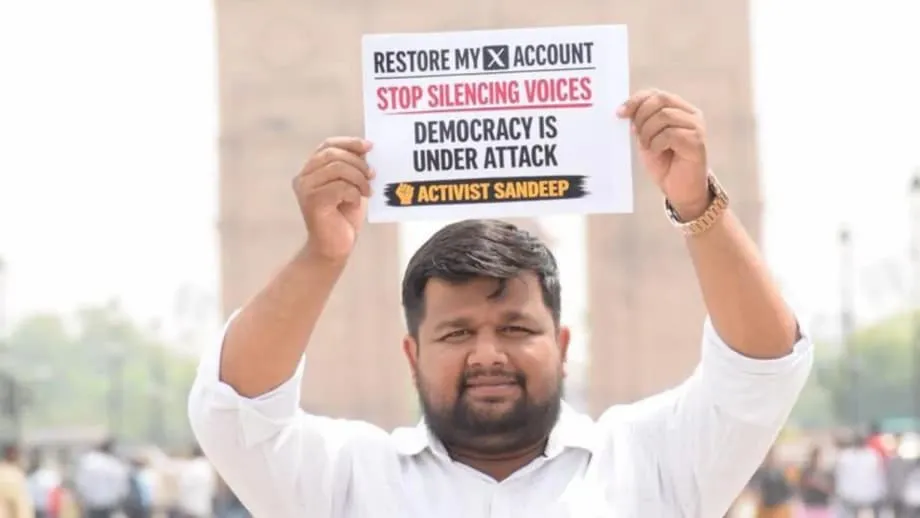
Sandeep Singh, whose X account @ActivistSandeep has more than 100,000 followers, remained blocked in India as of April 14. He began posting critical views because he felt mainstream media favoured the ruling BJP. Singh said the restriction would not change his intention to speak:
I stand for the truth and blocking my accounts or posts will not stop me from continuing speaking truth to power.
Creators must navigate legal proceedings to restore material, while platforms face immediate pressure to comply. That unequal burden is central to concerns that expanding the rules will encourage silence among people with little money or access to lawyers.
Earlier Court Decisions Shape the Legal Challenge
The Supreme Court's 2015 judgment in Shreya Singhal v. Union of India addressed the conditions under which intermediaries must remove content. It held that takedown obligations arise through court orders or government notifications citing specific constitutional grounds. The court also ruled that vague and overly broad restrictions on speech are constitutionally fatal.
Legal scholars argue that the proposed Rule 3(4), with its range of executive instructions, sits uneasily with that judgment. Their concern is that obligations affecting expression could become broader and less predictable than the court's framework permits.
The Bombay High Court considered a related issue in Kunal Kamra v. Union of India in September 2024. A majority of 2:1 struck down a 2023 amendment empowering a government fact-check unit to identify content about the central government as fake, false or misleading.
The majority held that the amendment was ultra vires, meaning beyond lawful authority, under Articles 14, 19(1)(a) and 19(1)(g) of the Constitution. Those provisions protect equality before the law, freedom of speech and expression, and the right to practise a profession. The Union government's appeal remains before the Supreme Court, which issued notice in March 2026.
Legal analysts see a similar operating logic in the March draft. Instead of making one government fact-check unit the trigger for platform action, Rule 3(4) would connect legal protection to an open class of executive communications. The related constitutional concerns involve delegation of power and weaker procedural safeguards.
The Code of Ethics in Part III was designed for publishers with editorial control and employed journalists. Extending it to ordinary users would make people discussing public affairs answerable under a framework they may lack the resources to navigate, including complaints before an Inter-Departmental Committee in Delhi.
The Press Club Demands Withdrawal
The Press Club of India demanded complete withdrawal of the draft Information Technology Second Amendment Rules, 2026, in a resolution dated April 11. It warned of a chilling effect, meaning people may avoid lawful expression because they fear punishment, removal or a costly dispute.
The club's concerns include self-censorship by independent creators trying to avoid algorithmic misidentification. A system that wrongly labels a post can impose costs even when the author believes the material is lawful. That risk grows when platforms have little time to assess context.
Solo podcasters, newsletter writers and YouTube creators are particularly exposed. The Press Club described the compliance framework as financially terminal for people without the legal resources available to established media houses. Its demand for withdrawal goes further than seeking clearer wording or narrower enforcement.
The Government Says the Draft Can Change
MeitY Secretary S. Krishnan has defended the proposal as clarificatory rather than an expansion of regulation. He says ministry guidelines remain consistent with the Constitution and existing law, and that a common policy or framework is needed because news and current affairs are now shared by ordinary citizens as well as publishers.
Krishnan indicated that interpreting the draft as treating users as publishers was unintentional. He said the government remained open to revising or even repealing particular clauses in response to stakeholder feedback.
A roundtable at Electronics Niketan brought together industry representatives, civil society advocates and media organisations. Following the meeting, Krishnan acknowledged requests for clearer distinctions among intermediaries, registered news publishers and individual users. The extension of consultation to April 29 gives participants more time to submit their concerns.
Apar Gupta, founding director of the Internet Freedom Foundation, said the modifications discussed at the meeting did not fundamentally change what the organisation regarded as the proposal's illegality or censorial effect. He explained the foundation's position:
We grounded this position in the framework of the IT Act, 2000, and in the existing patterns of opaque censorship under the Rules that operate without any meaningful adherence to the principles of natural justice.
Natural justice concerns fair procedures, including an opportunity to understand and respond to action affecting a person. Krishnan disputed Gupta's assessment, saying the amendment was not contrary to those principles. The final wording and any changes following consultation had not been decided as of April 14.
A Regional Pattern of Greater Digital Control
Bangladesh's Digital Security Act, 2018, Pakistan's Online Content Blocking Rules under the Prevention of Electronic Crimes Act, and Nepal's Online Media Directives share concerns identified in India's regulatory debate: vague prohibitions on false information, broad executive discretion and limited judicial oversight.
Legal scholars describe the wider trend as the development of micro-internets, in which national controls fragment online spaces and obstruct regional communication. Censorship by proxy is another part of this pattern: governments require private companies to undertake moderation that the state would find politically or technically difficult to carry out directly.
Mauritius has already cited India's 2021 rules in attempts to regulate social media. Digital rights organisations warn that India's approach could spread to other developing democracies. They also argue that accommodation by major platforms could normalise restrictions they would regard as unacceptable in Western democracies, weakening global protections for digital expression.
The Dates That Define the Dispute
The current debate combines a draft expansion of regulation, an enforcement deadline already in effect and a court challenge concerning an earlier amendment. The sequence explains why creators and platforms are facing several pressures at once.
- 2015: The Supreme Court set limits on intermediary takedown obligations in Shreya Singhal v. Union of India.
- 2021: The IT Rules introduced the framework governing digital media publishers and OTT platforms.
- September 2024: The Bombay High Court struck down the government's fact-check unit amendment by a majority of 2:1.
- February 20, 2026: The reduction in the blocking compliance deadline from 36 hours to three hours took effect.
- March 2026: The Supreme Court issued notice in the Union government's appeal concerning the fact-check unit ruling.
- March 30, 2026: MeitY released the draft amendments extending oversight to users sharing news and current affairs.
- April 11, 2026: The Press Club of India demanded withdrawal of the draft.
- April 14, 2026: The original consultation deadline was superseded by an extension to April 29.
April 29 is the next stated deadline for public feedback. The immediate dispute is whether a common framework for news content can be written without imposing newsroom obligations on individuals or making platforms remove speech simply to protect themselves from liability.
Key Points
- The March 30 draft would extend publisher rules to individual users sharing news and current affairs.
- Proposed Rule 3(4) would make safe harbour protection depend on compliance with seven categories of ministry instructions.
- A separate amendment already requires compliance with government blocking orders within three hours instead of 36.
- Meta restricted more than 28,000 pieces of content in India following government requests in the first half of 2025.
- Kumar Nayan's account was restored by court order, but ten posts remained blocked; Sandeep Singh's account remained blocked on April 14.
- The Press Club of India seeks withdrawal, while digital rights advocates warn of censorship and costly obligations for independent creators.
- Krishnan says provisions can be revised or repealed. Consultation runs until April 29.