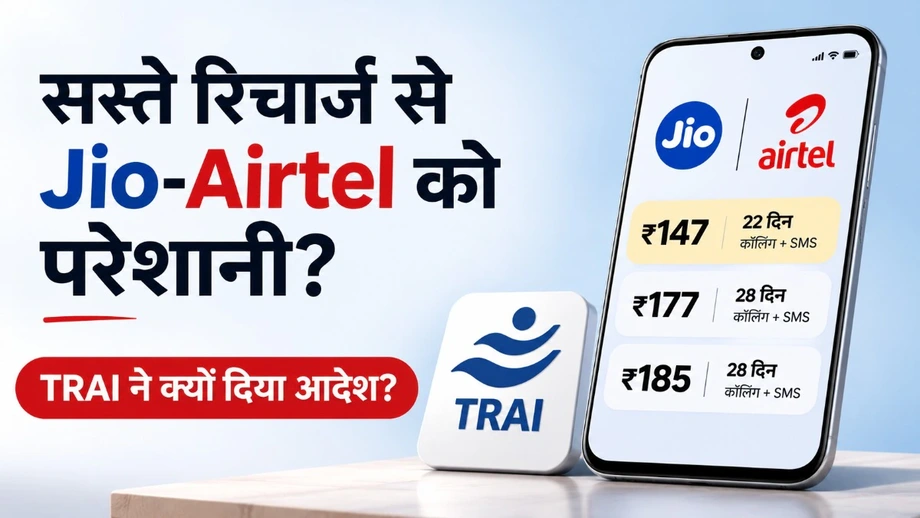
A dispute over what customers see first
On October 1, 2026, the Telecom Regulatory Authority of India (TRAI) ordered mobile operators to place a dedicated TRAI-Mandated Packs tab at the very front of their prepaid recharge menus. Companies had 30 days, until October 30, to comply and submit reports. The requirement covers websites, mobile apps and exclusive retail outlets run by Reliance Jio, Bharti Airtel, Vodafone Idea, BSNL and other service providers.
Contents
- A dispute over what customers see first
- What TRAI ordered, and why it acted
- How annual calling vouchers led to a display deadline
- What the mandated packs actually contain
- What the November 27 checks found
- Why ARPU explains the resistance
- How customers can compare the choices
- What is at stake beyond one tab
- Key Points
Nearly four weeks after that deadline, the position varied by company and by screen. Website checks on November 27 found Airtel and Vodafone Idea displaying the category first, while Jio listed it seventh. Checks of mobile apps that morning found the section on Jio and Airtel, but not in first position. Vi showed it first, and BSNL displayed it across its digital platforms.
The argument matters because the mandated vouchers serve more than 200 million subscribers who depend on calls and SMS without needing daily internet bundles. They include elderly people, rural residents, users of basic phones and households with limited budgets. Jio and Airtel have resisted compulsory top placement, according to three people aware of the discussions, because greater visibility could encourage customers to abandon costlier plans containing data. Jio maintains that it already complies.
What TRAI ordered, and why it acted
The direction requires a separate, easily visible section containing smaller recharges, vouchers for calls and SMS without data, plans with validity of 30 days and options that renew on the same calendar date each month. It must be the first tab in the prepaid recharge area, rather than merely existing somewhere on the first page. The same vouchers must receive prominent display at exclusive points of sale.
TRAI cited Section 13, read with sub clauses (i) and (v) of clause (b) of sub section (1) of Section 11 of the TRAI Act, 1997, as the legal basis. The underlying tariff obligations come from instruments including the Telecommunication Tariff Order, 1999 and the Telecom Consumers Protection Regulations, 2012. Special Tariff Vouchers, commonly called STVs, can cover different validity periods, including 30 days or less and longer durations.
TRAI, whose role includes protecting telecom consumers and regulating tariffs, described the complaints that prompted its intervention.
Received various complaints from consumers regarding the lack of adequate transparency, visibility and ease of access to the different types of TRAI-mandated vouchers on the websites and mobile applications of the service providers.
The regulator's own examination then found vouchers distributed among unrelated categories or hidden behind several screens. It described the problem as a form of digital dark patterns, meaning interface designs that steer people toward choices they might not otherwise make.
TRAI-mandated vouchers are neither displayed prominently nor are easily accessible, and in some cases, these vouchers are placed under different categories or require consumers to navigate through multiple screens to find them, as a result of which, consumers are facing difficulty in locating and subscribing to the vouchers suitable to their requirements.
For a customer who only needs calls, the practical difference is simple. A voucher can technically exist while remaining hard to discover behind menus promoting unlimited data, entertainment subscriptions or gaming benefits. TRAI's order addresses that discovery process; it does not, by itself, announce another reduction in recharge prices.
How annual calling vouchers led to a display deadline
The display dispute follows almost two years of attempts to widen choice for subscribers who do not use mobile internet. Companies initially met a broad obligation with a small number of long duration products, leaving customers who wanted shorter commitments with few alternatives.
- December 2024: TRAI required at least one Special Tariff Voucher for calls and SMS only, with validity extending up to 365 days.
- January 2025: Operators responded with quarterly and annual products. Most available options lasted around 80 to 84 days or 336 to 365 days, rather than offering shorter validity.
- April 7, 2026: A draft amendment proposed a voucher without data for every validity already sold with bundled calls, SMS and data. It also proposed price reductions largely proportional to the removed data benefit.
- April and May 2026: The comment deadline moved from April 28 to May 5, with counter comments accepted until May 12. TRAI received 1,132 responses from companies, industry associations, consumer groups and others.
- June 15, 2026: An Open House Discussion allowed stakeholders to present their arguments directly.
- September 21, 2026: TRAI notified the Telecom Consumer Protection (Thirteenth Amendment) Regulation, 2026. It took effect 30 days after gazette publication, around October 21.
- October 1 and October 30, 2026: TRAI issued its display direction, followed by the deadline for implementation and compliance reports.
- October and November 2026: Airtel introduced shorter calling products in mid-October, while Jio followed at the start of November. Checks on November 27 then examined how prominently those products appeared.
Consumer groups told TRAI that people were often buying data they did not need. Other respondents questioned demand for such vouchers, pointing to banking, telemedicine and digital inclusion. Some warned that inexpensive short validity products could be misused by telemarketers, while companies argued that a fixed reduction formula would amount to indirect price control.
The final regulation requires a reduced price voucher for calls and SMS only for every validity of 30 days or less that has a corresponding plan with data. It also requires renewal on the same date each month, moving to the last day when that date does not exist, and at least one longer option without data. TRAI replaced the rigid pricing formula with a requirement for appropriate reductions, suggesting average revenue per GB as a possible benchmark. It declined an automatic review after six months but retained the ability to revisit the rules.
What the mandated packs actually contain
Jio's November catalogue contained 10 mandated packs priced from ₹147 to ₹1,748. Six provided no mobile data, demonstrating that the category is broader than a single inexpensive monthly recharge.
- ₹147 for 22 days, ₹177 for 28 days, ₹196 for 30 days and ₹197 for a calendar month each included unlimited calling and 300 SMS, without data.
- ₹448 for 84 days included unlimited calling and 1,000 SMS. The ₹1,748 voucher lasted 336 days and included 3,600 SMS. Neither contained data.
- ₹319 and ₹339 calendar month vouchers provided 1.5GB per day, unlimited calls and 100 SMS per day. Speed fell to 64 Kbps after the daily data allowance. The ₹339 option also listed ₹14.95 of talktime.
- ₹355 and ₹365 vouchers lasted 30 days and supplied 25GB in total, unlimited calls and 100 SMS per day. The ₹365 option listed ₹7.47 of talktime.
Some Jio products also listed JioTV or JioAICloud benefits. Where JioHotstar Mobile was included, the stated condition required another recharge 48 hours before the existing validity expired. These conditions show why customers should examine benefits rather than assuming every product in the mandated category works identically.
Airtel's calling vouchers included ₹185 for 28 days, ₹203 for 30 days and ₹206 for a calendar month. Vi's range included ₹179 for 25 days and price points of ₹185, ₹203 and ₹206. The short duration products listed by the private operators included unlimited calls and 300 SMS without data.
The savings against bundles are real but modest. Airtel's and Vi's ₹185 vouchers were about 7 percent cheaper than their entry plans lasting 28 days with 2GB of data. Jio's ₹177 option cost ₹12 less than its ₹189 plan, a reduction of 6.3 percent. A customer who never uses data avoids paying for that allowance, while someone who needs internet must check whether the small saving justifies losing it.
Airtel also placed products containing data in the section. Its ₹589 plan offered unlimited calls, 300 SMS, 50GB of data for use at any time during 30 days and 12 months of Adobe Express Premium. A ₹609 version provided 60GB and validity based on one calendar month. Spending ₹20 more therefore added 10GB and changed the renewal structure. Earlier, Airtel had reduced its 84 day calling pack from ₹499 to ₹469 and its annual pack from ₹1,959 to ₹1,849.
What the November 27 checks found
Airtel's website opened its recharge catalogue with TRAI Mandated packs selected by default for the prepaid number tested. The category appeared before Content Packs, Top Data Packs, Recommended Packs and International Roaming. Its listings included vouchers priced at ₹429, ₹355 and ₹1,849 alongside the calling options at ₹185, ₹203 and ₹206.
Vi's website, checked with Maharashtra and Goa selected as the circle, also placed the mandated category first, ahead of popular packs and unlimited 4G+5G. Jio's website instead selected Popular Plans by default. TRAI Mandated Packs appeared seventh, after Popular Plans, Unlimited Plans, Youth & Gaming, Unlimited 5G upgrade, Entertainment Plans, and Annual and long term plans.
Mobile app checks conducted between 8 am and 11 am on the same date found Vi's tab at the top. Jio and Airtel had added their sections but had not placed them first. BSNL displayed the section across its digital platforms. Tab positions can change as companies update their software, and displays may vary between an app, a website, a circle or an individual account.
Jio's position is that it complies fully because the relevant packs are visible on the first page beside its other plans. That interpretation differs from TRAI's explicit instruction that the dedicated category itself be the first tab. Airtel has not publicly answered the claims about its resistance, and the website observation does not establish when its interface changed.
The website examination covered one Airtel prepaid number and did not independently test the mobile apps. These observations describe what customers could see at particular moments; they are not a TRAI compliance ruling.
Why ARPU explains the resistance
ARPU means average revenue per user. In plain language, it measures how much income an operator collects from an average subscriber during a period. A customer moving from a data bundle to a cheaper voucher for calls and SMS can reduce that figure, a process known as downtrading.
People familiar with the discussions said Jio and Airtel feared that putting cheaper options first would accelerate such movement. Industry executives have also argued that the products are already visible and that arranging tabs should remain a commercial decision, particularly when the new calling products are already pressuring revenue.
An Axis Capital estimate dated November 2 put the possible reduction in Airtel's mobile revenue below 1 percent, even if every 2G subscriber moved to a calling pack. Vi's exposure was estimated at about 2.3 percent because 2G users represented roughly 34 percent of its subscriber base. The expected effect on blended ARPU was below 1 percent for both companies.
Jio has no 2G network, so that particular scenario does not apply directly. Its exposure lies among customers using basic phones and 4G subscribers with limited usage. Entering the change, September quarter ARPU was ₹271 for Airtel and ₹218.8 for Jio. Vi reported customer ARPU of ₹198, excluding machine to machine connections, and blended ARPU of ₹178. The companies calculate these measures differently, so the figures are not strictly comparable.
Vi supplied an early real world indication on its November 13 earnings call. It reported no significant downgrading during the first two weeks and said some users had moved upward to its ₹199 plan. That experience came from the operator with the largest estimated exposure and one that had already given the mandated category top placement.
TRAI's Performance Indicators report for January to March 2026 helps explain the wider economics. Average revenue per GB fell from ₹9.11 in March 2025 to ₹7.51 in March 2026, a decline of ₹1.60 or 17.6 percent. Monthly ARPU nevertheless rose from ₹183 to ₹196.04, an increase of ₹13.04 or about 7.1 percent. Average monthly consumption per subscriber increased from 25.70GB to 26.70GB between the two most recent quarters cited, while total wireless data usage grew 6.31 percent compared with the preceding quarter. Operators were earning less from each GB while rising consumption supported revenue per customer.
How customers can compare the choices
The lowest advertised price does not always provide the lowest cost for each day of service. Calculations using the listed prices and validity periods produce these comparisons.
- Jio: ₹147 for 22 days, equivalent to about ₹6.68 per day.
- Airtel: ₹185 for 28 days, equivalent to about ₹6.61 per day.
- Vi: ₹185 for 28 days, also equivalent to about ₹6.61 per day.
- BSNL: ₹172 for 28 days, equivalent to about ₹6.14 per day.
Jio therefore requires the smallest initial payment among those four options, while BSNL has the lowest daily cost. Among Jio, Airtel and Vi, Jio's ₹177 voucher is the least expensive option lasting 28 days, although BSNL's ₹172 voucher costs less still.
Customers using MyJio can go to Recharge and then Prepaid, scroll through the categories and select TRAI-Mandated Packs. In Airtel Thanks, the category can be sought through Recharge. BSNL users can look under Recharge in the Selfcare app or portal. Before paying, subscribers should compare validity, SMS allowances, calling benefits, data and renewal dates. A plan lasting 30 days differs from one renewing on the same calendar date each month.
What is at stake beyond one tab
The industry's arguments create a commercial tension. If the mandated products are already prominent and the estimated revenue effect is below 1 percent for Airtel, moving their category to the front might appear relatively inexpensive. The resistance indicates that default visibility itself matters: a customer who sees a data bundle first may never reach the calling voucher, while a first tab presents that alternative before any scrolling.
The dispute also tests how far TRAI can shape digital storefronts after requiring companies to sell particular products. Vi's compliance and early upgrades show that top placement does not automatically produce widespread downtrading. For customers, consistent enforcement would make plan discovery less dependent on which operator they use.
The October 30 reporting deadline has passed, but no date has been announced for a further TRAI decision on Jio's placement or the differing app displays. Until such a decision arrives, the most reliable step for subscribers is to inspect the dedicated category themselves and compare the actual benefits rather than relying on the first plan presented.
Key Points
- TRAI's October 1, 2026 direction requires TRAI-Mandated Packs to be the first prepaid recharge tab on websites and apps.
- Operators had until October 30 to comply and submit reports, with prominent display also required at exclusive retail outlets.
- The measure is intended to help more than 200 million subscribers who rely on calls and SMS without daily data bundles.
- Website checks on November 27 found Airtel and Vi placing the category first, while Jio listed it seventh.
- Jio says visibility on the first page amounts to compliance; TRAI's direction specifically concerns the position of the dedicated tab.
- Jio's mandated catalogue ranged from ₹147 for 22 days to ₹1,748 for 336 days and included products both with and without data.
- Axis Capital estimated a mobile revenue effect below 1 percent for Airtel and about 2.3 percent for Vi.
- Vi reported no significant downtrading in the first two weeks and said some customers upgraded to its ₹199 plan.
- No date has been announced for TRAI's next enforcement decision.