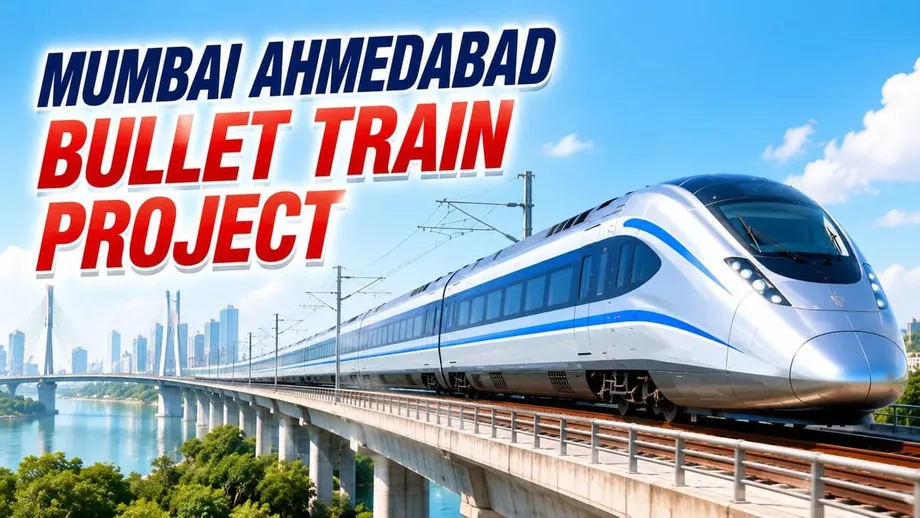
Trials on India's First Bullet Train Corridor to Begin in May 2027
India's first bullet train will enter its trial phase in May 2027 on a stretch of 50 kilometres between Surat and Bilimora in Gujarat, Railway Minister Ashwini Vaishnaw said on Monday, November 23, 2026. The stretch is the first section of the Mumbai-Ahmedabad High-Speed Rail corridor of 508 kilometres to be tested. Electrification on the section is complete, and the overhead equipment on both the up and down elevated lines was energised on November 20.
Contents
- Trials on India's First Bullet Train Corridor to Begin in May 2027
- What the November 20 Power Milestone Means
- How Fast Will the B-28 Train Go?
- The Phased Opening Plan
- The Hardest Part: Tunnelling Under Thane Creek
- The Trains: B-28 Now, B-35 Later
- Cost, Delays and the Japan Connection
- What Comes After Mumbai-Ahmedabad?
- What the Bullet Train Changes for Passengers and Cities
- What Remains Unknown
- Key Points
Signalling work on the stretch is expected to finish by January 2027. The B-28 trainset, built in India, will be used for the initial trials. It is designed to run at speeds of up to 280 kilometres per hour. A commercial service is targeted for August 15, 2027 on the Surat-Bilimora section, while the longer Surat-Vapi stretch is now planned for the final quarter of 2027.
The full Mumbai-Ahmedabad corridor is projected to be operational by the end of 2029. Once complete, travel between India's financial capital and Ahmedabad will take less than two hours, compared with eight to nine hours by road today.
What the November 20 Power Milestone Means
The National High Speed Rail Corporation Limited, the agency building the corridor, announced that the Overhead Equipment system was energised on November 20 on both lines of the elevated Surat-Bilimora section. The system supplies electricity to trains through overhead wires. The corridor uses a 2 x 25 kV overhead traction system, a technology common in high-speed rail networks around the world.
Power will come from the national grid through 14 traction substations placed along the route of 508 kilometres. The first substation, at Bilimora in Navsari district, has completed installation of its control panel, changeover switch, transformer and circuit-breaker buildings. It will draw electricity from the 220 kV Ambetha Grid Substation of the Gujarat Energy Transmission Corporation Limited.
The elevated stretch of about 50 kilometres between Surat and Bilimora includes bridges across four rivers and a steel bridge over National Highway 53. About 94,000 noise barriers have been fitted along the viaduct to reduce sound in nearby areas. The railway ministry issued a public safety warning, asking residents, commuters and construction workers to stay away from overhead electrical equipment and not to touch the installations or carry out unauthorised work near the section.
Energisation will be carried out progressively in smaller sections, under the close supervision of technical teams to ensure safety and compliance with prescribed procedures.
Officials clarified that switching on the power supply does not mean the stretch is ready for passenger services. They described the milestone as an important step towards testing.
How Fast Will the B-28 Train Go?
The B-28 trainset is designed for a maximum test speed of 280 kilometres per hour. Its planned operational speed is 249 kilometres per hour, according to the Ministry of Railways. Vaishnaw has said that rail services running above 240 kilometres per hour fall under the high-speed rail category and require special engineering and construction standards.
One of the biggest technical challenges at such speeds is air pressure. Vaishnaw said the pressure generated by trains moving at high speed must be factored into the design of both the train and the supporting infrastructure. The B-28 has passed a squeeze test, during which it was subjected to pressure levels twice the atmospheric pressure expected during regular operations. The test was aimed at checking whether the train can withstand demanding conditions at high speed.
The train will be available for trial runs by April or May.
A top government official gave that assessment on the same day Vaishnaw spoke about the May 2027 timeline. On the Surat-Bilimora stretch, the high-speed train is expected to cover 50 kilometres in about six minutes. Regular trains on the same route take between 45 minutes and 1.5 hours. For the full Mumbai-Ahmedabad journey, the bullet train will take 1 hour 58 minutes on express services with limited stops, and up to 2 hours 58 minutes if it stops at all stations. Initial frequency is planned at 30 minutes, then reduced to 20 minutes and eventually 10 minutes as more trainsets join the network.
The Phased Opening Plan
The Mumbai-Ahmedabad project will open in stages rather than all at once. This allows parts of the corridor to begin operations before the entire 508-kilometre line is finished. The railway ministry has set the following tentative timeline:
- Surat to Bilimora (about 50 km): first section, trials from May 2027, commercial service targeted for August 15, 2027.
- Surat to Vapi (about 100 km): operational target moved to the final quarter of 2027.
- Vapi to Ahmedabad (Gujarat stretch): targeted for completion by the end of 2027.
- Ahmedabad to Thane: services planned to reach Thane by 2029.
- Mumbai BKC to Ahmedabad (full corridor): projected operational by the end of 2029.
Vaishnaw said the project has moved beyond the planning stage. He has described the corridor as one of India's most ambitious infrastructure projects. The minister also said construction work in Maharashtra, including the undersea tunnel, is progressing well.
The Hardest Part: Tunnelling Under Thane Creek
Connecting the route into Mumbai requires complex underground engineering. The alignment runs through a tunnel 21 kilometres long in Maharashtra, including an undersea section 7 kilometres long beneath Thane Creek. It is India's first under-sea rail tunnel. Two giant tunnel boring machines were deployed from Vikhroli and Savli in July 2026. Each machine is about 96 metres long, stands as tall as a building four storeys high and weighs more than 3,000 tonnes. They are the largest tunnel boring machines ever used in India.
Progress is also visible above ground. Teams have completed 456 kilometres of pillar work and 371 kilometres of viaduct construction along the corridor. About 6 lakh noise barriers have been installed across a stretch of 299 kilometres, and more than 9,300 overhead equipment masts have been erected over 206 kilometres of viaduct. Civil construction is complete at eight stations, with architectural finishing underway. Work is advancing at three rolling stock depots in Sabarmati, Surat and Thane. In Palghar district, excavation is ongoing for seven hill tunnels. Between Mumbai's BKC and Shilphata, 5 kilometres of the tunnel 21 kilometres long has been excavated using the New Austrian Tunnelling Method.
The Trains: B-28 Now, B-35 Later
The B-28 trainset is being manufactured by state-owned BEML and the Integral Coach Factory. The first body frame is complete and is undergoing structural testing. The train will have eight coaches and measure about 202 metres. It can carry an estimated 557 passengers, including two designated spaces for Divyangjan and Persons with Reduced Mobility. Seven coaches will have standard 3x2 seating, and one executive coach will have 2x2 seating. Two eight-coach trainsets can be coupled to form a formation of 16 coaches for future demand.
BEML secured a Rs 5,400 crore contract to supply and maintain 16 high-speed trains for the corridor, the largest single order in the company's history. Its overall order book has crossed Rs 21,000 crore. The trains are being built at BEML's Aditya High-Speed Rail Complex in Bengaluru, a facility of 10 acres. A second B-28 trainset is expected in early 2028, which will help increase frequency on the route.
The railway ministry is also developing the B-35, capable of running at 350 kilometres per hour. Vaishnaw has said the B-35 is targeted for introduction by 2035, though a separate timeline mentioned 2028. Both trainsets are to be fully indigenous. The body material for the B-35, whether stainless steel or aluminium, has not been finalised.
Cost, Delays and the Japan Connection
The Mumbai-Ahmedabad high-speed rail project was initially estimated to cost Rs 1.08 lakh crore. The cost has since risen to nearly Rs 2 trillion, with a revised estimate of about Rs 2.02 lakh crore. Japan is providing 81 percent of the funding through a loan from the Japan International Cooperation Agency, while the Government of India and state governments cover the remaining 19 percent. The project uses Japanese Shinkansen technology, including the J-Slab ballastless track system.
The foundation stone was laid in September 2017 by Prime Minister Narendra Modi and the Government of Japan. Construction stalled in Maharashtra for close to two and a half years because state permissions and land were not available. The COVID-19 pandemic caused a further delay of two years. Full-scale construction began in 2021. Vaishnaw has attributed delays to political issues, particularly land acquisition in Maharashtra. Concerns over India-Japan coordination surfaced after a former Japanese minister blamed India for the delays.
India's first bullet train is no longer an announcement. It is 508 km of construction, moving at full pace. The first service begins in the last quarter of 2027!
Vaishnaw made that statement on November 20, three days before his latest briefing on the trial schedule. He has also said that serious construction on the project is just five years old.
What Comes After Mumbai-Ahmedabad?
The central government has approved seven more bullet train corridors in the budget, according to Vaishnaw. These are Delhi-Varanasi, Varanasi-Patna-Siliguri, Mumbai-Pune, Pune-Hyderabad, Bengaluru-Chennai, Bengaluru-Hyderabad and Chennai-Hyderabad. A Hyderabad-Mumbai high-speed link is also planned. The government has earlier approved the northern corridor linking Delhi to Guwahati through Agra, Lucknow, Varanasi, Patna and Siliguri, with projected journeys such as Delhi to Agra in 59 minutes and Delhi to Varanasi in 3 hours 35 minutes.
Projected travel times for the proposed corridors include Mumbai to Pune in 48 minutes, Bengaluru to Chennai in 73 minutes, Bengaluru to Hyderabad in 2 hours 10 minutes, Pune to Hyderabad in 2 hours 8 minutes, Delhi to Lucknow in 2 hours, Delhi to Varanasi in 3 hours 15 minutes, and Delhi to Siliguri in 6 hours. Three of the proposed routes centre on Hyderabad: Pune-Hyderabad, Hyderabad-Chennai and Hyderabad-Bengaluru.
What the Bullet Train Changes for Passengers and Cities
For passengers, the most immediate change is time. The Mumbai-Ahmedabad bullet train will cover the route in 1 hour 58 minutes on express services. The same journey takes eight to nine hours by road. On the first Surat-Bilimora section, a trip that now takes 45 minutes to 1.5 hours by regular train will take about six minutes.
The corridor will have 12 stations: Mumbai (BKC), Thane, Virar, Boisar, Vapi, Bilimora, Surat, Bharuch, Vadodara, Anand/Nadiad, Ahmedabad and Sabarmati. The Mumbai BKC station will be underground, while the other 11 will be elevated. Property buying has already increased in and around Surat, Navsari and Bilimora as construction nears completion, according to real estate observers. Land prices near stations have seen steady increases as buyers and builders position themselves for future demand.
Vaishnaw has said the bullet train fare will be within the budget of the middle class and that the fare structure will be released soon. He also pointed to the scale of Indian Railways: about 750 crore passengers travel by train each year, compared with 35 crore by airlines and 250 crore by road. Around 99.4 percent of the railway network is now electrified, with about 60,000 kilometres electrified, 36,000 kilometres of new tracks laid and 70,000 kilometres of track upgraded. To reduce waiting lists, the minister said 2,000 to 2,500 new trains are needed.
What Remains Unknown
The exact commercial start date for the first passenger service has not been confirmed beyond the target of August 15, 2027. The railway ministry has not released the fare. The B-35's body material has not been decided. The Surat-Vapi launch was initially set for August 2027 but has been moved to the final quarter of 2027. The full corridor to Mumbai depends on the completion of the tunnel 21 kilometres long, including the undersea section 7 kilometres long under Thane Creek.
The next dates to watch are January 2027, when signalling work on Surat-Bilimora is expected to finish; May 2027, when trials are scheduled to begin; August 15, 2027, the targeted start for the first commercial service on the stretch of 50 kilometres; the final quarter of 2027, when Surat-Vapi is planned to open; the end of 2027, when the Gujarat stretch up to Ahmedabad is targeted for completion; and 2029, when services are planned to reach Thane and the full Mumbai-Ahmedabad corridor is projected to be operational.
Key Points
- Trials on India's first bullet train corridor are expected to begin in May 2027 on the stretch of 50 kilometres between Surat and Bilimora.
- Electrification is complete, and overhead equipment was energised on November 20, 2026 on both lines. Signalling work is due by January 2027.
- The B-28 trainset is designed for a maximum test speed of 280 kmph and a planned operational speed of 249 kmph. It has passed a squeeze test at twice the expected atmospheric pressure.
- Commercial service on Surat-Bilimora is targeted for August 15, 2027, while Surat-Vapi is now planned for the final quarter of 2027.
- The full Mumbai-Ahmedabad corridor of 508 kilometres is projected to be operational by the end of 2029, with travel time of 1 hour 58 minutes on express services.
- The project cost has risen to nearly Rs 2 trillion from an initial Rs 1.08 lakh crore. Japan funds 81 percent through JICA, with India and state governments covering 19 percent.
- The corridor includes a tunnel 21 kilometres long with an undersea section 7 kilometres long under Thane Creek, India's first under-sea rail tunnel.
- BEML and the Integral Coach Factory are building the B-28 trains. The B-35, capable of 350 kmph, is targeted for 2035.
- Seven more bullet train corridors have been approved, including Delhi-Varanasi, Mumbai-Pune and three routes centred on Hyderabad.
- Fares have not been released. Vaishnaw has said they will be affordable for the middle class.