A Record Deficit Reached With Two Months to Spare
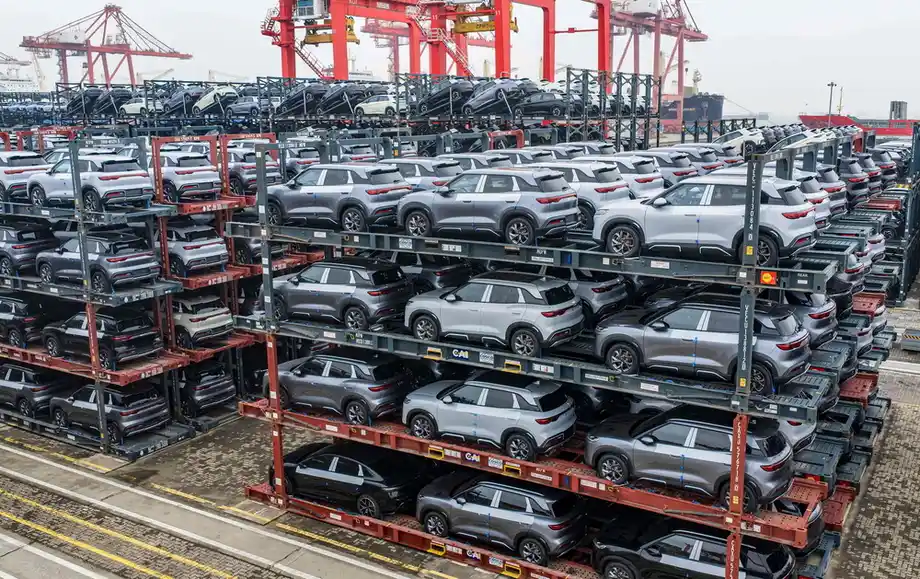
South Korea's auto trade deficit with China reached $4,230,560,000 between January and October, a sum equal to about 6 trillion won, according to the Korea International Trade Association and the Ministry of Trade, Industry and Energy. The total for the ten months rose 92.7 percent from the $2,195,610,000 recorded in the same period of 2025, and it has already passed the $2,511,620,000 deficit for the whole of last year, with two months of trade still to be counted.
Contents
- A Record Deficit Reached With Two Months to Spare
- Tesla's Shanghai Factory Supplies the Surge
- BYD and a Widening Slate of Chinese Brands
- Where South Korea Ranks Among Big Producers
- Why Cars Built in China Cost Less
- An 8 Percent Tariff Against Walls Built Elsewhere
- Domestic Brands Lose Ground in Their Home Market
- How Hyundai Is Responding
- The Tax Credit Fight Moves to the National Assembly
- What Is Not Yet Decided
- Key Points
Automotive exports to China fell 34.9 percent to $168,770,000. Imports rose 79.2 percent to $4,390,330,000. South Korea now buys about 26 times as many cars from China as it sells there.
In 2015 South Korea still sold more cars to China than it bought, and the annual figures since then trace the reversal.
- 2015: an auto trade surplus with China of $870,750,000.
- 2016: the surplus shrank to $18,900,000.
- 2017: the balance turned to deficit, the first of ten consecutive years.
- 2022: the annual deficit reached $466,050,000.
- 2023: the deficit widened to $943,070,000.
- 2024: it grew to $1,729,760,000.
- 2025: the deficit for the whole year came to $2,511,620,000.
- January to October 2026: the deficit reached $4,230,560,000, up 92.7 percent from a year earlier.
Tesla's Shanghai Factory Supplies the Surge
Most Teslas sold in South Korea come out of the company's Gigafactory in Shanghai. Korean buyers registered 98,313 new Teslas in the first ten months of this year, up 105.0 percent from the same period a year earlier, according to the Korea Automobile Importers and Distributors Association. The Model Y accounted for 78,631 of them, making it the best-selling imported model of the period. Tesla's share of the imported car market has passed 30 percent, and the brand has led monthly imported car sales for nine months in a row.
The Model Y is also closing on the best-selling vehicle of any kind in South Korea. Kia's Sorento had 81,717 sales through October, a lead of a little over 3,000 units, and the expectation in the auto industry is that the Shanghai-built Tesla will finish the year on top.
Shipments from the Shanghai plant reached 810,889 Model 3 and Model Y vehicles from January to October, 21.4 percent more than a year earlier, as retail sales inside China weakened. The growth came from the Shanghai factory's export surge, which sent a rising share of production to overseas buyers, and South Korea is one of the markets absorbing it.
BYD and a Widening Slate of Chinese Brands
BYD entered South Korea's passenger car market last year and registered 21,731 vehicles through October, against 3,791 a year earlier. Its Atto 3 and Dolphin models carry the price pitch: the Dolphin went on sale in February at 24.5 million won, about 4 million won less than Hyundai's Casper Electric or Kia's Ray EV.
Polestar, part of the Geely group, sells cars built in China in Korea, and brands including Zeekr and Xpeng are expanding or preparing to enter. In the first half of this year, China passed Germany as the largest source country for imported cars sold in Korea, a change for a market long dominated by German premium brands.
Where South Korea Ranks Among Big Producers
The share of cars built in China in South Korea's electric vehicle market rose from 1.1 percent in 2021 to 33.9 percent in 2025, an increase of 32.8 percentage points, according to the Korea Automobile and Mobility Industry Association and the International Organization of Motor Vehicle Manufacturers. Among the ten largest vehicle-producing countries, leaving out China itself, only Mexico and Brazil saw faster increases. Mexico went from zero to 90.7 percent of its EV market and Brazil from 3.8 percent to 85.4 percent.
Both Mexico and Brazil serve as assembly bases for global automakers and do not have large car brands of their own. Hyundai and Kia anchor South Korea's domestic industry, which designs, builds and exports cars, so a fast shift of the kind seen here is harder to absorb. Spain followed Korea with a rise of 21.9 percentage points, then Germany at 5.1, Japan at 2.3 and India at 0.9. In the United States the share fell 0.2 points and in France it fell 1.1 points.
Registrations of passenger electric vehicles built in China reached 112,417 units from January to September, 2.2 times the 51,535 registered a year earlier, and their share of the Korean market climbed to 38.1 percent.
Why Cars Built in China Cost Less
China's car production capacity grew by 10.21 million units between 2020 and 2025, from 19.46 million to 29.67 million, according to the China Passenger Car Association. Domestic sales grew by 4.45 million units over the same period, leaving a gap that manufacturers fill by exporting.
The Model Y built in Shanghai lists in Korea at 49.99 million won before subsidies, about 3 million won below its price in China. Tesla cut some trims of the same model in Korea from 52.99 million won to 49.99 million won late last year.
Lee Hang-gu, a special professor at Namseoul University, draws the comparison this way.
China has caught up reasonably on quality and is far ahead on value for money.
An 8 Percent Tariff Against Walls Built Elsewhere
South Korea applies its standard 8 percent tariff on imported passenger cars to vehicles built in China. The rate is below China's 15 percent most-favored-nation tariff, and passenger cars were left out of tariff elimination when the two countries signed their free trade agreement, so the 8 percent has stayed in place. South Korea has not opened a countervailing duty case or a similar measure against electric cars built in China.
Other large markets shield their producers far more heavily.
- The United States adds a 100 percent tariff on electric vehicles built in China under Section 301 of the Trade Act of 1974, taking the total as high as 127.5 percent, and plans to bar imports and sales of connected vehicles tied to Chinese or Russian entities from the 2027 model year.
- The European Union applies countervailing duties of up to 35.3 percent on top of its 10 percent base tariff, reaching 45.3 percent for companies that do not cooperate with its investigation, such as SAIC.
- France changed its electric vehicle subsidy rules in 2024 to include environmental assessments that shut out many models built in China.
- Japan's Strategic Domestic Production Promotion Tax System, introduced in 2024, gives 400,000 yen (about 3.4 million won) for each battery electric or hydrogen fuel cell vehicle produced at home and 200,000 yen for plug-in hybrids, with corporate tax relief running up to ten years.
- India charges a minimum basic tariff of 70 percent on imported cars, rising to 110 percent depending on price.
An industry official said China is entering global markets with price competitiveness built on the government's astronomical support, and that South Korea, whose economy depends on exports, finds it hard to take trade steps of the kind used by the United States and Europe, which has left the country a concentrated target for Chinese electric vehicle makers.
Domestic Brands Lose Ground in Their Home Market
South Korea's own automakers sold 1,043,729 vehicles inside the country from January to October, down 7.2 percent from the same period a year earlier, according to the Ministry of Trade, Industry and Energy's automotive industry trends. Imported car sales rose 23.3 percent to 325,542 units over the same period.
October brought a first: imported electric vehicles outsold domestic ones, 18,181 against 13,587 of the 31,768 EVs sold that month, as local purchases slowed when purchase subsidies ran out.
The auto industry warns that a fast rise in cars built in China threatens the domestic production base and the parts supply chain, because lower assembly volumes reach component makers, investment and jobs.
How Hyundai Is Responding
Hyundai addressed the competition during its third-quarter earnings presentation on October 29. The company said the Chinese electric vehicles are price competitive, and it pointed to lower monthly installment financing products and a service network much larger than those of its rivals as its answer, adding that it needs more time to build competitiveness in autonomous driving.
Tesla is still working with Chinese regulators to secure broader FSD approval for its driver assistance software in China, and expectations for that technology are among the reasons Korean demand for its cars has grown.
The Tax Credit Fight Moves to the National Assembly
Industry groups want electric vehicles added to South Korea's domestic production tax credit, a corporate tax break for goods made in the country. In August the government named six sectors eligible: solar, wind, secondary batteries, semiconductors, key materials and AI robot parts. Electric vehicles were not on the list.
Bills to amend the Restriction of Special Taxation Act so that electric and other future vehicles qualify have been introduced in the National Assembly. The government is reviewing a plan to give 2.5 million won in corporate tax relief for each electric vehicle produced and sold in Korea.
Automakers had asked for 4 million won per car. The figure discussed at the National Assembly's tax subcommittee in November points to 2 million to 3 million won. The Ministry of Finance and Economy plans to settle the level of support through an enforcement decree in January next year.
Kim Pil-soo, a professor of future automotive studies at Daelim University, said tax policy is part of what keeps production at home.
To stop the domestic auto industry from going downhill, a range of incentive policies, including tax credits, is needed.
What Is Not Yet Decided
No figure for the electric vehicle tax credit has been fixed, and no bill has passed the National Assembly. The Ministry of Finance and Economy has said it will set the level through an enforcement decree in January, without stating an amount. It is also not known how many more Chinese brands will begin selling in Korea this year or next.
Cho Chul, a special professor at Korea University's Future Growth Research Institute, expects imported cars to take more than half of South Korea's electric vehicle sales if more Chinese companies enter, and domestic models to take a heavy hit.
Key Points
- South Korea's auto trade deficit with China reached $4,230,560,000 in January to October 2026, about 6 trillion won and the largest on record, up 92.7 percent from a year earlier.
- Exports to China fell 34.9 percent to $168,770,000, while imports rose 79.2 percent to $4,390,330,000, about 26 times exports.
- Tesla, which builds most cars for Korea at its Shanghai plant, registered 98,313 vehicles in ten months, up 105.0 percent, with the Model Y at 78,631 units.
- BYD registered 21,731 vehicles through October, and China passed Germany as the largest source of imported cars in the first half of the year.
- Cars built in China rose from 1.1 percent of Korea's electric vehicle market in 2021 to 33.9 percent in 2025 and 38.1 percent in January to September 2026.
- Korea charges an 8 percent tariff on imported passenger cars, against up to 127.5 percent in the United States and up to 45.3 percent in the European Union.
- Domestic automakers sold 1,043,729 vehicles at home in ten months, down 7.2 percent, while imported car sales rose 23.3 percent.
- The government is weighing a 2.5 million won corporate tax credit for each electric vehicle produced and sold in Korea, to be settled by enforcement decree in January.