One product now carries half of Korea's exports
South Korea sold $77.4 billion of goods abroad in the first 20 days of November, up 101.5 percent from the same stretch of 2025 and the largest amount ever recorded for that part of a month, the Korea Customs Service reported on Nov. 23. The period contained 16 working days, half a day more than a year earlier, and even after that adjustment, average daily exports rose 95.2 percent to $4.84 billion.
Contents
- One product now carries half of Korea's exports
- How the month unfolded
- Fourth in the world, and eighth without chips
- The OECD warning on output, tax revenue and strategy
- When the chip cycle turns, the budget feels it
- The IMF lifts its forecasts and asks for restraint
- The 2027 outlook: chips past half of exports
- How much damage would a price slide do?
- What the export boom is worth at home
- Where the next engine could come from
- Markets are already hedging
- Supply chains have weak points of their own
- What to watch
- Key Points
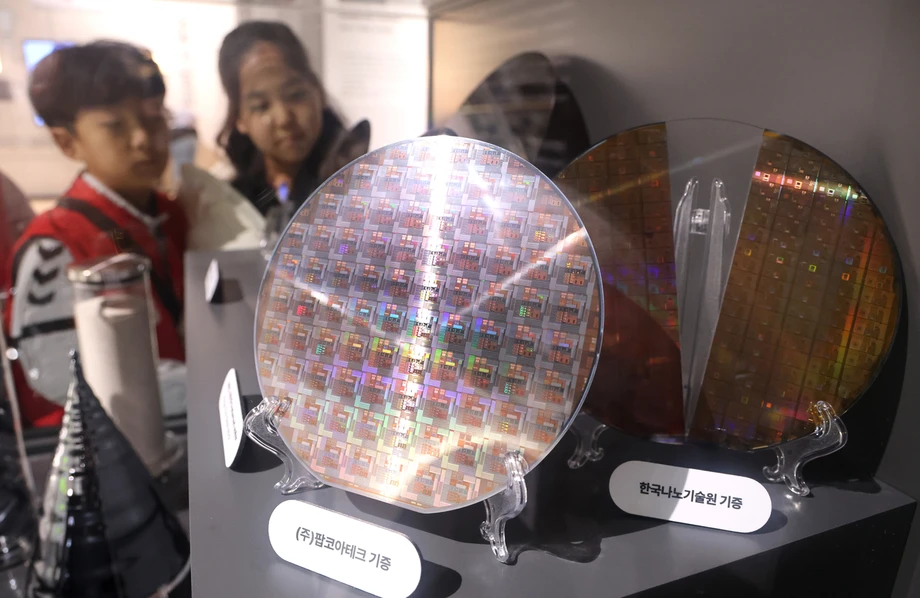
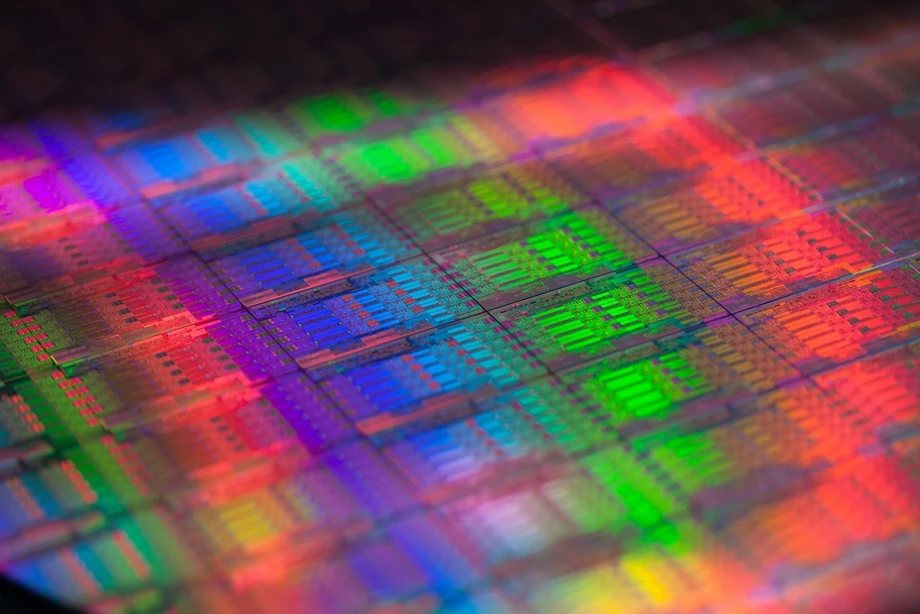
Semiconductors supplied nearly all of the momentum. Chip exports reached $38.5 billion, up 294.4 percent, roughly four times the level of a year earlier and a record for the period. Chips accounted for 49.7 percent of everything Korea sold overseas, 24.3 percentage points more than 12 months before. Of the roughly $39.0 billion increase in total exports, semiconductors contributed about $28.7 billion, or 74 percent.
Global spending on data centers and artificial intelligence sits behind the surge. High-bandwidth memory, a chip that stacks memory layers vertically so processors can move data quickly, has become a scarce part of AI systems, and Samsung Electronics and SK hynix are the main suppliers. Samsung Electronics reported third-quarter operating profit of 107.44 trillion won ($80.5 billion) and SK hynix 83.33 trillion won.
How the month unfolded
- July 2026: The OECD publishes its economic survey of Korea.
- Nov. 3 to Nov. 17: An International Monetary Fund Article IV consultation team visits South Korea.
- Nov. 4: Sogang University's Ji-Am Nam Duck-Woo Economic Research Institute holds a policy seminar on supply chains and industrial policy.
- Nov. 17: The IMF releases the findings of its consultation.
- Nov. 19, 2:09 p.m.: Cumulative annual exports pass $1 trillion for the first time.
- Nov. 20: Trade, Industry and Energy Minister Kim Jung-kwan meets representatives of six economic organizations in Seoul.
- Nov. 23: The Korea Customs Service reports the Nov. 1 to 20 trade figures, and the Korea Institute for Industrial Economics and Trade releases its 2027 outlook.
Fourth in the world, and eighth without chips
Cumulative exports reached $1.0076 trillion by Nov. 20, up 63.2 percent from a year earlier, after the country passed $1 trillion in November for the first time. Only the United States and Germany in 2006 and China in 2007 had crossed that line before, and the government expects the year to close at $1.17 trillion. Korea's climb to the fourth-largest exporting nation pushed it ahead of the Netherlands, a position that rests heavily on chips. Annual exports were about $700 billion in 2025.
Removing semiconductors changes the picture. From January to July, chip exports were $181.7 billion while everything else totaled $413.6 billion, a figure that ranked eighth in the world behind Mexico, Italy and Japan. In the first seven months, exports excluding chips were $15.2 billion below Japan's.
Other industries are not standing still. Exports excluding chips rose 20.2 percent from January to October, the fastest pace in 20 years, and shipments by small and medium-sized companies reached a record $107.6 billion. Consumer goods such as K-beauty and K-food, along with nuclear power and defense equipment, have widened the base, and food exports have grown quickly enough that instant noodles are approaching $2 billion for the year.
The OECD warning on output, tax revenue and strategy
The Organisation for Economic Co-operation and Development examined the same trend in its 2026 Korea Economic Report, published in July. The organisation credited semiconductor exports and investment with lifting Korea's growth contribution early this year, then cautioned that the concentration "creates volatility in output and tax revenue" and adds "strategic vulnerability."
The report also flagged a longer-term exposure. A technological breakthrough, such as alternative computing architectures, would weaken Korean-made chips and with them an engine of growth and tax revenue that has run for decades. Electronics' share of Korea's trade rose from 27 percent in 2023 to 33 percent in 2025, and the report found that Korean value chains are more exposed to disruption in foreign inputs and foreign markets than the OECD average. The World Trade Organization recorded a 38.4 percent rise in Korea's goods exports in the first quarter, the fastest growth among major exporters.
When the chip cycle turns, the budget feels it
Tax receipts swing with the industry, and the swings are large. During the 2021 and 2022 boom, strong corporate earnings produced large excess revenue. The following year, as chip conditions corrected, national tax income fell 13.1 percent from a year earlier, the steepest drop since 2000, opening a major revenue shortfall. The government has used additional and excess tax revenue from the current boom to create a Future Response Fund and finance projects inside it. If receipts move with the industry again, those projects have no guaranteed funding.
Cho Yoon-je, a special professor at Yonsei University's Graduate School of Economics, wants the windfall set aside. Until last year the largest corporate operating profit on record was Samsung Electronics' roughly 50 trillion won (about $37.4 billion), he noted. Collecting corporate tax on profits above that level for several years could build a fund worth hundreds of trillions of won, which he would rather spend on research institutes for advanced technology and on science and engineering talent than on current outlays.
The base outside chips is thinner than the headline suggests, which shows in trade with China. The trade balance with China swung into surplus this year on the strength of memory chips, yet without them the deficit through October widened to $41.5 billion from $29.1 billion a year earlier, as automobiles, batteries and electrical equipment lost ground to local competitors.
The IMF lifts its forecasts and asks for restraint
The International Monetary Fund raised its 2026 growth forecast for Korea to 3.9 percent, 0.6 percentage points higher than a month earlier, and lifted its 2027 figure by half a point to 3.3 percent after its Article IV consultation team visited from Nov. 3 to Nov. 17. Inflation is projected at 2.7 percent this year and 2.3 percent next, above the central bank's 2 percent target.
The fund credited surging technology exports, recovering investment and solid consumption for the upgrade, and said the AI boom is providing an exceptional growth impulse that is feeding through to corporate earnings and fiscal revenue. It also said the gains so far sit mainly in the high-technology sector, with broader spillover to the rest of the economy expected only gradually, and it named rapid population aging, regional imbalances and uneven productivity gains as constraints that must be addressed.
Policy advice followed. With the economy running above potential and inflation above target, the IMF recommended further monetary tightening and a moderately restrictive fiscal stance, while keeping targeted support for vulnerable households and businesses. It welcomed the Future Response Fund as a fiscal stabilization tool that can strengthen the countercyclical capacity of fiscal policy. It also urged structural reform to raise labor force participation, narrow wage gaps between employment types, expand the social safety net, diversify export markets and continue the transition to renewable energy.
The 2027 outlook: chips past half of exports
The Korea Institute for Industrial Economics and Trade published its "2027 Economic and Industrial Outlook" on Nov. 23. It expects exports to rise 14.1 percent next year to $1.3202 trillion and the trade surplus to widen to $455.9 billion from $377.8 billion, a second consecutive annual record, with combined exports and imports passing $2 trillion for the first time. Growth is projected at 3.7 percent this year and 3.5 percent next.
Chip exports are forecast to grow 29.9 percent to $669 billion, lifting their share of total exports to 50.7 percent from 44.5 percent and crossing half for the first time. Everything else is expected to grow just 1.5 percent. Sector forecasts split sharply: shipbuilding up 24.1 percent, information and communications devices up 18.3 percent, biohealth up 12 percent and secondary batteries up 11.5 percent, while automobiles fall 1.3 percent, home appliances 2.4 percent, textiles 1.8 percent, petrochemicals 3 percent and oil refining 10.8 percent.
Kim Yang-paeng, a senior researcher at the institute, identified the second half of next year as the risk point.
When semiconductor plants worldwide begin full-scale production around the second half of next year, increased supply will inevitably slow the rise in prices.
The institute expects chip export growth to slow from 33.9 percent in the first half of 2027 to a 0.7 percent decline in the second half. Hwang Kyung-in, head of its Strategic Industry Analysis Division, set out the choice facing policymakers.
Leading sectors such as memory chips must maintain their substantial technological lead, while traditional core industries facing intense price pressure must respond by expanding high-value-added products.
Facility investment is forecast to rise 7 percent, construction investment 1.8 percent and private consumption 2.3 percent, held back by household debt payments, an aging population and asset market volatility. Kwon Nam-hoon, the institute's president, gave the broader instruction.
We need to prepare for the period after the semiconductor boom while at the same time responding to the spread of AI's economic and social impact.
How much damage would a price slide do?
Prices now matter more than volumes. Kwon Hyo-sung, an economist at Bloomberg Economics, calculated that a 10 percent fall in semiconductor prices would cut Korea's total exports by about 4.3 percent if chip volumes and other exports held steady. Revenue and profits would shrink even if shipments kept rising, and the current account surplus would feel the pressure.
The dot-com bust offers the comparison. In 2001, Korean semiconductor export volumes rose 18.6 percent while export prices fell 51.9 percent, and the growth rate swung from a 69.4 percent increase in August 2000 to a 51.1 percent decline in June 2001. Chips were 15.1 percent of Korean exports in 2000, against 42.7 percent from January to October 2026, so the same price shock now lands on a far larger base.
Contract structures delay the damage. Samsung Electronics has contracts covering several years with price floors for major memory products, and SK hynix has agreements in which prices move within set ranges. How long those protections hold depends on how quickly memory makers adjust supply and how much output China's ChangXin Memory Technologies adds. A price decline could also open a gap between gross domestic product and gross domestic income: production and real value added can keep growing while the purchasing power Korea earns abroad weakens, feeding into corporate profits, share prices, household assets and tax revenue.
What the export boom is worth at home
Retail sales in the third quarter fell 0.5 percent from a year earlier, a sign that the boom has not reached every household. Trade, Industry and Energy Minister Kim Jung-kwan met representatives of six economic organizations in Seoul on Nov. 20 and described the mismatch.
There are those who say, 'There's no food at this much-publicized feast,' and others who feel marginalized.
Kim said quantitative expansion has given way to a test of what he called "qualitative growth."
If it isn't felt on the ground, 1 trillion dollars will remain just a number in the news.
He pointed to a structural risk beyond the current cycle. Chips drove 74.5 percent of the year-on-year increase in exports from January to October, and the minister worried that China may already have claimed the industries that would come next, naming advanced robotics, bio and aerospace as candidates for a "second semiconductor." He also warned that a large trade surplus can invite tariffs and import restrictions from major partners.
It's an era where simply selling more isn't enough to protect markets. We must become a partner that also benefits the industries and jobs of other countries.
Where the next engine could come from
Song Young-gwan, a senior research fellow at the Korea Development Institute, thinks demand will hold up longer than the pessimists expect, but sees a later break.
It is excessive to expect semiconductor demand to plunge by next year, but thereafter an export cliff is possible as AI investment slows. There is a need to diversify growth engines toward consumer goods exports and the tourism industry.
Tourism and services have room to grow. Korea's service exports rose 15.5 percent in the first nine months of 2026 to about $128.9 billion, helped by more than 20 million foreign visitors, but service imports of $147.7 billion left a deficit of $18.8 billion through September, a gap that has persisted in every year since 2000.
Park Sang-hyun, a senior expert at iM Securities, tied the domestic weakness to the same structure.
With domestic demand sluggish, the structure in which the growth rate is largely determined by the semiconductor cycle. Domestic demand should be revived by easing housing cost burdens, among other measures, and new growth engines should be secured.
Markets are already hedging
Semiconductor share prices have fallen even as export figures set records, a divergence that points to investor doubt about how long the cycle lasts. Rhee Chang-yong, a former governor of the Bank of Korea, described the supercycle as an "unprecedentedly positive shock" and warned against the "optical illusion of a boom." He noted that gains concentrated in one industry and a handful of companies can deepen income polarization, and that a large share of Korean savings now sits in semiconductor and AI assets. He said a market correction could arrive within two to three years, and invoked a proverb.
Many countries never see the sun, but the semiconductor supercycle has brought sunshine to us. We need to fix the roof while the weather is fine.
Cho Yoon-je, the Yonsei professor, called the cycle an "unprecedented super-boom" and said the economy has been "thrown out of balance." He expects the boom to run through next year and to avoid a sharp collapse after 2028, but doubts that Samsung Electronics and SK hynix can hold operating margins of 70 to 80 percent for long.
That is the history and physiology of markets. Once the boom passes, we will return to a long-term downward trend because of demographics, stagnant productivity and structural rigidity.
Cho forecasts a current account surplus above 20 percent of gross domestic product and compares the moment to the late 1980s "three lows" boom, when a surplus in the 6 percent range more than doubled land prices within three years, pushed up wages and strengthened the currency, eroding export competitiveness in the 1990s. Growth far above potential raises inflation pressure, he argues, so fiscal and monetary policy should stay conservative. He also prefers AI adoption as a broader source of productivity gains over the search for a single successor industry, pointing to power grids, transformers, cooling systems and energy storage as opportunities created by data centers, and to China's catch-up in humanoid robots, autonomous vehicles and batteries as the sharpest external threat.
Supply chains have weak points of their own
Concentration is not only about which products Korea sells. It runs through who supplies the inputs. At a policy seminar held by Sogang University's Ji-Am Nam Duck-Woo Economic Research Institute on Nov. 4, Heo Jung, a professor in the economics department, presented work on the structure of Korea's semiconductor export economy and identified reliance on a narrow set of countries and companies, dependence on imported materials, parts and equipment, and fragile supplier networks among smaller firms as unresolved tasks. He called for diversifying supply lines, widening the role of small and medium-sized companies in supply chains, and moving into higher-value areas such as high-bandwidth memory and system semiconductors.
Choi Min-cheol, a research fellow at the Korea Institute for Industrial Economics and Trade, told the same seminar that patents and technical results do not automatically translate into market value. He argued that industrial policy should connect technology, investment, technology finance, workers and global strategy so that Korean firms can turn research into domestic production and profit.
Measures are in motion, though their shape is not settled. The trade ministry is promoting the Super-Regional Special Zone Act, which would grant regulatory exceptions to advanced industrial hubs such as the Honam semiconductor cluster, and discussions continue over whether the bill would exempt such zones from the 52-hour workweek. Officials have not said how large the Future Response Fund will grow or which projects it will lock in.
What to watch
Several numbers will settle the debate. The Korea Customs Service publishes trade figures for the first 20 days of each month, with full monthly data following later, so the Nov. 1 to 20 reading will be tested when the complete November total arrives in early December. The institute's forecast of a second-half slowdown in chip export growth and the Bloomberg Economics view that prices turn before volumes give two dates to check against. Two external assumptions underpin the projections: Dubai crude averaging $86.6 a barrel and the won trading at 1,325 to the dollar next year, with Middle East supply disruptions easing gradually and AI investment continuing. A prolonged conflict or worsening trade conditions would lower the forecasts, and Washington is pressing Korean chipmakers to expand production in the United States.
Key Points
- Exports reached $77.4 billion for Nov. 1 to 20, up 101.5 percent from a year earlier and a record for the period, the Korea Customs Service said.
- Semiconductor exports hit $38.5 billion, up 294.4 percent, and made up 49.7 percent of total exports, 24.3 percentage points more than a year earlier.
- Chips accounted for about $28.7 billion of the roughly $39.0 billion rise in total exports, or 74 percent.
- Cumulative exports passed $1 trillion on Nov. 19, making Korea the fourth country to do so after the United States, Germany and China.
- Excluding chips, Korea ranked eighth in world exports from January to July, behind Mexico, Italy and Japan.
- The OECD warned that the concentration creates volatility in output and tax revenue and strategic vulnerability.
- National tax income fell 13.1 percent the year after the 2021 and 2022 boom, the largest drop since 2000.
- The IMF raised its 2026 growth forecast to 3.9 percent and urged diversification, further monetary tightening and a moderately restrictive fiscal stance.
- The Korea Institute for Industrial Economics and Trade forecasts exports of $1.3202 trillion in 2027, with chips passing 50 percent of the total and other exports growing just 1.5 percent.
- Bloomberg Economics estimates a 10 percent fall in chip prices would cut total exports by about 4.3 percent.