Gemini moves from answering questions to carrying out errands
Google is making Gemini's task execution feature free in the United States, Japan, Korea, Canada, Australia and India, allowing users to delegate jobs such as calling businesses, booking appointments, managing bills and buying products. The rollout, announced on November 17, 2026, uses Gemini 4 Hydrogen, the company's latest AI model.
Contents
- Gemini moves from answering questions to carrying out errands
- How the rollout reached six countries
- What happens when Gemini calls a business?
- From a $389 electricity bill to school calendars
- Shopping combines product search, payment and delivery records
- Some orders still finish in another app
- What users approve, and what they can change
- How Google says it protects the working environment
- Website restrictions can interrupt a task
- Key Points
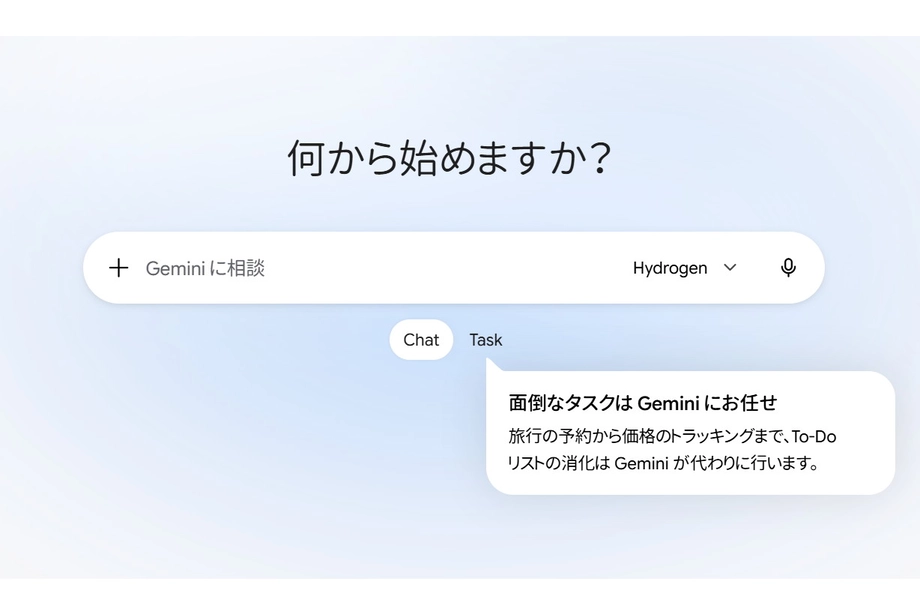
Users can switch from Chat to Task on the Gemini app's home screen and describe what they want done. Instead of simply suggesting a dealership or explaining a bill, the assistant can take steps across connected services, using information and permissions supplied by the user.
Google's Gemini Tasks announcement says the free expansion reaches hundreds of millions of people. More advanced features are starting in the United States. Email forwarding and texting are also initially limited to the United States, so users in Japan and the other rollout markets should begin with the app.
The change brings financial and privacy decisions into the same interface people use for ordinary questions. Google says Gemini is designed to seek approval before critical actions, including purchases, while allowing users to approve some trusted routines in advance.
Josh Woodward, Google's vice president for Labs, the Gemini app and AI Studio, described the purpose of the update in the announcement:
Our goal is for Gemini to save you time and money.
Google also acknowledges that tasks can fail or miss the user's intent. The practical promise is fewer steps for everyday errands, with people still needed to set limits, resolve uncertainty and sometimes finish a job themselves.
How the rollout reached six countries
Gemini Tasks grew out of Gemini Spark, an assistant first offered to selected testers in May. Access later expanded to subscribers of Google AI Ultra in the United States before the feature became Task Mode.
The November expansion moves the service beyond that paid audience. Google says it connects with more than 60 popular apps, although the functions available depend on the service and the market.
- May 2026: Gemini Spark began with selected testers, followed by access for U.S. Google AI Ultra subscribers.
- October 2026: The feature became Task Mode.
- November 12, 2026: Google announced Gemini 4 Hydrogen.
- November 17, 2026: Google began the free Tasks rollout in six countries, with advanced features starting in the United States.
Google has not given a date for bringing the initially U.S. messaging channels and advanced features to the other five countries. The rollout is gradual, rather than a promise that every account receives every function at once.
What happens when Gemini calls a business?
Woodward described asking Gemini to arrange service for his family's 2019 Honda Odyssey after its check engine light came on. His request included a location, a preferred time and a range of possible dates.
According to his account, Gemini used information already available through Google's Personal Intelligence features to identify the vehicle and home location. It found nearby dealerships through Google Maps, called two at once and checked Google Calendar for a suitable opening.
Woodward said the appointment was added to his calendar in less than five minutes. The example shows how several separate actions, finding a business, making a call, comparing availability and recording a booking, can become one delegated task.
Businesses retain a choice about participating. Woodward said Gemini identified itself as AI at the start of the calls and that businesses can opt out. He also said it would not disclose his payment or private account information without his permission.
From a $389 electricity bill to school calendars
A surprise $389 electricity bill provided another example in Woodward's announcement. He said he permitted Gemini to enter his utility portal through a new Google Password Manager integration and examine previous statements in his email.
Gemini identified his heat pump switching on around 4 p.m., during a period with higher electricity prices, as the main cause. The example connects two kinds of information that can be awkward to compare manually: billing documents and details about when energy costs more. Woodward did not give a figure for any subsequent savings.
Google also describes Tasks as a way to organise medical bills, track insurance renewals and manage children's schedules. Those jobs involve different actions: analysing a statement explains a charge, while paying a bill moves money. Users need to specify which action they want and review requests for approval.
For school administration, Woodward said he forwarded a batch of emails to [email protected]. Gemini added the dates to his calendar, invited his wife and spotted a clash with basketball practice. It then asked whether he wanted to text another parent about exchanging carpool duties.
The school example illustrates why connected information matters. An event can be copied from an email into a calendar, but identifying a conflict requires comparing it with plans already recorded there.
Shopping combines product search, payment and delivery records
Google's shopping example begins with a USB-C charger for a holiday trip. Woodward said Gemini used Google's Shopping Graph, its collection of product and shopping information, to compare choices and ask about wattage and colour before helping him check out through Google Pay.
He said the assistant also found a discount code worth $10. Users can set a firm spending limit before a purchase, and Google says Gemini is designed to keep within that budget.
Payments use the Agent Payments Protocol, or AP2. Google says supported card purchases use digital tokens, substitutes for sensitive card details that help a payment proceed without repeatedly exposing the underlying card number. The company names Mastercard and Visa among its payment partners, with American Express support coming soon.
Google says card points, cashback and purchase protections continue to apply at checkout. Receipts and tracking information go into Google Wallet, which began expanding to iOS alongside the Tasks announcement. Google also plans to integrate the Universal Commerce Protocol, or UCP, to improve the process from product discovery to checkout.
Some orders still finish in another app
Grocery shopping shows that handing over a task does not always mean handing over the final purchase. Woodward described texting Gemini to add lasagna, strawberries, cucumbers and vanilla ice cream to an Instacart order, then sending a photograph of an empty Cheerios box as a follow up.
Gemini added the items and passed him to Instacart to complete the order. For the user, that divides the job into two parts: Gemini assembles the basket, while the retailer's app handles the final step.
U.S. users can set up texting on Android or iOS by opening Gemini's Settings, choosing Channels, selecting Set up under Text with Gemini and verifying their phone number. Google describes the texting feature as using RCS, a messaging system that supports richer exchanges, including photos.
Email forwarding offers another entry point for tasks that start in an inbox. The address given by Google is [email protected]. Both channels let users submit work without first composing a request inside the Gemini app.
What users approve, and what they can change
Gemini is designed to pause before important steps and ask questions when instructions are unclear. Google says buying an item requires confirmation or approval granted beforehand. Users can also intervene while a task is running and supply new directions.
For familiar routines, an "Always allow" setting can reduce repeated prompts. Woodward's example is adding a familiar cereal to a grocery basket. That makes the scope of permission important: adding an item, completing a purchase and sharing account information are different actions.
Google provides controls to adjust task settings, disconnect Google and external apps, and delete chat history. These controls give users ways to change the assistant's access as their needs change.
A request with a clear budget, preferred dates and limits on sharing information gives the assistant concrete boundaries. Google's own examples use such details, from early Friday appointments to questions about a charger's specifications.
How Google says it protects the working environment
Google says Tasks runs through Google Cloud's Agent Compute Engine in a hardware isolated virtual machine dedicated to the user's account and never shared with other users. A virtual machine is a separate computing environment within a larger computer system.
Each environment is sandboxed, meaning the assistant works within boundaries intended to separate its activity from other systems. Google says its security teams regularly test these environments for weaknesses.
Other protections include filters for prompt injection, an attack in which instructions hidden in a webpage or other content try to redirect an AI assistant. Google says the filters scan search results, webpages and other material, while Google Safe Browsing helps restrict which links Gemini can open.
Woodward argues that people who already keep email, calendars, passwords, files, photos and payment cards with Google can use that information without moving it to another assistant provider. Completing an errand can still require authorised interaction with a dealership, shop, utility or payment service, making approval settings part of the protection.
Website restrictions can interrupt a task
Google acknowledges that some websites may let Gemini get most of the way through a task before returning control to the user for the final click. The company says it is working with major websites and security providers as services adapt to personal assistants acting online.
Businesses are also setting their own limits. Amazon has blocked Meta's Muse from shopping on its site, while United Airlines has announced restrictions on AI agents accessing its platform. Those decisions illustrate a practical constraint for assistants: a service's willingness to accept automated activity affects what they can complete.
Google asks users to give a response a thumbs down when a task fails or produces an unsuitable result. For people delegating appointments, household bills or purchases, the immediate change is that Gemini can now attempt the work across connected services, while approvals and occasional manual steps remain part of the process.
Key Points
- Gemini Tasks began rolling out free on November 17, 2026, in the United States, Japan, Korea, Canada, Australia and India.
- Users can request calls, bookings, bill management and shopping through the app's Task setting.
- Texting, email forwarding and advanced features are initially starting in the United States.
- Google says purchases require confirmation or prior approval, and users can set spending limits.
- Tasks uses isolated computing environments, security filters and controls for connected apps.
- Businesses can decline AI interactions, and some tasks still require the user to finish a step.