A screen with 16 pixels gives people and robots a shared label
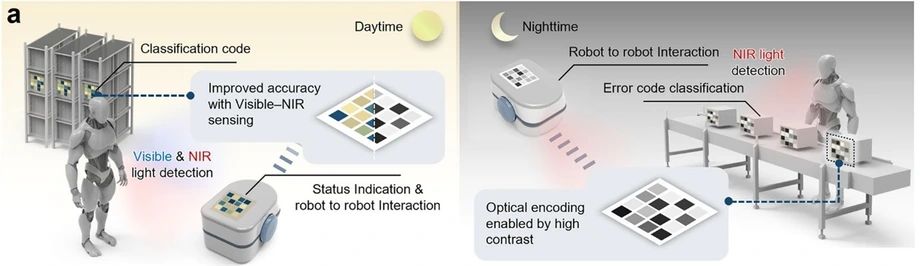
A flexible display developed by KAIST and its research partners uses just 16 individually controlled pixels to show information in two ways: colors that people can see and near-infrared patterns that a robot camera can detect. The team demonstrated changing patterns while the screen was attached to the back of a hand, as well as camera recognition in darkness and experimental fog.
Contents
- A screen with 16 pixels gives people and robots a shared label
- How electricity changes the reflected light
- Small electronic switches make selectable patterns
- Reading in darkness requires infrared illumination
- Low power claims and the work needed for larger screens
- A research publication and a busy November calendar
- UNIST reports a nickel catalyst with sustained performance
- POSTECH prepares an AI campus and industry discussion
- GIST connects energy companies with potential partners
- Key Points
KAIST announced the development on November 16, 2026, following publication of the research in npj Flexible Electronics on October 20. The project brings together researchers from KAIST, Yonsei University, the Gwangju Institute of Science and Technology (GIST), Chosun University, Kongju National University and the Massachusetts Institute of Technology.
The proposed use is straightforward: attach an electronic label to a transport box or a piece of factory equipment. A worker could check its status by looking at a color, while a robot could read a pattern through a dedicated camera. Both would receive information from the same physical display, even though their ways of seeing are different.
The display is the leading development in a group of university research and industry announcements that also includes a nickel catalyst for breaking down ammonia, an upcoming artificial intelligence event at POSTECH, and an energy business exchange hosted by GIST. Together, the announcements cover laboratory devices, performance testing and efforts to connect research with industrial users.
How electricity changes the reflected light
The KAIST device is a reflective display. Like paper or an electronic book screen, it uses light arriving from outside rather than producing its own illumination. Its electrical controls change how that light is absorbed and reflected.
The active material is a conductive polymer called PEDOT, used in a formulation described as PEDOT:PSS. Applying voltage changes how much light the material absorbs. When more light is absorbed, the display becomes darker; when more is reflected, it becomes brighter. This electrically controlled change in color or light absorption is called electrochromism.
The researchers combined the polymer with a thin optical structure in which light reflects repeatedly inside several layers. This structure, described in the study as a Gires-Tournois resonator, helps control the light returning from the screen. Adjusting the voltage changes both the visible appearance and the brightness detected in near-infrared images.
Near-infrared light lies just beyond the red end of the light people can see. A dedicated camera can detect it even though human eyes cannot. The device therefore gives people a color signal and machines a pattern of lighter and darker areas on one flexible surface.
Small electronic switches make selectable patterns
The prototype contains four rows and four columns, making 16 pixels. Each pixel is connected to a thin-film transistor, a tiny electronic switch that allows that part of the screen to be controlled separately.
Independent control is what turns a material that changes color into a display capable of carrying patterns. Instead of changing the whole surface at once, the researchers can select particular squares, much as someone might switch individual lights on a grid.
The team also used a gel electrolyte instead of a liquid electrolyte to reduce leakage risk. An electrolyte allows electrical charge to move within the device. Holding it in gel form helps keep it in place, while a flexible supporting substrate allows the screen to bend.
During the hand demonstration, the researchers changed individual pixels while the display followed the curved surface. Ordinary and near-infrared cameras captured its visible colors and infrared patterns. This demonstrated both flexibility and control of the separate pixels in the same device.
Reading in darkness requires infrared illumination
The camera experiments included dark and hazy conditions, where the near-infrared patterns remained detectable. In darkness, the researchers directed near-infrared light at the screen so that the camera could capture the reflected pattern.
The illumination is an essential part of how that experiment worked. The screen reflects near-infrared light supplied from outside, just as a printed label reflects visible light from a lamp. A factory installation intended to operate without visible lighting would therefore need suitable infrared illumination as well as a compatible camera.
The fog experiment also matters for the proposed industrial use. A label that carries both visible colors and camera-readable patterns gives workers and robots different ways to obtain information when visibility changes. The team demonstrated that approach under its experimental conditions.
Young Min Song, a professor in KAIST's School of Electrical Engineering who led the KAIST team, described the purpose of combining the two channels:
The significance of this study lies in our ability to present both visible color information for humans and near-infrared information for machines on a single flexible display,
A transport box illustrates the intended workflow. Its visible color could tell a worker its current status, while the infrared pattern could supply the information a robot needs for its next task. Flexible labels could also fit equipment surfaces that are curved rather than flat.
Low power claims and the work needed for larger screens
Song said the display consumes one-thousandth of the power of an organic light-emitting diode (OLED) display and can operate at voltages below 1 volt. OLED screens generate light, whereas this device controls reflected light, making illumination a separate consideration when planning a complete installation.
The immediate development target is a larger pixel array. Sixteen pixels allow simple patterns, but more pixels would provide room for a wider range of information. The researchers also plan to improve performance during repeated bending and prolonged use, and to connect the patterns read by cameras to actual robot tasks.
Ki Jun Yu, a professor in Yonsei University's School of Electrical and Electronic Engineering who led the collaborating Yonsei team, explained the role of the flexible electronics:
By integrating flexible transistors with electrochromic devices, we enabled independent control of each pixel,
No commercial deployment date was given. The next research steps concern making larger arrays operate reliably, keeping the display working through repeated bending, and integrating camera readings with robot control.
A research publication and a busy November calendar
The display study was published under the title "Flexible active-matrix dual-band electrochromic display based on a Gires-Tournois resonator for human and robotic vision." Hyo Eun Jeong, a doctoral candidate at KAIST, and Chanwoo Lee, a doctoral candidate at Yonsei University, contributed equally as first authors. Song and Yu were the corresponding authors responsible for communication about the paper.
Funding support included programs backed by South Korea's Ministry of Trade, Industry and Energy, the Ministry of Science and ICT, and the National Research Foundation of Korea. The research also received support through the Yonsei Fellowship funded by Lee Youn Jae and the KIST Institutional Program.
The publication, university announcement and related industry events fall across this schedule:
- October 20, 2026: The flexible display study was published in npj Flexible Electronics.
- November 13, 2026: GIST held its energy industry technology exchange for businesses, investors and support organizations.
- November 16, 2026: KAIST announced the flexible display development.
- November 19–20, 2026: POSTECH is scheduled to hold POSTECH AI:Q 2026 at Changeup Ground Pohang.
UNIST reports a nickel catalyst with sustained performance
A separate team led by UNIST professor Cho Seung-ho, working with the Korea Institute of Industrial Technology and Yeungnam University, developed a catalyst made primarily from nickel to break down ammonia. Ammonia contains nitrogen and hydrogen; decomposing it releases those elements as nitrogen and hydrogen gases.
A catalyst helps a chemical reaction proceed. In this case, the researchers sought to increase nickel's reactivity while stopping its particles from clumping together at high temperatures. Keeping the particles spread out helps preserve the surface available for the reaction.
The team used layered double hydroxides as the starting material. These materials have a layered structure that can help organize the components used to produce the catalyst. The resulting catalyst decomposed 95.5% of the supplied ammonia at 550°C.
A durability experiment at 525°C maintained performance for 100 hours. Electron microscope examination after the reaction showed that the nickel particles remained evenly dispersed, supporting the team's explanation that the catalyst resists particle clumping during operation.
The two tests answer different practical needs: the 550°C result measures how much ammonia was converted, while the 100 hours at 525°C measure how well performance persisted. For equipment intended to supply hydrogen from ammonia, both conversion and continued operation matter.
POSTECH prepares an AI campus and industry discussion
POSTECH will host POSTECH AI:Q 2026 over two days beginning November 19 at its Changeup Ground Pohang campus. The program will present the university's AI-Native University initiatives and include a joint announcement with LG Electronics about their vision for an AI smart campus.
The event will combine keynote lectures, talks and discussions with an AI and Research exhibition and programs open to the public. Experts from Microsoft, LG AI Research and Amazon Web Services are scheduled to discuss the skills industry needs as AI agents become part of work.
AI agents are software systems designed to carry out tasks, often through several steps and interactions with other tools. Their growing role in workplaces gives the planned skills discussion a concrete focus: what people need to know when software can take on more of a task rather than simply answer a question.
POSTECH's program places university research alongside campus planning and workforce needs. The exhibition will showcase research, while the sessions with industry participants will address how changes in AI affect the work people are expected to perform.
GIST connects energy companies with potential partners
GIST held the 2026 G.E.T. & Re:Born energy industry technology exchange on November 13 to support investment and business partnerships for companies in Jeonnam and Gwangju. More than 100 representatives from companies, investors and support organizations attended.
The Jeonnam-Gwangju Free Economic Zone Authority introduced the region's investment environment and policies supporting businesses. Seven companies, two research institutes and one university presented technologies and business plans, giving potential partners a chance to consider both technical work and commercial proposals.
GIST plans further consultations and investment connections after the event. Through its Energy Valley Technology Institute, it also intends to expand collaboration between industry and universities, along with joint research aimed at technology development and market entry.
The exchange addresses a different stage of the research process from the KAIST display or the UNIST catalyst tests. Its immediate task is to bring organizations with technologies together with organizations that may help fund, develop or bring them to market.
Key Points
- KAIST and its partners demonstrated a flexible display with 16 independently controlled pixels, showing visible colors for people and near-infrared patterns for robot cameras.
- The screen worked on the back of a hand and in dark and hazy experiments. Reading it in darkness required external near-infrared illumination.
- The display team plans larger arrays, better durability during repeated bending and integration with robot tasks.
- A UNIST team developed a nickel catalyst that decomposed 95.5% of ammonia at 550°C and maintained performance in a separate test lasting 100 hours at 525°C.
- POSTECH AI:Q 2026 is scheduled for November 19–20, while GIST plans further investment and business connections following its November 13 energy industry exchange.