2,592 ways to test a phone's defenses
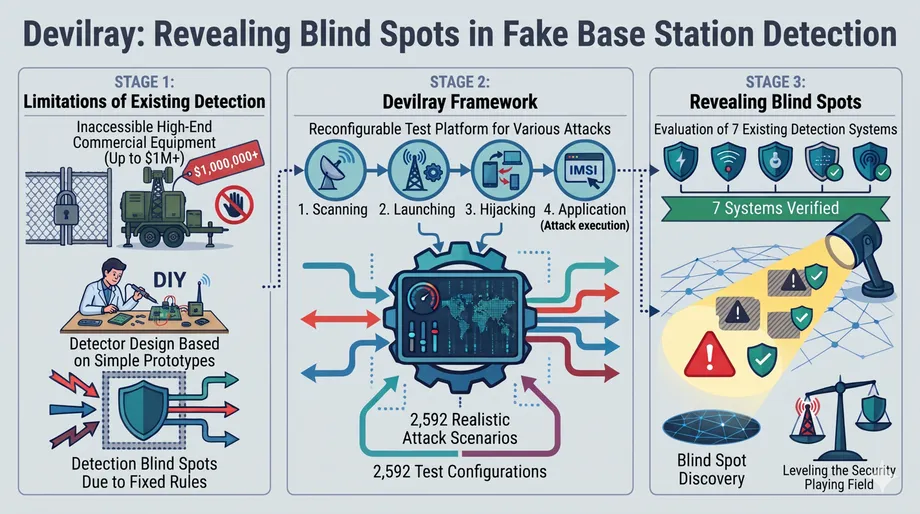
A KAIST research team has reproduced 2,592 ways a fake mobile base station can operate and tested them against seven existing detection systems. Every detector missed at least 192 configurations, exposing gaps in tools meant to identify equipment used for surveillance, location tracking and phishing.
Contents
- 2,592 ways to test a phone's defenses
- Why familiar tests leave gaps
- How LTE creates room for impersonation
- Building a realistic range of attacks
- Small changes can defeat warning signs
- Better detection brought more false alarms
- South Korea's experience gives the research urgency
- Private 5G networks are also under scrutiny
- Controlled access and the next public presentation
- Key Points
KAIST announced the work on November 4, 2026. Led by Yongdae Kim, a professor in its School of Electrical Engineering, the researchers built a testing platform called Devilray by examining a commercial surveillance device, earlier research and international mobile communications standards. They checked every configuration against real smartphones to confirm that its communication procedures worked.
The minimum number of missed configurations amounts to about 7.4 percent of the 2,592 tested. The central finding reaches beyond that figure: detectors built around familiar warning signs can miss attackers who achieve the same result through a different sequence of messages or a less conspicuous radio signal.
Fake base stations, also called IMSI catchers, cell-site simulators or StingRays, impersonate legitimate mobile towers and encourage nearby phones to connect. Governments use them for surveillance. Criminals have also carried them through city streets in vehicles to send messages posing as banks or delivery companies.
For phone users, the consequences can include exposed subscriber identifiers, location tracking, interrupted service or fraudulent messages delivered outside the usual carrier messaging route. For carriers and investigators, Devilray offers a way to test a wider range of suspicious behavior without obtaining every expensive and restricted commercial device.
Why familiar tests leave gaps
Researchers have spent roughly 20 years developing ways to detect fake base stations. Commercial surveillance equipment, however, is expensive and subject to restrictions on purchase and operation. University teams have often had to build their own imitation towers, observe their behavior and design detectors around those observations.
A detector evaluated against equipment built with the same assumptions can perform well while missing other approaches. An attacker may change the order of messages, select another frequency or reduce transmission power while still collecting the information being sought.
Kim, the KAIST electrical engineering professor who led the study, described the problem:
Detection has been built around the attacks we already know. Real attackers don't stay there. Until now, the playing field has tilted toward them.
Devilray changes the starting point of an evaluation. Instead of asking whether a detector recognizes one particular imitation tower, it maps a range of choices available to an attacker and tests whether the detector catches those variations.
The collaboration included South Korea's National Security Research Institute, Kyung Hee University, the University of Florida and mobile network company Cape. The researchers describe their work as the first academic study to analyze a commercial fake base station sold to law enforcement and intelligence agencies.
How LTE creates room for impersonation
LTE, the technology commonly associated with 4G mobile service, allows a phone to act on some network messages before it has verified the network's identity. During the initial connection process, an imitation tower can exploit that gap to influence what the phone does next.
A fake tower can request a permanent subscriber identifier, information that can connect a mobile subscription to a person. The Electronic Frontier Foundation's Rayhunter detector watches for such requests. Another procedure can use a rejection message to make a phone reconnect and disclose its identifier without the same direct request.
A detector watching only for the direct request may therefore miss another route to the same information. The weakness comes from procedures allowed by the LTE standard, making the problem broader than an error in one phone model or one manufacturer's software.
LTE also remains relevant to people using 5G phones. Many 5G networks still depend on LTE, and phones can fall back to LTE when 5G coverage is unavailable or an attacker induces the change. Buying a handset capable of 5G does not remove its exposure to the LTE connection process.
Building a realistic range of attacks
The commercial device examined by the team could copy a legitimate tower's identity, change frequencies and operate two networks at once. It could also reduce its transmission power to cover only a few meters, an important capability when testing detectors that expect suspicious towers to broadcast unusually strong signals.
The researchers combined those observations with previous studies and specifications from 3GPP, the partnership that develops international mobile communications standards. They divided an operation into four stages: surveying the surrounding network, launching a fake cell, attracting phone connections and carrying out the attack.
Across those stages, the team identified seven dimensions that an attacker could vary. Simply combining every choice would also create combinations that cannot work together in real communications, so the researchers applied 21 dependency rules to remove incompatible combinations.
The resulting set contained 2,592 configurations. Each was tested with real smartphones, giving the evaluation a practical check alongside its basis in standards and commercial equipment. The number describes the testing range constructed by the team; the study does not give a count of how often those configurations occur in actual attacks.
For defenders, a repeatable test matters because a detector can be examined again after a software change. A developer can check whether an update catches a previously missed behavior and whether it creates problems elsewhere, using the same set of operating conditions.
Small changes can defeat warning signs
The seven evaluated systems used several kinds of evidence, including signaling messages, information broadcast by base stations, radio signals, statistical patterns and machine learning. Every system had blind spots, often linked to the particular clues its designers had chosen.
Message detectors could miss a procedure that collected an identifier through a different exchange. Detectors looking for excessive signal strength could miss the commercial device when it operated at low power. A nearby attacker covering a small area may have little reason to transmit across a whole neighborhood.
A statistical detector faced another problem. It monitored how often phones were asked to disclose their identifiers, but an attacker could collect identifiers slowly and approach only some nearby phones. The resulting pattern could resemble ordinary activity at a bus terminal rather than an obvious burst of surveillance requests.
These examples explain why finding fake towers is more complicated than maintaining a list of suspicious messages. Attackers can adjust timing, power and communication procedures while staying close to behavior that also occurs on legitimate networks.
Better detection brought more false alarms
The team also investigated whether machine learning could close the gaps. It retrained detectors using attacks that they had previously missed, then measured both successful detection and false alarms on ordinary carrier traffic.
For a model examining Radio Resource Control, or RRC, messages, detection rose from 51 percent to 96 percent. RRC messages help manage the radio connection between a phone and the network. Its false alarm rate also increased, from 1.4 percent to 5.3 percent, nearly four times the earlier rate.
For a model examining Non-Access Stratum, or NAS, messages, detection increased from 27 percent to 63 percent. NAS signaling handles matters such as registration and mobility between a phone and the mobile core network. Its false alarm rate rose from 4.7 percent to 8.8 percent. In the hardest case examined, the NAS model's false alarm rate reached 15 percent.
Put in simpler terms, a 5.3 percent false alarm rate means about 53 warnings for every 1,000 legitimate examples assessed under those test conditions, compared with about 14 at a rate of 1.4 percent. That creates more ordinary activity for a person or system to investigate.
The RRC detector gained 45 percentage points in detection, while the NAS detector gained 36. Both improvements came with extra false warnings. The researchers therefore argue that evaluations should present detection and false alarm rates together, so users can judge whether stronger attack coverage is practical in everyday operation.
South Korea's experience gives the research urgency
South Korea has already experienced financial harm involving illegal cellular equipment. A government investigation into an incident involving KT, which came to public attention in August 2025, counted 368 victims and about 200 million won in losses from unauthorized small payments.
The incident involved illegal femtocells. A femtocell is a small base station normally used to improve coverage or relieve traffic on a mobile network. In that case, attackers used counterfeit equipment to intercept user information and enable unauthorized charges.
Kim discussed mobile network testing at the .HACK Conference 2026 on April 8. His laboratory's work included an LTE sniffer, a device that listens to radio messages exchanged by phones and base stations. The researchers found that information sent without encryption could help track a device's physical location.
Metadata, such as identifiers and connection details, describes communications rather than the words in a message or conversation. Even when message content is encrypted, exposed connection information can still reveal useful details about a device and its movements.
The laboratory also conducted experiments involving fake emergency alerts and used Devilray to reproduce SMS blaster attacks and SigOver attacks that disconnect devices from internet service. Those demonstrations show the range of outcomes the researchers are trying to test, from deceptive messages to disruption of a phone's connection.
Private 5G networks are also under scrutiny
Kim's April presentation extended the concern to private 5G networks built for particular organizations or industrial sites. Defense facilities, industrial complexes and medical institutions are among their users, giving the security of device and location information practical importance.
He warned that weaknesses in equipment software could combine with weaknesses in mobile communications procedures to create routes for interception or malicious software. His concerns also covered baseband components, the hardware and software that handle a device's cellular radio communications.
The laboratory was developing a 5G version of its sniffer, described at the April presentation as about 90 percent complete. Kim also raised concerns about exposed metadata allowing an observer to infer the presence and location of devices inside a facility.
Devilray's detector evaluation focused on LTE. The parallel work on 5G reflects the laboratory's effort to examine newer networks while addressing a technology that continues to carry mobile traffic and support many 5G deployments.
Controlled access and the next public presentation
The research team restricts Devilray to vetted researchers and organizations under controlled access because its ability to reproduce attack behavior could be misused. Intended users include carriers, investigators and developers who need to test defenses against a broader range of equipment behavior.
The team shared attack cases missed by Rayhunter with the Electronic Frontier Foundation, which is working on ways to detect them. The GSMA, the global association of mobile operators, also invited the researchers to present Devilray to its Fraud and Security Group, where industry and standards representatives discussed detection approaches.
The research has been posted on arXiv and accepted for ACSAC 2026, with presentation scheduled in Los Angeles during the December 7–11 conference. The main public milestones span several months:
- April 8, 2026: Kim presented the laboratory's mobile network testing framework at .HACK Conference 2026.
- November 4, 2026: KAIST announced Devilray and the evaluation of seven detection systems.
- December 7–11, 2026: The work is scheduled for presentation at ACSAC 2026 in Los Angeles.
Kim's group is also developing a detector that combines observations from phones, carrier networks and independent radio sniffers to detect and locate fake base stations. The work brings together information from several observation points rather than relying on a single warning sign.
Kim described the purpose of the testing platform this way:
Devilray is not meant to defeat existing detectors. It gives defenders the same choices attackers already have, so that attack and defense can finally advance together.
Key Points
- Devilray reproduces 2,592 fake base station configurations, each checked against real smartphones.
- All seven evaluated detectors missed at least 192 configurations, about 7.4 percent of the testing set.
- Attackers can vary messages, signal power and collection patterns to avoid familiar warning signs.
- Retraining two machine learning models improved detection but also increased false alarms on legitimate traffic.
- Access to Devilray is restricted to vetted users, and the research is scheduled for ACSAC 2026 in December.