Gwangju moves into contention for southwest Korea project
SK Group is considering Gwangju's Advanced Research and Development Zone 3 as a leading location for an artificial intelligence data center with OpenAI, with a facility measured in double digit megawatts under discussion. SK has proposed several locations and is awaiting OpenAI's response, leaving the final choice open.
Contents
- Gwangju moves into contention for southwest Korea project
- What SK and OpenAI have formally agreed
- Why Gwangju and Haenam are competing
- Haenam's national computing project is a separate decision
- Electricity explains much of the location debate
- The partnership also reaches into memory factories
- Demand and financing will determine the next steps
- Key Points
The Gwangju district is being considered because of its suitability for a large data center, its infrastructure and the local government's strong interest in attracting the investment. Industry discussions have identified Gwangju and Haenam's Solarseado development in South Jeolla Province as suitable locations for facilities of 10 to 20 megawatts or more.
The location would put a major piece of OpenAI's Korean infrastructure in the southwest. OpenAI announced plans in October 2025 to pursue two Korean data centers with Samsung and SK, covering the southeast and southwest respectively. Pohang has been announced for the Samsung project, while the SK project's location remains under discussion.
Gwangju's position contrasts with industry accounts that described Haenam as SK's preferred location and, in some cases, effectively chosen. OpenAI has described its Korean data center discussions with SK and Samsung as being at an early stage, with locations, capacity and timing to be settled through consultation.
The competing locations matter because another major investment, the proposed National AI Computing Center, is being pursued for Haenam by a consortium led by Samsung SDS. That creates two possible patterns for the southwest: concentrating computing facilities around Haenam, or spreading major projects between Haenam and Gwangju.
What SK and OpenAI have formally agreed
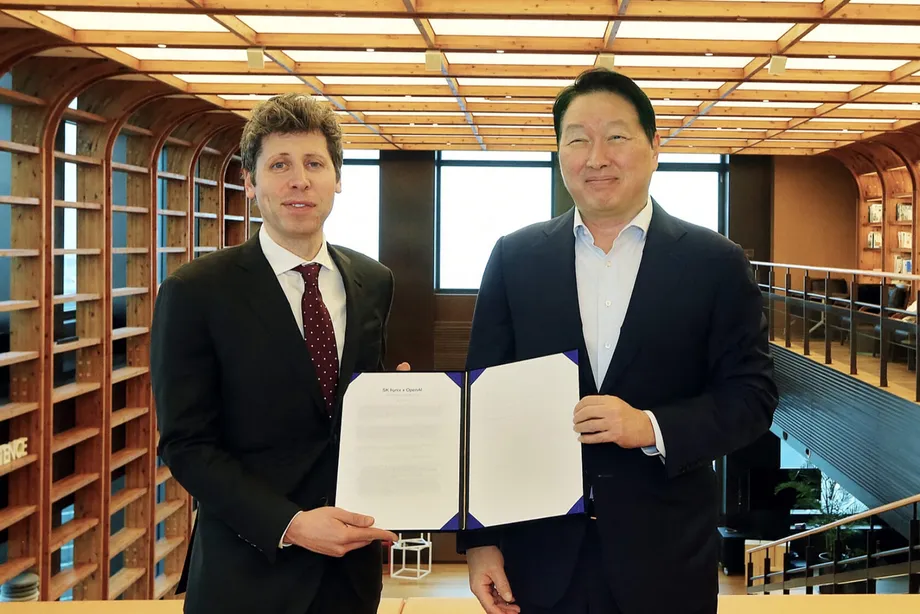
SK Group's October 2025 announcement provides the firm starting point. On October 1, 2025, SK Chairman Chey Tae-won and OpenAI Chief Executive Sam Altman met at SK headquarters in Seoul to sign agreements covering memory supplies and AI infrastructure.
SK Telecom signed a memorandum of understanding with OpenAI to collaborate on developing, constructing and operating an AI data center in southwest Korea as part of Stargate Korea. Stargate is OpenAI's program to expand the computing infrastructure needed to train and run AI systems.
A memorandum of understanding sets out areas in which companies intend to cooperate. Detailed investment commitments, construction arrangements and operating responsibilities can then be negotiated. SK's announcement identified the southwest region without naming a city, specifying electrical capacity or setting a construction date.
Altman described South Korea's role in the partnership in the official announcement:
Korea has the vision, technology, talent and infrastructure to lead globally in AI.
SK Telecom and OpenAI also agreed to explore AI services for consumers and businesses and to develop new computing and data center technologies. The partnership therefore reaches beyond finding land and putting servers inside a building.
Why Gwangju and Haenam are competing
Gwangju's Advanced Research and Development Zone 3 offers a potential site within an established research development district. SK's interest rests on the location's capacity to accommodate a large facility, infrastructure conditions and support from local authorities.
Haenam's Solarseado development offers a different set of attractions: extensive land, relatively low land costs, industrial water infrastructure and a nearby solar power complex with 98 megawatts of capacity. Data centers need land for buildings and electrical equipment, dependable electricity for servers, and cooling systems that may require substantial water supplies.
Industry assessments supporting Gwangju have pointed to the Samsung SDS consortium's plans for Haenam as a reason SK might choose another location. Earlier accounts favoring Haenam instead described the same area as a likely destination for both projects. SK's submission of multiple candidates to OpenAI keeps both possibilities in play.
For the local governments, the prize extends beyond the initial construction contract. Haenam officials have described ambitions to attract related companies and skilled workers, while Gwangju's interest reflects its effort to secure a major computing facility within its research district. Those benefits depend on the eventual investment and operating plans.
Haenam's national computing project is a separate decision
A consortium led by Samsung SDS, with Naver Cloud, KT and Kakao reportedly involved, has been pursuing the National AI Computing Center contract, valued at 2.5 trillion won, or about $1.7 billion. The consortium was described as the sole bidder.
Samsung SDS planned to place the center at Solarseado Data Center Park in Haenam if it secured the contract. Gwangju, Gyeongbuk and North Jeolla Province were also evaluated for that national project and were reportedly ruled out. Gwangju remains under consideration for the separate SK–OpenAI facility.
The national center's proposed expansion would provide 15,000 graphics processing units, or GPUs, by 2028 and 50,000 by 2030. GPUs are chips that can carry out many calculations at once, making them useful for training AI models and running them when users submit requests.
The increase from 15,000 to 50,000 GPUs would add 35,000 chips and bring the planned total to about 3.3 times the 2028 level. Access is intended for businesses, universities and startups, giving organizations a way to use powerful computing equipment without buying an entire installation themselves.
The procurement process had already encountered difficulty. Two earlier requests for proposals reportedly failed amid strict ownership conditions and requirements involving domestically produced AI chips. A later request relaxed some conditions. The bidding timetable pointed to a final government decision in December after further review; a completed award is not confirmed in the information accompanying that timetable.
Electricity explains much of the location debate
The SK–OpenAI project's possible size is being discussed in megawatts, a measure of power. A facility drawing 20 megawatts uses electricity at twice the rate of one drawing 10 megawatts. Its GPU capacity would depend on the equipment installed and the electricity needed for cooling and other operations.
Haenam's 98 megawatt solar complex helps explain the area's appeal. Solar output changes with daylight and weather, while data center operators need a dependable supply throughout the day and night. Grid connections and the arrangements for delivering electricity are therefore central to the location decision.
Haenam has experienced restrictions on solar output when local generation exceeds what the electricity network can absorb. Locating a large electricity user nearby could create more demand close to the power plants. The practical challenge is to match generation, network capacity and the data center's operating needs.
South Jeolla's designation as a Distributed Energy Special Zone supports efforts to produce and consume more electricity locally. Plans described for Haenam and Yeongam include attracting data centers near solar generation and testing AI tools to forecast electricity demand and manage distribution.
Haenam officials have also linked renewable energy development to resident participation and profit sharing under the Act on the Promotion of the Development, Use, and Distribution of New and Renewable Energy. Their proposed benefits include opportunities for residents to invest directly or through cooperatives. The arrangements would depend on the renewable energy projects involved.
The partnership also reaches into memory factories
SK hynix signed a separate letter of intent to supply high bandwidth memory, known as HBM, for OpenAI's global Stargate infrastructure. HBM places memory close to powerful processors so they can receive data quickly, helping keep expensive AI chips working efficiently.
SK's official announcement said SK hynix would establish a production system capable of responding to OpenAI demand equivalent to as many as 900,000 DRAM wafers a month. Wafers are discs of semiconductor material from which chips are manufactured. SK described that scale as more than twice the HBM industry's capacity at the time.
The companies left specific supply volumes and commercial arrangements for further discussions. The memory plan covers OpenAI's global infrastructure, while the southwest Korean data center is one location within the broader relationship. The two negotiations connect chip manufacturing with the buildings and services that use those chips.
Chey and Altman have continued meeting to discuss cooperation. Their contacts included an AI summit in San Francisco in July and a lunch in Seoul on October 31, reportedly attended by SK hynix and SK Telecom executives. Details of the lunch discussions were not disclosed.
Demand and financing will determine the next steps
OpenAI's Korean expansion is taking place in a market with substantial demand for its services. In June 2025, Chief Strategy Officer Jason Kwon said South Korea ranked second only to the United States in paid ChatGPT subscriptions, alongside the company's Seoul office expansion. OpenAI also said weekly active users in the country had grown to 4.5 times their level a year earlier.
The planned data centers will depend on business demand across South Korea and the wider Northeast Asian market. SK, Samsung and OpenAI also need to agree how investment will be divided. Those decisions will help determine the facilities' size and construction schedules.
The main milestones span existing agreements and future targets:
- June 10, 2025: OpenAI highlighted South Korea's paid subscription ranking as it expanded its presence in Seoul.
- October 1, 2025: SK and OpenAI signed agreements covering memory supply and a southwest Korean AI data center.
- 2028: The separate National AI Computing Center project targets opening with 15,000 GPUs.
- 2030: The national center's proposed capacity reaches 50,000 GPUs.
For Gwangju, the immediate decision is whether OpenAI accepts a location proposed by SK. For Haenam, the national computing project and the possibility of further data center investment remain tied to contracting, electricity infrastructure and development plans. Neither SK's southwest facility nor Samsung's southeast facility has an announced construction start date.
Key Points
- SK is considering Gwangju's Advanced Research and Development Zone 3 as a leading candidate for its southwest Korean data center with OpenAI.
- SK has submitted several locations and is awaiting OpenAI's response. Haenam has also been described as a preferred candidate.
- The proposed facility is being discussed at a scale of double digit megawatts, with its final size still under negotiation.
- A Samsung SDS consortium has separately proposed Haenam for the National AI Computing Center, targeting 15,000 GPUs by 2028 and 50,000 by 2030.
- SK's October 1, 2025, agreement confirms cooperation with OpenAI in southwest Korea without specifying a site or construction timetable.
- Investment shares, regional demand and infrastructure arrangements will shape the final projects.