Missing Wages Leave Families Without Support
Nearly 240 migrant workers, mostly from Bangladesh, have gone without wages for two to three months at two Singapore firms, with many also losing the work permits that allowed them to earn a living. Singapore's Ministry of Manpower (MOM) said on October 24 that it was investigating Process Maintenance Solutions and Jurong Technical & Construction.
Contents
- Missing Wages Leave Families Without Support
- A Recruitment Loan Worth 15 Months of Pay
- Some Payments Arrive, While Others Remain Outstanding
- New Jobs May Keep Workers in the Same Sector
- Promised Training Becomes Another Source of Uncertainty
- Company Representatives Dispute Responsibility
- Director Changes Connect Several Companies
- Why Local Employment Records Matter
- How the Dispute Developed
- Key Points
Workers said their salaries stopped in August and their permits began being cancelled in batches from late September. Their immediate needs now stretch from recovering unpaid wages to finding another employer, while families in Bangladesh wait for money used for food and loan repayments.
Hossain Midul, 24, from Bangladesh's western Pabna district, said Process Maintenance Solutions owed him $1,800. Since arriving in Singapore in July 2025, he had earned about $600 a month, including overtime, and sent almost all of it home. For two months, he had sent nothing.
MOM and the Migrant Workers' Centre (MWC) are helping workers pursue salary claims through the Tripartite Alliance for Dispute Management, the body that handles employment disputes. Some workers received overdue wages in October, while others continued waiting.
The case also involves disputed promises of construction training, changes in company directors and corporate connections to a man arrested in July over suspected employment offences. For the workers, those issues meet at a practical problem: they borrowed heavily to secure jobs that have stopped providing an income.
A Recruitment Loan Worth 15 Months of Pay
Midul said about half of his monthly earnings went towards repaying a $9,000 bank loan taken out to cover recruitment agent fees. Most of the remainder supported his family of six. His employer cancelled his permit in early October without explanation, he said, although it was due to expire in July 2027.
The size of that debt helps explain the pressure on his household. A $9,000 loan equals 15 months of his stated $600 monthly earnings, before interest or money needed for living expenses. The $1,800 he said he was owed equals another three months of those earnings.
Midul, a worker at Process Maintenance Solutions, described how families had financed the journey to Singapore:
Many of our families sold land and cattle, and we took loans to come here. Some people also borrowed money from relatives.
Several workers said they had paid agents in Bangladesh more than $12,000 to obtain jobs in Singapore's process sector. Their unpaid salaries therefore affect more than their current spending: loan repayments continue even when wages stop, and relatives who helped fund the move may also be waiting for support.
Saimon Islam, 21, who worked for Jurong Technical & Construction, said he was owed roughly $1,800 and feared he might receive only part of it. Workers interviewed about the dispute said they had all been in Singapore for less than two years.
Some Payments Arrive, While Others Remain Outstanding
Five of 15 Process Maintenance Solutions workers interviewed about the case said they had received their overdue wages in October. Four workers from Jurong Technical & Construction said on October 24 that they remained unpaid. Those accounts show that payments had resumed for some people, while the salary dispute continued for others.
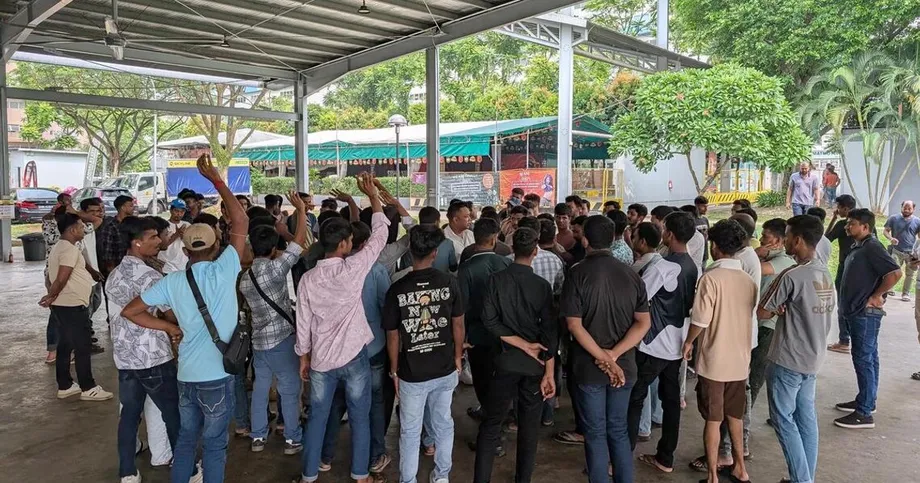
About 70 Process Maintenance Solutions workers met company director Ruzaidi Massunik and MOM officers on October 23 at the MWC Recreation Club in Soon Lee Road. Ruzaidi handed documents recording working days and overtime hours to workers who said they were still owed money.
Those records matter because a salary claim depends on establishing the work performed and the amount due. For workers whose earnings include overtime, the number of additional hours worked forms part of that calculation.
MOM said it would take appropriate enforcement action if breaches of employment laws were established. An employer that fails to pay wages on time may also lose the mandatory $5,000 security bond it must purchase for each worker holding a work permit who is not Malaysian.
The bond is a financial guarantee tied to the employer's obligations. Workers are pursuing their unpaid wages through the salary claims process, while MOM investigates whether the companies broke employment rules.
New Jobs May Keep Workers in the Same Sector
Rajiv Hossain, 25, said he received his overdue wages about a week before the October 23 meeting. According to his account, authorities told workers they would receive letters authorising them to seek new employers in the process sector.
Process work includes specialised industrial, manufacturing and maintenance tasks, including work at sites such as Jurong Island. Finding another employer in that sector would give workers a route back to paid employment after their permits were cancelled.
MWC said on October 23 that it was working with employment agency partners to explore suitable jobs and assistance during the move between employers. It was also providing financial assistance and meals to about 90 workers.
For workers who have stopped receiving wages, food assistance addresses an immediate need. A new job addresses the continuing loss of income. Recovering arrears remains a separate priority because the money is payment for work already completed.
Promised Training Becomes Another Source of Uncertainty
Several workers said they had been promised enrolment in a construction certification course after a year of employment, with employers expected to fund the training. Among 15 workers interviewed, only one said he had been sent for Building and Construction Authority (BCA) certification.
Riyag, 26, who said he had not been sent for the course, explained that some workers holding process permits sought BCA certification so they could qualify for construction jobs, where average earnings were higher.
An August survey published by migrant worker advocacy group Transient Workers Count Too put average monthly construction earnings at $868 and process sector earnings at $771. Both figures included allowances but excluded overtime. The difference was $97 a month, or about 12.6 percent of the process sector figure.
Rajiv said workers had been told MOM could not help them obtain BCA certification because the recruitment fees had been paid in Bangladesh. He said they were advised to ask prospective employers about training. His account describes what workers understood from the discussion.
Rajiv, a Process Maintenance Solutions worker who had received his arrears, described his concern about changing employers:
If we have to pay an agent a lot of money again to join a new company, but they also don't send us for BCA course, it'll be a big problem.
The workers' goals therefore extend beyond getting another process sector job. Some had paid substantial recruitment fees expecting both employment and a later opportunity to qualify for construction work.
Company Representatives Dispute Responsibility
A man at the Process Maintenance Solutions office in Kaki Bukit said on October 26 that the salary claims and certification issues had been settled. He attributed the wage delays to discrepancies when the company changed hands in August. He also denied a connection between Process Maintenance Solutions and Jurong Technical & Construction.
Workers from the two firms had described shared arrangements. They were housed in the same rooms in dormitories in Tuas and said the same Bangladeshi manager had recruited them and deployed them to the same worksites.
Corporate records also trace connections through former directors and other companies. Usha Rani Balakrishnan, the current director of Jurong Technical & Construction, denied involvement in the matter when contacted on October 26 and said former director Ren Ji was responsible.
The full number of settled salary claims, the outcome of MOM's investigations and the workers' eventual job placements had not been announced. No deadline for completing the investigations or resolving all claims was given.
Director Changes Connect Several Companies
Corporate records show that Ruzaidi took over Process Maintenance Solutions from Fok Chee Meng on August 1. Fok had held the directorship from July 27, following Ren, who had been a director for about a year.
Jurong Technical & Construction, formerly named Great Ocean Tech, also changed directors on August 1. Balakrishnan took over from Ren that day.
The same sequence involving Ren, Fok and Ruzaidi appeared at construction company Prudent (SG). Ren left its directorship on July 27, Fok held the role for five days, and Ruzaidi became director on August 1.
Balakrishnan also became a director of construction and design firm Elite Projects on August 3, immediately after Ren left. Corporate intelligence records showed that Ren had relinquished directorships at six firms since February.
These leadership changes put both employers within a wider set of companies connected through former and current directors. MOM's investigation is examining the employers while workers seek payment and replacement jobs.
Why Local Employment Records Matter
Ren was among 14 people arrested by MOM in July over suspected employment offences. On July 23, the ministry said it was investigating suspected fraudulent Central Provident Fund (CPF) contributions for 139 local people who were not employed by the group. MOM said it believed those arrested might be part of a criminal syndicate.
CPF is Singapore's compulsory savings system, funded through contributions associated with employment. In the suspected arrangement under investigation, contributions were allegedly made for people who were recorded as employees despite not actually working for the businesses.
Local employment numbers matter because Singapore limits how many foreign workers a company can hire. In the process sector, the quota described by MOM allows five workers holding work permits for every resident employee earning at least the local qualifying salary of $1,800 a month.
Recording people as local employees can therefore create room under the quota to recruit more foreign workers. MOM's July investigation concerned whether employment records and CPF contributions had been used fraudulently. Its October statement addressed the ongoing investigations into Process Maintenance Solutions and Jurong Technical & Construction.
How the Dispute Developed
The wage complaints, permit cancellations and company changes unfolded over several months. The main dates place the workers' accounts alongside the corporate changes and official response:
- July 23: MOM described an investigation involving 14 people arrested over suspected employment offences and CPF contributions for 139 locals who were not employed by the group.
- July 27 to August 3: Directorships changed at Process Maintenance Solutions, Jurong Technical & Construction, Prudent (SG) and Elite Projects.
- August: Workers said their salaries stopped.
- Late September: Workers said permit cancellations began in batches.
- October 23: About 70 Process Maintenance Solutions workers met Ruzaidi and MOM officers. MWC outlined employment and welfare assistance.
- October 24: MOM confirmed its investigations. Four Jurong Technical & Construction workers said they remained unpaid.
- October 26: A man at the Process Maintenance Solutions office said salary and training issues had been settled. Balakrishnan denied involvement and attributed responsibility to Ren.
For the affected households, the next practical steps are payment of outstanding wages and a return to employment. Workers seeking construction certification also want the training opportunities they said helped persuade them to pay for their move to Singapore.
Key Points
- Nearly 240 migrant workers at two Singapore firms faced two to three months without pay, with many permits cancelled.
- MOM is investigating Process Maintenance Solutions and Jurong Technical & Construction and helping workers pursue salary claims.
- Some workers received arrears in October, while others continued to report unpaid wages.
- Recruitment debts and disputed promises of construction training have added to workers' financial pressure.
- Corporate records connect the firms through director changes involving Ren Ji, who was arrested in July over suspected employment offences.
- MWC is helping with employment transitions and providing meals to about 90 workers.