October 31 test targets a wide area
North Korea says it tested a cluster warhead for tactical ballistic missiles on October 31, 2026, claiming that its Standard Type 2 could devastate nearly 13 hectares and promising to make four categories of the weapon available to military units before the end of the year.
Contents
- October 31 test targets a wide area
- What the warhead is designed to do
- Images show an island prepared with targets
- Four categories promised before December ends
- South Korea tracked the launch before acknowledging it
- Which missile carried the warhead?
- April's trial leads to a new deployment promise
- Border tensions and diplomacy continue alongside testing
- Unexploded submunitions can outlast an attack
- Key Points
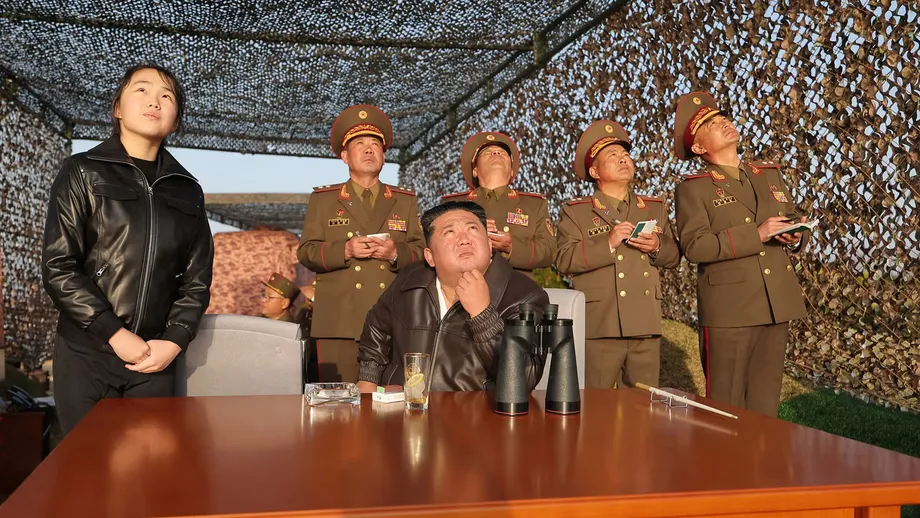
Gen. Kim Jong-sik, a member of the ruling Workers' Party Central Military Commission and first vice department director of the Party Central Committee, directed the test. North Korean leader Kim Jong-un, who attended an earlier cluster warhead trial in April with his daughter Ju-ae, did not attend this launch.
South Korea's Joint Chiefs of Staff confirmed that it detected a missile fired from the Chongju area, also rendered as Jeongju, in North Pyongan Province toward the Yellow Sea. It said South Korean and American forces had tracked related activity before the launch and maintained readiness.
The announcement brings together two developments: another test of a weapon designed to scatter small explosives across a broad area, and a deadline for giving military units a choice of warheads suited to different targets. For South Korean forces, that would mean facing a wider selection of missile payloads intended to attack personnel, vehicles and military positions.
North Korea's Missile Administration described the launch as part of regular scientific research to increase the power of its combat systems. Its performance claims and promised deployment have not been independently verified.
The November 1 announcement described the previous day's test as an assessment of the combat applicability and power of a "cluster combat unit" for a tactical ballistic missile.
What the warhead is designed to do
A cluster warhead carries many smaller explosive devices, called submunitions, inside a larger casing. Instead of delivering its explosive force at one point, it opens in the air and spreads those devices across the ground below.
Cluster weapons can release dozens or hundreds of submunitions. North Korea did not specify how many the Standard Type 2 carried. The purpose of this design is to strike several targets within an area, rather than concentrate the entire payload on a single building or vehicle.
The Missile Administration's Ballistic Missile Systems Institute and Warhead Institute said the tested warhead could devastate a target area of 12 to 13 jeongbo, a Korean unit of land measurement. That corresponds to approximately 11.9 to 12.9 hectares, or 119,000 to 129,000 square metres.
A further account of the announcement described a standard-type cluster warhead as capable of devastating about 12 hectares with a high density of strikes.
The upper figure is roughly the combined area of 18 football pitches. It describes the claimed footprint of the attack, not the missile's travel distance. North Korea presented the test as an assessment of both the warhead's destructive power and its suitability for military use.
Images show an island prepared with targets
Images released by North Korea showed a projectile leaving a mobile launcher, the warhead opening in the air and small explosives spreading toward an island target. Other images showed explosions across the target area.
Arched structures on the island appeared to imitate military facilities such as aircraft shelters, ammunition stores or artillery positions. Photographs showed structures being struck and damaged. Their shape and arrangement suggest that the trial was intended to demonstrate effects against a group of military targets spread over a defined area.
Shin Jong-woo, secretary-general of the Seoul based Korea Defense and Security Forum, assessed that the claimed area of coverage pointed to a weapon intended to attack personnel and lightly armoured vehicles. His interpretation connects the broad spread of explosives with targets that can be damaged without a direct hit from a large warhead.
The distinction matters for people working around military installations. A weapon that scatters explosives can threaten personnel and equipment between buildings as well as the structures themselves. North Korea's mock targets gave its demonstration a concrete military setting.
Four categories promised before December ends
The Missile Administration's general director said North Korea divided its cluster warheads into four categories, including standard types and weapons for special purposes. The official's name was not given.
The director described the intended timetable and the freedom military units would have to choose a warhead:
Within this year we will enable units to select and use all those types according to operational aims and specific features of targets.
The deadline is the end of 2026. The announcement described the Standard Type 2 trial but left the functions and technical specifications of the other categories unexplained. It also gave no quantities or named units scheduled to receive them.
North Korea is therefore presenting the programme as more than a single successful launch. Its stated goal is a selection of payloads that commanders could match to a particular mission. A warhead intended to scatter explosives over exposed troops would serve a different purpose from one intended for another kind of target, even if both travelled on tactical missiles.
The next concrete milestone is whether North Korea announces that units can use all four categories by December 31. The declaration sets a deadline, while the October test supplies the public demonstration supporting that promise.
South Korea tracked the launch before acknowledging it
South Korea's Joint Chiefs of Staff said South Korean and American forces shared intelligence closely and followed activity before the missile was fired. Its confirmation came after North Korea publicised the test, rather than through the prompt announcement that often follows a North Korean ballistic missile launch.
South Korea's military was reported to be conducting further analysis of the projectile's range and classification. Shin assessed that a short flight at low altitude toward an island in the Yellow Sea could have made it harder to distinguish the weapon from a rocket artillery projectile.
Japan's Defense Ministry also made no related public announcement. North Korea disclosed neither the launch site nor the precise launch time, flight distance or altitude. South Korea's statement supplied the launch area and direction.
The sequence separates detection from identification: South Korea said it tracked the activity, while determining the exact weapon required further analysis. That explains why the timing of a public announcement matters less for understanding the test than what the military says it detected and how confidently it can classify it.
Which missile carried the warhead?
Shin's assessment was cited identifying the missile as the Hwasong-11 Na, also known as KN-24; another account attributed to him identified it as the Hwasong-11 Ra. North Korea's announcement focused on the warhead and did not identify the missile model used in October.
The account identifying October's missile as the Hwasong-11Na (KN-24), known as North Korea's version of ATACMS, also described April's cluster-munition test as using a Hwasong-11D-type missile.
The distinction matters because the April trial involved the Hwasong-11 Ra. If October's launch used a different missile, the programme would extend cluster warhead testing across more than one delivery system. The model remains unresolved in the public information released about this test.
Shin also described the launch as North Korea's first cluster munition firing from a wheeled mobile launcher. Such a launcher carries the missile to a firing position rather than launching it from a permanent installation. North Korea's released photographs showed a mobile launch, making the delivery vehicle another feature of the demonstration.
A tactical ballistic missile is intended for military targets within a regional theatre, rather than an intercontinental journey. The missile carries the warhead toward the target; the warhead then determines how the explosive payload is delivered. In this trial, the main announced development concerned that payload.
April's trial leads to a new deployment promise
North Korea had already tested cluster and fragmentation mine warheads fitted to the Hwasong-11 Ra in April. Kim Jong-un and Ju-ae attended that event, which North Korea said evaluated the effects of the two payloads.
The October trial came about six months later, with Kim Jong-sik overseeing the work and the Missile Administration attaching an explicit timetable for military units to use four categories. The progression moves from testing named payloads toward a stated plan for broader operational choice.
- April 19, 2026: North Korea tested cluster and fragmentation mine warheads on the Hwasong-11 Ra, with Kim Jong-un and Ju-ae attending.
- October 31, 2026: The Missile Administration conducted the latest cluster warhead trial under Kim Jong-sik's direction.
- November 1, 2026: North Korea issued its detailed announcement, and South Korea confirmed detecting the launch.
- By the end of 2026: North Korea says military units will be able to select among four categories of cluster warheads.
The latest trial also followed demonstrations involving attack drones, a precision guided torpedo system and an intermediate range hypersonic missile, alongside a drone exhibition. Together, those activities show the range of weapons North Korea has recently chosen to display.
Border tensions and diplomacy continue alongside testing
Three South Korean soldiers were wounded in a landmine explosion near the border during the period surrounding the test. North Korea denied responsibility and vowed to strengthen its border defences and resume its loudspeaker campaign.
The missile trial also came amid renewed calls for North Korea's complete denuclearization from the top diplomats of South Korea, the United States and Japan during talks in Atlanta. Their demand concerns North Korea's nuclear programme, while this announcement focused on a cluster explosive payload.
U.S. Secretary of State Marco Rubio said President Donald Trump remained open to talks with Kim Jong-un if Pyongyang was willing to discuss issues of concern to Washington and its allies. No meeting had been scheduled.
North Korea did not carry the test announcement in Rodong Sinmun, the Workers' Party newspaper read inside the country. It nevertheless released photographs and a detailed description of the warhead through its external news announcement. The public presentation put the weapon's claimed effects and deployment timetable before foreign governments at a time of continued military and diplomatic tension.
Unexploded submunitions can outlast an attack
Cluster weapons create a danger that can continue after the immediate explosions. Some submunitions may fail to detonate when they land, leaving explosive objects in fields, roads or damaged buildings where civilians can encounter them later.
Children are among those at risk from unexploded devices. A strike intended for military targets can therefore leave nearby communities facing a longer period of danger, including after fighting has moved elsewhere.
The Convention on Cluster Munitions, adopted in 2008, prohibits the use, production, transfer and stockpiling of cluster munitions for its parties. Neither North Korea nor South Korea is a party. The United States, Russia, China and India are also outside the convention.
For the Korean Peninsula, North Korea's announcement joins an immediate military concern with a lasting civilian one: weapons designed to spread explosives across a large area can threaten both the targets selected during an attack and people who later enter the affected ground.
Key Points
- North Korea says it tested a Standard Type 2 cluster warhead on October 31, 2026, under Gen. Kim Jong-sik.
- It claims the warhead can devastate approximately 11.9 to 12.9 hectares.
- South Korea detected a missile launched from the Chongju area toward the Yellow Sea and said it tracked activity with the United States beforehand.
- North Korea aims to make four categories of cluster warheads available to units by the end of 2026.
- The missile model remains unresolved, and the claimed performance and deployment have not been independently verified.
- Unexploded submunitions can leave civilians facing danger long after an attack.