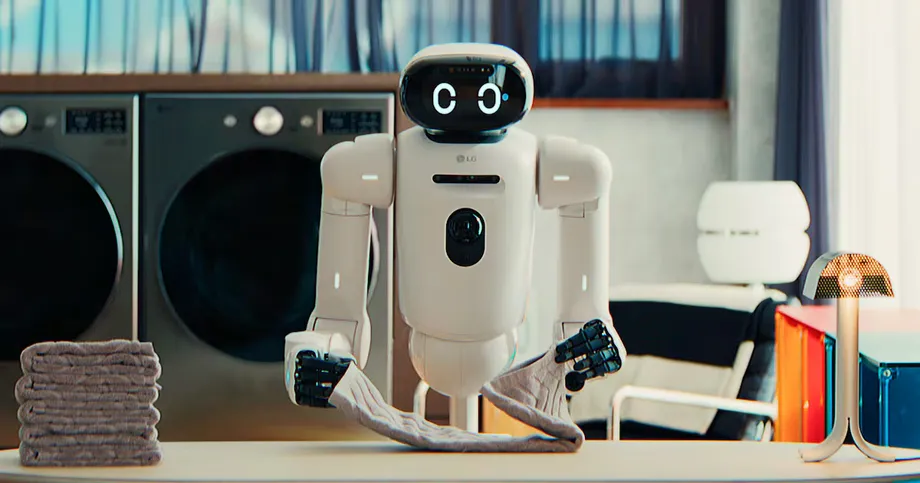
A household robot strategy built around price
LG Electronics plans to expand into home humanoid robots around 2030, using experience from factories, logistics sites and its appliance business to develop machines that households can afford. Its immediate targets include about 500,000 hours of robot training data by the end of 2026 and full operation of a new training facility in Seoul during the fourth quarter.
Contents
- A household robot strategy built around price
- Why factories and institutions come first
- What the Seoul data factory will do
- Nvidia partnership combines real and virtual practice
- Robot joints create an earlier sales opportunity
- Cooling orders grow more than fivefold
- Bigger liquid cooling units and new production capacity
- Strong orders still need to become revenue
- Existing businesses fund the expansion
- The milestones between now and household expansion
- Key Points
Lee Jae-mo, LG Electronics executive director responsible for robotics strategy, outlined the approach during the company's third quarter earnings conference call on October 28. LG intends to build its robotics business first in academia, public institutions and manufacturing, where it expects demand to develop earlier than in homes.
The household strategy connects two kinds of product development: robots designed to work with appliances, and appliances designed to be easier for robots to operate. Rather than treating the robot as a separate purchase with an unlimited list of chores, LG is looking at how its existing appliance business can help make household automation useful and affordable.
Lee described the price requirement for opening that market:
To develop the home market, it is important to approach a price range that households can realistically consider purchasing.
LG has not announced a household robot price, a final product design or a firm launch date. Around 2030 is its intended period for expansion, tied to its expectation that robots capable of handling a wider range of physical tasks will become suitable for consumers.
The company is developing this longer term business alongside a faster growing source of orders: cooling equipment for artificial intelligence data centers. Orders for that business exceeded 3 trillion won through the third quarter, giving LG another route into the infrastructure supporting AI.
Why factories and institutions come first
LG's initial robotics customers are expected to be organizations rather than individual households. Universities and public institutions can purchase devices for research or specific services, while manufacturers and logistics operators can use robots for tasks within established work processes.
Lee said the company would first concentrate on markets expected to form earlier, while building technology, product ranges and a record of supplying working equipment. That record matters because a prospective customer needs to understand how a robot or component performs in use, beyond a demonstration.
Manufacturing and logistics are also intended to provide a commercial foundation for the move into homes. LG plans to develop production experience and customer relationships in those markets while preparing household robot forms that draw on its appliance expertise.
LG's ambition extends beyond selling complete machines. Its proposed business structure includes finished robots, core components, data platforms and operating systems. Potential products include individual research devices, packages of hardware and software developed with systems integration partners, and services for collecting or supplying robot data.
What the Seoul data factory will do
The LG Data Factory in Umyeon-dong, in Seoul's Seocho district, is central to that preparation. LG describes it as South Korea's largest hub for robot training and data acquisition. The facility has begun partial operation, with full operation planned for the fourth quarter.
Inside environments resembling homes and manufacturing sites, LG plans to gather examples of robots carrying out physical tasks. Such data help train the artificial intelligence that guides a robot's decisions and movements. A robot must connect what it detects around it with an action, such as moving a joint or handling an object.
Kim Chang-tae, LG Electronics chief financial officer and executive vice president, set out the operating schedule during the earnings call:
In the fourth quarter, we plan to begin full-scale operation of the LG Data Factory in Umyeon-dong, Seoul, which will be Korea's largest hub for robot training and data acquisition.
LG intends to use its experience in homes, manufacturing and industrial settings to improve its robot foundation model. A foundation model is a broadly trained AI system that can support multiple tasks, rather than software built for just one tightly defined action.
Nvidia partnership combines real and virtual practice
LG is working with Nvidia across simulation, world models and robot development platforms. Its target is to accumulate about 500,000 hours of training data by the end of the year, combining information gathered from physical environments with data generated virtually.
Simulation lets a robot's control system practice in a computer representation of an environment. A world model helps an AI system represent its surroundings and anticipate how actions may change them. Both are part of what the industry calls physical AI: artificial intelligence that guides machines interacting with the physical world.
Combining actual and virtual experience gives LG more ways to train its systems than relying on physical practice alone. The data factory supplies examples grounded in real tasks, while simulation can generate additional situations for training. LG describes the process as a cycle in which data collection and model improvement support each other.
The 500,000 hour target covers the combined data pool. LG is also considering paid services that would open the data factory to outside users for testing and validation, although it places that business in its medium to long term plans.
Robot joints create an earlier sales opportunity
LG is preparing to manufacture actuators, the components that control movement at robot joints. An actuator combines a motor with a reducer, a mechanism that adjusts rotational speed and turning force so a joint can move in a controlled way.
The company established a pilot actuator production line in Changwon, South Gyeongsang Province, during the first half of 2026. Its work in the second half includes automating equipment and improving production quality in preparation for mass production.
LG is simultaneously pursuing potential global customers. Selling components gives it a way to participate in other companies' robot production while developing its own finished machines. Production experience can also help it refine the parts it intends to use across its robotics business.
Kim said LG expects an advantage from helping establish component standards early in the market's development. Standards can make it easier to specify, manufacture and integrate parts across products. For LG, the commercial objective is to build customer relationships and a record of successful applications while the market is still taking shape.
Cooling orders grow more than fivefold
LG's AI data center cooling business is already attracting substantial orders. Cumulative orders rose from about 600 billion won at the end of the first half to more than 3 trillion won through the third quarter. Using those figures, the total grew to more than five times its earlier level.
Kim disclosed a long term cooling solutions supply agreement with US infrastructure company AIR Control Concepts covering 5 gigawatts. That figure describes the scale covered by the agreement; LG separately expressed its cumulative orders in won.
AI servers generate heat as their processors work. Cooling systems remove that heat so equipment can continue operating within suitable temperatures. As more computing power is packed into server facilities, cooling becomes a major part of the supporting infrastructure.
LG currently earns most of its AI data center cooling revenue from chillers, machines that remove heat from a cooling circuit. It plans to broaden its product mix into liquid cooling and equipment that manages air movement, including fan wall units.
Shin Dong-hoon, the executive responsible for management administration in LG's Eco Solution business, said the company aims eventually to handle cooling system design, control and maintenance as well as equipment supply. That would extend its role from delivering individual machines to helping operate the cooling infrastructure over time.
Bigger liquid cooling units and new production capacity
LG has secured Nvidia specification approvals for several coolant distribution units, known as CDUs. These devices manage the circulation and transfer of heat in liquid cooling systems serving computing equipment.
The company received approval for a unit rated at 600 kilowatts in July and a unit rated at 1 megawatt in September, followed by approval for a unit rated at 2.6 megawatts. One megawatt equals 1,000 kilowatts, so the largest of those units has more than four times the stated cooling capacity of the 600 kilowatt model.
LG plans to invest about 220 billion won in expanding production across Virginia in the United States and Pyeongtaek and Changwon in South Korea. The Virginia facility is scheduled to be established in 2027, with a total floor area of about 32,000 square meters.
The United States is the main geographic focus because LG sees the largest demand there. The company is also pursuing business in the Middle East and Asia. Its intended progression is from chillers to a wider equipment range, then to integrated services covering design, controls and upkeep.
Strong orders still need to become revenue
LG's cooling order growth comes before the full financial benefit of those contracts. The Eco Solution division's third quarter revenue was broadly level with a year earlier, while profitability declined as spending on new businesses and personnel increased.
The division recorded revenue of 2.1736 trillion won and operating profit of 87.2 billion won. Orders can support future production, but revenue is recorded as the company delivers under its contracts. That timing helps explain why a growing order book can sit alongside more modest current results.
Shin said larger production volumes and a greater contribution from higher value products and services could improve the business's performance compared with conventional heating, ventilation and air conditioning operations. LG did not disclose specific medium or long term revenue targets or the expected sales share of each cooling product.
The same need to turn investment into repeatable sales runs through the robotics strategy. LG is building data collection, component production and product development capabilities before its planned household expansion. Its earlier commercial opportunities lie in organizational customers, components and related services.
Existing businesses fund the expansion
LG reported third quarter consolidated revenue of 23.8241 trillion won and operating profit of 781.9 billion won, increases of 8.9% and 13.5% from a year earlier. Revenue for the first nine months reached 71.3778 trillion won, with operating profit of 4.0347 trillion won.
The home appliance division generated quarterly revenue of 7.0444 trillion won and operating profit of 259.2 billion won. LG said its overseas market share improved relative to Chinese competitors during the first half, particularly in North America, while competition remained intense.
The vehicle solutions division posted revenue of 2.8261 trillion won and operating profit of 190.3 billion won, its highest results for a third quarter. LG plans to extend that business from vehicle infotainment into high performance computing for autonomous driving and advanced driver assistance systems. These computers process the information needed for functions that help a vehicle understand and respond to its surroundings.
LG is also developing an AI home solution connecting internet connected devices and AI platforms for centralized control and personalized services. That work sits alongside its plans for appliances and robots that can operate together.
Other established products face cost pressure. LG expects LCD television and monitor panel prices to face stronger upward pressure from the first quarter of 2027, with intense competition limiting how much of the increase can be passed to buyers of lower priced products.
The milestones between now and household expansion
LG's plans stretch from immediate production work to a household robot business around the end of the decade. The sequence places data, components and commercial customers ahead of a broad consumer rollout.
- First half of 2026: LG established its pilot actuator production line in Changwon.
- July and September 2026: Nvidia specification approvals followed for CDUs rated at 600 kilowatts and 1 megawatt, respectively. Approval for a 2.6 megawatt unit followed.
- October 28, 2026: Executives detailed the robotics and cooling strategies during the third quarter earnings call.
- Fourth quarter of 2026: LG plans full operation of the Seoul data factory and cancellation of about 730,000 treasury shares purchased during the year.
- End of 2026: LG targets a cumulative robot training data pool of about 500,000 hours.
- 2027: LG plans to establish its Virginia production facility and pursue an additional 100 billion won in shareholder returns.
- Around 2030: LG intends to expand into home humanoid robots.
LG has also set an ambition to secure a leading position in robotics by 2035. For households, the nearer practical issue is the one Lee identified: whether a robot can perform useful work at a price a family would consider paying. LG's answer is to develop the robot, the appliances it uses and the technology behind both as connected parts of the same business.
Key Points
- LG plans to expand into home humanoid robots around 2030, after targeting institutions, manufacturing and logistics.
- Its Seoul data factory is moving from partial operation toward full operation in the fourth quarter.
- LG and Nvidia are cooperating on robot development, with about 500,000 hours of combined real and virtual training data targeted by year end.
- A Changwon pilot line supports preparations for actuator mass production and sales to global customers.
- AI data center cooling orders exceeded 3 trillion won through the third quarter, up from about 600 billion won at midyear.
- LG plans about 220 billion won of production investment across the United States and South Korea.
- A household robot price, final design and firm launch date have not been announced.