A new manufacturing route for magnets used in cars and robots
South Korea's Korea Institute of Materials Science (KIMS) announced on October 23, 2026, that its researchers had developed core manufacturing technologies for powerful permanent magnets without adding the expensive heavy rare earth elements dysprosium and terbium. The process uses high purity powder particles about one micrometre across and combines powder production, magnetic alignment and sintering, the heating process that turns compacted powder into a solid magnet.
Contents
- A new manufacturing route for magnets used in cars and robots
- Why resistance to losing magnetism matters
- Making tiny particles instead of grinding an alloy
- Protecting the powder from oxidation
- Helping fine particles line up
- Removing carbon left by the lubricant
- Two journal publications and nine patents
- What manufacturers still need
- Key Points
The full KIMS announcement describes the development of ultrafine single-crystal Nd-Fe-B powder and the alignment and sintering technologies needed to turn it into permanent magnets without heavy rare earth additives.
The work was carried out by Kim Su-min, a senior researcher, and principal researchers Kim Tae-hoon and Lee Jung-gu in the institute's nanomaterials research division. Their approach targets neodymium, iron and boron magnets, known as Nd-Fe-B magnets, which are used in electric vehicle motors, robot joints and wind turbine generators.
Neodymium remains an essential ingredient. The advance concerns removing the need for particular heavy rare earth additives while improving the magnet's ability to resist losing its magnetism. The team pursued that goal by making the material's crystal grains smaller and developing ways to turn the resulting fine powder into a useful magnet.
For Korean manufacturers, the potential benefit is a domestic production route that reduces reliance on costly materials whose supply is concentrated in a small number of countries. Kim said further work to connect the processes and establish mass production would be needed before applications in electric vehicle motors and humanoid robots.
Why resistance to losing magnetism matters
Nd-Fe-B magnets are widely used because they produce strong magnetic fields. In an electric vehicle motor, however, magnetic strength is only part of the requirement. The magnet also has to retain its magnetism while operating in a hot environment.
Researchers describe resistance to demagnetisation as coercivity. In simple terms, it measures how strongly a magnet resists an opposing magnetic field that tries to change its magnetic state. High coercivity is especially valuable in demanding motor applications, where retaining magnetic performance is essential.
Dysprosium and terbium are commonly added to improve that resistance. Both belong to the heavy rare earth group, and both are expensive materials with concentrated supply chains. Manufacturers therefore have a reason to seek another way to obtain the required magnetic properties.
The KIMS team focused on the magnet's internal structure rather than those additives. Its approach uses very fine powder to produce smaller crystal grains, the tiny crystalline regions within the finished material. Refining those grains offers a route to improving coercivity without adding dysprosium or terbium.
Making tiny particles instead of grinding an alloy
Conventional powder production involves breaking an existing alloy into smaller pieces. Mechanical grinding has limits, however, when the aim is to obtain extremely fine particles suitable for this approach.
The researchers instead used rare earth oxides as starting materials and directly synthesised fine Nd-Fe-B crystal particles through a reduction and diffusion process, abbreviated as RD. Reduction involves removing oxygen from the starting compounds, while diffusion allows atoms to move and combine to form the intended material.
The resulting powder particles measured about one micrometre, or one millionth of a metre. That is one thousandth of a millimetre. This is the scale of the powder particles used to manufacture the magnet, rather than the size of the finished component.
Direct synthesis addresses the size limits of grinding by creating small particles from the beginning. The researchers then had to preserve the quality of that powder and develop processing methods suited to particles so small that they tend to stick together.
Protecting the powder from oxidation
The RD route already had a processing problem: oxidation of the powder. Oxygen reacting with the material during processing can compromise its quality, making control of the powder's condition an essential part of producing a useful magnetic material.
The KIMS team developed a treatment after synthesis to address that oxidation problem. According to the institute, this enabled production of high purity Nd-Fe-B powder at approximately the one micrometre scale.
Powder size and purity therefore formed two connected parts of the work. The researchers needed particles small enough to support grain refinement, while also controlling unwanted chemical changes that could undermine the benefit.
The next task was to make those particles point in a useful direction and hold together during manufacturing. A fine magnetic powder still requires alignment, shaping and heat treatment before it becomes a finished permanent magnet.
Helping fine particles line up
Very small particles create a handling problem. Friction between them and their tendency to clump together make it harder for each particle to turn into the desired orientation inside a magnetic field.
Alignment matters because the powder's magnetic directions need to work together. When more particles are oriented in the intended direction, the finished magnet can make better use of the material's magnetic properties.
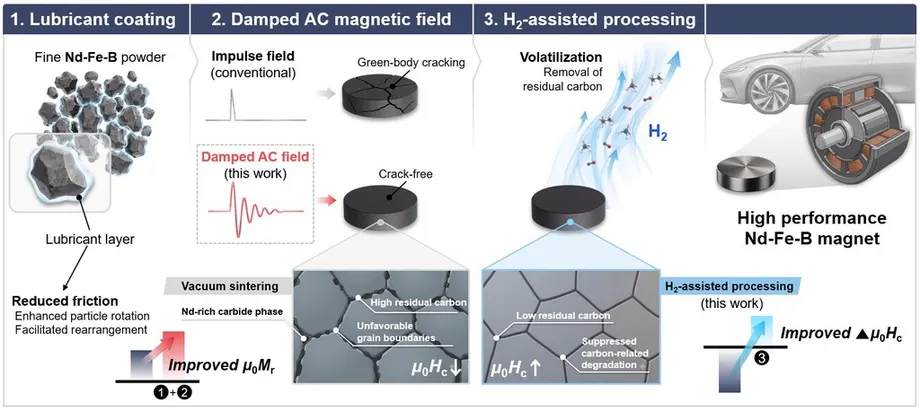
The researchers coated the powder surfaces with a lubricant to help the particles move. They also applied a damped alternating magnetic field. The field changes direction while its strength gradually decreases, helping the particles settle into alignment.
KIMS said the combination improved both the powder's orientation and the stability of the shaped powder body. That body is the compacted form prepared before sintering. Keeping it stable is part of carrying the desired particle arrangement through the remaining manufacturing steps.
Removing carbon left by the lubricant
The lubricant solved one problem but introduced another processing concern: residual carbon. Carbon left behind by the lubricant could contribute to a loss of coercivity after heat treatment, weakening the property the team was trying to preserve.
The researchers used a process assisted by hydrogen to reduce that residual carbon. KIMS said the treatment addressed the decline in coercivity after heating and helped establish a route for manufacturing sintered magnets from the ultrafine powder.
Sintering uses heat to bond compacted particles into a dense solid. For this research, the challenge was to move from small, carefully aligned particles to a solid magnet while retaining the desired magnetic performance.
The work therefore joined several manufacturing tasks: synthesising fine particles, limiting oxidation, improving alignment, stabilising the compacted powder and reducing carbon before completing heat treatment. Each step addressed a problem that could otherwise reduce the value of the improvements made earlier.
Two journal publications and nine patents
The research was supported through the National Research Foundation of Korea's Nano and Materials Technology Development Program, funded by the Ministry of Science and ICT. KIMS said the team generated nine patents related to the technologies.
The findings were published in two journals, with one study covering ultrafine powder production and the other addressing powder alignment and magnet manufacture. The sequence places the powder synthesis work before the publication of the research on turning that powder into magnets.
- July 14, 2026: The research on producing ultrafine Nd-Fe-B powder was published in the Journal of Alloys and Compounds.
- September 19, 2026: The research on powder alignment and magnet manufacture appeared online in the Chemical Engineering Journal.
- October 23, 2026: KIMS announced the combined manufacturing advances and their potential industrial applications.
The powder production study was published online, with Kim Tae-hoon and Lee Jung-gu as corresponding authors. For the alignment and magnet manufacturing study, post-master's researcher Kim So-yeon was first author and research leader Kim Su-min was corresponding author.
The studies carry the identifiers 10.1016/j.jallcom.2026.189820 and 10.1016/j.cej.2026.182156, respectively. These digital object identifiers provide permanent reference numbers for locating the individual research papers.
What manufacturers still need
Kim Su-min, the research leader and a senior researcher at KIMS, described the result as progress across both powder synthesis and the subsequent manufacturing stages. He said:
This research is significant because it overcame the technical limitations of ultrafine powder synthesis and powder alignment and sintering needed to manufacture high-performance Nd-Fe-B permanent magnets. In particular, we have presented a new technical approach that can improve magnet performance without relying on expensive heavy rare earths.
KIMS identified electric vehicle drive motors and humanoid robots as potential applications once further process integration and mass production technologies are secured. Permanent magnets also serve robot joints and wind turbine generators, making the manufacturing approach relevant to several industries that depend on strong magnetic materials.
The announcement gave no numerical coercivity results, operating temperature limits, production costs, factory output targets or commercial launch date. Those details will matter to manufacturers deciding whether the process can meet the requirements of a particular motor or robot.
Although KIMS described improvements in coercivity and the processing steps used to preserve it, the supplied material does not give measured coercivity values or operating-temperature test results. It therefore does not quantify how the magnets perform at the elevated temperatures encountered in motor applications.
The supply benefit centres on reducing demand for dysprosium and terbium in these magnets. Neodymium and rare earth oxide feedstocks remain part of the process. For Korea, the industrial opportunity is to develop more of the manufacturing capability domestically while reducing reliance on the heavy rare earth additives that the researchers set out to replace.
The immediate achievement is a connected set of core processing technologies, from approximately one micrometre powder to sintered magnets. The next step identified by the team is to link those technologies for production at scale, so the material can move toward use in demanding industrial equipment.
Key Points
- KIMS announced a manufacturing approach for Nd-Fe-B magnets without dysprosium or terbium on October 23, 2026.
- The process directly synthesises high purity powder particles about one micrometre across.
- New treatments address oxidation, particle alignment and carbon remaining from lubricant.
- The research appeared in two journals, and the team generated nine related patents.
- Further process integration and mass production work are needed for the proposed vehicle and robot applications.
- The magnets still contain neodymium, a rare earth element.
- The supplied material gives no measured coercivity values or operating-temperature test results.