A disappearing lead puts research spending under pressure
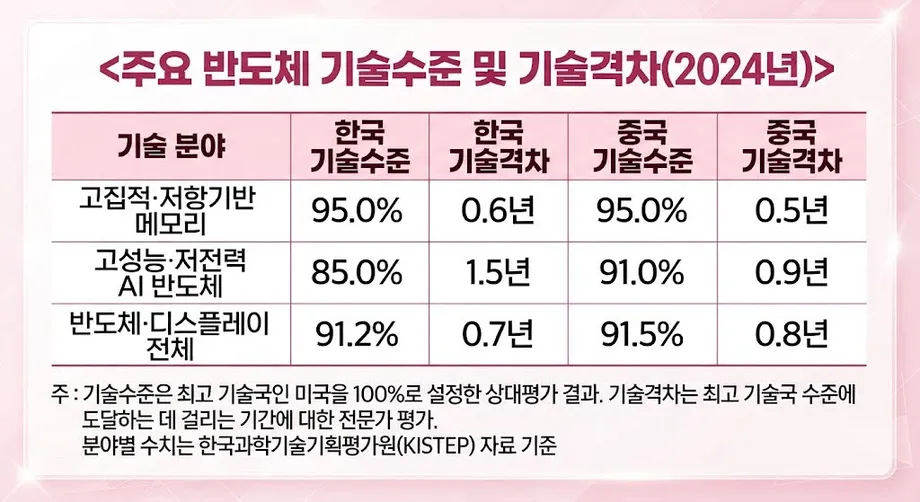
South Korea and China both scored 95% in an assessment of advanced memory technology against a United States benchmark of 100%, while China led South Korea by 91% to 85% in chips designed for artificial intelligence. The figures, based on a 2024 evaluation, have sharpened scrutiny of two major Korean semiconductor research projects scheduled to begin in 2027, with combined budgets of 1.1538 trillion won.
Contents
- A disappearing lead puts research spending under pressure
- What the technology scores measure
- China caught up in memory, while Korea narrowed its AI deficit
- Factory strength gives Korea a different advantage
- Why advanced AI memory remains difficult to copy
- NAND competition is already changing the Chinese market
- More Chinese capacity could pressure prices by 2028
- Two large projects start in 2027, after earlier programmes
- People and research foundations are part of the contest
- Key Points
Rep. Kim Nam-kuk of the Democratic Party of Korea presented the findings on October 23, 2026, after examining data submitted by the Ministry of Science and ICT and the Korea Institute of S&T Evaluation and Planning, known as KISTEP. He called for faster research spending, training linked to industry needs and regulatory changes as Chinese manufacturers expand.
The memory assessment estimated that South Korea was 0.6 years behind the leading country and China 0.5 years behind. For high performance AI chips that use less electricity, the estimated distances were 1.5 years for South Korea and 0.9 years for China.
South Korean manufacturers still possess substantial advantages in advanced production and memory used alongside AI processors. China is gaining ground along several different fronts, however: research capability, domestic market share and the volume of chips its factories can supply.
For Samsung Electronics and SK hynix, the challenge is therefore broader than defending the most advanced chip. They must keep improving manufacturing while competing with expanding Chinese suppliers and navigating American restrictions on equipment for their factories in China.
What the technology scores measure
KISTEP describes its assessment process in the 2025 technology assessment, published on February 5, 2026, under publication number 기관2025-022. The research ran from January through December 2025 and was led by Jung Eui-jin.
The institute examines 136 technologies, comparing South Korea with the United States, the European Union, Japan and China. Experts receive patent and research paper analyses before completing two rounds of a Delphi survey, a structured process in which specialists assess a subject and reconsider their judgments through successive rounds.
The percentage score expresses a technology's assessed position relative to the leader. The gap in years estimates the time needed to reach the leading level. Experts judge these measures separately, which explains how South Korea and China can share a 95% score while receiving slightly different estimates in years.
The memory category covers high density and resistance based memory, including technologies intended to increase capacity, speed and energy efficiency. Resistance based memory stores information through changes in electrical resistance. The category reaches beyond the DRAM products sold by individual companies.
China caught up in memory, while Korea narrowed its AI deficit
KISTEP's semiconductor technology brief, published on February 19, 2025, provides an earlier reference point. Written by Jung Eui-jin and Shin Dong-pyeong, it records South Korea at 95% and China at 90% in the 2022 memory assessment. The 2024 figures put both at 95%, eliminating that five percentage point difference.
AI semiconductors followed a different pattern. South Korea rose from 80% in 2022 to 85% in 2024, while China increased from 90% to 91%. Korea's deficit narrowed from 10 percentage points to six, although China retained the higher score. China's lead in this category was already present in 2022.
AI processors perform the calculations needed to train models and produce answers. Their performance depends on how much useful computation they deliver and how much electricity they consume. Memory supplies the data those processors need, making the two technologies closely connected but distinct industrial strengths.
The broader semiconductor and display category placed China at 91.5% and South Korea at 91.2% in 2024. The technologies covered and the assessment framework changed between the 2022 and 2024 rounds, so the clearest historical comparisons come from examining the individual categories alongside their definitions.
Factory strength gives Korea a different advantage
A survey of 39 Korean semiconductor specialists conducted in 2024 helps explain the industry's uneven competitive position. Published in KISTEP's February 2025 brief, it found China ahead of South Korea in underlying memory capabilities, while Korea remained slightly ahead in turning those capabilities into commercial products.
Across the semiconductor production cycle, South Korea scored 86.9% for process technology against China's 81.0%. For mass production, Korea scored 87.0% and China 81.2%. China's scores were higher in basic research, at 81.1% against Korea's 78.8%, and design, at 80.2% against 79.4%.
Those survey results are averages from a different scoring exercise. They describe a practical split: China was stronger in some foundations of future development, while Korea was stronger at manufacturing chips reliably and at scale.
Samsung, SK hynix and American manufacturer Micron together account for more than 90% of the global DRAM market. CXMT, or ChangXin Memory Technologies, held about 4% in the market snapshot describing its first profitable year in 2025.
Korean industry specialists have estimated China's commercial DRAM technology lag at roughly two to three years; Dong-A University professor Shim Dae-yong puts it above five years. Their estimates concern manufacturing capabilities and advanced products, while KISTEP's 0.6 and 0.5 year figures measure each country's assessed distance from a common technology leader.
Why advanced AI memory remains difficult to copy
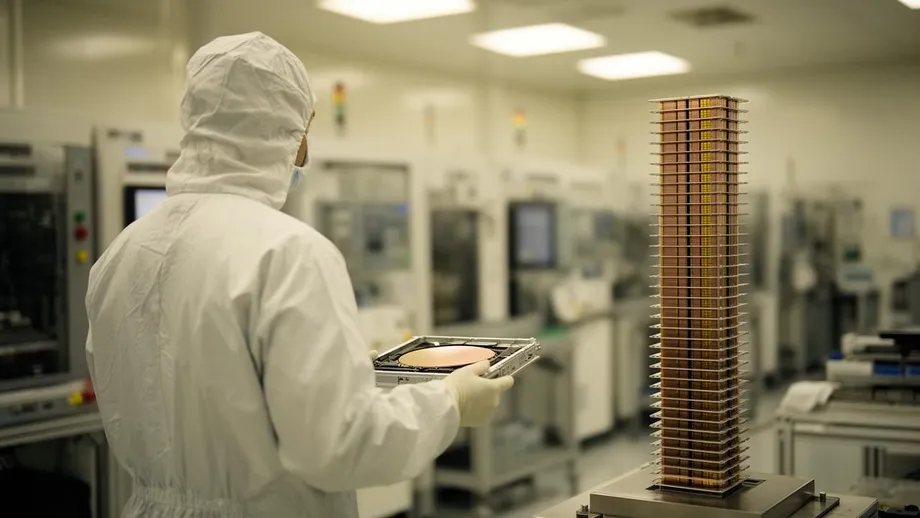
Shim spent 26 years at SK hynix, working on DRAM development and the early advancement of high bandwidth memory, or HBM. HBM stacks memory chips vertically so they can move large amounts of data quickly to an AI processor.
Korean manufacturers are supplying HBM3E and preparing HBM4, while CXMT has outlined plans for HBM3 class products. Producing these stacks requires precise connections, heat management and consistent quality across multiple layers.
Shim, a professor of next generation semiconductors at Dong-A University, described the limits of relying on investment alone:
Semiconductor business is not something that can be mastered with money alone.
Advanced DRAM also depends on access to equipment. Shim identifies restricted access to extreme ultraviolet lithography, or EUV, as a major constraint for China. EUV machines use extremely short wavelengths of light to form tiny chip features. Older equipment can extend its reach by repeating patterning steps, but the process becomes more complicated as features shrink.
Industry comparisons place leading Korean production at the 1b and 1c DRAM generations, with Chinese firms mainly at the earlier 1z generation. Shim argues that EUV becomes effectively indispensable from 1b onward. Commercial cost competitiveness also typically requires yields of around 80% to 90%, meaning that proportion of manufactured chips must work properly.
Stacking offers China another route to progress, but brings its own material and packaging demands. Japanese suppliers including Resonac and Namics hold strong positions in protective materials used in HBM. Korean memory producers also have decades of experience developing and validating products with customers such as Microsoft, Google, Apple and Nvidia.
NAND competition is already changing the Chinese market
China's progress is visible in NAND flash, the memory that keeps data when a device is switched off. YMTC's share of the Chinese NAND market rose from 28% to 38.5% in the market comparison accompanying factory upgrade plans. Samsung's share fell from 36% to 33.5%, while SK hynix declined from 20% to 17%.
Samsung and SK hynix together therefore fell from 56% to 50.5%, a loss of 5.5 percentage points. YMTC gained 10.5 points. These figures concern the Chinese market; Samsung adviser Kyung Kye-hyun separately put Chinese suppliers' share of the global NAND market at about 20%.
Samsung's Xi'an factory accounts for about 40% of the company's worldwide NAND production. Its upgrade plan targets V9 NAND with 286 layers, beginning with capacity of 5,000 wafers at the initial year end milestone and reaching 40,000 by the end of 2027. Wafers are the discs on which many chips are manufactured.
Samsung has also introduced V10 NAND with more than 400 layers. The Xi'an plan shows how a company's factories can operate at different generations as equipment, investment and permissions shape their upgrade schedules.
SK hynix's Dalian factory produces NAND with 192 layers and has received American approval to move to 240 layers. Further plans for more than 300 layers depend on permission. A US measure introduced in 2025 tightened licensing for foreign chipmakers seeking to expand or upgrade factories in China. SK hynix is also negotiating with Intel over establishing NAND production in the United States.
Chinese manufacturing progress varies by technique. A comparison citing the National Academy of Engineering of Korea placed Chinese NAND production at 232 layers and leading Korean production at 286 to 321 layers, while identifying YMTC's hybrid bonding technology as more advanced than that of Korean competitors. Hybrid bonding connects chip surfaces closely, helping manufacturers combine layers.
More Chinese capacity could pressure prices by 2028
Kyung Kye-hyun, who led Samsung's semiconductor business from December 2021 to May 2024, warned that rapid Chinese expansion could weaken the memory boom by 2028. He said Chinese firms planned to add capacity of 300,000 wafers over three years, potentially reaching around 12% to 13% market share.
CXMT reported revenue of 50.8 billion yuan in the first quarter of 2026, up 719% from a year earlier, and forecast revenue of 110 billion to 120 billion yuan for the first half. Rising DRAM prices were helping its growth.
Kyung also identified a risk on the demand side. Large technology companies are spending heavily on AI infrastructure, but could reduce investment if financial returns weaken. Speaking as a Samsung executive adviser, he explained:
By around 2028, if returns on investment weaken, they may have no choice but to scale back spending.
More supply arriving as customer spending slows would put pressure on prices and factory profits. Kyung also pointed to a possible shift toward AI processors designed for particular customers and data centres, increasing the need for memory tailored to those systems.
Samsung faced a separate production risk earlier in 2026, when its union planned a strike involving about 50,000 workers from May 21 to June 7. KB Securities estimated potential global supply disruption of 2% to 3% for NAND and 3% to 4% for DRAM if it proceeded. Those figures were conditional estimates attached to the proposed action.
Two large projects start in 2027, after earlier programmes
The Ministry of Science and ICT figures cited by Kim schedule 1.0638 trillion won for ultra fine stacked semiconductor technology development and 90 billion won for fundamental research into next generation compound semiconductors, including applications in extreme environments. Both projects are due to begin in 2027.
Kim argued that this timetable was too slow against China's nationally supported expansion. CXMT was his example of a DRAM manufacturer accelerating development and mass production with substantial state backing.
Korea's research programme has nevertheless been progressing through earlier initiatives. The ministry developed a semiconductor future technology roadmap in 2023, expanded it to 59 technologies in 2024, and reorganised it in 2026 into three fields, 10 groups, 50 core technologies and 90 detailed component technologies.
The main milestones show how the assessments and investment plans overlap:
- 2022: Korea scored 95% in memory and China 90%; China led AI semiconductors by 90% to 80%.
- 2023: The ministry established its semiconductor future technology roadmap.
- 2024: Three linked research projects began, including advanced packaging; the assessment later cited by Kim placed Korea and China level in memory.
- 2025: Two further projects began, including next generation optical packaging. KISTEP published its semiconductor analysis on February 19.
- 2026: KISTEP published its assessment report on February 5. Three roadmap projects covering automotive chips, advanced ceramic materials and optical computing were scheduled to begin during the year.
- 2027: The stacked semiconductor and compound semiconductor projects are scheduled to start.
The schedule places the two large projects alongside continuing programmes rather than at the beginning of Korea's research effort. The ministry data cited by Kim give 2027 as their starting year, without a specific launch date or a detailed spending timetable.
People and research foundations are part of the contest
KISTEP's semiconductor brief identified the loss of skilled personnel as the leading issue affecting Korea's future technology position. It described fewer students entering advanced study and experienced staff seeking better conditions and compensation overseas.
The brief also cited 2022 semiconductor research spending equivalent to 9.5% of company revenue in Korea, compared with 19.5% in the United States, 14% in Europe, 12% in Japan and 11% in Taiwan. These ratios place Korea's investment debate alongside the question of when public projects begin.
KISTEP recommended stronger connections between chip design, manufacturing and packaging, together with support for equipment, materials and public research infrastructure. Its survey results make the priorities concrete: protect Korea's factory expertise while strengthening the basic research and design capabilities where its scores were weaker.
For engineers, that means training that matches increasingly complex equipment and production methods. For smaller suppliers, it means opportunities to develop materials, tools and packaging technology alongside larger manufacturers. Kim's call for earlier budget execution and practical training addresses the same pressure from the policy side.
Korea's position now combines commercial leadership with a narrowing research advantage. China's expanding factories can increase competition even while Korean companies retain the strongest advanced products. Decisions about research timing, skilled workers and factory upgrades will shape how long those strengths translate into profitable production.
Key Points
- Korea and China both scored 95% in the 2024 assessment of advanced memory technology.
- China led AI semiconductors by 91% to 85%, although Korea narrowed its deficit from 2022.
- Korean manufacturers retained stronger scores in process technology and mass production in a separate expert survey.
- China is gaining NAND market share and expanding capacity, while advanced DRAM and HBM remain difficult manufacturing challenges.
- Two Korean research projects with combined budgets of 1.1538 trillion won are scheduled to begin in 2027.
- Samsung adviser Kyung Kye-hyun warned that expanding Chinese supply and weaker customer spending could pressure the memory market by 2028.