A power shortage at the point of connection
South Korea's capital region accounted for 674 of 1,107 applications to a pilot electricity grid assessment program by the end of September 2025. Among the 648 capital region applications that Korea Electric Power Corporation had finished reviewing technically, 313, or 48.3%, received a finding that power could not be supplied.
Contents
- A power shortage at the point of connection
- Why Namyangju needs more than a construction site
- What the application figures reveal
- Conditional approval can mean a long wait
- Why so many projects cluster below 10 megawatts
- Ansan shows how projects accumulate locally
- Strong demand keeps developers interested
- What the government changed
- Building the grid also requires local agreement
- Key Points
Outside the capital region, which comprises Seoul, Gyeonggi Province and Incheon, the corresponding figure was 33 out of 327 completed reviews, or 10.1%. The rejection rate around the capital was about 4.8 times higher, according to KEPCO data submitted to People Power Party lawmaker Kim Sung-won.
The figures show the difficulty facing companies trying to build data centers close to their customers and existing businesses. A project needs more than land, financing and servers. It also needs a connection to an electricity network capable of delivering a large, steady supply of power.
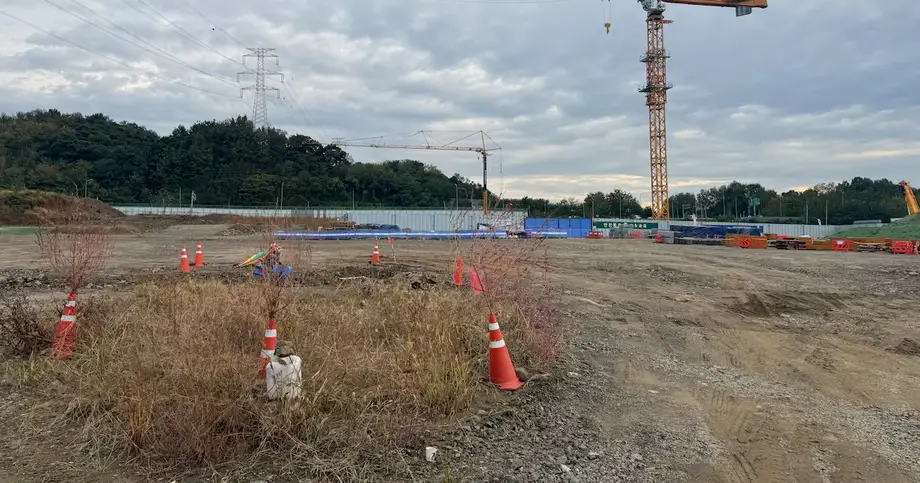
Shinhan Bank's planned artificial intelligence data center in Namyangju illustrates the problem. The bank announced an investment of 850 billion won in December 2024 after examining 130 possible locations nationwide. Its chosen project, with a planned power capacity of about 50 megawatts, had still not passed the grid impact assessment at the time of the account describing the September figures.
Government procedures have since changed. The Ministry of Climate, Energy and Environment announced revisions on November 28, 2025, while an official assessment page now lists updates dated February 13 and March 27, 2026. Those later developments make the September figures a dated measure of the bottleneck, rather than a current count of rejected applications.
Why Namyangju needs more than a construction site
Namyangju's Wangsuk urban industrial complex is intended to accommodate data centers for financial and technology companies, including Shinhan Bank, Woori Bank and Kakao. Construction of a 345 kilovolt substation is part of the area's electricity infrastructure development.
A substation changes voltage and directs electricity through the network. Transmission lines carry power over longer distances, while distribution lines deliver it closer to individual users. A data center can be ready to operate before the facilities needed to connect it are finished.
Shinhan's proposed 50 megawatts describes a rate of electricity use, not an amount consumed over a year. One megawatt equals 1,000 kilowatts. Securing that capacity means arranging for the network to carry a substantial additional load whenever the facility needs it.
The approval process therefore has several practical stages. A developer must secure a favorable assessment, agree on how electricity will reach the site and wait for any necessary lines or substations. Passing an early review can leave a project dependent on years of infrastructure construction.
What the application figures reveal
The capital region represented 60.9% of all applications in the pilot assessment figures through September 2025. Its share of demand was large, while its rate of unsuccessful technical reviews was much higher than elsewhere.
An earlier Ministry of Climate, Energy and Environment dataset, covering the first technical review stage from August 2024 through March 2025, recorded 279 findings that supply was unavailable among 522 capital region applications, or 53.4%. The later figure of 48.3% covers a longer period and a different number of completed reviews.
These assessment statistics sit alongside a more specific measure of data center development. KEPCO records obtained by Democratic Party lawmaker Choi Ki-sang showed 72 data center electricity applications in the capital region during the reported period of 2025. Of those, 64 requested less than 10 megawatts.
The pressure had been visible earlier. In March 2023, the Ministry of Trade, Industry and Energy identified 601 prospective new data center sites in the capital region through 2029. Only 40, or 6.7%, were considered capable of receiving electricity on time. Together, the figures describe a persistent mismatch between preferred locations and available connections.
Conditional approval can mean a long wait
KEPCO's August 2025 records identified 232 customers still at the electricity application stage for contracted capacity of at least 5 megawatts, after excluding completed supply arrangements, cancellations and other excluded cases. Their requested capacity totaled about 12 gigawatts.
That was roughly four times the approximately 2.95 gigawatts of contracted capacity for data center customers already receiving electricity from KEPCO. The comparison shows the size of the application queue relative to existing contracted supply.
Another KEPCO dataset, covering supply planning reviews from 2021 through August 2025, classified 65 of 179 completed reviews as conditionally possible. That was 36.3% of the total.
KEPCO explained that conditional findings could arise when a planned substation's completion date did not match a customer's requested starting date, or when additional time was needed to build a supply line. In practical terms, a developer may have to move its opening date to match the electricity network's construction schedule.
Industry figures cited in the reporting put standard construction periods for 154 kilovolt transmission and substation facilities at about six and a half to seven and a half years. Average construction periods cited for facilities of 345 kilovolts or more were around a decade. For companies investing in rapidly changing AI technology, that creates a difficult planning gap.
Why so many projects cluster below 10 megawatts
Of the 72 capital region data center electricity applications, 52 requested capacity in the 9 megawatt range. Applications below 10 megawatts rose from 31 in 2024 to 64 during the reported period of 2025.
The 10 megawatt threshold matters because it determines whether a project enters the grid impact assessment process. It also affects connection arrangements: the reported KEPCO supply rules generally require 154 kilovolt transmission connections and related facilities above 10 megawatts, while smaller facilities can receive power through 22.9 kilovolt distribution lines.
Developers have consequently promoted smaller urban facilities as edge data centers. An edge facility processes information closer to where people or machines use it, reducing the time spent sending data to a distant computing center. That can help financial transactions, factory automation and other services that need quick responses.
In the capital region, the size of these projects also reflects the electricity approval threshold. At an October 6, 2025 parliamentary audit, Climate, Energy and Environment Minister Kim Sung-hwan addressed two neighboring proposed centers in Seoul's Geumcheon district requesting 9 and 9.9 megawatts. He said dividing a larger project into applications would be illegal if it amounted to splitting a project to avoid the rules.
Ansan shows how projects accumulate locally
Ansan's Banwol and Sihwa industrial areas provide a concentrated example of data center growth. Nine facilities operating, under construction or planned there had a combined stated electricity receiving capacity of 417.6 megawatts.
The group includes Kakao's 40 megawatt data center at Hanyang University's ERICA campus, completed in September 2023 with capacity for 120,000 servers. Other projects include the 40 megawatt Ansan Global Cloud Center, targeted for completion in the second half of 2027, and a 50 megawatt KT Cloud facility targeted for 2029.
Smaller development is appearing alongside those large projects. Construction of the OUR Data Center began on October 12, 2025, with completion targeted for October 2027. Its planned electricity receiving capacity is 7.6 megawatts, including 4.82 megawatts for computing equipment. The difference reflects electricity needed for cooling and other supporting systems.
Ansan's May 2025 AI industry plan focused on industrial applications, including the use of AI in the Banwol and Sihwa manufacturing areas. Published descriptions of that plan, and the city's July requests to the national government, did not include a data center or electricity planning item.
For an industrial city, the practical issue is how hundreds of megawatts of planned computing demand fit alongside factories already using the network. Local planning must connect individual development approvals with the substations and lines serving the wider industrial area.
Strong demand keeps developers interested
Commercial property figures help explain why companies continue pursuing difficult sites. Cushman & Wakefield recorded a decline in the capital region's data center vacancy rate from 6.9% in the second half of 2024 to 1.1% in the first half of 2025.
CBRE figures placed average monthly rents per kilowatt at about 140,000 won in 2019 and about 250,000 won in 2024, an increase of roughly 79%. Together, tighter availability and higher rents create a financial incentive to secure usable capacity near Seoul.
Smaller facilities bring their own cost pressures. The reported construction contract for a 9 megawatt center near Gangnam's Samseong Station was 129.6 billion won, while a 9.8 megawatt project in Bucheon carried a construction contract of 126.8 billion won. Their costs per megawatt were about 14.4 billion won and 12.9 billion won respectively.
A 40 megawatt Ansan project carried a reported construction cost of 400 billion won, or 10 billion won per megawatt. Construction scope varies by project, but the figures illustrate why developers must weigh faster access to a smaller connection against the cost advantages of building at greater scale.
What the government changed
The Ministry of Climate, Energy and Environment's pilot procedure notice, numbered 2025-139 and dated November 28, 2025, revised the grid impact assessment arrangements under Article 23 of the Special Act on the Promotion of Distributed Energy.
The notice changed assessment criteria, introduced simplified procedures and preferential arrangements, and added technical review charges. It also directed applicants to revised guidance for preparing assessment documents.
For projects seeking exclusion from the assessment requirement, the ministry changed the criteria used to identify qualifying national advanced strategic industries and the application procedure. It referred applicants to Article 23 of the act, Article 26 of its enforcement decree and a designated exclusion application form.
The official assessment status page lists documents dated February 13 and March 27, 2026. The listing gives the dates of those updates, but the figures within the PDFs are not included in the published extract, so a newer rejection rate cannot be stated here.
The main dated milestones show how the pressure and the policy response developed:
- March 2023: The industry ministry identified timely electricity supply at only 40 of 601 prospective capital region sites.
- August 2024 to March 2025: Initial technical reviews found supply unavailable for 279 of 522 capital region applications.
- September 2025: The expanded pilot dataset recorded 313 unavailable findings among 648 completed capital region reviews.
- November 28, 2025: The climate and energy ministry announced revised pilot assessment procedures.
- March 27, 2026: The latest dated assessment document listed on the official status page was published.
Building the grid also requires local agreement
KEPCO received 5,095 data center related complaints through September 2025, compared with one in 2021. Industry accounts described growing resistance over health and fire concerns, alongside opposition to transmission lines and substations.
Developers therefore face both engineering schedules and the challenge of securing local acceptance. A smaller center may fit an existing industrial property, while the surrounding area still needs enough network capacity to serve several projects together.
A seminar hosted by the National Economic Advisory Council on November 28 examined proposals to address the bottleneck. Participants suggested performance deposits and capacity reservation charges to filter out applications with little prospect of proceeding.
Other proposals included separating grid investment accounting from KEPCO's electricity sales losses and reflecting construction spending gradually in tariffs. Participants also proposed a temporary body with full authority to set priorities and cost principles within six months, followed by construction starts for priority projects in Yongin and Honam within 36 months. Those periods were proposed targets, rather than announced construction commitments.
The immediate challenge is to align three schedules: when a company wants to open, when the network can deliver power and when the necessary infrastructure can secure approval and be built. The Namyangju project and the concentration of applications below 10 megawatts show how that mismatch is already shaping investment decisions.
Key Points
- By September 2025, 48.3% of completed capital region technical reviews found electricity supply unavailable, compared with 10.1% outside the region.
- Conditional approval can require developers to wait for new substations or supply lines.
- Of 72 capital region data center electricity applications in the reported 2025 period, 64 requested less than 10 megawatts.
- Nine operating, developing or planned facilities around Ansan's Banwol and Sihwa industrial areas totaled 417.6 megawatts of stated receiving capacity.
- The government revised assessment procedures in November 2025, and the official status page lists a further update dated March 27, 2026.