A smaller headquarters with a wider military task
South Korea established its Defense Drone Headquarters on November 1, 2026, replacing a command of about 280 personnel with an organization of roughly 100 as the military pursues more than 20,000 inexpensive, expendable drones by 2030. The change separates responsibility for developing drone capabilities from responsibility for flying combat missions.
Contents
- A smaller headquarters with a wider military task
- Who will control drone missions?
- What the personnel cuts change
- How the reorganization reached this point
- North Korea's threat extends beyond the aircraft
- A faster route from commercial products to military units
- Why batteries and motors matter
- More than 20,000 drones and a longer range attack program
- What changes for South Korea's forces
- Key Points
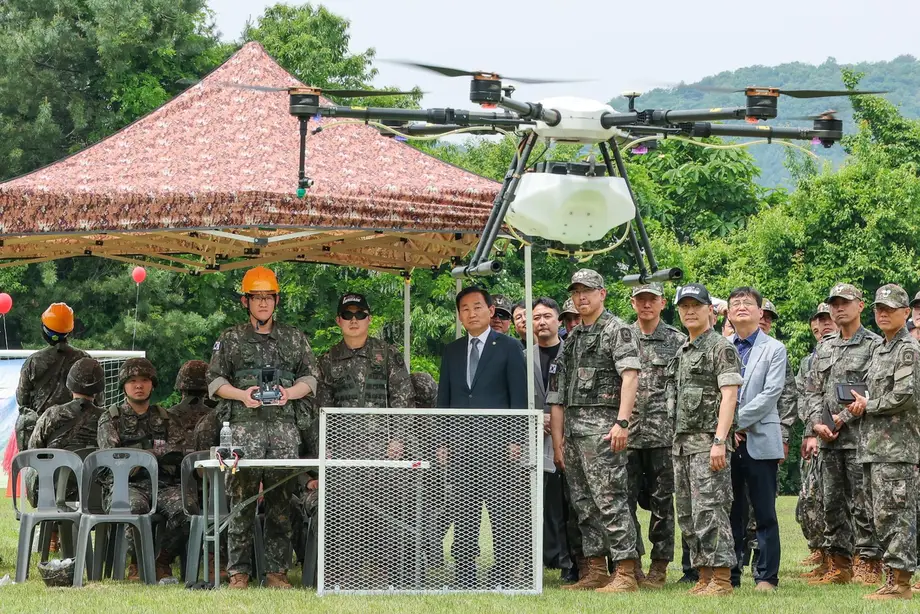
Vice Defense Minister Lee Doo-hee attended the launch ceremony on November 2 in Pocheon, about 40 kilometers north of Seoul. The headquarters, a unit directly under the Ministry of National Defense, will coordinate drone policy, assess new technology and help the armed services bring equipment into use more quickly.
Combat missions and operational assets move to the service branches, with the Joint Chiefs of Staff providing integrated command and control. The new headquarters will concentrate on deciding what capabilities the military needs, testing their usefulness and coordinating standards across the armed forces.
The reorganization comes as North Korea expands its drone program and draws lessons from its involvement in Russia's war against Ukraine. During the week before the ceremony, Pyongyang conducted weapons tests simulating mass drone attacks against mock South Korean military guard posts and American tanks.
Seoul's response combines three efforts: spreading drone use across military units, improving defenses against hostile drones and changing how commercial technology reaches soldiers. The smaller headquarters is intended to support that expansion by bringing planning and technical work together while operational personnel move elsewhere.
Who will control drone missions?
The former Drone Operations Command primarily conducted drone operations. Under the previous division of work, the individual services generally concentrated on surveillance and reconnaissance, while the command focused on strikes. Reconnaissance means gathering information about an opposing force, such as its location or movements.
The services will now conduct both reconnaissance and strike missions. Most descriptions of the transfer identify the Army, Air Force and Marine Corps as recipients; a broader description also includes Navy operational commands. The Joint Chiefs of Staff will coordinate the dispersed operations.
A defense ministry official explained why drone attacks should be planned alongside other weapons rather than managed as a separate activity:
Drone strikes need to be integrated with other capabilities, including artillery and aircraft.
For a military unit, that means coordinating drones with artillery fire and aircraft operating against the same targets or in the same area. The ministry also wants defenses against drones connected to existing air defense systems, allowing those responsible for protecting an area to manage the response together.
The headquarters will support these missions through policy, technology assessment and capability planning. The services will remain responsible for operations and training, while the Joint Chiefs will integrate their actions.
What the personnel cuts change
The reduction from about 280 personnel to about 100 removes roughly 180 positions from the central organization, a decrease of approximately 64 percent. Operational, logistics and combat support functions are being transferred or reduced within the headquarters as the services take over missions.
The remaining staff will have a different mix of experience. Field grade officers and those of higher rank previously accounted for about 17 percent of personnel. They will now make up more than half. Field grade officers include majors, lieutenant colonels and colonels, who commonly carry out planning and management duties.
The headquarters will draw personnel from the former command, capability development specialists from the services and acquisition specialists from the Defense Acquisition Program Administration, known as DAPA. Dedicated departments will cover combat development, demonstrations, acquisition support and cooperation with civilian companies.
A major general will lead the organization, matching the rank of the former command's chief. The incumbent Drone Operations Commander will initially perform the headquarters chief's duties. The ministry's intention is to place experienced planners and technical staff in the smaller organization while distributing operational work across the force.
How the reorganization reached this point
The Drone Operations Command was established in 2023 after North Korean drones entered South Korean airspace in December 2022. It faced criticism over its preparation and later became embroiled in controversy concerning drone flights into Pyongyang in October 2024.
Investigations and court proceedings connected to the December 3, 2024, martial law episode brought scrutiny of the command's involvement in those flights. Under President Lee Jae-myung's administration, a joint civilian, government and military special advisory committee recommended replacing the command with a functional headquarters.
- December 2022: North Korean drones entered South Korean airspace.
- 2023: South Korea established the Drone Operations Command.
- October 2024: Drone flights into Pyongyang became the subject of subsequent investigations and controversy.
- January 2026: The special advisory committee recommended disbanding the command and establishing a functional headquarters.
- June 2026: The ministry announced its Defense Drone and Counter-Drone Development Policy.
- July 24, 2026: The ministry issued notice of the proposed decree revision.
- October 13 and October 20, 2026: The Cabinet approved the revision, followed by promulgation of the headquarters decree.
- November 1 and November 2, 2026: The headquarters was established, then held its launch ceremony.
The command closed after about three years. Its replacement follows both the advisory committee's recommendation and the June policy, which called for broader drone use and stronger defenses against unmanned aircraft.
North Korea's threat extends beyond the aircraft
North Korea's recent simulated attacks put military positions and tanks at the center of Seoul's immediate concerns. Its participation in the war against Ukraine also gives Pyongyang access to experience from a conflict in which drones are used extensively for reconnaissance and attacks.
South Korea's defense ministry said it was taking the threat seriously and described the capabilities it considers necessary when assessing drone power:
We take North Korea's advancing drone capabilities and related threats very seriously, although evaluating drone power requires looking beyond mere performance to fully consider detection, identification, tracking and countermeasure systems.
Those stages describe a practical sequence: find an aircraft, determine what it is, follow its movement and choose a response. The ministry's plan therefore covers both drones that South Korean forces will operate and the equipment needed to defend against hostile aircraft.
The headquarters will study recent fighting in Ukraine and the Middle East, then test how relevant technologies and operating methods work in the Korean Peninsula's environment. It will also examine wider roles for drones, including attack, defense and electronic warfare, which involves using the electromagnetic spectrum to disrupt or affect an opponent's systems.
A faster route from commercial products to military units
Defense ministry officials have identified existing defense procurement procedures as a cause of delays in bringing drones and artificial intelligence into service. Their concern is especially acute for inexpensive equipment designed to be used up in combat and replaced in large numbers.
The ministry is pursuing a certification and purchasing system modeled on the United States' Blue Unmanned Aircraft Systems program, commonly called Blue UAS. The proposed Korean approach would allow domestically produced commercial drones that meet certification requirements to enter a marketplace from which the military could purchase them quickly.
The headquarters will help establish standards for military suitability, support tests and connect civilian technology with operational requirements. Component standardization and improved operating and management rules are also part of its remit. The ministry is pursuing separate legislation to support faster adoption.
DAPA will retain responsibility for actual acquisition work once requirements are approved. That includes decisions on how projects proceed, purchasing, contracts and quality certification. The headquarters will help determine needs and assess technology; DAPA will continue to manage the purchases.
The headquarters will also participate in the Joint Chiefs' existing requirements review process. By comparing requests from different services before projects advance, it aims to reduce overlapping investments and support common purchases without adding a separate review stage.
Why batteries and motors matter
South Korea wants to reduce dependence on Chinese components, including drone batteries and motors. These parts are central to keeping aircraft available: batteries provide power, while motors drive the propellers that allow many small drones to fly.
A defense ministry official described the government's supply arrangements:
We are working to secure supply chains with allies and partners, including the United States.
The ministry is pursuing domestic production alongside cooperation with partners on component standards and supply networks. For Korean manufacturers, the headquarters will provide a connection between civilian technology and military requirements, helping companies understand what their products must do to be useful to the armed services.
Component standards also connect the industrial policy to the operational plan. If drones are to become common equipment across many units, the military will need dependable access to replacement parts as well as complete aircraft. The certification system and supply efforts are intended to support that wider use.
More than 20,000 drones and a longer range attack program
The military aims to secure more than 20,000 inexpensive, expendable drones by 2030. The planned fleet includes drones for reconnaissance at short distances and small attack drones that are consumed when they strike a target.
A ministry official described the intended scale of everyday use by saying the military needs a foundation that lets every unit use drones:
like a second personal firearm
The phrase captures the ministry's aim to move drone capability beyond a single specialist command. Units across the services would operate drones as a regular part of their equipment, supported by shared development work and coordinated military operations.
South Korea is also advancing the Korean Low-Cost Uncrewed Combat Attack System, or K-LUCAS. The program seeks to develop domestic loitering munitions with long range for strikes on important targets behind enemy lines and for neutralizing air defenses. A loitering munition is an unmanned weapon that can remain airborne before attacking its target.
The wider plans include bringing a domestically developed reconnaissance aircraft operating at medium altitude into service during 2026. The ministry has given 2030 as the goal for the fleet of more than 20,000 expendable drones, but has not announced a detailed delivery schedule or total budget for that fleet, or a firm deployment date for K-LUCAS.
What changes for South Korea's forces
Army, Air Force and Marine Corps units will take on a broader combination of reconnaissance and strike responsibilities. Their drone missions will be coordinated with other military capabilities, while planners at the new headquarters work on common standards, suitable technology and overlapping equipment requests.
The plan connects three decisions that might otherwise be handled separately: what soldiers need, which commercial products can meet those needs and how to buy them quickly. Its success will depend on coordination among the services, the Joint Chiefs, the headquarters and DAPA. The ministry is still examining how to strengthen its central policy role as those responsibilities are redistributed.
The security setting also includes diplomacy. The launch follows the Atlanta talks on denuclearization, where South Korea, the United States and Japan renewed their commitment to North Korea's complete denuclearization while supporting dialogue. Seoul is pursuing those diplomatic goals alongside changes intended to make its forces better equipped for drone warfare.
For military units, the immediate organizational change is straightforward: combat operations move to the services, development work is concentrated in the new headquarters and procurement remains with DAPA. The larger equipment goals will take years to deliver.
Key Points
- The Defense Drone Headquarters was established on November 1, 2026, with a ceremony in Pocheon the following day.
- Its staff numbers about 100, compared with roughly 280 at the former Drone Operations Command.
- The services take over combat missions, coordinated by the Joint Chiefs of Staff.
- The headquarters handles capability planning, technology assessment and standards; DAPA retains purchasing and contracting.
- South Korea plans more than 20,000 inexpensive, expendable drones by 2030 and is advancing K-LUCAS.
- Certification reforms and supply cooperation aim to speed purchases and reduce dependence on Chinese components.