A factory robot takes priority in Samsung's next growth push
Samsung Electronics Chairman Lee Jae-yong visited the company's robotics development hub in southern Seoul on October 27, 2026, to review core technologies and preparations for a possible humanoid robot unveiling at CES in January 2027. The visit puts the chairman directly behind a business Samsung wants to develop first inside its own factories, then sell to other companies and eventually consumers.
Contents
- A factory robot takes priority in Samsung's next growth push
- What Lee's inspection brings into focus
- One organization for engineering and business decisions
- Why Samsung wants robots working in its own factories first
- The robotic hand is a major technical and cost challenge
- Gumi is meant to turn factory activity into training data
- Rainbow Robotics and Samsung affiliates supply different pieces
- A growing market with a demanding commercial test
- Key Points
Lee inspected the Robotics eXperience Business Development Office, known as RX, at Samsung's Seoul R&D Campus in Umyeon-dong, Seocho district. It was his first visit since the office was established in July to bring robotics research, product planning and commercialization under one leadership structure.
The immediate challenge is practical: build robots that can handle objects accurately and work reliably on production lines making semiconductors, smartphones and home appliances. Samsung is developing a humanoid with its own robotic hand and components from Rainbow Robotics, in which it holds a 35% stake.
A public appearance at CES in Las Vegas remains conditional. A Samsung representative said the company intends to show the robot if it meets minimum standards, with a decision expected later in October. The company has not specified those standards or announced a firm commercial launch date.
Samsung's wider target is to convert its domestic and overseas manufacturing facilities into AI autonomous factories by 2030. In simple terms, that means using artificial intelligence to coordinate more production decisions and physical tasks, with robots carrying out work that requires movement and handling.
The factory strategy also gives Samsung a place to improve its robots before offering them to outside customers. Production lines can supply repeated tasks, operating experience and training data, linking the company's manufacturing business to its ambitions in physical AI, the use of artificial intelligence to control machines that act in the real world.
What Lee's inspection brings into focus
Lee's visit followed an August robotics technology demonstration attended by Roh Tae-moon, Samsung Electronics president and head of the Device eXperience division, and other senior executives. Before the October inspection, researchers were expected to prepare demonstrations of precision manipulation using humanoid arms and hands.
Precision manipulation means doing more than picking up a large object. A robot may need to position a small component, turn a part or connect a flexible cable while applying the right amount of force. Those abilities matter directly to electronics assembly.
Samsung Research has developed technology for assembling and connecting flexible materials resembling electrical cables. Such work is difficult because a cable changes shape as it moves. A robot must keep tracking its position and adjust its grip rather than simply repeat a fixed movement.
The main steps in Samsung's robotics expansion show how the focus has moved from investment toward deployment:
- December 2024: Samsung expanded its relationship with Rainbow Robotics and formed a dedicated future robotics organization.
- July 21, 2026: Samsung announced the RX office directly under its chief executive, bringing together robotics development and business planning.
- August 2026: Senior executives attended an internal robotics technology demonstration.
- September 2026: DX Chief Technology Officer Yoon Jang-hyun was assigned to lead RX hardware and AI software development teams.
- October 27, 2026: Lee visited the RX office to review development progress.
- January 2027: Samsung is considering a humanoid presentation at CES, subject to readiness.
One organization for engineering and business decisions
Roh leads RX while also overseeing Samsung's Device eXperience division, which includes smartphones and home appliances. The office covers long term strategy, core technology, design, product planning and commercialization, giving it responsibility for both developing robots and finding a business for them.
Samsung is combining capabilities from its future robotics organization, the Samsung Research robotics center and robotics researchers at its production technology institute. Oh Jun-ho, a KAIST distinguished professor and a founding member of Rainbow Robotics, continues to lead the future robotics group within the broader structure.
The company has also recruited specialists in autonomous robotics, control and robotic hands. They include Seoul National University professor Kim Hyoun-jin and Ajou University professor Kim Ui-kyum. Its robotics strategy team is led by an executive recruited after working on robotics strategy at Hyundai Motor Group's Boston Dynamics.
Yoon's responsibility for both hardware and AI software links the robot's physical design with its perception and decision making. Engineers must make those parts work together: software has to understand what the cameras see, decide how to move and stay within the limits of the motors and joints.
Why Samsung wants robots working in its own factories first
Samsung plans to test robots in its own production facilities before expanding sales to other manufacturers and, later, the consumer market. The approach gives the company access to operating conditions and a potential first customer for its technology within the same group.
Roh described the order of priorities in January, explaining that factory automation would come before a broader commercial expansion.
Our top priority is using robotics to automate our manufacturing facilities," President Roh said. "Building on the technological insights accumulated there, we plan to expand step by step from the industrial business-to-business market to the broader consumer market.
Business to business sales mean supplying robots to companies rather than households. A manufacturer might buy a robot for a defined assembly or handling task. A consumer robot would need to cope with a wider variety of objects, rooms and requests.
Samsung's deployment plans contain different stages. Initial placements on its production lines were targeted as early as the second half of 2026 to gather operating data. A later development target puts industrial deployment of the humanoid under preparation as early as 2027, or by 2028 at the latest. The earlier timetable concerns learning in factories, while the later one concerns bringing the developing humanoid into industrial use.
For factory managers, the central test will be reliable output. A robot must complete useful work repeatedly, recover from mistakes and fit into the pace of production. Samsung is developing and testing robots intended to operate around the clock, making maintenance, power and consistency central engineering concerns.
The robotic hand is a major technical and cost challenge
Samsung has reportedly developed a robotic hand that uses camera vision to adjust the arrangement of its fingers to an object's shape. A related US patent filing was reported in April 2026. The design is intended to support industrial tasks such as turning and tightening components.
A human hand can sense a slipping object and change its grip almost instantly. Giving a machine similar control requires coordinated fingers, visual information and feedback about contact. Too little force can drop a component; too much can damage it.
Robotic hands account for about 30% of humanoid component costs, according to an industry estimate. That makes dexterity a financial issue as well as an engineering one: a capable hand must also be affordable and durable enough for repeated work.
Samsung is developing its own capabilities while considering partnerships and investments in companies with expertise in hands, walking and control of the whole body. Rainbow Robotics products are reportedly being used for the developing humanoid's arms and actuators, the mechanisms that turn power into physical movement.
Gumi is meant to turn factory activity into training data
Samsung plans to connect its Seoul research operations with a robotics data factory at its Gumi complex in North Gyeongsang province. The facility would collect action, visual and touch data to train robots for manufacturing tasks.
A data factory is a place for generating and organizing examples that machines can learn from. For a robot, those examples can include what a component looks like, how a hand approaches it and how contact changes during a successful movement.
The link between Seoul and Gumi would allow researchers to use manufacturing data when developing general purpose humanoids. The goal is a robot that can learn a range of useful tasks, rather than a machine built to repeat only one movement.
Samsung also plans to dedicate two buildings at its Seoul R&D Campus to robotics and establish research hubs in the United States, China and Japan. Those locations are intended to support recruitment and access to local technology networks.
The manufacturing network gives Samsung a concrete development resource. Its factories can provide repeated examples of assembly and handling work, while researchers can use the resulting data to improve control and test the next version of a robot.
Rainbow Robotics and Samsung affiliates supply different pieces
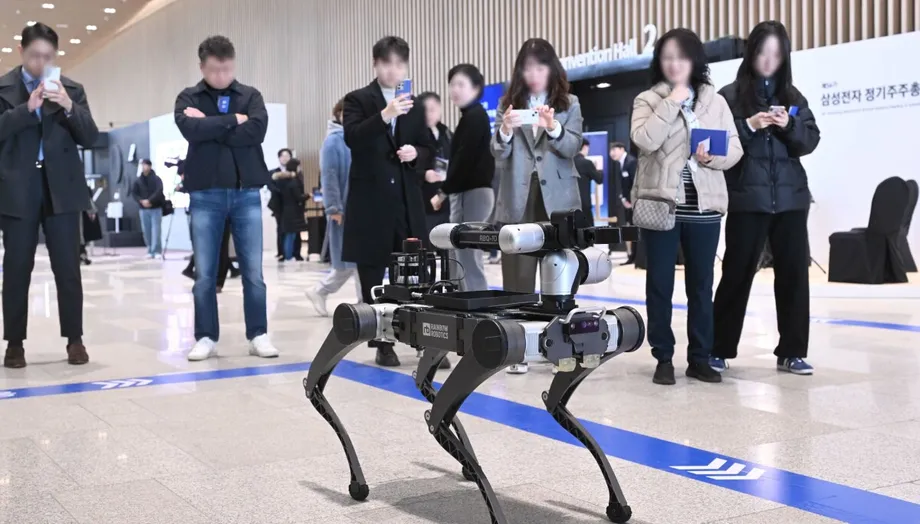
Samsung's 35% holding makes it Rainbow Robotics' largest shareholder. The relationship gives Samsung access to a company whose work includes robots with two arms, autonomous mobile robots, robots that walk on four legs and humanoid technology.
Rainbow Robotics was founded in 2011 by researchers associated with KAIST's humanoid program, including developers of HUBO, South Korea's first humanoid that walked on two legs. Oh's continued role connects that engineering experience with Samsung's commercialization effort.
Other Samsung companies could contribute components for future humanoids. The proposed combination includes solid state batteries from Samsung SDI, cameras and sensors from Samsung Electro-Mechanics, AI semiconductors from Samsung Electronics' Device Solutions division and OLED panels from Samsung Display.
Each component serves a different need. Batteries supply energy, sensors help a robot perceive its surroundings, chips process information, and displays can support communication with people. Samsung is considering how to combine those capabilities alongside outside partnerships and further acquisitions or investments.
The group has also outlined an investment plan of about 60 trillion won to develop a physical AI cluster in the Yeongnam region. That broader regional plan provides context for the robotics push; no individual allocation for the humanoid under development has been announced.
A growing market with a demanding commercial test
IDC figures put global humanoid shipments at approximately 25,000 units in the first half of 2026, up 432.1% from the same period a year earlier. Market value exceeded $740 million, an increase of 322.7%.
Those 25,000 shipments already exceeded the previous full year's approximately 18,500 units by 6,500, or about 35%. The comparison helps explain the urgency among manufacturers seeking a position in the market.
Longer term forecasts are much larger. Goldman Sachs projects a global humanoid market worth $138 billion by 2035. Morgan Stanley forecasts a market exceeding $5 trillion by 2050 and more than 1 billion humanoids operating worldwide. The projections describe different future dates, with the later estimate assuming many more years of adoption.
Han Jae-gwon, a professor in Hanyang University's Department of Robotics Engineering, said Samsung's participation could expand the industry while bringing tougher competition.
It is a welcome signal that a giant enterprise like Samsung is fully entering the robotics industry, as it means the market pie is growing, but it also implies that competition will be equally fierce.
Chris Hauser, head of Samsung's RX Robotics Lab, has acknowledged the company's competitive position and the work needed to improve it. Speaking at Samsung AI Forum 2026, he set out its ambition directly.
Although our current technology is lagging, our goal is to quickly catch up with and overtake our competitors.
Samsung's next public milestone is the decision on CES. Beyond that presentation, its commercial progress will depend on robots carrying out useful factory work at a cost customers can justify. The combination of hands, control software and training data will determine how quickly that ambition becomes a product.
Key Points
- Lee Jae-yong visited Samsung's RX robotics office in Seoul on October 27, 2026.
- A humanoid unveiling at CES in January 2027 depends on meeting Samsung's readiness standards.
- Samsung plans to test robots in its factories before expanding to other businesses and consumers.
- The company is developing robotic hands, building a training data operation in Gumi and expanding research infrastructure.
- Rainbow Robotics and other Samsung affiliates could supply key technologies and components.
- Samsung aims to convert its domestic and overseas factories into AI autonomous facilities by 2030.