A larger budget faces a test of lasting returns
Timor-Leste's proposed 2027 state budget totals US$2.5685 billion, while La'o Hamutuk warns that continued reliance on petroleum savings, proposed borrowing authority of up to $1.6 billion and heavy commitments to oil and gas projects could strain public finances for years.
Contents
- A larger budget faces a test of lasting returns
- What changed between June and October?
- Petroleum savings still carry the state
- Borrowing plans add another commitment
- Gas projects command large allocations
- Infrastructure needs money and delivery capacity
- Farmers and local businesses face two gaps
- Growth and taxes must reach households
- Public scrutiny before the final vote
- Key Points
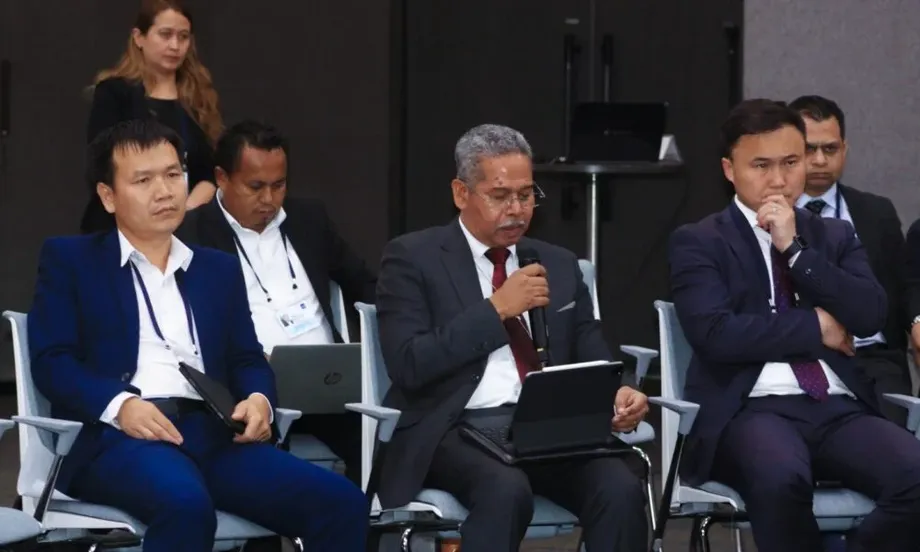
The warning, presented by the organisation's coordinator, Jonatan Gonçalves, at a press conference described on October 27, 2026, follows the government's formal submission of the budget to Parliament on October 1. Lawmakers must now examine how spending will support jobs, food production and essential services while protecting the country's main financial reserve.
The Ministry of Finance had proposed a $2.1 billion spending ceiling in June. The October submission is $468.5 million, or approximately 22.3%, higher than that earlier ceiling. This increase puts the government's stated commitment to fiscal discipline alongside a substantially larger spending proposal.
La'o Hamutuk also identifies conflicting Petroleum Fund withdrawal projections in two budget documents. It is asking the government to reconcile those figures, publish complete information early enough for public scrutiny and explain the expected returns from major investments before Parliament approves them.
The government says its proposal supports economic diversification, public services and institutional reform. Its October announcement allocates $756.6 million to human capital and public services, including education, health, social protection and skills development. The central issue for the budget debate is how those commitments, infrastructure projects and petroleum investments fit within resources the country can sustain.
What changed between June and October?
The Ministry of Finance's Budget Strategy Statement, published in June 2026, proposed a $2.1 billion consolidated ceiling, 10.5% below the rectified 2026 budget of $2.3458 billion. A rectified budget is an existing annual budget revised during the year.
The June plan comprised a baseline of $1.9435 billion and $156.5 million available for new policy priorities. It projected reductions in goods and services spending to $396.9 million and capital and development spending to $377.4 million.
The government's October budget submission announcement instead gives a consolidated Administrative Public Sector total of $2.5685 billion. Its framework lists approximately $1.99 billion in forward estimates, $197.3 million in baseline adjustments and $380.5 million for government policy priorities. Forward estimates project the future cost of continuing existing policies.
Gonçalves describes proposed total spending as rising by up to 12% against the 2026 budget. The ministry's June strategy envisaged a 10.5% reduction against the rectified 2026 budget. Those comparisons use different budget stages and reference points. Parliament's examination will need to explain the movement from June's proposed restraint to October's larger submission.
Salaries show another change. La'o Hamutuk puts the proposed wage bill at $523 million, compared with about $487 million in 2026, an increase of roughly 7.4%. The June strategy had set a 2027 baseline of $482.1 million, against $486.3 million in the rectified 2026 budget.
Petroleum savings still carry the state
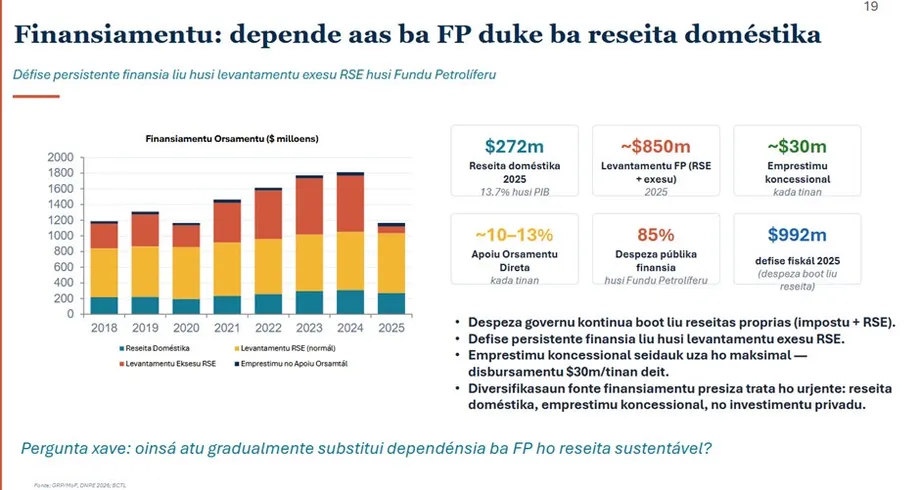
Petroleum Fund financing accounted for approximately 72% of the approved 2026 budget, according to the Finance Ministry. La'o Hamutuk's July budget statement says petroleum revenues stopped arriving in June 2025 after production ended at Bayu-Undan, the country's only active field.
The fund holds accumulated petroleum wealth in investments. Withdrawals allow the government to keep spending after production ends, but repeated withdrawals beyond sustainable income reduce the savings available to support future budgets.
The June strategy projects domestic revenue of $290 million in 2027. Against its own $2.1 billion ceiling, that would cover only about 13.8% of spending. It also projects $533.7 million in Estimated Sustainable Income, or ESI, the benchmark for how much petroleum wealth can support annual spending while preserving wealth over time.
Even under that lower ceiling, the ministry projected $1.1551 billion in withdrawals above ESI. Its forecast fiscal deficit was 59.9% of economic output outside the petroleum sector, illustrating the distance between expenditure and income generated domestically.
The ministry's strategy projects potential fund depletion by 2038 under current policy assumptions. An explanatory memorandum accompanying a public debt amendment proposal cited in October's Petroleum Fund strategy review used a 2037 estimate, while La'o Hamutuk's July statement warned that the fund could be empty within ten years. Future spending, investment returns and domestic revenue will shape how long the reserve lasts.
Borrowing plans add another commitment
Article 5 of the proposed 2027 budget law would authorise public borrowing of up to $1.6 billion for infrastructure, petroleum and gas activities, and other development purposes, according to La'o Hamutuk. Gonçalves warns that large loans extending over many years could leave future generations with repayments if investments fail to generate clear economic returns.
The June strategy discussed maintaining a borrowing ceiling of $850 million in 2027 and projected $45 million in loan financing for that year. A borrowing ceiling sets the permitted limit for commitments, while annual loan financing concerns money expected to be received during the budget year. Parliament needs to examine both the size of the proposed authority and the schedule of future payments.
The ministry argues that carefully managed borrowing could spread expenditure over time and reduce immediate pressure on Petroleum Fund withdrawals. It puts existing concessional debt at approximately $800 million. Concessional loans generally provide more favourable terms than ordinary commercial borrowing, but still require repayment.
La'o Hamutuk wants lawmakers to assess repayment capacity, financing costs, risks and expected economic and social benefits. Its recommendation connects borrowing decisions directly to project quality: an investment should help generate income, improve services or lower future costs enough to justify the financial commitment.
Gas projects command large allocations
The proposed Ministry of Petroleum and Mineral Resources allocations include $193.5 million for Greater Sunrise negotiations and development studies, alongside $38.35 million for a technical study of a pipeline to Natarbora, according to La'o Hamutuk. Together, those two proposed allocations total $231.85 million.
The organisation also identifies proposed spending on Bayu-Undan studies, Tasi Mane and other petroleum activities. It is calling for independent assessments and publication of feasibility studies, total costs, financing sources, investors, expected returns, and social and environmental risks before major public commitments.
La'o Hamutuk challenges the balance within the $492 million investment grouping described as the blue economy. It says nearly 55% goes to petroleum and gas, while the specific blue economy programme receives only 3%. The organisation argues that petroleum activities fall outside the blue economy definition it applies.
Those shares correspond to approximately $270.6 million for petroleum and gas and $14.8 million for the specific programme, using the organisation's rounded percentages. The allocation matters because fisheries and other activities based on marine resources compete for funding within a policy area presented as a route to diversification.
The June strategy also records sharply different spending progress among petroleum programmes. By June 16, 2026, Greater Sunrise development had spent $173.5 million of a revised $231.4 million allocation, or 75%. Tasi Mane had spent $1.2 million against $63.7 million, or 2%.
Infrastructure needs money and delivery capacity
The proposed Infrastructure Fund allocation is $327 million for 2027, followed by a projection of $1.807 billion for 2028, according to La'o Hamutuk. That is an increase of $1.48 billion, with the projected 2028 amount more than five times the proposed 2027 allocation.
The Finance Ministry's own execution figures show the challenge of converting allocations into completed work. Capital and development spending averaged an execution rate of 56% between 2021 and 2025. In practical terms, only a little over half of the money allocated in that category was spent on average.
The strategy identifies weaknesses in project preparation, procurement, implementation planning and contract management. La'o Hamutuk therefore wants large allocations matched by the institutional capacity to plan, deliver and monitor projects transparently.
The October submission sets aside $414.6 million for infrastructure and basic services, $171.6 million for municipal and territorial development, and approximately $277.9 million for territorial capital investment covering 1,643 projects. These are different budget groupings, with the territorial projects including work managed by the Ministry of Public Works.
Citizens consulted for the budget gave infrastructure a high priority: 60.3% selected it as the development pillar needing greatest attention. Within infrastructure, 69.5% prioritised roads and bridges, followed by water supply and sanitation. La'o Hamutuk's July statement calls for attention to maintenance and usefulness, including rural roads, domestic maritime transport, schools and clinics outside Dili.
Farmers and local businesses face two gaps
Agriculture receives only 2.1% of the proposed budget, according to La'o Hamutuk, which also describes climate response funding as limited. The organisation wants more investment in local food production, irrigation, water management, agricultural research and support for farmers.
The ministry's June figures show that allocations alone are part of the problem. By June 16, the agriculture, horticulture, coffee and crops programme had spent $3.8 million of its revised $27.4 million allocation, an execution rate of 14%. Fisheries recorded 18%, livestock 9% and tourism 20%.
Private financing is also scarce in productive sectors. The ministry records only $1.4 million in outstanding agricultural loans and $6.4 million in manufacturing loans. Together with weak public spending execution, those figures show why efforts to expand local production need both financing and the capacity to put resources to work.
La'o Hamutuk cites a goods trade deficit exceeding $900 million in 2025. The ministry separately records a current account deficit of $733.6 million, financed through Petroleum Fund withdrawals. The current account covers goods, services and income flows, making it a broader measure than the trade balance for goods alone.
Imported food and other essentials expose households to price increases abroad. La'o Hamutuk points to COVID-19 and the Middle East conflict in 2026 as examples of external disruption affecting the country. Its proposed response is practical: increase domestic production and strengthen the systems that help farmers bring food to market.
Growth and taxes must reach households
The government projects growth outside the petroleum sector of 4.6% in 2027 and average annual inflation of 1.8%. La'o Hamutuk also cites a growth projection of 4.3% for 2026, but wants budget performance judged through employment, private sector productivity, poverty and household purchasing power as well as output.
Gonçalves cites unemployment estimates of 1.6% to 1.8% for 2025 alongside labour force participation of only 30.5%. The unemployment rate measures people without work who are seeking and available for it. Participation measures the share of the working age population either employed or actively seeking work, so low participation can sit alongside limited job opportunities.
The organisation says informal work is widespread and formal employment remains limited, particularly for young people. Its July statement calls for education and technical training linked to jobs in agriculture, fisheries, tourism, digital technology and local businesses.
The Finance Ministry plans to introduce value added tax, or VAT, in 2027 to broaden the revenue base. VAT is a tax on consumption collected through businesses. The strategy estimates initial revenue gains of between 1% and 1.5% of GDP, depending on compliance and administrative capacity.
La'o Hamutuk supports stronger domestic revenue collection but wants the effects of VAT and selective taxes on vulnerable households assessed before implementation. It calls for measures protecting access to nutritious food and basic necessities, so that revenue reform and household welfare are considered together.
Public scrutiny before the final vote
Gonçalves acknowledges that the government held consultations across all municipalities and organised a Budget Day workshop. He nevertheless calls for a stronger process in which people receive consistent documents early enough to analyse them and see how their contributions affect decisions.
The June strategy records 1,214 citizen respondents and 40 representatives from social partner organisations. Among citizen respondents, 72.7% were men, 22.9% women and 4.4% did not disclose their gender. Persons with disabilities represented 4.5%.
La'o Hamutuk identifies a discrepancy between Petroleum Fund withdrawal projections in Table 60 of the Budget Report Book and Table 5 of the Informative Elements Book, Volume I. The government needs to explain and reconcile those figures so that Parliament and the public can assess the planned use of savings.
The organisation also calls for publication of contracts, transparent procurement, independent audits and effective supervision by Parliament, the Court of Accounts and the Anti-Corruption Commission. Accessible documents in Tetum would help more citizens follow the choices being made.
The budget process has passed several milestones:
- June 2025: Bayu-Undan production ended and petroleum revenues stopped, according to La'o Hamutuk.
- June 2026: The Finance Ministry published its strategy proposing a $2.1 billion spending ceiling for 2027.
- July 9, 2026: La'o Hamutuk called for budgeting centred on results, local production and public oversight.
- October 1, 2026: The government submitted its $2.5685 billion proposal to Parliament.
- October 27, 2026: Gonçalves presented concerns over fiscal risks, allocations and transparency.
The proposal now faces parliamentary analysis and discussion under the applicable legal procedures. No date for final approval was given in the government's submission announcement. La'o Hamutuk's seven recommendations cover transparency, Petroleum Fund sustainability, borrowing scrutiny, independent project assessment, fair taxation, food and climate security, and investment in diversified employment.
Key Points
- The government submitted a $2.5685 billion budget proposal, $468.5 million above June's proposed ceiling.
- La'o Hamutuk wants scrutiny of borrowing authority of up to $1.6 billion and major petroleum investments.
- The Finance Ministry projects possible Petroleum Fund depletion by 2038 under current policy assumptions.
- Agriculture receives 2.1% of the proposal, according to La'o Hamutuk, while productive sectors also face weak spending execution.
- The government plans VAT in 2027; La'o Hamutuk seeks protection for vulnerable households.
- Parliament must assess the proposal while the organisation presses for consistent figures, published project studies and meaningful public participation.