
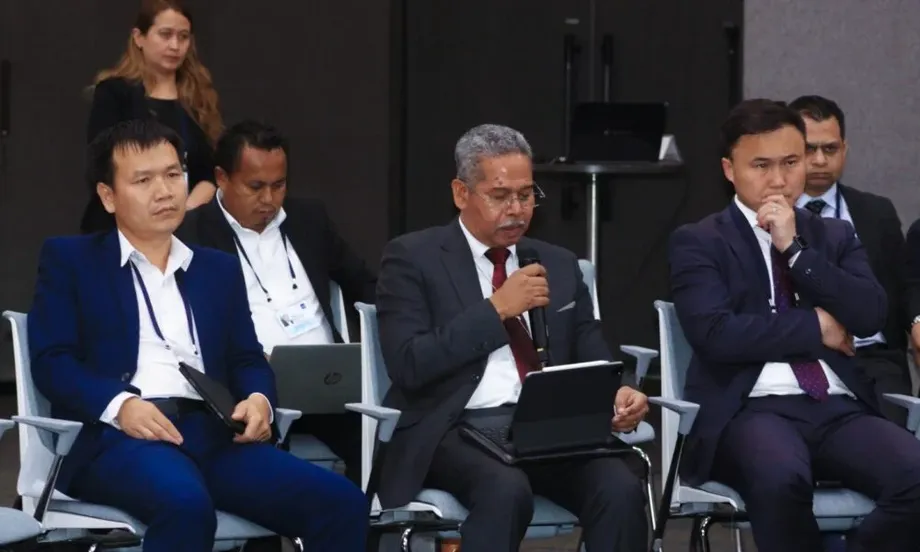
A larger stake, with the price still undisclosed
Timor Gap has signed a binding agreement to acquire Osaka Gas Australia's 10% interest in Greater Sunrise, a transaction that would increase Timor-Leste's national oil company's holding from 56.56% to 66.56%. The agreement, announced on 2 September 2026, would leave Woodside Energy with the remaining 33.44%, but completion still requires government and regulatory approvals.
Contents
- A larger stake, with the price still undisclosed
- What the agreement covers
- The resource is large, but development is not approved
- Timor Gap wants progress on the Timor LNG concept
- Financing concerns extend beyond the purchase price
- The earlier Petroleum Fund loan remains part of the exposure
- Earlier talks with China show the search for partners
- The decisions and dates still to watch
- Key Points
The purchase price has not been disclosed. Timor Gap President and Executive Director Rui Maria Alves Soares said the agreement had been submitted to the Australian and Timor-Leste governments for approval. On 24 September, Timor-Leste's Minister of Petroleum and Mineral Resources said the price could not yet be made public and acknowledged that the larger stake would increase the state's financing needs.
The acquisition strengthens Timor Gap's position as it seeks to bring Greater Sunrise gas to Timor-Leste for processing. It also increases the country's exposure to the cost of developing a resource estimated to contain 5.13 trillion cubic feet of gas and 225.9 million barrels of condensate.
That tradeoff is central to a transparency request issued by La'o Hamutuk on 29 September. The civil society organization wants the government and Timor Gap to disclose the acquisition cost, financing arrangements and risks to public assets. Its concern is that a greater ownership share carries greater spending obligations before any gas revenue reaches the state.
Osaka Gas is selling as it shifts its focus to other activities. Its departure does not establish that Greater Sunrise is commercially unworkable, just as Timor Gap's purchase does not establish that development will deliver a profitable return. The agreement changes the ownership structure. It does not yet settle the project's financing, processing location or investment decision.
What the agreement covers
The transaction covers Osaka Gas Australia's interests in two existing production sharing contracts, PSC 03-19 and PSC 03-20, and two Australian retention leases, NT/RL2 and NT/RL4. These interests are awaiting the finalization of a single production sharing contract under the Maritime Boundaries Treaty between Timor-Leste and Australia.
A production sharing contract sets the terms under which petroleum companies develop resources and share production with the relevant government. The planned single contract matters because the acquisition spans interests held under several existing legal instruments. Buying the stake and completing the project's contractual framework are separate steps.
The precise ownership figure after completion is 66.56% for Timor Gap. One report gives 66.5%, while retaining Woodside's 33.44% share. Those figures do not total 100%; the 66.56% figure in the announcement does. The acquisition adds 10 percentage points to Timor Gap's holding, equivalent to an increase of about 17.7% relative to its existing 56.56% interest.
Timor Gap would therefore hold roughly two thirds of the venture. Woodside, the designated operator, would remain a substantial partner. A larger participating interest does not by itself resolve the technical and commercial choices required to develop the fields.
The resource is large, but development is not approved
Greater Sunrise consists of the Sunrise and Troubadour gas and condensate fields, discovered in 1974. Reports place the fields about 450 kilometers northwest of Darwin. Their position relative to Timor-Leste is described differently: approximately 140 kilometers south in one account and 150 kilometers southeast in another.
The estimated gas resource is consistently given as 5.13 trillion cubic feet. Condensate estimates are stated as 225.9 million barrels in the acquisition announcement and 226 million barrels in another account, a rounding difference. Condensate is a liquid hydrocarbon recovered alongside natural gas and can provide a separate source of sales revenue.
These quantities are described as contingent resources. That means they are discovered resources whose commercial development still depends on conditions being met. They should not be read as a guarantee of production or future earnings.
One September 2026 report gives an expected production window of 2028 to 2030. The binding purchase agreement, however, remains subject to approvals, and the partners are still working toward a development concept and final investment decision. The production window is therefore an expectation, not a confirmed start date.
A final investment decision is the point at which the project participants formally commit to development spending. For Greater Sunrise, the ownership transaction is a step toward that decision, rather than the decision itself.
Timor Gap wants progress on the Timor LNG concept
Timor Gap says the acquisition should help advance pending work toward selecting the Timor LNG development concept. The government's objective is to bring the gas by pipeline to Timor-Leste, where a new liquefied natural gas plant would process it for export. LNG is natural gas cooled into liquid form so it can be transported by ship.
Soares, Timor Gap's chief executive, also said the purchase could improve cooperation among the remaining partners. Describing the expected effect on the Sunrise Joint Venture, he said:
We also expect this acquisition to improve alignment within the Sunrise Joint Venture, enabling the joint venture partners to work together more effectively towards a final investment decision that will unlock the value of the Greater Sunrise resource for the benefit of the people of Timor-Leste, the Sunrise Joint Venture members, and all other stakeholders.
The statement sets out Timor Gap's expectation, not a commitment by all parties to a particular processing route. The central development dispute has been whether to build a new LNG plant in Timor-Leste or send the gas to the existing LNG hub in Darwin.
Wood Australia, part of the UK engineering group Wood, was commissioned in April 2024 to conduct a concept study for the fields. Wood Australia is distinct from Woodside Energy, the project's operator and remaining equity partner. The acquisition accounts do not establish that a final development concept has since been selected.
Financing concerns extend beyond the purchase price
La'o Hamutuk's request for disclosure reaches beyond the undisclosed payment to Osaka Gas. The organization wants information about where the acquisition money will come from, how financing will be structured, what future investment obligations will arise and who will bear the risk if development costs increase.
Its estimate is that the additional interest could raise Timor Gap's Greater Sunrise capital expenditure obligations from about US$7.4 billion to US$8.7 billion. That is an increase of US$1.3 billion, or approximately 17.6%. The percentage is close to the 17.7% relative increase in Timor Gap's ownership share.
Those figures are La'o Hamutuk's estimates, not a disclosed project budget or an approved financing package. They concern potential development spending, which is separate from the purchase price. Without publication of the transaction terms and the assumptions behind development costs, the total additional financial commitment cannot be established.
The Minister of Petroleum and Mineral Resources acknowledged on 24 September that increasing the state's participation would increase its financing needs. No amount or financing source was disclosed in that statement.
La'o Hamutuk also argues that money and institutional capacity committed to Greater Sunrise must be assessed against other public priorities. It names agriculture, fisheries, local industry, food production, renewable energy, infrastructure, education, health and youth employment. This is a question of competing uses for public resources, not evidence that any particular program has already lost funding because of the acquisition.
The earlier Petroleum Fund loan remains part of the exposure
The new purchase follows Timor Gap's acquisition of Greater Sunrise interests from Shell and ConocoPhillips using a US$650 million Petroleum Fund loan in 2018. La'o Hamutuk cites that borrowing as a reason to examine the latest transaction alongside existing obligations rather than in isolation.
According to the organization, the original loan arrangement requires Timor Gap to begin repayments exceeding US$120 million annually in 2028. A proposal would postpone the initial repayment to 2033 and extend the loan's end date from 2037 to 2042. The reported changes are a proposal, not a confirmed revision.
The proposed delay would move both dates back by five years. It would also change the relationship between debt repayment and the reported 2028 to 2030 production window. Whether project income could support repayments would depend on when production actually starts, development costs, sales arrangements and the terms of the financing.
La'o Hamutuk says Timor Gap and Woodside have written the investment down to zero, while Banco Central de Timor-Leste has recorded a 39% write down. These are different reported accounting treatments. They cannot be combined into a single valuation without knowing what each institution assessed and the assumptions it used.
A write down reduces an asset's recorded accounting value. It is not, on its own, proof that the resource has no possible future value. It nevertheless makes the basis for new public spending especially relevant: a decision to buy more equity needs to be assessed separately from past expenditure and past expectations.
Earlier talks with China show the search for partners
The ownership agreement comes after Timor-Leste explored other possible development partnerships. In October 2024, President Jose Ramos-Horta said the country had held discussions with private and state owned Chinese entities. Some representatives had visited as part of a Chinese business delegation.
Asked about Sinopec, the Chinese energy company, Ramos-Horta said:
Sinopec has been in touch.
Sinopec did not comment on those discussions. Ramos-Horta also said Timor-Leste could approach Chinese or Kuwaiti partners if agreement with Australia was not reached. Those statements described possible partnerships, not a completed investment or a confirmed role in Greater Sunrise.
The pressure to develop another source of petroleum income had increased after Bayu Undan ceased gas exports in 2023, according to the October 2024 account. That account also cited a US$65 billion revenue estimate for Greater Sunrise dating from 2018. The figure is a historical estimate, not a current valuation or a promise of money available to the government.
The distinction matters because an estimated resource, projected revenue and public income are different measures. Development requires infrastructure and financing before gas can be sold. The amount eventually received by the state would depend on costs, commercial arrangements and the governing contracts.
The decisions and dates still to watch
The next confirmed step for the Osaka Gas transaction is securing the necessary government and regulatory approvals and meeting the agreement's other completion conditions. No approval deadline or completion date is stated. The purchase price and financing arrangements also remain undisclosed.
The project's wider sequence includes several separate decisions: finalizing the single production sharing contract, selecting a development concept, arranging finance and reaching a final investment decision. The acquisition announcement does not establish that these steps have been completed.
The key dates show how the new agreement sits alongside earlier borrowing, development discussions and future obligations:
- 2018: Timor Gap used a US$650 million Petroleum Fund loan to acquire interests from Shell and ConocoPhillips.
- April 2024: Wood Australia was commissioned to conduct a Greater Sunrise concept study.
- October 2024: Ramos-Horta described discussions with Chinese companies and possible approaches to other partners.
- 2 September 2026: Timor Gap announced the binding agreement to buy Osaka Gas Australia's 10% interest.
- 24 September 2026: The petroleum minister said the price could not yet be disclosed and that state financing needs would increase.
- 29 September 2026: La'o Hamutuk called for disclosure and scrutiny of the transaction.
- 2028: Repayments on the earlier loan are scheduled to begin under the original arrangement.
- 2028 to 2030: One report gives this expected production window, without a confirmed development commitment.
La'o Hamutuk has asked parliament and oversight institutions to examine the purchase price, funding structure, future investment obligations and economic assessment. It has also urged publication of documents that can legally be disclosed. Until those details are available, the ownership increase is measurable, but its full cost and prospective public return are not.
Key Points
- Timor Gap has agreed to buy Osaka Gas Australia's 10% Greater Sunrise interest, subject to approvals and other completion conditions.
- Its stake would rise from 56.56% to 66.56%, with Woodside retaining 33.44%.
- The purchase price and financing arrangements have not been disclosed.
- Greater Sunrise holds estimated contingent resources of 5.13 trillion cubic feet of gas and 225.9 million barrels of condensate.
- Timor Gap wants the acquisition to support selection of the Timor LNG concept, but a final investment decision is still pending.
- La'o Hamutuk estimates potential capital expenditure obligations could increase from about US$7.4 billion to US$8.7 billion.
- The earlier US$650 million Petroleum Fund loan has repayments scheduled from 2028; a proposed deferral has not been confirmed.