
A vast industrial plan, just 16 factories in production
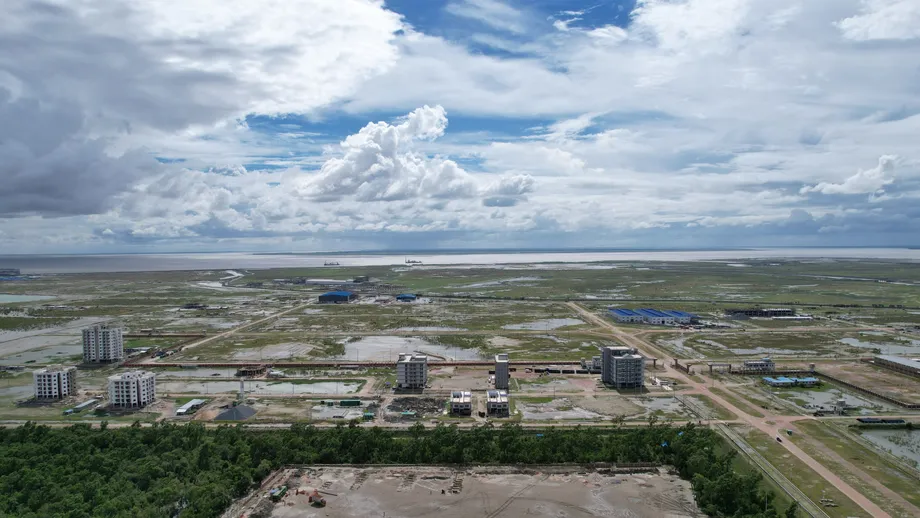
Bangladesh's National Special Economic Zone has developed just 5,500 acres of a planned 33,804.76 acres, while direct employment stands at about 8,000 against a target of 238,000 by 2026. Figures attributed to the Bangladesh Economic Zones Authority (BEZA) as of 8 September 2026 show 16 enterprises in commercial production and another 15 under construction, despite 134 plots having been allocated.
Contents
- A vast industrial plan, just 16 factories in production
- The targets do not all tell the same story
- Land allocations have outrun usable plots
- Water and energy remain operating constraints
- Housing and safety affect recruitment
- An online portal has not removed separate approvals
- A master developer would take broader responsibility
- Jetty plans seek to turn the coastline into an advantage
- Rancon's lease puts delivery deadlines in writing
- The next milestones are practical, not just financial
- Key Points
The project, stretching across coastal parts of Chattogram and Feni, was intended to become the country's largest industrial hub. A decade into that effort, investors describe a more basic challenge: obtaining land that is ready to build on, dependable water and energy supplies, and somewhere safe for workers to live.
A new commitment offers a test of whether that can change. On 5 October 2026, Rancon Lubricants signed a lease for 6.5 acres of developed land, promising a $19.65 million blending plant and more than 250 jobs. Its agreement sets deadlines for land handover, construction and production. Those milestones matter because the zone's central problem has been converting allocations into functioning factories.
The scale of the gap needs careful interpretation. BEZA's NSEZ master plan divides the estate into 12 precincts, including housing, logistics, open space and public services. The entire site was never meant to be covered with factories. Even so, the developed area amounts to only about 16.3% of the master plan footprint, and investors say essential services remain incomplete within the areas intended for industry.
The targets do not all tell the same story
The September figures put domestic investment at Tk12,815 crore and foreign direct investment at $147 million. A crore equals 10 million, making the domestic total Tk128.15 billion. These amounts cannot be combined into a dollar total without an exchange rate and a common accounting basis, so they do not establish precisely how much of the $5.5 billion investment target for 2026 has been achieved.
The employment comparison is more straightforward: about 8,000 direct jobs represent roughly 3.4% of the 238,000 target for 2026. Earlier stakeholder projections suggested investment could exceed $19 billion by the end of the decade, but that was an expectation, not money already invested.
Export targets differ between accounts. BEZA's master plan states a $15 billion export ambition, while reports describing the project's initial plans cite $40 billion by 2030. The reported export total so far is $47.2 million. The figures establish a substantial gap, but the reports do not clarify whether all the export targets and results use the same annual or cumulative basis.
Factory counts also conflict. An April 2026 account of a proposed jetty, citing BEZA, described at least 20 industries producing and at least 30 under construction. The September figures instead list 16 in commercial production and 15 under construction. There is no explanation of whether the counts cover different parts of the zone or apply different definitions, so they cannot reliably be read as evidence that factories closed.
Land allocations have outrun usable plots
The garment park illustrates the distance between an agreement and an operational site. BEZA's master plan records about 500 acres allotted to the Bangladesh Garment Manufacturers and Exporters Association (BGMEA), with a contractor appointed to develop the park. It describes an intended $2 billion investment and 500,000 jobs. Those are planned outcomes, not current achievements.
Some of that land has still not been demarcated or formally handed over. Former BGMEA vice president Rakibul Alam Chowdhury says investors have paid for land and met the requirements but remain unable to proceed. His account identifies plot handover, roads and electricity as the conditions needed before entrepreneurs can consider starting work.
Other allocations are at different stages. An account of the proposed Green Factory Hub said BEZA had taken possession of approximately 17,500 acres. It described Bashundhara as nearing completion of three factories, PHP Group as having taken possession of its land, and BSRM as beginning land filling. Possession, development and production are separate milestones, and none should be treated as interchangeable.
The allocation figures themselves vary. BEZA's master plan lists 1,150 acres for the Bangladesh Export Processing Zones Authority (BEPZA), while another account gives 1,138 acres. The authority cancelled the SBG Economic Zone consortium's 500 acre lease for failing to begin development, and a proposed 900 acre Indian Economic Zone remained stalled. These cases show why allocated acreage alone is a weak measure of industrial progress.
Water and energy remain operating constraints
For factories that have already invested, the challenge is keeping production viable. Modern Syntex invested about Tk1,700 crore. Its senior general manager, Safal Barua, says uninterrupted electricity, water and gas are essential to running a project of that scale profitably. He also says factories remain heavily dependent on groundwater.
BEZA says 15 of 38 planned water pump houses are operational, about 39% of the planned total. A treatment plant is under construction, with its first phase scheduled for completion by March 2027. That phase is intended to supply 50 million litres a day; a second phase would add another 50 million litres. No completion date is given for the second phase.
Electricity figures show substantial installed infrastructure, but they do not settle the reliability question. BEZA reports 2,280 megavolt amperes of transformer capacity across the zone. In the Rural Electrification service area, connected load is about 230 megawatts, against peak demand of around 60 megawatts.
Megavolt amperes measure electrical equipment capacity, while megawatts measure real power. The two cannot be directly equated without further technical information. Connected load also does not prove that every factory receives uninterrupted electricity. Investors' complaints concern dependable supply at the plant, rather than the presence of transformers alone.
Karnaphuli Gas Distribution Company has installed three stations supplying about 4 million cubic feet daily. The master plan describes arrangements intended to supply 200 million cubic feet daily to future industrial customers. Current reported delivery is one fiftieth of that planned provision, although this is not a measure of unmet demand today. As more factories open, both the gas network and the national supply will need to support them.
Housing and safety affect recruitment
The zone's coastal location is part of its commercial appeal, but it also creates daily operating difficulties. Investors describe factories as being 20 to 25 kilometres from the main highway. SQ Electricals, which has invested around Tk400 crore, reports problems recruiting workers.
Ehsanul Kabir Nizami, an official in the company's human resources department, says the area becomes quiet and dark at night, leaving workers uncomfortable and concerned about safety. This is a recruitment problem as well as a security issue: factories need employees who can reach work and return home safely.
Affordable worker housing is under construction in Sub-zone 18. Chattogram Chamber of Commerce and Industry president Amirul Haq says suitable accommodation and social facilities are still lacking nearby. He argues that housing must develop alongside dependable gas, electricity and water if the zone is to attract investment.
The master plan reserves 4,606.57 acres for residential and support amenities and another 1,778.59 acres for mixed use and residential development. These allocations show that worker accommodation and urban services were part of the original design, rather than needs that emerged unexpectedly after factories arrived.
Several support buildings are approaching completion but are not yet finished. BEZA puts construction of the Skill Development Centre and Childcare Centre at 87%, the Environmental Laboratory at 94%, and the Emergency Response Centre at 72%. Construction percentages do not establish when these facilities will be staffed and operational.
Invest Bangladesh chairman Ashik Chowdhury expects security to improve within one to two months and says digital surveillance is being planned. The reporting gives no fixed date from which to calculate that period. A planned hospital has made little progress, and authorities are considering converting existing buildings into healthcare facilities instead.
An online portal has not removed separate approvals
Investors also describe having to approach multiple government bodies for environmental clearance, fire safety approvals, trade licences and other permissions. Nizami argues that the approval service needs to become easier and more effective, despite the existence of BEZA's online portal.
BEZA says its One Stop Service portal provides 62 services online. Integration with the National Board of Revenue's National Single Window is nearly complete, while integration with the Department of Environment's system remains underway. A single window is intended to let businesses submit information through one entry point rather than repeat the process across separate agencies.
The distinction is between making a service available online and completing an approval through a coordinated process. The number of portal services does not, by itself, establish that investors no longer need separate contacts or submissions.
The agency structure has also changed. Reports describe Invest Bangladesh as having begun operations on 23 August 2026 under the Invest Bangladesh Act, 2026, merging BEZA, the Bangladesh Investment Development Authority and the Public Private Partnership Authority. That consolidation brings investment functions under one institution, but the unfinished portal connections show that coordination with other regulators remains a separate task.
A master developer would take broader responsibility
BEZA has proposed allocating 500 acres to an international master developer for a Green Factory Hub under a public private partnership. Rather than simply leasing individual plots, the developer would handle land development, facilities, utilities and plot allocation to investors.
Abdullah Al Mahmud Faruk, project director of the NSEZ Development Project, described the change in approach:
We have moved beyond allocating small plots. Our focus now is on developing larger zones with full infrastructure.
The government owned Infrastructure Investment Facilitation Company was expected to conduct a feasibility study before international tenders. Selection and allocation were expected to take around two years. Faruk also expressed hope that about 1,500 acres would be ready for industrial use within two years, but the account gives no firm calendar deadline.
The proposal addresses a recurring weakness: the investor who receives land may still have to wait for several agencies to deliver the services needed to use it. A master developer would take broader responsibility for preparing a complete industrial site. The model remains a proposal, however, and the feasibility study, tender and selection stages must precede delivery.
Jetty plans seek to turn the coastline into an advantage
The master plan describes a 25 kilometre coastline along the Sandwip Channel and places the zone about 70 kilometres from Chattogram Port and Shah Amanat International Airport. It includes a 1,802.29 acre port and logistics precinct and a planned 10 kilometre access road. Those are planned infrastructure features, not evidence that every connection is ready.
A jetty agreement between BEZA and the Bangladesh Inland Water Transport Authority (BIWTA) was scheduled for 9 April 2026. BEZA executive member Major General (retired) Md Nazrul Islam said BEZA would provide the land, while BIWTA would build and operate the jetty near the sea west of Mirsarai.
Shipping ministry secretary Nurunnahar Chowdhury said the land had been selected and tendering was underway. The jetty would support cargo movement by small vessels. Initial plans call for three jetties, one operated by BIWTA and two built through private investment, alongside a container terminal and connections by rail, road and sea.
These links could give factories more transport options, but no opening date is established in the reporting. The scheduled signing should not be treated as proof that an agreement was completed or that construction has finished.
Rancon's lease puts delivery deadlines in writing
Rancon Lubricants' October agreement provides a concrete investment commitment against this wider picture. The company plans an annual production capacity of 25 million litres, using imported raw materials to blend lubricants locally for the domestic market. Its business has marketed Shell lubricants for more than two decades and recently began marketing Motul.
Project coordinator and manager Al-Amin Talukder says the plant will include laboratory facilities and receive base oil by road and through pipelines from vessels. That plan makes dependable transport and utility connections relevant to the project from the outset.
The renewable lease runs for 50 years from possession. Land handover is scheduled within 90 days of signing. The more detailed account specifies that construction must begin within 120 days of receiving the land and production within 36 months of handover. Another account gives the construction period without making its starting point equally explicit.
Invest Bangladesh is to assist with utility connections and access to announced customs duty, VAT and tax incentives. Rancon must obtain approvals, meet environmental, labour and safety requirements, and install waste and sewage treatment facilities connected to the zone's common systems. The agreement provides for performance monitoring, time to correct breaches and arbitration under the Arbitration Act, 2001.
Nahian Rahman Rochi, identified in the October reporting as a member responsible for investment development, described it as Invest Bangladesh's first land lease after the merger. The $19.65 million remains a planned investment, not evidence that the plant is already built. Its promised jobs should likewise not be added to September's employment total.
The next milestones are practical, not just financial
The project now has several different clocks running. The dated developments and stated deadlines are:
- 9 April 2026: BEZA and BIWTA were scheduled to sign the jetty agreement.
- 23 August 2026: Invest Bangladesh reportedly began operations following the agency merger.
- 8 September 2026: the reported operational snapshot recorded 16 producing enterprises and about 8,000 direct jobs.
- 5 October 2026: Rancon signed its land lease, with handover due within 90 days.
- March 2027: the water treatment plant's first phase is scheduled for completion.
- After Rancon's land handover: construction is due within 120 days and production within 36 months.
Longer ambitions remain much larger. BEZA's master plan envisages 1.5 million jobs within 15 years, while former NSEZ consultant Abdul Kader Khan estimates up to 1.4 million direct jobs if the zone is fully equipped. Neither figure is a forecast of employment already secured.
Khan calls for coordinated development of internal roads, water distribution, gas pipelines and electricity grids. Chowdhury identifies an additional limit: Bangladesh's energy shortage is a national problem that cannot be solved by addressing one zone alone.
The next evidence of progress will therefore be physical and operational: plots handed over, water delivered, reliable energy connections, occupied worker housing and completed approvals. The zone retains major corporate commitments, including sizable landholdings by Bangladeshi and Chinese industrial groups. Turning that interest into production depends on delivering the services that those commitments require.
Key Points
- September 2026 figures record 16 enterprises in commercial production, 15 under construction and about 8,000 direct jobs.
- Only 5,500 acres have been developed, roughly 16.3% of the master plan area.
- Reported factory counts and export targets differ, without a clear explanation of their scope.
- Land handovers, utility reliability, housing, safety and separate approvals continue to restrict progress.
- The first water treatment phase is due by March 2027, with planned capacity of 50 million litres daily.
- A Green Factory Hub and three proposed jetties remain development initiatives, not completed facilities.
- Rancon's $19.65 million plant commitment includes deadlines for handover, construction and production.