
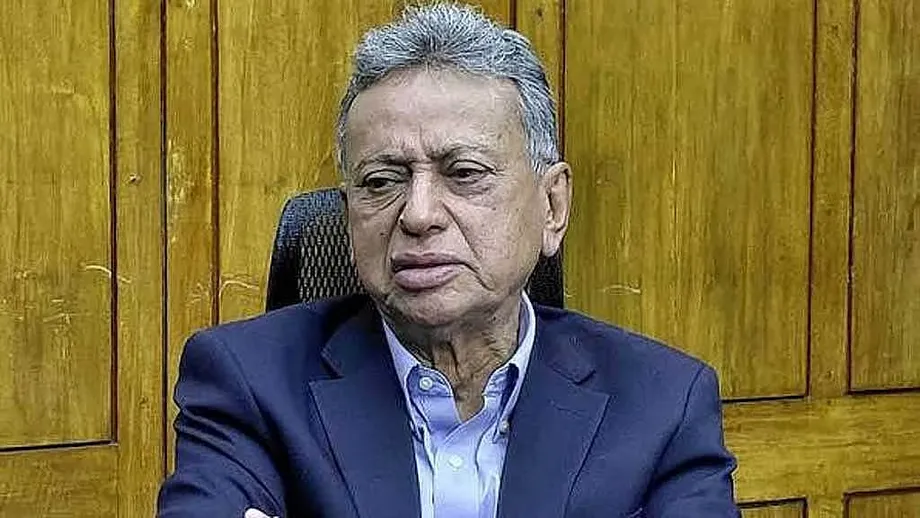
Cancellation claim leaves a new loan in doubt
Bangladesh has received $3.64 billion in five instalments under an International Monetary Fund loan programme expanded to $5.5 billion, according to Finance Division accounts. Now Finance Minister Amir Khosru Mahmud Chowdhury says he has cancelled that programme, even as officials prepare further negotiations for a replacement worth about $4 billion to $4.5 billion over three years.
Contents
- Cancellation claim leaves a new loan in doubt
- What the IMF has actually committed to
- How the government reached this point
- The figures and programme status do not fully agree
- Reforms remain at the centre of negotiations
- Energy costs and weak taxes constrain the options
- Banking changes affect more than the IMF loan
- Markets are the minister's alternative
- Investor confidence and the next decisions
- Key Points
The minister made his declaration on 4 October at the opening of World Investor Week 2026 at the Krishibid Institution auditorium in Dhaka. The event was jointly organised by the Bangladesh Securities and Exchange Commission (BSEC) and the International Organization of Securities Commissions (IOSCO).
Khosru said the government would turn to capital markets rather than accept conditions it considered unsuitable. He connected that decision to a target of making Bangladesh a $1 trillion economy by 2034.
"I have cancelled the IMF programme. You know that, you are seeing it. Their conditions are not acceptable to us. I want to raise my money from the market," he said.
Yet Finance Division officials say discussions with the IMF are continuing. Their explanation is that the minister meant leaving the old agreement, not abandoning the application for a new one. Other officials say even the existing arrangement remains active, with the stalled sixth instalment still potentially subject to review.
The distinction matters: a political decision to reject an existing programme is not the same as confirmed termination of that arrangement, withdrawal of a replacement request or approval of a new loan. None of those separate steps has been conclusively established by the minister's latest remarks.
What the IMF has actually committed to
The IMF confirmed on 3 June that Bangladesh had requested a replacement programme. Its statement did not announce a loan amount or approval of a financing package. It described further engagement on economic conditions, policy priorities and reforms.
Ivo Krznar, the IMF mission chief for Bangladesh, explained in that statement that a new arrangement would depend on the country's external financing requirements and its reform commitments.
"Any new arrangement would need to be based on Bangladesh’s balance-of-payments needs and strong policy commitments anchored by a credible reform agenda, and would be subject to the IMF’s policies and Executive Board approval," Krznar said.
Balance of payments refers to a country's transactions with the rest of the world, including trade, investment and borrowing. An IMF programme addresses financing pressures arising from those transactions. It is therefore different from a fund intended simply to pay for a collection of infrastructure projects.
Krznar said an initial staff visit would assess recent developments and reform challenges. Negotiations over the size of a potential programme and its commitments would follow in a separate mission. Agreement to discuss a replacement does not amount to Executive Board approval.
The government's proposed amount has also changed across reports. Early accounts described $5 billion to $6 billion over three to four years, while another put the request at $5 billion over three years. Later accounts described $4 billion to $4.5 billion, with the latest preliminary discussions centred on $4.5 billion over three years. These are negotiating proposals, not an announced IMF commitment.
How the government reached this point
The move towards a replacement arrangement predates the October speech. Bangladesh sought the original financing during a foreign currency shortage, and the current administration began reconsidering its terms after taking office in February 2026.
The main developments span several months:
- July 2022: The government sought IMF assistance as external financing pressures grew.
- 30 January 2023: The IMF approved the original programme, generally reported as $4.7 billion.
- February 2023: Bangladesh received its first instalment of $476.3 million.
- 2025: The interim administration secured an expansion reported as $800 million, bringing the programme to $5.5 billion.
- April 2026: The new government discussed leaving the existing arrangement during the IMF and World Bank Spring Meetings.
- 21 May: Khosru held a virtual meeting with IMF Deputy Managing Director Nigel Clarke on a replacement framework.
- 3 June: The IMF confirmed Bangladesh's request for a new programme.
- July: An IMF mission held preliminary discussions in Dhaka, with one account placing the end of its work on 17 July.
- 4 October: Khosru publicly said he had cancelled the IMF programme and would seek financing from markets.
The minister's earlier statements were more explicit about continued engagement. In April, he said discussions with the IMF, World Bank and Asian Development Bank (ADB) were ongoing. At a July Secretariat briefing, he said Bangladesh would negotiate a new programme while protecting public interests.
The figures and programme status do not fully agree
Reports differ on both disbursements and the status of the old arrangement. The Finance Division figures repeated in several accounts put receipts at $3.64 billion across five instalments. Other reports give $3.8 billion, while a report dated 19 May gives $3.595 billion.
There is also a discrepancy in the original approval amount. Most accounts describe $4.7 billion, followed by an $800 million expansion to $5.5 billion. Two describe the original amount as $4.5 billion but also say that adding $800 million brought it to $5.5 billion. Those latter figures do not reconcile arithmetically. Reports place the expansion in either May or June 2025.
Using the widely repeated $3.64 billion disbursement figure, Bangladesh has received about 66% of the expanded $5.5 billion package. The difference is $1.86 billion, although that arithmetic does not establish how much remains legally available or when it could be released.
Accounts also differ on timing. Several say the sixth instalment has been pending since November 2025. Another says $1.3 billion across two instalments had remained unpaid since June 2025. The old programme's endpoint is variously described as December 2026 or a schedule extending into 2027.
Most consequentially, some officials describe a decision to exit, while others say the programme remains active and a coming mission could still discuss the sixth instalment. A definitive statement on formal termination, remaining access and the replacement request is still needed.
Reforms remain at the centre of negotiations
The government's stated objection concerns the pace and substance of reforms, rather than an announced end to all economic cooperation. A Finance Ministry statement issued in May said the old programme was designed under a different economic and policy setting. It described a preference for gradual, practical reforms rather than abandoning reform altogether.
Conditions under discussion reportedly include reducing subsidies, increasing revenue, repairing weaknesses in banks and restoring economic stability. More specific proposals include a uniform 15% value added tax rate, fewer tax exemptions, an exchange rate determined by the market, separation of tax policy from collection, and a bankruptcy law.
Officials also describe proposals to replace broad electricity and fertiliser subsidies with targeted cash transfers. Broad subsidies lower prices for everyone receiving the product. Targeted transfers instead direct support to selected households or recipients, requiring a reliable way to identify and pay them.
Khandaker Golam Moazzem, an economist and president of the Knowledge Hub Institute, argues that Bangladesh still wants roughly $4.5 billion in new financing, but is reluctant to accept the associated conditions. He estimates negotiations could take at least two years, much longer than the December agreement suggested in another account.
Zahid Hussain, a former lead economist at the World Bank's Dhaka office, says a replacement programme is likely to require similar reforms because the underlying weaknesses have not disappeared. Changing the agreement could provide more time, but would not by itself remove the need to address revenue, banks and subsidies.
Energy costs and weak taxes constrain the options
The scale of government spending helps explain why officials doubt Bangladesh can quickly dispense with development financing. This fiscal year's allocations include Tk 370 billion for electricity subsidies and Tk 60 billion for liquefied natural gas (LNG) subsidies, a combined Tk 430 billion.
Separately, the Finance Division reportedly released about Tk 238 billion for LNG imports over two and a half months. That release should not automatically be added to the subsidy allocations, because import financing and budgeted subsidy costs are not necessarily separate spending categories.
The government says Bangladesh Petroleum Corporation lost approximately Tk 228.76 billion between March and August. At the international prices cited in those accounts, diesel losses were about Tk 89 per litre, with annual subsidy needs estimated near Tk 400 billion. A Tk 20 increase in fuel prices was expected to reduce the annual diesel gap by about Tk 100 billion, still leaving roughly Tk 300 billion.
Revenue has moved in the opposite direction to the old programme's goals. The ratio of tax receipts to gross domestic product fell from 7.4% when the agreement was signed to 6.8%, a decline of 0.6 percentage points. The programme had called for increases of 0.5 percentage points in each of the first two years and 0.7 points in the third.
The government set a revenue target about 45% above the preceding year's actual collection while also granting tax concessions. Officials say the IMF wants estimates of how much each reform would raise, and that the National Board of Revenue's collection plan has not convinced the lender.
There are unresolved institutional commitments too. Separation of the NBR's policy and collection functions was due by December 2025. An ordinance was issued, but reportedly has not become law. A review committee headed by Ismail Zabiullah has yet to submit its report. Rationalising tax exemptions had a July 2027 deadline.
Banking changes affect more than the IMF loan
Bank reform presents another disputed area. The Bank Resolution Act 2026 amended the Bank Resolution Ordinance 2025, under which steps were taken to merge five troubled Islamic banks. A resolution framework sets out how authorities restructure or deal with banks that cannot operate safely.
Development partners reportedly objected to a provision that could allow former owners to regain control after repaying government funds on favourable terms. The World Bank was reported to have sought repeal of Section 18(A) as a condition for a separate $500 million budget support credit. That is a reported negotiating position, not confirmation that the credit has been refused.
The IMF's January Article IV assessment, a regular review of a member country's economy, identified weak revenue, banking vulnerabilities, incomplete implementation of the exchange rate framework and elevated inflation. It also said the revenue target had been missed by a wide margin and that a promised strategy for banking stability had not been adopted.
Officials estimate an active IMF programme could help secure $3 billion to $4 billion in annual budget assistance from the World Bank and ADB. Other accounts describe that figure as Bangladesh's annual budget support requirement. Either way, the IMF negotiation affects more than a single stream of lending, because other financiers may use its assessment when deciding whether to provide support.
Markets are the minister's alternative
Khosru says Bangladesh needs approximately $50 billion in investment a year to pursue its $1 trillion economy target. His proposed response includes domestic bonds, international borrowing and equity investment, rather than dependence on multilateral lenders.
At the October event, the finance minister described the need to connect Bangladesh with international financial centres.
"We want to create opportunities to raise money from the international market. We have to connect ourselves with the international financial centres," he said.
Plans under discussion include dollar bonds in New York, a Bangladesh investment fund in Hong Kong, local currency bonds, samurai bonds and panda bonds. Samurai bonds are yen denominated bonds issued in Japan by foreign borrowers. Panda bonds are renminbi denominated bonds issued by foreign borrowers in China's domestic market.
He also called for securitisation, which turns cash flows from assets into securities investors can buy, and said commercial businesses such as airlines should seek market funding rather than taxpayers' money. Processes to bring the Padma and Jamuna bridges into the capital market are also being considered, although no transaction structure or timetable has been announced.
The proposed $4.5 billion IMF replacement would average $1.5 billion a year across three years, equivalent to 3% of the minister's $50 billion annual investment figure. The comparison shows the difference in scale, but the two amounts serve different purposes. Broad investment funding is not a direct substitute for support addressing foreign currency needs and government budget pressures.
Market borrowing also has repayment obligations, investor requirements and pricing risks. Foreign currency bonds require servicing in the currency borrowed. No issuance terms have been announced, so the claim that markets will provide cheaper financing cannot yet be tested against actual borrowing costs.
Investor confidence and the next decisions
The capital market strategy depends on rebuilding confidence in a market that officials acknowledge lacks depth. Khosru called for coordination among Bangladesh Bank, the NBR, insurers, exchanges and brokers, along with better governance and stronger companies entering the market.
Tanvir Shahriar Gani, the prime minister's special assistant for investment and capital markets, set a two year goal of making Bangladesh's market comparable with others in the region. Products being discussed include convertible bonds, real estate investment trusts, equity stock options and local currency bonds.
BSEC Chairman Masud Khan said IPO approvals would be completed within three months under a revised process. He also said no new company had been listed for two and a half years, and described measures including reconstruction of Beximco Limited's board. Dhaka Stock Exchange Chairman Mominul Islam identified restoring investor confidence as the largest immediate challenge.
The next IMF discussions are expected around the annual meetings scheduled for 12 to 18 October in Bangkok, where Khosru is to lead Bangladesh's delegation. Officials say reform proposals have already been submitted. Reports disagree on the next Dhaka mission, placing it in late October or November, and one suggests a new agreement could be signed in December.
Those dates remain expectations, not confirmed approval deadlines. Another account places the annual meetings in Washington rather than Bangkok. The immediate decisions are whether the old programme remains active, whether any pending funds can be released, and what reforms Bangladesh will commit to under a replacement. The minister's market financing plans do not yet settle any of those questions.
Key Points
- Khosru said on 4 October that he had cancelled the IMF programme, but officials say replacement loan talks continue.
- The IMF confirmed a new programme request on 3 June. Financing still requires negotiations and Executive Board approval.
- Recent discussions centre on about $4 billion to $4.5 billion over three years, although earlier proposals were larger.
- Reports differ on total disbursements, the old programme's formal status and the timing of pending instalments.
- Tax collection, subsidies, bank reform and exchange rate policy remain central negotiating issues.
- The government is promoting bonds and equity markets, but has not announced final financing terms or issuance dates.
- Further talks are expected in October and November. A December agreement is a possibility, not a confirmed outcome.