
A record currency low meets a widening price squeeze
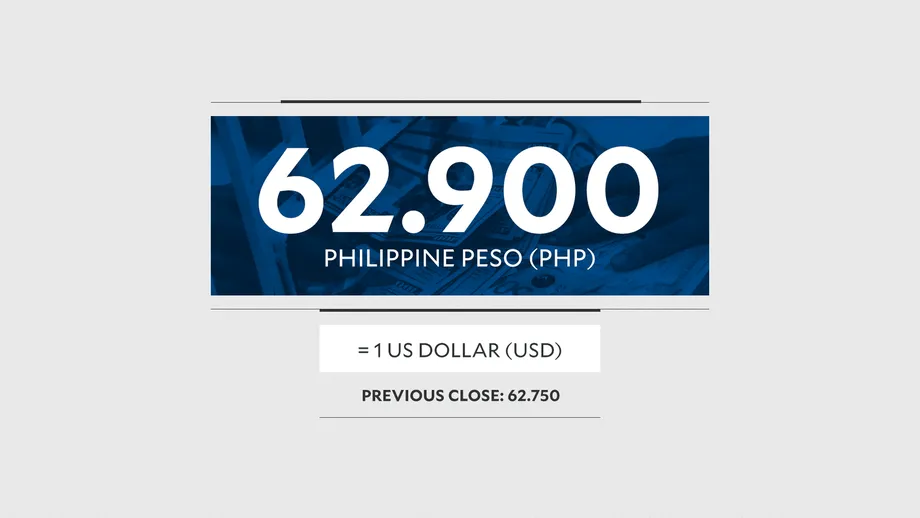
The Philippine peso closed at PHP62.90 per US dollar on October 8, 2026, setting a record as September inflation reached 7.2% and the poorest households faced an even steeper 9% increase in prices. With rice inflation at 20.3% and transport inflation at 14.6%, the pressure extends beyond currency trading into food budgets, commuting costs and business expenses.
Contents
- A record currency low meets a widening price squeeze
- What the exchange rate figures show
- Food accounts for much of the inflation pressure
- Prices are rising beyond food and fuel
- Poorer households and areas outside Manila face higher inflation
- Oil and dollar strength reinforce the squeeze
- The October rate decision carries a growth cost
- Reserves decline, while stocks also weaken
- Fuel tax relief and business assistance enter the debate
- What the next figures and meetings will test
- Key Points
The Philippine Statistics Authority's September inflation report puts the national rate up from 6.1% in August and 1.7% in September 2025. Average inflation from January through September 2026 was 5.4%. The latest monthly reading matched April's rate and was the fastest since March 2023, when inflation reached 7.6%.
Economist Emmanuel Leyco, speaking in an October 9 radio interview, warned that rising prices were eroding purchasing power while making peso investments less attractive. He urged the government to consider broader fuel tax relief and tax holidays for small businesses, arguing that the response cannot rest with the Bangko Sentral ng Pilipinas alone.
The central bank's benchmark interest rate stands at 5% after three increases this year. Its next policy meeting is scheduled for October 22, with several banks expecting another quarter percentage point increase. The difficulty is that higher borrowing costs could restrain inflation and support the currency while also weakening already slow consumption and investment.
What the exchange rate figures show
The October 8 close surpassed the previous record of PHP62.86 per dollar on September 14 by four centavos. The peso weakened 15 centavos during the October 8 session, while trading volume rose to $1.4 billion from $1.2 billion in the previous session.
One October 6 market account contains an inconsistency that prevents a reliable reading of that day's movement. It describes a 15 centavo depreciation but gives a closing rate of PHP61.771 against PHP62.621 the previous day. Those figures would indicate an appreciation of 85 centavos, because fewer pesos would be needed to buy a dollar. The same account gives an intraday low of PHP62.84.
The broader chronology places the latest record within a longer period of currency weakness:
- October 30, 2025: The peso touched PHP59.20 per dollar and closed at PHP59.13.
- September 14, 2026: The currency recorded a closing low of PHP62.86, described as its 25th record low that year.
- October 8, 2026: The peso closed at a new record of PHP62.90.
- October 9, 2026: Leyco called for measures to protect consumers and small businesses.
Since the October 2025 record, the peso cost of buying one dollar has risen from PHP59.13 to PHP62.90, an increase of about 6.4%. That comparison measures the exchange rate change, not the increase in every imported product's retail price.
Food accounts for much of the inflation pressure
The PSA identifies food and nonalcoholic beverages, housing and utilities, and transport as the main contributors to September inflation. Their respective shares of the 7.2% national rate were 35.8%, 24.0% and 18.3%. Together, those categories accounted for 78.1% of headline inflation.
Food and nonalcoholic beverages inflation reached 6.7%, up from 4.6% in August. Food alone rose 6.8%. Rice prices increased 20.3% from a year earlier, compared with 19.4% in August, while vegetables, tubers, plantains, cooking bananas and pulses moved from a 3.4% annual decline to a 10.7% increase.
Fish and seafood inflation rose to 7.4%, and fruit and nut inflation reached 8.7%. Meat prices and prices for milk, dairy products and eggs still declined from a year earlier, although those declines became smaller. Corn inflation eased from 18.2% to 17.3%, showing that prices did not accelerate uniformly across all foods.
It is also necessary to distinguish a category's contribution to the inflation rate from its contribution to the increase since August. Food and nonalcoholic beverages accounted for 35.8% of September's total inflation rate, but a separate calculation put their share of the monthly acceleration at 73.4%.
ING's breakdown differs, assigning roughly 75% of the 1.1 percentage point acceleration to food excluding rice, with rice and transport contributing about 10% each. These breakdowns should not be treated as interchangeable, since they assign the increase to different categories. Both identify food as the main driver of September's acceleration.
Prices are rising beyond food and fuel
September's inflation increase spread across 11 of the 13 commodity groups tracked by the PSA. Information and communication was the only group with slower inflation, at 0.9%, while financial services remained unchanged at zero.
Health inflation rose from 5.0% to 5.6%, household furnishings and maintenance from 4.1% to 4.7%, and recreation, sport and culture from 5.1% to 5.3%. Restaurants and accommodation services reached 7.0%. This breadth matters because it suggests that the pressure is reaching goods and services beyond the original food and energy shocks.
Core inflation, which excludes selected food and energy items to help track underlying price trends, increased from 4.1% to 4.7%. That was its highest reading since October 2023. Core inflation does not establish the cause of every price increase, but its acceleration strengthens concerns that higher operating costs are spreading through the economy.
Ateneo de Manila University economist Leonardo A. Lanzona Jr. described how an external shock can develop into persistent domestic price pressure:
"Imported shocks start the fire, while domestic pass-through keeps it burning," he said.
University of Asia and the Pacific economist Marco C. Agonia also identified emerging secondary effects. These occur when an initial increase in fuel or food costs is followed by further price adjustments elsewhere, including businesses charging more to cover transport, materials or wages. Philippine Institute for Development Studies senior research fellow John Paolo R. Rivera warned that inflation becomes harder to reduce quickly when pressure extends beyond volatile food and energy.
Poorer households and areas outside Manila face higher inflation
Inflation for the bottom 30% of households rose to 9% in September from 8.2% in August. That was 1.8 percentage points above the national headline rate. Their average inflation from January through September reached 6.5%, compared with a 0.4% price decline during the same period in 2025.
The difference reflects the prices and spending patterns captured by the separate household measures. It means that the national 7.2% figure understates the measured price increase facing the poorest households. Agonia warned that families just above the poverty line have limited room to absorb sustained increases.
Geography adds another divide. Inflation in the National Capital Region reached 5.4%, while areas outside it recorded 7.6%, a gap of 2.2 percentage points. Outside the capital region, food and nonalcoholic beverages inflation was 7.0% and transport inflation was 15.2%, compared with 4.9% and 11.5% respectively in the capital.
Sixteen of the country's 18 regions recorded faster inflation. The Bangsamoro Autonomous Region in Muslim Mindanao had the highest rate at 9.7%, while MIMAROPA had the lowest at 5.9%. Lanzona advocated targeted cash transfers, rice supply measures and fare support rather than blanket assistance.
Oil and dollar strength reinforce the squeeze
A weaker peso raises the local currency cost of imports priced in dollars, including oil and some rice supplies. Higher global prices can compound that effect: importers may face both a more expensive product and a more expensive dollar with which to pay for it.
UnionBank of the Philippines chief economist Ruben Carlo Asuncion identified persistent dollar strength, elevated US Treasury yields and oil above $100 per barrel as pressures on the currency. RCBC chief economist Michael Ricafort cited Treasury yields reaching 5.29%, which can make dollar assets more attractive to investors.
ING's fuel price comparison put Philippine gasoline inflation at 63%, against 35% in Indonesia and 33% in Thailand. The Philippine figure was therefore 28 percentage points above Indonesia's and 30 points above Thailand's. These are gasoline price comparisons, not national headline inflation rates.
Deepali Bhargava, ING's regional head of research for Asia Pacific, explained the difference:
"What stands out when comparing the Philippines with its regional peers is the much stronger pass-through from global oil prices to domestic fuel prices," she said.
Brent crude exceeded $100 per barrel in early September amid renewed hostilities in the Persian Gulf. Bank of America warned that the BSP's inflation projections could require revision because its underlying oil assumptions were $81 per barrel for 2026 and $75 for 2027. Those projections put inflation at 6.1% and 5.4%, respectively. The bank also said easing energy prices in the following weeks could reduce the need for an upward revision.
The October rate decision carries a growth cost
The BSP raised its benchmark rate by a total of 75 basis points through quarter percentage point increases on April 23, June 18 and August 27. A basis point is one hundredth of a percentage point. Another 25 basis point increase would take the rate from 5% to 5.25%.
BPI, Chinabank Research, BMI, ING and Nomura expect an October increase. The Monetary Board's two remaining scheduled policy meetings in 2026 are October 22 and December 17. These expectations are forecasts, not announced decisions.
Leyco's concern is that the 5% policy rate is below the current 7.2% inflation rate. The simple gap is 2.2 percentage points, illustrating the pressure inflation places on returns measured in purchasing power. It is not an investor's actual return, since yields differ across assets and investment decisions also depend on expected inflation and currency movements.
BPI lead economist Emilio Neri Jr. expects increases in October and December, taking the rate to 5.50% by the end of 2026. He also considers a larger 50 basis point move possible at one remaining meeting. UOB expects three successive quarter percentage point increases through the first quarter of 2027, reaching 5.75%. Goldman Sachs expects increases at both remaining 2026 meetings.
BMI, by contrast, expects tightening to stop after October because weak growth limits the room to raise borrowing costs. Its 2026 growth forecast is 3.3%, and it cited a September contraction in the manufacturing purchasing managers' index, a survey indicator of business conditions. Bank of America forecasts growth below 3% in 2026 and 3.5% in 2027.
Reserves decline, while stocks also weaken
The BSP's gross international reserves fell 8.3% from a year earlier to $99.99 billion in September, their lowest level since September 2023. Reserves are foreign assets that help the country meet import and external debt payments and give the central bank resources to manage currency volatility.
The September total was $4.01 billion below the BSP's revised target of $104 billion for the end of 2026. That target had been reduced from $111 billion amid the US and Iran war. A September reading below the target does not establish what the December total will be.
The BSP attributed part of the decline to lower gold valuations and occasional intervention in the foreign exchange market. Its gold holdings fell 7% from the previous month to $17.8 billion, while offshore investments declined to $76.5 billion. Foreign currency and deposits fell 17% to $1 billion.
The central bank said reserves still covered 6.3 months of imports of goods and payments for services and primary income, and about 3.2 times short term external debt based on residual maturity. SM Investments group economist Robert Dan Roces described the situation as one of managing volatility rather than an inability to meet external obligations.
Equities also weakened on October 6. The Philippine Stock Exchange index fell 1.15% to 5,677.12, while the All Shares index dropped 0.86% to 3,170.73. Trading exceeded 536.164 million shares worth PHP5.457 billion. Decliners outnumbered advancers 120 to 73, and every sectoral index fell, with mining and oil recording the largest percentage decline at 2.38%.
Fuel tax relief and business assistance enter the debate
Leyco urged a suspension of excise taxes on oil products, estimating potential relief of PHP6 to PHP10 per litre. His argument is that Manila cannot control the conflict driving global energy prices, but it can change the domestic tax component of pump prices.
President Ferdinand Marcos Jr. suspended excise taxes on kerosene and liquefied petroleum gas in September. Gasoline and diesel were excluded because of concerns about lost government revenue and whether broader relief would benefit wealthier households more than poorer families.
Leyco also proposed tax holidays for small entrepreneurs comparable to those granted to foreign investors. He supported wage increases but said small firms needed assistance with rising operating costs. These proposals create another policy choice: relief can protect household spending and business activity, but reducing taxes also reduces revenue unless offset elsewhere.
Socioeconomic Planning Secretary Arsenio M. Balisacan outlined a response focused on reducing fuel, electricity and logistics costs while strengthening food supply and storage. Planned agricultural measures include expanding storage facilities, rolling out an African Swine Fever vaccine and preparing for possible intensification of El Niño.
These measures address a different part of the problem from interest rates. Higher rates can restrain spending and help contain expectations of further inflation, but they do not directly increase harvests or storage capacity. Supply measures aim to reduce shortages and distribution costs. Their effect on prices depends on implementation and timing.
What the next figures and meetings will test
National Statistician Claire Dennis S. Mapa identified El Niño and recent fare increases as risks during the final three months of 2026, with fare adjustments expected to appear more fully in October's inflation figures. Chinabank Research expects inflation to peak in November, while ING warns that weather effects could become more evident late in 2026 and early in 2027.
Forecasts differ on how quickly inflation will ease. Nomura expects headline inflation around 7% in the fourth quarter, averaging 5.8% in 2026 before falling to 3.4% in 2027. BMI forecasts 5.9% for 2026 and 5% for 2027. UOB's 2026 forecast is 6%.
The government's Development Budget Coordination Committee set a 6% to 7% inflation range in July, above the BSP's 2% to 4% target. September's 7.2% reading exceeded both ranges, although the January to September average of 5.4% is a different measure from a single month's rate.
The immediate scheduled decisions are the October 22 and December 17 policy meetings. Beyond them, the central issue is whether food supply, oil prices and the peso improve enough to slow inflation without further pressure on borrowing and spending. Leyco warned that weaker purchasing power would appear in subsequent growth figures as households cut consumption. That is a warning about future data, not a confirmed growth outcome.
Key Points
- The peso closed at a record PHP62.90 per dollar on October 8, 2026.
- September headline inflation reached 7.2%, up from 6.1% in August.
- Rice inflation was 20.3%, transport inflation was 14.6% and core inflation was 4.7%.
- Inflation for the poorest 30% of households reached 9%.
- Several banks expect an October rate increase to 5.25%, but differ on subsequent moves.
- September reserves fell to $99.99 billion, while covering 6.3 months of imports and related payments.
- Leyco proposed broader fuel tax relief and tax holidays for small businesses.
- The BSP's remaining 2026 policy meetings are October 22 and December 17.