A $4,000 memory chip at the center of China's AI supply squeeze
High bandwidth memory made by Samsung Electronics and SK hynix is reportedly reaching Huawei through a smuggling network that pairs expensive memory with cheap processors, moves the components through Hong Kong and recovers the memory in Shenzhen. A broker involved in the trade says an HBM3E unit now costs about $4,000 in China, compared with several hundred dollars a year earlier.
Contents
- A $4,000 memory chip at the center of China's AI supply squeeze
- How the reported supply route works
- What the December 2024 rules changed
- Why memory can hold back a powerful processor
- What the price jump means for buyers
- Huawei's next chip depends on the same scarce component
- Can Chinese HBM production ease the shortage?
- Enforcement pressure meets a profitable trade
- Key Points
At that price, the six to eight memory units needed for an AI accelerator would cost $24,000 to $32,000 before paying for the processor, server hardware or electricity infrastructure. The trade exposes a costly dependency behind China's push to develop domestic AI computing: a powerful processor still needs enough fast memory to keep it working.
Huawei is reportedly the main buyer of the smuggled memory. People familiar with its supply chain say the company has told some customers that its next flagship AI processor, the Ascend 960DT, will primarily use HBM from Samsung and SK hynix. Huawei has also reportedly asked some customers to obtain the necessary memory themselves because direct purchases from the Korean suppliers are difficult under export restrictions.
The allegations center on how components are classified when memory and a processor are packaged together. The United States introduced a specific export classification for advanced HBM in December 2024, while excluding certain integrated packages whose main function is processing from that particular memory category. Traders are reportedly exploiting that difference to move valuable memory inside products assessed by their processor performance.
How the reported supply route works
A trader who owns a chip design company reportedly arranges for inexpensive processors to be paired with HBM made by the two Korean companies. The processors offer relatively little computing power, while the attached memory is valuable to buyers building advanced AI systems.
The combined products reportedly travel to Hong Kong before commuters carry them across the border into Shenzhen in their luggage. Technicians then recover the memory and discard the unwanted processors and other components.
Recovering the HBM requires careful handling. Technicians heat the assemblies to soften solder, but excessive or uneven heat can deform or crack the memory. The operation reportedly has a high failure rate, meaning some of the expensive components are lost before they can reach a customer.
High resale prices nevertheless make the trade attractive. The processor becomes a disposable carrier for the memory, reversing the usual commercial relationship in which memory supports the operation of a valuable computing chip.
The reported route also involves several separate stages: combining the components, shipping them, crossing the border, recovering usable memory and finding buyers. Each stage adds cost and risk before a working HBM unit becomes available for an AI accelerator.
What the December 2024 rules changed
The US Commerce Department's Bureau of Industry and Security, known as BIS, issued an interim final rule on December 2, 2024, expanding restrictions on advanced computing and semiconductor manufacturing. It added export control classification number 3A090.c for HBM with a memory bandwidth density greater than 2 gigabytes per second per square millimeter.
Memory bandwidth measures how much data a memory device can move each second. Bandwidth density divides that speed by the area of the package or stack. The measure allows regulators to identify compact memory devices capable of supplying large amounts of data to powerful processors.
The rule says classification 3A090.c does not cover integrated circuits that combine HBM and logic chips in the same package when their primary function is processing. Such products are assessed under the applicable rules for the combined device. The reported trade exploits the treatment of a processor package rather than exporting the HBM as a separate memory product.
For the processing-based classification, an earlier April 2024 BIS rule gives the text of ECCN 3A090.a: "Integrated circuits having one or more digital processing units having either of the following:" followed by 3A090.a.1, "A 'total processing performance' of 4800 or more," or 3A090.a.2, "A 'total processing performance' of 1600 or more and a 'performance density' of 5.92 or more." A second tier covers integrated circuits with one or more digital processing units meeting 3A090.b.1, "A 'total processing performance' of 2400 or more and less than 4800 and a 'performance density' of 1.6 or more and less than 5.92," or 3A090.b.2, "A 'total processing performance' of 1600 or more and a 'performance density' of 3.2 or more and less than 5.92." The entry applies regional stability and anti-terrorism license controls. Its regional stability controls cover destinations in Country Groups D:1, D:4 and D:5, excluding destinations also in A:5 or A:6, with reference to § 742.6(a)(6)(iii). These processing provisions are distinct from the HBM-specific classification introduced in December.
BIS also created a restricted HBM license exception for qualifying memory with bandwidth density below 3.3 gigabytes per second per square millimeter. Its conditions include restrictions on eligible exporters, direct purchases by the designer of the combined product, shipment to the packaging location and safeguards against diversion to entities in mainland China and Macau.
The rule bars HBM classified under 3A090.c from using two other authorization routes, the Notified Advanced Computing and Advanced Computing Authorized license exceptions. The regulatory changes therefore address both the technical characteristics of the memory and the companies, destinations and manufacturing arrangements involved in a transaction.
Why memory can hold back a powerful processor
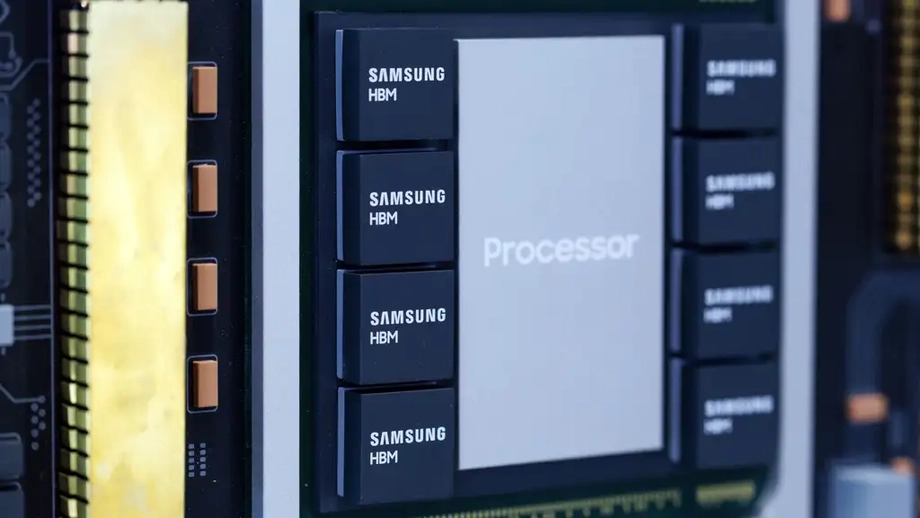
HBM stacks memory chips vertically and places them close to a processor. The short connections and wide data pathways allow large quantities of information to move quickly between the memory and the computing circuits.
An AI processor performs calculations, while memory supplies the model information and working data those calculations require. A simple comparison is a busy kitchen: adding more cooks helps only if ingredients arrive quickly enough. A processor with greater computing capacity can spend time waiting when its memory cannot deliver data at the required speed.
Samsung and SK hynix together account for more than 80% of the global HBM market, according to the figures cited in the reporting. Their position leaves Chinese accelerator makers dependent on a concentrated group of foreign suppliers for a component that directly affects usable computing performance.
The pressure extends beyond restricted sales. Samsung and SK hynix have been directing resources toward profitable AI memory as demand grows. Their investment during the memory shortage included a combined 1.4871 trillion won spent at three Chinese plants in 2025, while buyers of conventional memory also faced tighter supplies. Those plants produce other important memory products, while the reported smuggling concerns advanced HBM used alongside AI processors.
What the price jump means for buyers
A Shenzhen chip broker who connects suppliers with companies seeking HBM described the price change:
A year ago, a single HBM3E unit changed hands in China for several hundred dollars. Today it's about $4,000.
Using that quoted price, six units cost $24,000 and eight cost $32,000. Moving from six to eight adds $8,000, an increase of one third in the memory bill alone. Damaged components, transport charges and other transaction costs can put further pressure on the economics of the supply chain.
The $24,000 to $32,000 figure represents the value of the memory at the quoted price. A broker's profit depends on acquisition costs, losses during recovery and other expenses, for which no figures were given.
Chinese AI buyers therefore face several costs at once: expensive processors, scarce memory and the equipment needed to turn individual accelerators into operating servers. Requests for customers to obtain HBM themselves move part of the purchasing burden from the chip supplier to the organizations trying to build computing capacity.
Huawei's next chip depends on the same scarce component
Huawei reportedly describes the Ascend 960DT as delivering twice the performance of its existing chip and as China's most powerful domestic processor. Another performance description places the planned 960DT around the level of Nvidia's H100, while describing Huawei's current Ascend 950DT as delivering about half the H100's performance.
The 950DT reportedly sells for approximately $37,000, a price compared with Nvidia's B200. That gives Chinese buyers a difficult combination: a high purchase price and performance described as below an earlier Nvidia generation. The $37,000 selling price and the separately quoted HBM costs concern different products and purchasing arrangements, so the cost of a complete Huawei system depends on its actual configuration and supply terms.
Huawei's access to memory matters more as its domestic business expands. IDC figures described in coverage of its narrowing gap with Nvidia put Huawei's Chinese AI accelerator shipments at 572,000 in the first half of 2026, against Nvidia's 678,000. Their reported market shares were 28% and 34%, respectively.
A larger accelerator business requires more supporting components. If Huawei uses six to eight HBM units for a particular accelerator design, every additional batch of processors creates demand for several times as many memory units. The ability to design and produce the processor is therefore only one part of delivering usable AI hardware to customers.
Can Chinese HBM production ease the shortage?
Chinese memory manufacturer CXMT has reportedly begun risk production of HBM3E, with mass production expected by the end of 2026. Risk production is an early manufacturing stage used to test whether a process can produce working components consistently before output expands.
CXMT's yields reportedly remain low. Yield means the share of manufactured components that work properly. When fewer units pass testing, the cost of the usable units rises because the factory still pays to manufacture those that fail.
Low yields also limit supply. A production line may process substantial amounts of material while producing relatively few memory units suitable for customers. Raising yields would help CXMT deliver more working HBM from its manufacturing capacity and reduce the cost of each usable unit.
The central dates span the introduction of the restrictions and China's planned supply response:
- December 2, 2024: BIS issued the rule adding the specific HBM export classification and related licensing provisions.
- December 31, 2024: Compliance began for several associated foreign direct product and end use provisions.
- First half of 2026: Huawei shipped a reported 572,000 AI accelerators in China.
- End of 2026: CXMT is expected to begin mass production of HBM3E.
Enforcement pressure meets a profitable trade
The trader behind the reported packaging operation fears action by South Korean and US authorities as the method becomes more widely used. Taiwan and Malaysia have also reportedly increased efforts against chip smuggling, while US investigations have involved arrests of people connected to other technology supply operations.
The reported HBM trade remains difficult to measure. The volume reaching Huawei, the identities of the intermediaries and any knowledge the Korean manufacturers had of the alleged diversion have not been publicly detailed. The accounts also give no launch date for the 960DT or precise date for CXMT's planned transition to mass production.
Some participants describe their work in patriotic terms. A Chinese memory broker involved in the trade said he did not consider himself a smuggler and viewed the activity as a contribution to his country. That motivation sits alongside a strong commercial incentive: a memory unit worth several hundred dollars a year earlier now reportedly changes hands for about $4,000.
For Chinese AI developers, the immediate issue is obtaining enough working memory at an affordable cost. For regulators, the reported route places attention on products that combine restricted memory with relatively weak processors and then move through several locations before the memory reaches its final buyer. CXMT's planned production expansion offers a domestic source of supply, while its reported yield problems leave buyers facing a continuing shortage.
Key Points
- Samsung and SK hynix HBM is reportedly reaching Huawei through intermediaries using cheap processor packages and a route through Hong Kong and Shenzhen.
- A Shenzhen broker quoted HBM3E at about $4,000 per unit, putting six to eight units at $24,000 to $32,000.
- US rules introduced a dedicated HBM export classification in December 2024, with separate treatment for certain packages whose main function is processing.
- Huawei's planned Ascend 960DT reportedly depends mainly on Korean HBM, and some customers have been asked to obtain memory themselves.
- CXMT has reportedly begun HBM3E risk production and is expected to start mass production by the end of 2026, although yields remain low.