Three Chinese plants become critical to the supply response
Samsung Electronics and SK hynix invested a combined 1.4871 trillion won in three Chinese chip plants in 2025 as the artificial intelligence boom strained global memory supplies. Samsung increased spending at its Xi'an facility by 67.5 percent, while SK hynix more than doubled investment in Wuxi and raised spending in Dalian by 52 percent.
Contents
- Three Chinese plants become critical to the supply response
- Why AI is absorbing so much memory
- What Samsung and SK hynix spent in China
- Export controls complicate factory upgrades
- Washington wants factories while Beijing seeks investment
- Phones and computers face higher costs
- Retail limits and recycled chips show the strain
- Memory makers overtake internet giants in market value
- Why the shortage could continue through 2027
- Efficiency gains and funding constraints could change demand
- Key Points
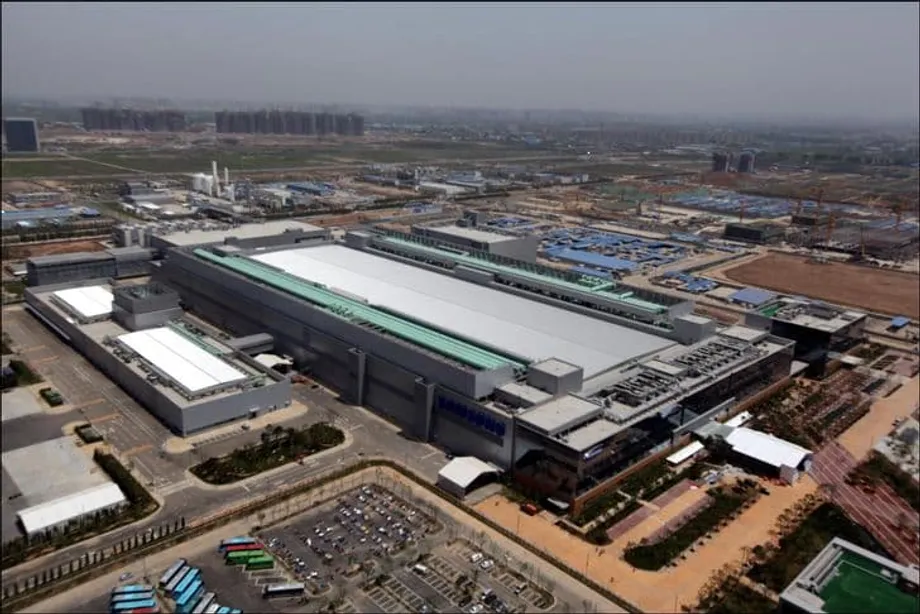
The facilities carry enormous weight. Xi'an produces roughly 40 percent of Samsung's NAND flash memory, and Wuxi supplies more than 30 percent of SK hynix's dynamic random access memory, or DRAM. Dalian is SK hynix's primary NAND production base. Together, the two Korean companies control roughly two thirds of the global memory market and supply approximately 45 percent of China's domestic memory demand through their local operations.
As of March 31, 2026, their challenge is to increase output quickly while managing tighter United States controls on equipment shipments to China. New factories typically take three to five years to build, equip and bring into full production. Existing Chinese plants offer an immediate production base, even as their future upgrades depend on American approvals.
The shortage is spreading far beyond AI servers. Smartphone makers, computer manufacturers and electronics retailers are struggling to obtain conventional memory as suppliers prioritize more profitable products for data centers. Some prices have more than doubled, and certain DDR5 chips recorded a much steeper annual increase.
Industry analysts describe the squeeze as the most severe in 15 years. Goldman Sachs estimates that DRAM supply will fall 4.9 percent short of demand in 2026, up from its previous forecast of 3.3 percent. It also predicts a NAND shortage equivalent to 4.2 percent of demand and describes conditions as the tightest since the late 2000s.
Why AI is absorbing so much memory
AI data centers need high bandwidth memory, usually called HBM, alongside their graphics processing units. These processors perform the calculations behind large language models, while memory supplies the data they need. HBM stacks chips vertically in three dimensional arrangements so information can move rapidly between memory and processors.
HBM is more complex and valuable than conventional memory. Its importance extends across AI training, when a model learns from data, and inference, when it uses that learning to answer requests. Memory bandwidth has become a bottleneck that helps determine the performance of entire AI systems.
Samsung and SK hynix are directing production toward these lucrative components. Conventional memory production has fallen sharply as a result, leaving shortages across categories ranging from flash chips in USB drives to advanced server DRAM. DRAM holds information needed while a device is operating; NAND flash provides storage for files and other data.
Market researcher TrendForce says prices in some memory segments have more than doubled since February. DRAM contract prices are expected to rise by 55 to 60 percent in the current quarter. Contract prices are the amounts negotiated between suppliers and customers purchasing chips, rather than prices shoppers see for finished devices.
The supply imbalance could raise consumer electronics prices and delay digital infrastructure projects worth hundreds of billions of dollars. It could also slow productivity gains expected from AI, at a time when economies are already dealing with inflation and uncertainty over trade tariffs.
What Samsung and SK hynix spent in China
Samsung invested 465.4 billion won, approximately $308.8 million, in its Xi'an plant in Shaanxi province during 2025, according to its annual report filed with South Korea's Financial Supervisory Service. The increase of 67.5 percent followed a period of restrained spending at its only overseas memory chip factory.
Samsung had invested 698.4 billion won at Xi'an in 2019, then largely paused capital expenditure during a four year hiatus from 2020 through 2023. Its renewed investment reflects the urgency of increasing output from infrastructure already in place.
SK hynix invested 581.1 billion won at Wuxi in Jiangsu province, an increase of 102 percent from the previous year. It also spent 440.6 billion won at Dalian in Liaoning province, up 52 percent from 2024. The company made no investments at either Chinese facility in 2023 before increasing spending sharply over the following two years.
These sites already have established supply chains, skilled workers and mature manufacturing networks. Their substantial existing investment would take years to reproduce elsewhere. Improving operations at the plants therefore offers a much faster response than constructing replacement factories.
Lee Byung-chul, a visiting research fellow at the Sejong Institute and a former Samsung Electronics executive vice president, worked at Samsung's Chinese subsidiary for 15 years. He explained why existing facilities matter to the immediate supply response:
Since building new plants typically takes three to five years, optimizing operations at existing production bases in China enables a much faster supply response,
Lee said Korean semiconductor companies must make the most of those production bases as United States export controls tighten. He also warned that stronger rivalry could eventually force them to consider adjustments to their production exposure in China.
Export controls complicate factory upgrades
United States restrictions create uncertainty over how much Samsung and SK hynix can maintain and upgrade their Chinese production lines. In August 2025, Washington removed the verified end user status that had allowed the companies to ship American manufacturing equipment to those facilities without seeking the approvals now required.
Both companies must now obtain annual approval to import United States equipment into China. Their investments therefore take place within a regulatory system that makes future access to manufacturing tools less predictable. Investment totals alone do not give a timetable for additional chip output; no precise production increase or completion date was given.
Washington's broader strategy is to restrict China's access to advanced semiconductor technology, especially technology relevant to artificial intelligence and military applications. Export controls have increasingly become a means of imposing costs on adversaries and limiting their technological capabilities.
During the Biden administration, National Security Advisor Jake Sullivan described advanced logic and memory chips as foundational technologies in which the United States needed to maintain as large a lead as possible. That approach moved beyond the earlier goal of keeping only a couple of generations ahead.
Any disruption at the Chinese plants would travel through global supply chains. Their importance reaches from smartphones to automotive manufacturing, exposing Korean chipmakers and China's technology industries to potentially substantial economic damage.
Washington wants factories while Beijing seeks investment
United States Commerce Secretary Howard Lutnick has threatened tariffs of 100 percent on foreign memory chipmakers unless they commit to building manufacturing facilities in the United States. Korean companies already have major American projects, although those projects serve different parts of the semiconductor industry.
Samsung is investing $37 billion in a foundry cluster in Taylor, Texas, with production scheduled to begin in 2026. A foundry makes chips for customers according to their designs. SK hynix is building a $3.87 billion advanced packaging facility in West Lafayette, Indiana, where chips can be assembled into sophisticated components.
Industry analysts regard the tariff threat as unrealistic because memory chips are standardized commodities sold into open markets. Their manufacturers compete heavily on cost. Foundries can negotiate production costs into contracts with customers, while memory producers must sell into a market where price competitiveness determines profitability.
A 2024 report by the Korea International Trade Association estimates that manufacturing in the United States costs 20 to 40 percent more than in East Asia. Higher labor expenses, regulatory requirements and a less developed industrial ecosystem contribute to the difference. Micron Technology, the only major American memory producer, also maintains core production bases in Japan, Taiwan and Singapore rather than domestically.
China, meanwhile, is actively seeking greater Korean investment. Zheng Shanjie, head of the National Development and Reform Commission, recently met Samsung Electronics Executive Chairman Lee Jae-yong in Beijing and urged Samsung to take opportunities arising from China's economic opening and expand investment cooperation.
Lee responded that China remains an important part of Samsung's global strategy. He and SK hynix CEO Kwak Noh-jung also attended the China Development Forum in Beijing for the second consecutive year, signaling continued commitment to the market despite political tensions.
The companies face pressure from both directions: Washington wants more manufacturing investment on American soil, while Beijing wants them to deepen their Chinese operations. Their immediate supply commitments depend heavily on factories already operating in China.
Phones and computers face higher costs
Park Joon Deok, head of DRAM marketing at SK hynix, told analysts that computer and mobile customers are having difficulty securing memory. They face both direct and indirect effects from supply constraints and strong demand for server products.
TrendForce recorded a 314 percent annual increase in DDR5 DRAM chip prices in the fourth quarter of 2025. An increase of that size means prices reached more than four times their level a year earlier, illustrating how rapidly costs have changed for buyers of this memory category.
Xiaomi and Realme have warned that handset prices may need to rise by 20 to 30 percent by the middle of 2026 to cover higher memory costs. Francis Wong, Realme India's chief marketing officer, described the increases as unprecedented since smartphones emerged.
Wong explained that manufacturers might save money on cameras, processors or batteries, but storage costs still have to be absorbed by the company or passed to customers. Memory is an unavoidable part of producing a functioning smartphone.
Research firms IDC and Counterpoint now expect global smartphone shipments to decline by at least 2 percent in 2026, reversing earlier forecasts for growth. The personal computer market is projected to shrink by 4.9 percent after growing 8.1 percent in 2025.
Samsung's own mobile business shows the tension between the gains enjoyed by memory suppliers and the costs borne by device makers. Its mobile business profit fell 10 percent in the fourth quarter. Co-CEO TM Roh warned of a challenging year and acknowledged that higher chip prices would inevitably affect device production costs.
Samsung plans to double its deployment of Galaxy devices equipped with AI features to 800 million units in 2026. That ambition depends partly on access to the same components whose shortages are benefiting its semiconductor business.
Retail limits and recycled chips show the strain
Retailers in Tokyo's Akihabara electronics district have begun limiting purchases of hard disk drives and solid state drives to discourage hoarding. Some stores restrict customers to eight memory products in total and report that one third of their products are sold out.
Prices for 32 gigabyte DDR5 memory kits popular with gamers have climbed from about 17,000 yen to more than 47,000 yen since October. Higher specification kits with 128 gigabytes have more than doubled to approximately 180,000 yen.
Recycled memory is also finding new buyers. Chips removed from retired data center servers are moving through a growing secondary market. A reseller based in California reported monthly sales rising from $500,000 to $800,000 or more as intermediaries based in Hong Kong sought supplies for Chinese clients.
The race for new chips is equally intense. Microsoft, Google, Amazon and Meta have reportedly sought orders without a fixed upper limit, offering to buy as much memory as suppliers can provide regardless of price. Alibaba, ByteDance and Tencent have sent executives to press Samsung and SK hynix for larger allocations.
An industry executive described customers as begging for supply and warned that companies unable to secure memory allocations could be left unable to operate. That urgency helps explain why the Chinese plants remain essential despite the political risks surrounding them.
Memory makers overtake internet giants in market value
Samsung Electronics and SK hynix reached a combined market capitalization of $1.14 trillion in early 2026. For the first time, their combined value exceeded the $1.07 trillion valuation of Alibaba and Tencent. The difference was $70 billion.
The comparison captures a shift in investor attention from software applications toward the hardware needed to run AI. Memory chips, long treated primarily as commodity components, now occupy a central position in technology infrastructure and national competition.
SK hynix supplies memory to Nvidia and has benefited from profitable HBM and server DDR5 products. Its operating profit exceeded Samsung's for the full year of 2025 for the first time. Samsung shares rose 125 percent during 2025, their largest annual gain in 26 years.
Those financial gains coexist with pressure elsewhere in the industry. Higher memory prices improve chipmakers' earnings while squeezing smartphone and computer manufacturers, including Samsung's own device operations. Customers that cannot obtain sufficient memory may also struggle to expand their businesses even when they are willing to pay more.
Why the shortage could continue through 2027
Analysts at Citigroup and KB Securities project that the shortage could extend through 2027. Previous semiconductor upturns linked to smartphone and computer replacement cycles typically lasted one to two years. The present cycle draws strength from a broader wave of AI infrastructure spending.
New factories will help determine how long supply remains tight. Relevant projects include the first phase of SK hynix's Yongin Cluster and Micron's New York facility. The pace of their completion matters because existing plants must cover demand while new capacity is being built.
Demand also depends on whether major technology companies can earn enough from AI to sustain their large capital expenditure programs. Spending on facilities and equipment must eventually be supported by businesses that generate revenue from the services they deliver.
AI use is expanding beyond the training of large models. Inference, physical AI applications such as autonomous vehicles and robotics, and agentic AI services are expected to broaden memory demand beyond its current concentration in HBM. Agentic services use AI to carry out tasks, rather than simply produce an answer to a request.
The pressure on suppliers could consequently last longer than a conventional consumer electronics boom. Its duration depends on both the arrival of new production capacity and the continued growth of customers willing to fund large AI systems.
Efficiency gains and funding constraints could change demand
Google recently announced that its TurboQuant algorithm can reduce memory requirements to as little as one sixth of current levels. If such efficiency gains become widely adopted, they could weaken demand over the longer term by allowing some AI work to use substantially less memory.
AI infrastructure spending presents another risk. Funding constraints at major investors such as OpenAI or SoftBank could slow construction and reverse the shortage quickly. Memory makers must decide how much capacity to add while their customers' spending plans remain vulnerable to changes in financing.
SEMI projects that semiconductor equipment sales will reach $156 billion by 2027. Manufacturers nevertheless remain cautious about building too much. During the downturn of 2018 and 2019, aggressive capacity expansion left facilities idle.
Samsung and SK hynix are therefore balancing an urgent supply shortage against the possibility of a later surplus. Their Chinese investments offer a bridge between current demand and factories that take years to complete. At the same time, annual equipment approvals and pressure to expand in the United States complicate decisions about where future production should be located.
The immediate challenge is concrete: keep supplying AI customers while preserving enough conventional memory for phones, computers and other devices. Xi'an, Wuxi and Dalian remain central to that effort because they already produce a substantial share of the chips the market needs.
Key Points
- Samsung and SK hynix invested a combined 1.4871 trillion won in their Xi'an, Wuxi and Dalian plants in 2025.
- Xi'an supplies roughly 40 percent of Samsung's NAND output, while Wuxi produces more than 30 percent of SK hynix's DRAM.
- Goldman Sachs forecasts 2026 shortages equivalent to 4.9 percent of DRAM demand and 4.2 percent of NAND demand.
- Annual United States equipment approvals complicate Chinese factory upgrades, while Washington is pressing foreign memory makers to invest in American manufacturing.
- Higher memory costs are squeezing device makers, with smartphone shipments expected to fall by at least 2 percent and computer shipments by 4.9 percent in 2026.
- Samsung and SK hynix reached a combined market value of $1.14 trillion, exceeding Alibaba and Tencent's $1.07 trillion.
- Analysts project shortages through 2027, although more efficient AI algorithms and slower infrastructure spending could reduce demand.