A major funding round meets a production test
South Korean AI chip designer FuriosaAI has completed an 820 billion won Series D funding round at a valuation of approximately 3.8 trillion won, securing money to expand production of its RNGD inference processor and develop a successor with Broadcom. The company closed the round on October 29, 2026, after attracting more investment than it initially sought.
Contents
- A major funding round meets a production test
- What the valuation and investment mean
- Who supplied the capital?
- Why RNGD focuses on electricity use
- Korean deployments provide operating experience
- Sweden turns overseas ambition into an order
- Broadcom partnership targets larger systems
- Rebellions offers a useful domestic comparison
- A large round shapes the wider investment picture
- Key Points
The National Growth Fund supplied 370 billion won, about 45% of the total. FuriosaAI now plans to produce 20,000 RNGD chips in 2026 and more than 40,000 in 2027, while pursuing customers beyond South Korea in a market dominated by Nvidia.
A contract announced in August gives that expansion a concrete destination: an AI data center in Stockholm, Sweden. FuriosaAI agreed to supply more than 8,800 RNGD accelerator cards under a deal worth approximately 123 billion won. Its immediate task is to turn orders and investment into deliveries, operating installations and revenue.
RNGD, short for Renegade, specializes in inference, the work an AI model performs after training. When a chatbot answers a question or software summarizes a document, it is running inference. FuriosaAI is targeting the electricity and operating costs of doing that work repeatedly, rather than competing primarily over the computing power used to train models.
CEO Baek Jun-ho said the company was entering the stage of bringing its technology more widely into global AI infrastructure. The funding supports two efforts at once: selling more of the chip already in production and financing a more ambitious system for large data centers.
What the valuation and investment mean
FuriosaAI began fundraising in January with a target of 450 billion to 750 billion won. The final amount exceeded the upper end by 70 billion won, or about 9.3%, following interest from domestic and international investors.
The round used a valuation of 3 trillion won before the new investment. Adding 820 billion won brings the figure to 3.82 trillion won, expressed as approximately 3.8 trillion won after investment. This is the value placed on the business in the financing, while 820 billion won is the fresh capital raised.
The distinction matters because the money available for expansion is much smaller than the headline company valuation. FuriosaAI will use the proceeds to increase RNGD production and supply capacity, win global customers, strengthen its software ecosystem and develop its third generation accelerator.
The company described the financing as the largest startup funding round in South Korean history. The National Growth Fund's contribution gives public investment a central role in the expansion, alongside private investors backing the company's commercial prospects.
Who supplied the capital?
Existing shareholders invested another 170 billion won, accounting for about 20.7% of the round. Nextrans contributed 48 billion won, the largest additional investment among existing shareholders, and Korea Development Bank added 30 billion won.
Early investors Naver, DSC Investment and KDB Capital also participated. Naver invested through its US investment arm, Naver Ventures, following its earlier backing through Naver D2SF. Other returning investors included Kakao Investment, Quantum Ventures and Korea Investment Partners.
Infinitum was the largest overseas investor. The US investment firm also co-led a $650 million financing for AI chip company Groq in June, giving it exposure to another business pursuing the inference market. Other overseas participants included Cisco Investments, Singapore's QUDA Capital Partners, Abu Dhabi's Neoport Holdings, and US firms Jericho Capital and Worldline Capital.
UAMCO committed 40 billion won, the largest contribution among new domestic investors. Hanwha Asset Management also joined, as did the Export-Import Bank of Korea. Individual investment amounts were disclosed for only some participants.
Why RNGD focuses on electricity use
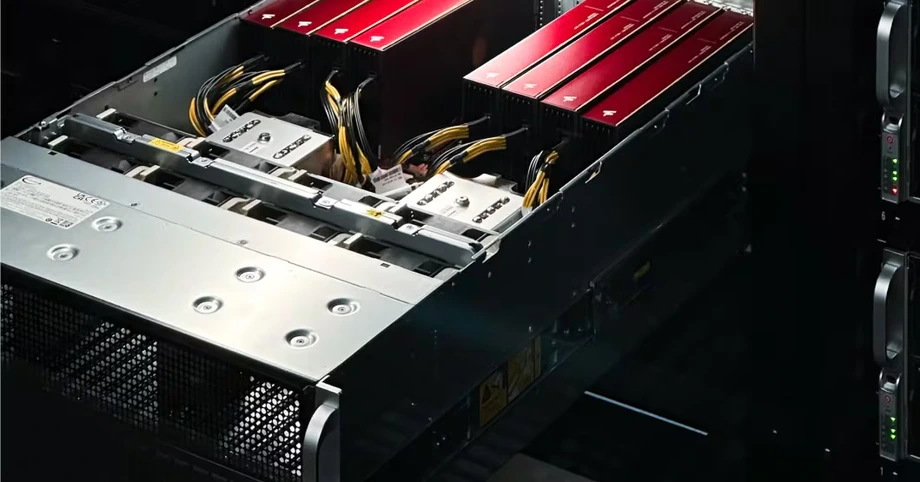
RNGD is a neural processing unit, or NPU, a processor designed for the calculations used in AI. FuriosaAI designs its chips rather than operating its own semiconductor factories, a business model known as fabless chipmaking. RNGD entered mass production in January using Taiwan Semiconductor Manufacturing Company's 5 nanometer manufacturing process.
FuriosaAI gives RNGD a maximum computing specification of 512 TOPS at 180 watts. TOPS means trillions of operations per second, so the figure describes up to 512 trillion operations each second. For customers, the practical issue is how efficiently that hardware runs their particular AI models while delivering answers at the speed they need.
The company's commercial argument centers on reducing electricity consumption and the cooling needed to remove heat from servers. Those costs recur whenever a data center runs AI services. A processor that performs the required work using less power can therefore change the expense of serving each customer request.
FuriosaAI also points to compatibility with existing servers. Its challenge is to make the hardware, software and operating environment work together well enough for customers to adopt RNGD in everyday services. That makes deployment experience with Korean partners an important part of its overseas sales effort.
Korean deployments provide operating experience
LG AI Research has worked with FuriosaAI on technology validation and commercialization. RNGD has undergone validation in production environments involving LG AI Research and Samsung SDS, and LG is using the processor to run its Exaone AI model.
Samsung SDS has introduced an RNGD service through its cloud environment. Called NPU as a Service, it lets customers rent access to AI accelerators instead of purchasing and installing the hardware themselves. That gives businesses a way to use the processor through cloud infrastructure.
Upstage has also received RNGD chips for its services. Together, these relationships give FuriosaAI several routes into commercial use: supplying hardware, working with an AI model developer and making computing capacity available through a cloud provider.
The funding will also support software development. Customers need tools that allow their models to run on the processor and connect with the rest of their systems. For FuriosaAI, expanding chip supply and improving that software must proceed together if more installations are to become routine business.
Sweden turns overseas ambition into an order
The Stockholm agreement is worth approximately 123 billion won, compared with FuriosaAI's revenue of 5.7 billion won in the previous year. The contract's value is therefore about 21.6 times that annual revenue, showing how much larger the company's order opportunities have become.
Revenue from the agreement will be recognized according to deliveries and the contract's terms. The next commercial measure is how quickly the company supplies the cards and converts the order into recorded sales. A detailed delivery schedule for the Swedish contract has not been disclosed.
The planned increase from 20,000 RNGD chips in 2026 to more than 40,000 in 2027 would more than double annual output. Achieving that expansion means coordinating chip manufacturing, packaging, hardware supply and customer deployment while continuing to support existing users.
The main milestones connect fundraising to that production effort:
- January 2026: RNGD entered mass production, and FuriosaAI began seeking 450 billion to 750 billion won in financing.
- August 2026: The company announced the Stockholm agreement for more than 8,800 RNGD cards, worth approximately 123 billion won.
- October 29, 2026: FuriosaAI completed its 820 billion won Series D round.
- 2026: The company targets production of 20,000 RNGD chips.
- 2027: Planned RNGD production rises to more than 40,000 chips.
Broadcom partnership targets larger systems
FuriosaAI's third generation accelerator, identified as Stork, is intended for operators of very large data centers, often called hyperscalers. The company is developing it with US semiconductor business Broadcom, with an emphasis on connecting more computing capacity and improving performance for each watt consumed.
The planned design combines multiple semiconductor dies, the individual pieces of silicon inside a package. Instead of relying on one large piece of silicon, this approach connects several smaller components. FuriosaAI plans to use a 2 nanometer manufacturing process for the computing dies and high bandwidth memory technologies HBM4 and HBM4E.
High bandwidth memory moves large amounts of data between memory and processors. That matters because an AI processor needs a steady supply of model data to keep working efficiently. Faster connections between processors also become important when a model or service runs across several chips.
FuriosaAI wants to extend its product from individual chips to an inference platform supplied at the scale of a server rack. A rack holds multiple pieces of computing equipment, so this would require the company to deliver a coordinated system as well as a processor. The third generation product's launch date has not been announced.
Rebellions offers a useful domestic comparison
South Korean rival Rebellions raised approximately 640 billion won in March ahead of a planned stock market listing, reaching a valuation of 3.4 trillion won. Together, the two companies' cited rounds total 1.46 trillion won, illustrating the scale of investment going into domestic AI chip developers.
Rebellions recorded approximately 32 billion won in revenue in the previous year, including about 28.4 billion won from product sales. Its revenue was roughly 5.6 times FuriosaAI's 5.7 billion won, while FuriosaAI's latest valuation was about 400 billion won higher. Investors are placing substantial value on future expansion as well as current sales.
Rebellions has built an operating base at SK Telecom. According to Rebellions, its processors handled approximately 14 million AI requests a day across four SK Telecom services as of September. Applications included call summaries, work following customer service consultations and detecting suspected scam messages.
In September, Rebellions also announced plans with Japanese AI infrastructure company ai& to introduce its RebelRack system at a Tokyo data center and expand to more than 100 units. The initial shipment quantity and contract value were not disclosed. Both Korean chip designers are pursuing overseas data centers, with FuriosaAI pointing to its Swedish order and Rebellions building on telecom service deployments.
A large round shapes the wider investment picture
FuriosaAI's financing also had a large effect on South Korean startup investment totals. Startup data platform The VC counted 1.0187 trillion won invested in domestic unlisted startups and smaller companies in October. It assigned 260 billion won of FuriosaAI's financing to that month's total, equivalent to 25.5%.
The monthly figure covers only the portion recorded for October, while the company's 820 billion won announcement covers the completed round. Separately, a weekly tally for October 26 to 30 counted 44 companies receiving funding. The 13 that disclosed amounts raised a combined 1.11573 trillion won, with FuriosaAI accounting for approximately 73.5% of that disclosed total.
Other AI businesses also attracted capital that week. NanoForge AI, which uses AI in materials development, raised 14.6 billion won in seed funding. FuriosaAI's much larger round nevertheless dominated the disclosed investment amounts, making a single company's financing central to the week's headline total.
Hanwha Asset Management cited demand for sovereign AI, including in the Middle East, among its reasons for investing in FuriosaAI. Sovereign AI refers to efforts by countries or organizations to build and control their own AI capabilities and infrastructure. The investor saw an opportunity for a company supplying its own chips to serve that demand.
FuriosaAI now has funding to pursue production, overseas sales and a new processor generation simultaneously. Its next measurable results will come from RNGD deliveries, progress toward the 2027 output target and the conversion of customer agreements into revenue. The investment has enlarged its capacity to compete; execution will determine the scale of the business it builds.
Key Points
- FuriosaAI completed an 820 billion won Series D round on October 29, 2026, at a valuation of approximately 3.8 trillion won after investment.
- The National Growth Fund invested 370 billion won, about 45% of the round; existing shareholders contributed another 170 billion won.
- RNGD entered mass production in January. FuriosaAI targets 20,000 chips in 2026 and more than 40,000 in 2027.
- An August agreement covers more than 8,800 RNGD cards for a Stockholm AI data center, with a contract value of approximately 123 billion won.
- LG AI Research, Samsung SDS and Upstage are involved in RNGD validation, deployment or services.
- FuriosaAI is developing a third generation accelerator with Broadcom for larger data center systems. No launch date has been announced.